

Netherlands Knitted Underwear Imports: Rotterdam Entry, Duty and VAT
Netherlands buyers importing knitted underwear from Bangladesh: Rotterdam entry, EBA duty, 21% import VAT with Article 23 deferment, EU fiber labels, Dutch packaging duties and an example landed cost.
Short answer
To import knitted underwear from Bangladesh to the Netherlands, specify each style by wearer, fiber mix and waistband, and shortlist suppliers making that style. Verify documents and capability, approve a pre-production sample, and classify each style under heading 6107 or 6108. Confirm ten-digit line and preference in force with your broker, enter through Rotterdam with an EORI number and proof of origin, and build the landed cost at 21 percent import VAT, using the Article 23 route where it applies.
On this page
Key takeaways
Knitted underwear is classified in heading 6107 for men's styles and 6108 for women's styles, split by fiber into cotton, man-made fibers and other textile materials; confirm the full ten-digit line with your broker.
Everything But Arms gives least developed countries duty-free and quota-free access for all products except arms and ammunition, subject to origin rules and the preference in force on the entry date; treat any unconfirmed duty line as confirm with broker.
Dutch import VAT is 21 percent on the customs value, and the Article 23 reverse-charge route moves payment to the VAT return for businesses holding a permit, directly or through a tax representative.
Before the goods reach the Dutch market, settle EU fiber labeling under Regulation (EU) No 1007/2011 and Dutch packaging registration, reporting and contribution duties, including who bears each obligation.
For a Netherlands-based buyer, importing knitted underwear from Bangladesh is a Rotterdam decision before it is a factory decision. The port where the container lands, the VAT treatment at that border, and the proof of origin in the file decide much of the landed cost, while the factory decides fit, waistband recovery, and shade consistency across a multi-pack.
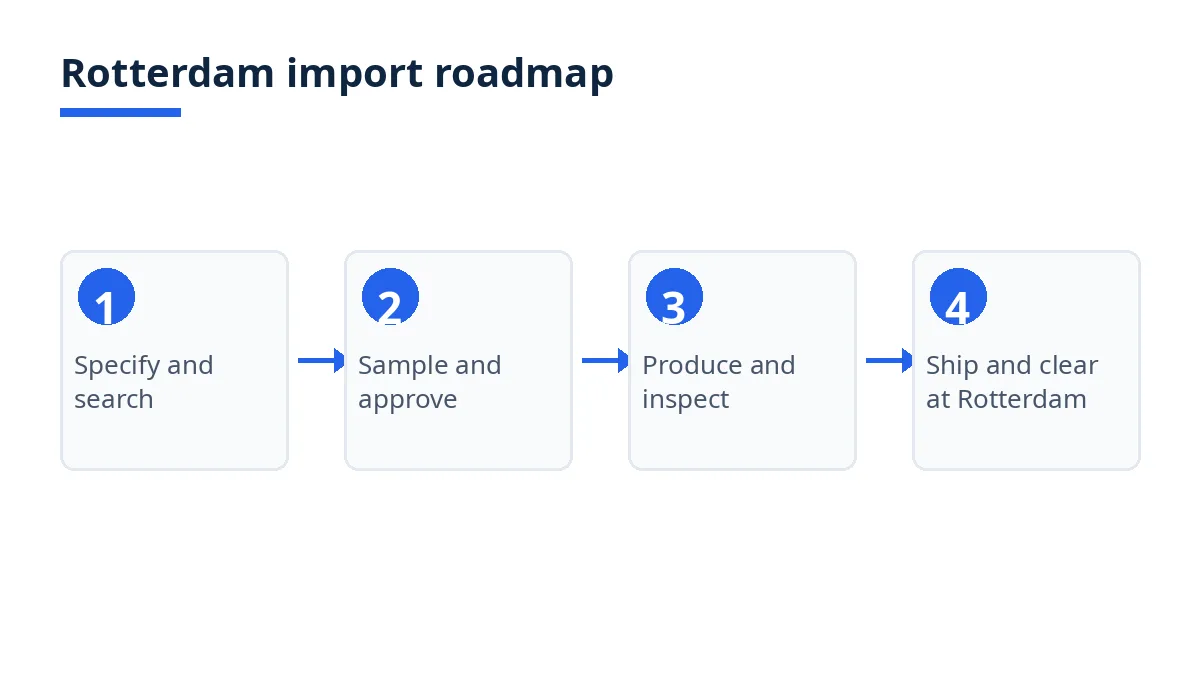
This guide follows one route end to end: specification and supplier checks, samples and quality control, the Rotterdam entry, duty and Dutch import VAT, and an example landed cost. It states no typical price, minimum order, or transit time, because none has a single figure across styles, fiber mixes, and shipment dates.
Why source knitted underwear from Bangladesh
Buy by style and construction, not by factory size alone. Knitted underwear covers men's and women's briefs and panties, boxer briefs, trunks, and slips, in cotton, man-made fibers, and blends, sold as single styles and in multi-packs. Quality turns on narrow operations: knitting or buying the fabric, cutting to a graded size range, applying a waistband and elastic that recover after washing, finishing leg openings, and packing pieces so that every piece in a pack matches in shade and size.
A supplier already running your style in your fiber mix will quote more reliably than a general knitwear factory that must set the style up from scratch. A factory running men's cotton briefs every week is a closer fit for a cotton brief program than for women's lace-trimmed panties, which need different machines, trims, and finishing. Shortlist by current production first, then compare on the identical specification.
Find and verify suppliers
Where should you start the search?
Start with a specification, not with factory names. Write down every style first: men's, women's, or children's; brief, trunk, boxer brief, slip, or panty; fiber composition and fabric weight; waistband type and width; leg finish; size range; color or print; labeling; and packing. Then shortlist suppliers whose current range already includes knitted underwear in that construction. Browse suppliers on Exportain before you send the specification out.
Send every candidate the identical specification and ask for the same reply format: fabric assumed, pieces per retail unit, price inclusions, validity, and minimum per style and per color. Ask separately about knitting capacity, whether fabric is knitted in-house or bought in, waistband and elastic sources, and the dyeing route. Compare suppliers only on your specification.
How do you verify a supplier before you pay?
Verification has three layers. The first is company documents: trade license, export registration, and association membership where applicable, checked so that name, address, and bank account name agree across every document. The second is capability: monthly capacity, knitting or fabric source, waistband and elastic supply, dyeing route, and recent styles the factory can show. A finished garment from current production shows more than a catalogue photograph: waistband recovery, seam stretch, leg opening finish, and size consistency.
The third layer is payment discipline. Keep payments to the company account named in the documents, never to a personal account, and verify any change of bank details separately. On Exportain, supplier profiles carry document and photo review badges. A badge is a review of documents and photos, not a factory inspection or a guarantee, and Exportain is not a party to the goods contract.
MOQ, pricing and samples
What is the typical MOQ for knitted underwear from Bangladesh?
There is no single typical minimum order quantity for knitted underwear from Bangladesh. The minimum is set per style and usually per color, because yarn is dyed in batches, waistband elastic is ordered by width and color, and a cutting and sewing plan is set up per size range. A plain cotton brief and a multi-color lace-trimmed panty will not carry the same minimum. Ask each supplier how its minimum splits by style, color, size range, and pack composition.
How is the price built, and how should you compare quotes?
Fabric is usually the main cost element, followed by knitting or fabric purchase, cutting and sewing, dyeing, waistband elastic, trims, testing, packing, and the factory margin. Fabric use per piece depends on size range and style, and detail adds operations: lace trim, jacquard waistbands, printed labels, and multi-piece packs each cost more to process. Two quotes can differ because one assumes a lighter fabric, a narrower waistband, fewer sizes, or simpler packing, so ask what each price is based on, in writing.
Compare quotes on the same basis: same style, fiber mix, size range, waistband, packing, delivery term, and shipment port. Ask each supplier to state what is excluded, for example elastic upgrades, testing, special packing, or freight to Rotterdam.
Which samples do you need, and how do you approve them?
Work in stages. A development sample shows whether the factory can knit or cut the style, apply the waistband evenly, finish the leg openings cleanly, and grade the size range. A pre-production sample, made in the actual production fabric, color, waistband, and finish, is the sample you approve for bulk. Do not approve fit or color from substitute fabric: dyeing and finishing change dimensions and shade.
Test the samples as your customers will use them: wash and dry them following your care label, measure waistband and leg openings before and after washing, and check that all pieces in a multi-pack match in shade and size. Agree the colorfastness tests you want run, including washing and perspiration for next-to-skin styles, and name the test method in the specification. Approve in writing and keep one sealed counter-sample of each style.
Quality control and certifications needed
Which quality checks are specific to knitted underwear?
Against the approved sample and size chart, check fiber composition and fabric weight, waistband width and recovery, leg opening finish, seam stretch and strength, and consistency across the size range. Then check construction piece by piece: waistband joining, elastic coverage, label position and legibility, and shade consistency across the pack. A pack can pass piece by piece and still fail as a pack if one piece is from a different shade batch.
Agree the inspection method and defect limits before production, and inspect in stages: an inline check during sewing and finishing, and a final random inspection on packed goods covering quantity, workmanship, measurements, labels, and packing. Read the knitted underwear quality control checklist and put its checks into your inspection plan.
Which label rules apply to underwear sold in the Netherlands?
Fiber labeling follows the EU textile regulation, which applies in the Netherlands as it does across the European Union. Article 9 of Regulation (EU) No 1007/2011 states that a textile product shall be labelled or marked with the name and percentage by weight of all constituent fibers in descending order.1 Agree the wording at sampling stage and check that the percentages match the fabric you bought, because the labelled composition is also the composition your classification is built on. Elastane in a cotton blend must appear in the list at its percentage, not disappear into a generic description.
Add care, size, and origin marking as your market and customers require, Agree label language and size notation with your Dutch customer before bulk sewing.
What about Dutch packaging obligations?
Packaging is a separate Dutch obligation that buyers placing packaged goods on the Dutch market must settle before the goods reach the market. In the Netherlands, producers and importers of packed products are legally obliged to ensure the prevention, collection, and recycling of packaging, under the Packaging Management Decree of 2014, implemented collectively through Afvalfonds Verpakkingen.2 Settle who registers, who reports the packaging quantities, and who pays the waste management contribution in your buying agreement, because the obligation follows the party placing the packaging on the Dutch market, not the factory that sewed the garments.
Plastic packaging carries its own reporting route. Importers or producers putting plastic packaging on the market must register with the Packaging Waste Fund and report the amount put on the market each year.3 Check whether your polybags, retail packs, and cartons fall in scope, and confirm the thresholds and deadlines with the fund or your adviser.
Incoterms, shipping and transit time
Which delivery term should a first order use?
Under Incoterms 2020, delivery and risk points vary by term. Free Carrier (FCA) delivers when the goods are handed to the carrier for the named place, while Free On Board (FOB) delivers when the goods are on board the buyer's nominated vessel, and the ICC Academy notes FCA is typically the better choice for containers.4 For a first order shipped in containers from Bangladesh, weigh FCA at the named terminal against FOB at the Bangladeshi port on that basis, and write the chosen rule, the Incoterms 2020 edition, and the named place into the contract and the purchase order.
Keep the delivery term, the freight payer, and the insurance buyer as three separate answers in the order file. A term that moves risk early does not by itself buy insurance.
How does the Rotterdam entry work?
Rotterdam is the entry most Netherlands-based buyers plan around, because it keeps the sea leg, customs clearance, and onward delivery inside one Dutch route. Your customs broker files the import declaration, and you or your broker must hold the documents it relies on: commercial invoice, packing list, transport document, and proof of origin where a preference is claimed. When you import goods from non-EU countries, you file an import declaration with Dutch Customs, and you will always need an EORI number when dealing with Dutch Customs.5
Before the first shipment, confirm your EORI number and who acts as declarant. If the goods are imported under your name, you pay the VAT to Customs and deduct or reclaim it later as input tax where the conditions are met.6 If a tax representative acts for you, the representative can apply the reverse-charge mechanism on your behalf and you will not be required to pay Customs the VAT on the import declaration.6
How long does shipping take?
There is no single typical transit time for knitted underwear from Bangladesh to the Netherlands. Sea freight is the standard route for bulk orders and it takes weeks rather than days, varying by port, routing, transshipment, and season. Plan from your forwarder's current sailing schedule, and add clearance and delivery. Keep production time separate from transit time. Confirm pieces per carton, dimensions, and weight, because carton count can limit a light shipment before weight does.
Import duty, taxes and documents
How are knitted underwear styles classified for duty?
Duty follows the classification of each style in the EU tariff, not the supplier's product name. The Harmonized System provides a structure of over 1,200 headings grouped in 96 chapters, with each heading identified by a four-digit code and subdivided into six-digit codes.7 The heading for men's or boys' underpants, briefs, nightshirts, pyjamas, bathrobes, dressing gowns, and similar articles, knitted or crocheted, is 6107.8
The two headings that matter are 6107 for men's or boys' styles and 6108 for women's or girls' styles. Within each heading, underpants and briefs split by fiber: men's 6107 11 00 (cotton), 6107 12 00 (man-made fibers), 6107 19 00 (other materials); women's 6108 21 00, 6108 22 00, 6108 29 00 on the same split.9 Read the HS code guide for knitted underwear for the classification factors, and confirm the full ten-digit line for each style with your broker before you price or ship. An unconfirmed line is a confirm with broker line, not an assumed rate.
What import duty applies?
For goods of Bangladeshi origin, the starting point is the EU preference for least developed countries. The Everything But Arms initiative provides least developed countries with duty-free and quota-free access to the EU market for all products except arms and ammunition.10 Duty on qualifying goods can therefore be zero, but the preference is not automatic: it depends on the origin rules and the preference in force on the entry date. Agree the proof of origin at order stage.
Bangladesh will continue to benefit from the scheme while it has least developed country status, with benefits continuing during a three-year transition after graduation.11 For an order shipping months ahead, ask your broker what preference will be in force on the entry date. No duty rate is stated in this guide from a tariff line that was not opened for it: every unopened line is marked confirm with broker.
What Dutch import VAT applies?
Import VAT is separate from duty and applies even when duty is zero. Goods imported from outside the EU to the Netherlands must be declared to Customs, and the VAT is paid to Customs on the customs value, which is the value of the goods plus transport costs, insurance, and similar costs up to the external border of the EU.6 In the Netherlands, the standard VAT rate is 21 percent, with 9 percent and 0 percent as the two additional rates.12 Work your landed cost at 21 percent on the customs value.
The cash timing depends on the Article 23 route. The reverse-charge mechanism on import means you are not required to pay the VAT on import immediately, and the VAT can then be paid when you file your VAT return, but you will need an Article 23 permit, and as a foreign entrepreneur you cannot apply for one yourself: you can engage a tax representative, who can apply for a permit for you.13 With a representative, the VAT is declared and deducted on the same return, with no advance payment at import.13 Without that route, budget for paying at the border and recovering it later.
Which documents do you need for clearance?
The standard import set is the commercial invoice, packing list, bill of lading or air waybill, and proof of origin where a preference is claimed. The invoice should name each style plainly, for example women's cotton knitted briefs in a three-piece pack, with composition, sizes, quantities, prices, and delivery term on its own line. Keep men's and women's styles, and cotton, man-made fiber, and blended styles, on separate lines matching their classifications. Quantities, weights, and carton counts must agree across every document.
Landed cost example
A landed cost is the full cost of one piece, ready to sell. Every number below is an example figure only, not a quote.
Example figures: 12,000 women's cotton knitted briefs in three-piece packs, FCA Chattogram terminal, sea freight to Rotterdam, duty at zero only if the preference described above is confirmed for the entry date, import VAT shown separately.
Cost element | Example figures (per piece) | How to obtain your figure |
|---|---|---|
Product price, FCA | $1.62 | Confirmed pro forma invoice |
International freight | $0.18 | Forwarder quote divided by pieces shipped |
Insurance | $0.02 | Policy or forwarder quote |
Duty | $0.00 | Broker calculation from confirmed codes and preference, or confirm with broker |
Port, clearance and broker fees | $0.08 | Broker invoices divided by pieces |
Local delivery to warehouse | $0.05 | Local carrier quote divided by pieces |
Total landed cost before import VAT | $1.95 | Sum of all lines above |
Import VAT at 21 percent | $0.38 | 21 percent on customs value plus any duty payable, here $1.82 |
Import VAT is shown separately because its recovery and its cash timing depend on your tax position and on whether the Article 23 route applies. In this example the customs value is the product price plus freight and insurance, and duty is zero, so the VAT base and the customs value are the same. Work the calculation twice: at quote stage, style by style, and again after shipment with the actual invoices. See landed cost for imports from Bangladesh for the full method.
Step-by-step import checklist
Write the specification style by style: men's, women's, or children's, style, fiber composition, fabric weight, waistband type, size range, colors, labels, and packing.
Classify every style from headings 6107 and 6108, then the fiber split, and confirm each ten-digit line and the preference in force with your broker.
Decide the Rotterdam route: declarant, EORI number, Article 23 or pay-at-border VAT treatment, and who bears the Dutch packaging obligations.
Shortlist suppliers whose range includes your style, and request comparable quotes on the identical specification and delivery term.
Verify the chosen supplier: documents, capacity, knitting or fabric source, waistband and dyeing route, and a factory check for a first order.
Order samples in stages, wash and measure them, then approve a pre-production sample of each style.
Confirm the order in writing: purchase order, pro forma invoice, delivery and payment terms, inspection plan, labeling, packaging responsibility, and shipment date.
Ship to Rotterdam, clear customs with the confirmed code and proof of origin for each style, and reconcile the actual landed cost including 21 percent import VAT.
How Exportain helps
Browse suppliers for Bangladeshi knitwear exporters, then post your specification and target quantity as an RFQ and compare replies on the same terms before you choose a factory for sampling. Exportain is a B2B marketplace where buyers post RFQs, receive quotations, and message suppliers. It does not inspect goods, book freight, or clear customs.
FAQs
What is the typical MOQ for knitted underwear from Bangladesh?
There is no single typical minimum. It is set per style and usually per color, because yarn is dyed in batches, waistband elastic is ordered by width and color, and a cutting and sewing plan is set up per size range.
How long does shipping take?
Production time and transit time are separate, and neither has a single typical figure. Sea transit takes weeks rather than days and varies by port, routing, and season.
What import duty applies?
Duty follows the confirmed classification of each style, the origin, and the preference in force on the entry date. Knitted underwear sits in headings 6107 and 6108, split by fiber.8 9 Everything But Arms provides least developed countries with duty-free and quota-free access for all products except arms and ammunition, subject to the origin rules.10 Confirm the ten-digit line and preference with your broker, and treat any unconfirmed line as confirm with broker.
How do I verify a supplier?
Check company documents first, so that name, address, and bank account agree across the trade license, export registration, and invoices. Then check capability: knitted-underwear capacity, knitting or fabric source, waistband and dyeing route, and recent production in your style. Keep payments to the company account named in the documents, and approve a pre-production sample of each style before bulk production.
Next steps on Exportain
Read how to import from Bangladesh for the full process, then use the landed cost method to price your styles before you commit. When ready, post a free RFQ on Exportain and compare quotes from Bangladeshi suppliers on the same terms.
Sources
- Regulation (EU) No 1007/2011 on textile fibre names and related labelling and marking of the fibre composition of textile products, Article 9: Multi-fibre textile products. legislation.gov.uk (accessed )
- Afvalfonds Verpakkingen Policy 2023. Afvalfonds Verpakkingen (accessed )
- What you must do if you produce or import single-use plastic products. Netherlands Chamber of Commerce (KVK) (accessed )
- Place of delivery & risk transfer in trade contracts. ICC Academy (accessed )
- Importing home accessories. Netherlands Chamber of Commerce (KVK) (accessed )
- Import from non-EU countries to the Netherlands. Dutch Tax and Customs Administration (accessed )
- Harmonized System FAQ. World Customs Organization (accessed )
- Classification Detail: HS Code 6107. United Nations Statistics Division (accessed )
- Regulation (EU) 2015/936: Annex - textile categories and CN codes. legislation.gov.uk (accessed )
- EU invites Bangladesh to share success story in preferential market access. The Financial Express (accessed )
- Garment exports to EU might lose duty-free access after graduation. The Financial Express (accessed )
- VAT rates and exemptions. Government of the Netherlands (accessed )
- Reverse-charge mechanism on import: Article 23. Belastingdienst (accessed )
About the author
Sourcing from Bangladesh?
Post a request for quotation and suppliers on Exportain can send you their quotes directly.
Post an RFQ


