

Importing Knitted Underwear to France From Bangladesh
France buyers: knitted underwear from Bangladesh via Le Havre, with EBA duty, 20% TVA, French labelling and EPR covered in one checklist.
Short answer
To import knitted underwear from Bangladesh to France, specify each style by wearer group, fabric, waistband and French size curve, confirm the 6107 or 6108 classification and the duty rate in force on the entry date with your broker, and claim the Everything But Arms preference only with a valid statement on origin. Approve fit and pre-production samples, ship to Le Havre, clear customs at 20 percent TVA, and label in French with Triman sorting information.
On this page
Key takeaways
Knitted underwear is classified in headings 6107 (men's and boys') and 6108 (women's and girls'), split by garment type and fibre; confirm the full 10-digit code for each style with your broker.
Bangladesh benefits from duty-free, quota-free access under Everything But Arms, subject to the origin rules; claim it only with a valid statement on origin from a registered exporter.
France applies a 20 percent standard TVA rate; budget it on the customs value plus duty, and label in French with fibre composition, care and size.
French textile EPR applies to clothing placed on the French market: agree who holds producer responsibility and how Triman sorting information appears on the pack before the first shipment.
A French underwear programme lives or dies on fit, size curve and labelling, not on the unit price alone. A brief that fits well in one market can fail in France on a waistband that rolls, a size label a customer cannot read, or a fibre label that does not match the fabric in the pack. This guide is for buyers ordering for the French market, with Le Havre entry, French labelling and the French textile waste scheme built in from the start.
Knitted underwear in this guide means briefs, panties, boxer briefs and similar next-to-skin garments made from knitted fabric. The Harmonized System gives every traded good a six-digit code, and the first six digits mean the same thing in every country that uses the system, with countries adding digits for their own tariffs.1
Why source knitted underwear from Bangladesh
Bangladesh supplies knitted garments at volume, and underwear is a natural part of that knitwear base: circular knitting, cutting, elastic and waistband work, and packing in retail multipacks are routine operations for knitwear factories. For a French buyer, the practical point is whether a factory already makes the exact construction you sell: the fabric weight, the elastane share in the waistband, the leg opening finish, and the pack format your shelf uses.
Choose the factory by construction, not by catalogue size. A factory that makes men's cotton briefs in bulk may not be the right factory for women's modal-blend briefs with a lace trim. Ask for current production in your construction, in your size range, with your pack format. A sample from current production tells you more than a catalogue photograph: waistband recovery after stretching, seam finish at the leg, and whether dye is even across the size curve.
Plan around the French selling calendar. Underwear is a replenishment line, so the first order sets the pattern for repeats: the same fabric, waistband, size curve and pack. Agree at the first order how repeats will be matched to the approved sample.
Find and verify suppliers
Where should you start the search?
Start with a written specification, not with factory names. Write down each style separately: wearer group, fabric composition, fabric weight, waistband type and width, leg finish, size range on the French size set you use, colours, pack format, and labelling. Then shortlist factories whose current range already includes that construction, and send every candidate the identical specification so quotes can be compared on the same basis.
Ask each candidate the same questions: which constructions are in current production, what the factory knits in-house and what it buys in, how elastics and waistbands are sourced, and how multipacks are assembled and checked.
How do you verify a supplier before you pay?
Verification has three layers. The first is company documents: trade licence, export registration and association membership where applicable, checked so that name, address and bank account name agree across every document. The second is capability: knitting or fabric sourcing route, cutting capacity across your size curve, waistband and elastic handling, dyeing and finishing route, and packing capacity for your format. Ask to see the style you want in current production.
The third layer is payment discipline. Keep payments to the company account named in the documents, never to a personal account, and verify any change of bank details separately. Read how supplier verification works on Exportain for what document and photo checks cover. A badge is a review of documents and photos, not a factory inspection or a guarantee, and Exportain is not a party to the goods contract.
MOQ, pricing and samples
What is the typical MOQ for knitted underwear from Bangladesh?
There is no single typical minimum order quantity for knitted underwear from Bangladesh. The minimum is set per style, and usually per colour and per size curve, because fabric is knitted and dyed in batches and a cutting plan is set up per size range. A plain men's brief in three colours and a women's lace-trim brief in eight sizes will not carry the same minimum. Ask each supplier how its minimum splits by style, colour, size and pack format.
How is the price built, and how should you compare quotes?
Fabric is usually the largest cost element, followed by elastics and waistband, cutting and sewing, dyeing, finishing, testing, labelling and packing, and the factory margin. Fabric use per piece depends on size, and the size curve decides how much fabric an order really uses. Waistband width, elastic quality and trim each add cost.
Compare quotes on the same basis: same style, fabric composition and weight, waistband, size curve, colours, pack format, delivery term and packing. Ask each supplier to state what is excluded, for example testing, special labelling or individual retail boxes.
Which samples do you need, and how do you approve them?
Work in stages. A development sample shows whether the factory can make the construction: waistband formation, seam finish, leg opening and pack presentation. A fit sample, made in the right sizes on your French size set, decides whether the garment fits the wearer it is sold to. Check it in each key size, not only in the middle size. A pre-production sample, made in the actual production fabric, colour, waistband and trims, is the sample you approve for bulk.
Test the samples as your customers will wear and wash them: stretch and release the waistband and check recovery, wash the sample following your care label and measure shrinkage and shade change, and check that the label wording matches the fabric you bought. Approve in writing and keep one sealed counter-sample of each style, colour and pack format.
Quality control and certifications needed
Which quality checks are specific to knitted underwear?
Against the approved sample and size chart, check fabric composition and weight, finished measurements across the full size curve, and consistency from the smallest to the largest size. Then check construction piece by piece: waistband width and tension, elastic attachment and recovery, seam type, leg opening finish, trim attachment, and print or dye evenness. Check the pack as a unit: the right sizes in the right quantities, matching shades within a pack, and labels that match the contents.
Agree the inspection method and defect limits before production. An acceptance quality limit plan, agreed in advance, sets how many pieces are drawn from a lot and how many defects are accepted before the lot is rejected. Inspect in stages: an inline check during sewing catches a waistband drift while correction is still possible, and a final random inspection on packed goods checks quantity, workmanship, measurements, labels and packing.
Which label rules apply in France?
Fibre labelling applies to every style in the order. Under Regulation (EU) No 1007/2011, a textile product shall be labelled or marked with the name and percentage by weight of all constituent fibres in descending order.2 Agree the wording at sampling stage and check that the percentages match the fabric and waistband you bought. Supply consumer-facing information in French, including fibre composition, care and size, and check the finished label before bulk label sewing begins.
France adds a second labelling layer after sale. If you place clothing on the French market, you fall under the French extended producer responsibility scheme for clothing, household linen and footwear, and Refashion states that placing new clothing on the French market for retail purposes requires a contribution to prevention and end-of-life management.3 Refashion explains that producers join the approved eco-organisation and make a financial contribution, and that consumers receive sorting information through the Triman logo.3 Agree with your French entity or agent, before the first shipment, who holds the producer responsibility and how the Triman information appears on the pack.
Which certifications do you actually need?
No single certificate covers every underwear order. What you need follows your market and your customer: a retailer or brand group may name a specific test or scheme in its own supplier manual, including limits that apply to dyes, finishes and trims in next-to-skin garments. Name any such requirement in the specification, ask for the matching test report or certificate, and check its scope, product covered, issuing body and date.
Do not accept a certificate as a substitute for your own checks. A certificate describes what was tested, not what is in your carton. Keep the test report with the order file, beside the approved sample and the inspection report.
Incoterms, shipping and transit time
Which delivery term should a first order use?
The Incoterms 2020 rules set out, for each rule, where delivery takes place, and risk passes from seller to buyer at the same point. Under FOB the seller delivers when the goods are loaded on board the vessel, and under FCA the seller delivers when the goods are handed to the carrier nominated by the buyer.4 The four sea rules, FAS, FOB, CFR and CIF, are only for sea and inland waterway transport, while FCA works for any mode, including containerised ocean shipment.4
For a first container order to Le Havre, weigh FOB at the Bangladeshi port against FCA at the named terminal. Under FOB, the factory delivers the goods on board and your forwarder handles the sea leg. Under FCA, delivery happens when the goods are handed to your carrier, which matches how containerised cargo moves. See the best Incoterm for importing knitwear from Bangladesh for the comparison for this product group.
How long does shipping take, and where does the container enter France?
There is no single typical transit time for knitted underwear from Bangladesh. Sea freight is the standard route for bulk orders and it takes weeks rather than days, varying by port, routing, transshipment and season. Plan from your forwarder's sailing schedule, and add clearance, onward delivery, and time for the French labelling and pack checks on arrival. Keep production time separate: an order is ready only when every size has finished sewing, inspection and packing.
Le Havre is the natural entry point for a French programme. Le Havre remains France's leading container port, integrated into the HAROPA PORT grouping with Rouen and Paris, and its 2025 activity is reported at 84.7 million tonnes of maritime traffic and 3.2 million container TEU.5 A direct Le Havre entry keeps customs, TVA handling and onward delivery inside France, under one broker. Confirm carton dimensions and weight in the specification, because underwear is light for its volume and carton volume can limit a shipment before weight does.
Import duty, taxes and documents
How are knitted underwear styles classified for duty?
Duty follows the classification of each style in the destination tariff, not the supplier's product name. The central headings are 6107 for men's or boys' underpants, briefs and similar articles, knitted or crocheted, and 6108 for women's or girls' slips, petticoats, briefs, panties and similar articles, knitted or crocheted. Within those headings the split is by wearer group, garment type and fibre. Confirm the full national code for each style with your broker.
The lines most French underwear orders start from are 6107.11 for men's or boys' underpants and briefs of cotton, and 6108.21 for women's or girls' briefs and panties of cotton, 6108.22 for briefs and panties of man-made fibres, and 6108.29 for briefs and panties of other textile materials. A cotton men's brief, a modal-blend women's brief and a boys' multipack in one order can therefore sit on different lines. Classify each style on its own line, and keep knitted and woven styles apart.
What import duty applies?
This guide states no most-favoured-nation duty rate, because no tariff-schedule line was opened for it. Confirm the current 10-digit line and the rate in force on the entry date with your broker for every style, and do not price from a rate quoted for a different fibre or a different entry date. If an opened schedule you consult is an old edition, confirm the current line and rate in force on the entry date before you commit to a selling price.
The preference position is separate from the standard rate. As a least developed country, Bangladesh benefits from the most favourable regime under the EU Generalised Scheme of Preferences, namely the Everything But Arms arrangement, which grants duty-free, quota-free access to the EU for exports of all products except arms and ammunition.6 A preference depends on the goods meeting the origin rules, so agree the proof of origin at order stage and price on the standard rate until the preference is confirmed for your exact styles. The European Commission's proof-of-origin guidance explains that registered exporters in the REX system make out a statement on origin on the invoice or another commercial document, and that unregistered exporters may make out statements on origin for consignments up to 6,000 euro on an ex-works basis.7 Ask your supplier for its REX number and the statement wording before shipment.
Import TVA is separate from duty. The European Commission's VAT rates table lists France at a standard rate of 20 percent, with reduced rates of 10 percent and 5.5 percent and a super-reduced rate of 2.1 percent.8 Underwear is taxed at the standard rate, so budget TVA at 20 percent of the customs value plus duty, and ask your tax adviser how import TVA is recovered in your position. TVA is a cash cost at clearance even when it is later recovered.
Which documents do you need for clearance?
The standard import set is the commercial invoice, packing list, bill of lading, and statement on origin where a preference is claimed. The invoice should name each style plainly, with composition, size curve, quantities, unit prices and the delivery term, on its own line. Keep men's, women's and boys' styles, and cotton, man-made fibre and blended styles, on separate lines matching their classifications. Quantities, weights and carton counts must agree across every document.
Landed cost example
A landed cost is the full cost of one piece, ready to sell in France. Every number below is an example figure only, not a quote, and the duty line assumes the Everything But Arms preference is confirmed for the exact styles.
Example figures: 20,000 pieces, mixed men's and women's briefs, FOB Chattogram, sea freight to Le Havre, duty at an example rate only.
Cost element | Example figures (per piece, EUR) | How to obtain your figure |
|---|---|---|
Product price, FOB | 0.85 | Confirmed pro forma invoice |
International freight | 0.12 | Forwarder quote divided by pieces shipped |
Insurance | 0.01 | Policy or forwarder quote |
Duty | 0.00 | Broker calculation from confirmed codes and rates; example assumes EBA preference confirmed |
Port, clearance and broker fees | 0.06 | Broker invoices divided by pieces |
Local delivery to warehouse | 0.05 | Local carrier quote divided by pieces |
Total landed cost, excluding TVA | 1.09 | Sum of all lines above |
Import TVA is not included in the total, because its treatment depends on your tax position. At the 20 percent standard rate, TVA on the example customs value plus duty would be about 0.20 euro per piece, as an example figure. The Refashion eco-contribution is also excluded: confirm the contribution for your styles and volumes with your French agent before pricing, and add it as its own line. Work the calculation twice: at quote stage, style by style, and again after shipment with the actual invoices.
Step-by-step import checklist
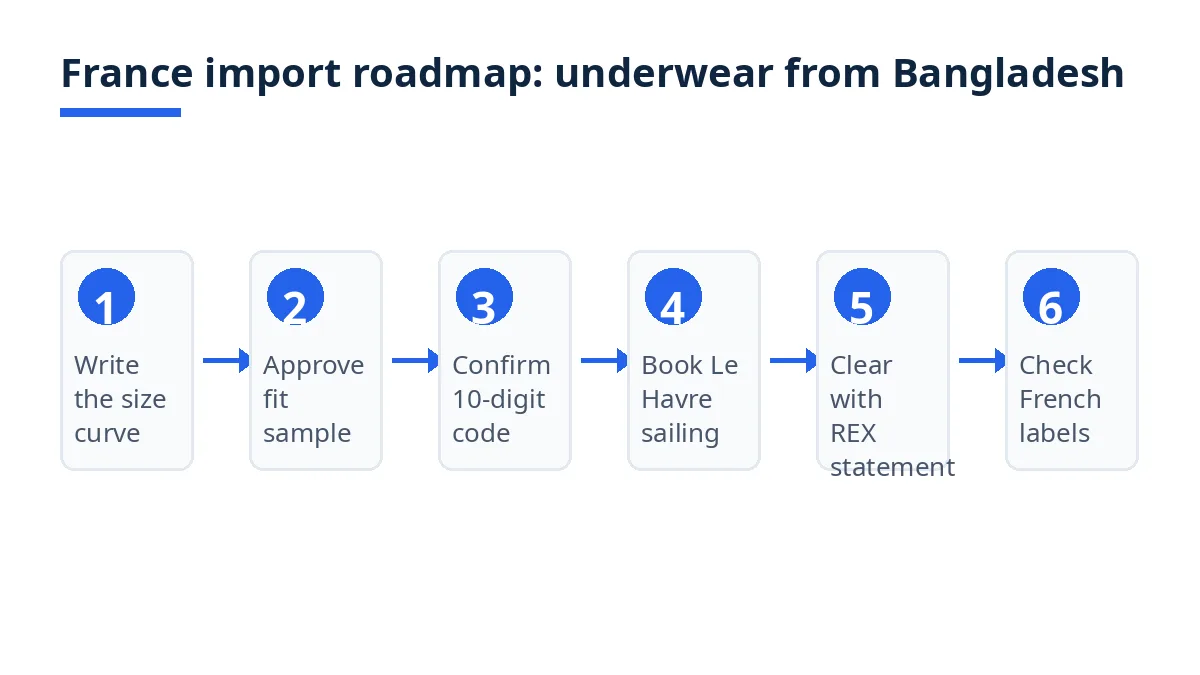
Write the specification style by style: wearer group, fabric and waistband, French size range and size curve, colours, pack format, and French consumer labelling.
Classify every style from headings 6107 and 6108, and confirm each full 10-digit code and rate in force on the entry date with your broker.
Shortlist factories whose current range includes your construction, and request comparable quotes on the identical specification, size curve, pack format and delivery term.
Verify the chosen supplier: company documents, fabric sourcing route, cutting capacity across your size curve, waistband handling, dyeing and finishing route, and packing capacity.
Order samples in stages, check fit on your French size set, wash and measure them, then approve a pre-production sample of each style in production fabric, colour, waistband and trims.
Confirm the order in writing: purchase order, pro forma invoice, delivery and payment terms, inspection plan, labelling including French wording and Triman sorting information, packing and shipment date.
Agree the proof of origin at order stage: REX number, statement on origin wording, and the commercial document it will sit on.
Inspect during production and again on packed goods against the approved samples, checking measurements, waistband recovery, shade matching within packs, and label wording.
Ship to Le Havre, clear customs with the confirmed code for each style, pay TVA on the customs value plus duty, and reconcile the actual landed cost style by style.
How Exportain helps
Browse suppliers for Bangladeshi knitwear exporters and compare their current ranges against your construction list. Then post your specification, size curve and target quantity as an RFQ and compare replies on the same terms before you choose a factory for sampling. Exportain is a B2B marketplace where buyers post RFQs, receive quotations and message suppliers. It does not inspect goods, book freight or clear customs.
FAQs
What is the typical MOQ for knitted underwear from Bangladesh?
There is no single typical minimum. It is set per style, and usually per colour and per size curve, because fabric is knitted and dyed in batches, elastics are bought to a specification, and a cutting plan is set up per size range. Ask each supplier how its minimum splits by style, colour, size and pack format.
How long does shipping take?
Production time and transit time are separate. Sea transit takes weeks rather than days and varies by port, routing and season. Plan from your forwarder's current sailing schedule to Le Havre, and add clearance and onward delivery.
What import duty applies?
This guide states no standard duty rate, because no tariff-schedule line was opened for it. Confirm the current 10-digit line and rate in force on the entry date with your broker for every style. Bangladesh benefits from duty-free, quota-free access under the Everything But Arms arrangement, subject to the origin rules, and the preference is claimed with a statement on origin from a registered exporter.6 7
How do I verify a supplier?
Check company documents first, so that name, address and bank account agree across the trade licence, export registration and invoices. Then check capability: knitting or fabric sourcing, cutting across your size curve, waistband and elastic handling, dyeing and finishing, and packing for your format. Keep payments to the company account named in the documents, and approve a pre-production sample of each style before bulk production.
Next steps on Exportain
Read how to import from Bangladesh for the full process, then work through the landed cost method with your broker's confirmed codes. When ready, post an RFQ on Exportain with your style list, size curve and pack format, and compare quotes on the same terms.
Sources
- What is the Harmonized System (HS)?. World Customs Organization (accessed )
- Regulation (EU) No 1007/2011 on textile fibre names and related labelling and marking of the fibre composition of textile products. European Union, (accessed )
- Understanding EPR. Refashion (accessed )
- Incoterms Explained: Avoid Shipping Risks. Export Development Canada (accessed )
- The Port of Le Havre. CESAM (accessed )
- EU trade relations with Bangladesh. European Commission, (accessed )
- Proof of origin. European Commission (accessed )
- Value added tax. European Commission (accessed )
About the author
Sourcing from Bangladesh?
Post a request for quotation and suppliers on Exportain can send you their quotes directly.
Post an RFQ


