

Importing Hotel Linen to the Netherlands From Bangladesh: A Step-by-Step Guide
Hotel linen from Bangladesh to the Netherlands: room sets, par stock and laundry durability, Rotterdam entry, EBA preference, 21% import VAT, supplier checks, and a per-set landed cost example at two duty outcomes.
Short answer
To import hotel linen from Bangladesh to the Netherlands, define the room set and par stock for the hotel laundry program, classify each piece under heading 6302, confirm the EBA preference and REX statement on origin, and settle the Rotterdam declaration, EORI, and Article 23 VAT route before ordering. Shortlist hotel-experienced suppliers, approve a pre-production sample after repeated washes, and cost the order at both duty rates.
On this page
Key takeaways
A hotel linen program is bought by room set and par stock: a common guideline is a 3-par system, one set on the bed, one in the laundry cycle, and one in storage, with luxury properties running 4 to 5 par, and the level must reflect occupancy, laundry turnaround, and loss rates.
Hotel linen sits mainly in heading 6302, with bed linen at 6302.10, 6302.21 to 6302.29 and 6302.31 to 6302.39, cotton terry towels at 6302.60, and table linen at 6302.40, 6302.51, 6302.53 and 6302.59; bathrobes are garments and leave the heading. Every heading is indicative until a broker confirms the full code.
The tariff listing consulted lists third-country duty of 12.00 percent on most 6302 lines and 6.90 percent on certain nonwoven lines, to be confirmed with a broker, while Everything But Arms grants full duty-free and quota-free access subject to origin rules and a REX statement on origin for shipments over 6,000 euro.
The standard VAT rate in the Netherlands is 21 percent, separate from duty. An Article 23 permit lets import VAT be declared on the VAT return instead of paid at the border, but a foreign entrepreneur needs a tax representative to apply.
There is no single typical MOQ, price, or transit time for hotel linen: set the room-set specification, approve a pre-production sample after repeated washes in the actual laundry program, set your own inspection limits, and check OEKO-TEX STANDARD 100 certificates by number, Product Class II, articles covered, and expiry date.
To import hotel linen from Bangladesh to Netherlands buyers should start with the hotel program, not a price list. A hotel order is a repeating stock of room sets that must survive a commercial laundry program, match shade batch after batch, and clear at Rotterdam with code, origin evidence, and VAT treatment settled. This guide follows that order: room set and par stock, Rotterdam entry, classification and duty, supplier checks, washed samples, delivery terms, and a worked landed cost.
A retail set fails when one piece looks wrong. A hotel set fails when the third par runs short, when a washed sheet measures short, or when a repeat order arrives in a different white.
Import hotel linen from Bangladesh to Netherlands, room set first
A hotel linen program is a stock system. Par stock is the standard quantity of each item a hotel keeps in circulation to meet daily demand, and a common guideline is a 3-par system: one set on the bed, one in the laundry cycle, and one in storage, with luxury properties running 4 to 5 par.1 Too little par stops room turnover; too much ties up cash in linen that ages in storage, so the level must reflect occupancy, laundry turnaround, and loss rates.1
Linen moves through collection, sorting, washing, drying, finishing, storage, and distribution, and sheets and towels are washed separately because towels need higher heat and stronger extraction.1 An on-premise laundry gives control over turnaround but needs capital investment; an outsourced laundry needs less capital but adds dependence on a third party schedule.1 Ask the laundry operator for the wash program: temperature, detergent and bleach, extraction, drying heat, and ironing.
One supplier analysis reports that standard institutional linens may only survive 150 wash cycles before thinning or tearing, whereas premium hospitality linens are engineered for 250 or more, and premature degradation can raise the replacement rate by 20 percent or more.2 Treat those figures as one analysis, not a promise: ask each supplier for its own wash-cycle evidence and judge the sample after repeated washes. The same analysis notes percale uses a one-over, one-under pattern resistant to pilling and tearing, while a cotton-polyester blend releases water more efficiently and reduces drying time.2
The room-set specification: write it before you ask for a price
Send every supplier the same room-set document: the pieces that make one bed and one bathroom ready, counted at the par multiple, with table linen listed separately.
Room-set line | Fix in writing before quoting |
|---|---|
Bed pieces | Flat sheet, fitted sheet, pillowcases, duvet cover: finished size after washing, tolerance accepted |
Bath pieces | Bath towel, hand towel, face towel, bath mat, pool towel: finished size after washing |
Table pieces | Tablecloths and napkins, listed separately from bed and bath pieces |
Fiber and weave | Fiber content by weight, weave, finish, in label wording |
Laundry program | Temperature, bleach, drying, ironing, wash cycles the sample must survive |
Shade and batch | Color reference, white standard, shade tolerance between lots and repeat orders |
Construction | Hem and stitching, elastic coverage, duvet closure, towel border |
Labels and packing | Fiber, care, and size wording, label position, pieces per par set and carton, carton size and weight |
Order by finished size after washing, in centimeters, with a tolerance for every piece; a fitted sheet must state pocket depth. State the par multiple in the same document and price the program on the par quantity. Keep one sealed, washed counter-sample of each piece, with the shade card attached, and judge repeat orders against it.
Rotterdam first: declaration, EORI, CVB and the Article 23 decision
Settle the Dutch entry before the goods sail. Goods imported from outside the European Union must be declared to Dutch Customs, filed electronically through the DMS system; a buyer with little import experience is advised to have a shipper, logistics provider, or customs agent complete the declaration.3 For a first order, use a customs representative.
The Container Release Message (CVB) applies to containers, trailers, general cargo, and bulk cargo arriving through a Dutch port, and an import declaration can only be submitted after the goods are unloaded.3 That sets the timetable: unloading, CVB, declaration, then duty is calculated. Ask before booking who holds the CVB step. An EORI number is required as the identification number when exchanging data with customs, mainly when trading with countries outside the European Union.3
Import VAT is separate from duty. The general VAT tariff in the Netherlands is 21 percent, applying to all other products and services unless an exemption or reverse-charging applies.4 Budget at 21 percent and confirm the base, recovery, and timing with your tax adviser or broker.
The Article 23 route changes the cash timing, not the amount. Under the reverse-charge mechanism on import you are not required to pay VAT immediately; it is paid when you file your VAT return, but you need an Article 23 permit.5 A foreign entrepreneur cannot apply directly, but can engage a tax representative who applies for the permit, declares the VAT, and deducts it as input tax on the same return, so no VAT is paid in advance.5 Decide before the first shipment whether to appoint a representative. Do not price as if Article 23 applied when no permit is in place.
Classification, duty and the EBA preference for a mixed hotel order
Duty follows the classification of each piece, not the order label. The Harmonised System classifies goods in chapters of two digits, headings of four digits, and subheadings of six digits, and the European Union Combined Nomenclature uses eight-digit codes.6 Every heading here is indicative: verify it on the official tariff and ask your broker to confirm it in writing. See the HS code guide for hotel linen.
Hotel linen sits mainly in heading 6302.7 Bed linen splits by construction, print, and fiber: 6302.10 knitted or crocheted, 6302.21 to 6302.29 printed, and 6302.31 to 6302.39 not printed.7 Cotton terry towels sit at 6302.60, other towels at 6302.91, 6302.93, and 6302.99 by fiber, and table linen at 6302.40, 6302.51, 6302.53, and 6302.59 with no printed split.7 Bathrobes are garments and leave heading 6302, so keep robes on their own invoice lines. Invoice each piece group separately, with fiber, construction, print status, quantities, prices, and delivery term stated plainly.
The tariff listing consulted, the Northern Ireland Online Tariff heading page for 6302, lists third-country duty of 12.00 percent on most 6302 lines, and 6.90 percent on certain nonwoven lines in 6302.22, 6302.32, 6302.53, and 6302.93.8 It applies the European Union tariff structure, but it is not the Netherlands TARIC entry: treat every line as indicative and confirm the rate for the exact code, origin, and entry date with your broker, marked confirm with broker until then.
Everything But Arms is a special arrangement for least developed countries, granting full duty-free and quota-free access to the European Union Single Market for all products except arms and ammunition.9 The updated Generalised Scheme of Preferences, approved for application from 1 January 2027, continues to include Everything But Arms, which will now continue indefinitely.10 That is the scheme position, not a promise about any shipment: confirm Bangladesh holds EBA access on the entry date, the claim is entered correctly, and the proof of origin meets the origin rules. Work the landed cost at both rates, because if the origin evidence fails, the third-country rate applies.
Under the REX system, a statement on origin is added by the registered exporter to the invoice or another commercial document, and an exporter must be registered with the competent authorities of its country of residence to make one out.11 For shipments under 6,000 euro, the statement can be made out without registration.11 Most hotel orders exceed that value, so ask whether the exporter is REX-registered, which origin criterion the statement cites, and record the number and wording in the order file.
Suppliers for a hospitality program: track record in hotels, not a catalogue
Shortlist suppliers whose current range includes hotel linen and whose recent work includes hotel programs, not only retail ranges. A supplier that makes only retail sets or apparel is not a close substitute. Browse suppliers on Exportain, send every candidate the identical specification, and ask for the same reply format: fiber and weave, finished sizes, price inclusions, validity, minimum per piece and color, and delivery term.
Verification has three layers, checked before payment. First, company documents: trade licence, export registration, and association membership where applicable, with name, address, and bank account name agreeing across every document. Second, capability: fabric source and width, dyeing and printing route, cutting and hemming capacity, and current hotel programs. Third, payment discipline: pay only the company account named in the documents, and verify any bank change through a separate channel.
On Exportain, profiles carry document and photo review badges where checks have been completed. Verification is a document and photo review, not a factory inspection, and a badge records which checks were reviewed rather than guaranteeing capacity, quality, or delivery.12 Exportain is not a party to a contract for goods, and it does not inspect goods, book freight, or clear customs.12 Treat a badge as one input, and keep a backup supplier.
Minimums, pricing and samples judged after washing
There is no single typical minimum. It is set per piece and usually per color, because fabric is woven and dyed in batches. A plain white flat sheet, a printed duvet cover, and a cotton terry towel will not carry the same minimum. Ask how each minimum splits by piece, color, size, and par multiple, and how it is counted, in writing.
Fabric is usually the main cost element in cotton linen, followed by dyeing, cutting, sewing, finishing, testing, labeling, and packing. Compare quotes only on the same basis: pieces, finished sizes, fiber, weave, color standard, label set, delivery term, par quantity, and packing. Ask what is excluded and convert every offer to the same landed cost basis. Read how to import from Bangladesh.
Work samples in stages. A development sample shows whether the supplier can construct the pieces and hold the size. A pre-production sample, in the actual production fabric, weave, color, and finish, is the sample you approve for bulk. Wash it through the laundry program more than once, measure every piece, and check shade, shrinkage, colorfastness, pilling, hem and elastic condition, and labels. Keep one sealed counter-sample, and do not start bulk production before written approval.
Quality, laundry durability, labels and certificates
Agree the inspection method and defect limits before production, and set the limits yourself. ISO 2859-1:2026 defines acceptance sampling plans for inspection by attributes, and AQL is the maximum average percentage of defective items considered acceptable during random sampling, used to set sample sizes and acceptance thresholds.13 The standard gives a method, not the buyer limit. Set the limit, defect classes, and sample size in writing, inspect inline and finally on packed goods, and add a wash-cycle check on a bulk sample measured against the counter-sample.
Fiber labeling is set by European Union law. A multi-fiber textile product shall be labeled with the name and percentage by weight of all constituent fibers in descending order.14 The composition descriptions shall be indicated in catalogues, on packaging, labels, and markings so they are easily legible, visible, and clear, and clearly visible before purchase, including online.15 Labeling shall be in the official language or languages of the Member State where the products are made available, unless that Member State provides otherwise.15 Plan for Dutch wording, confirm the position with your broker, and have the Dutch wording checked by a reader who works in Dutch.
No single certificate covers every order. Name any hotel-group requirement in the specification, ask for the matching report or certificate, and check its scope, articles, issuing body, and date. OEKO-TEX STANDARD 100 is the certification Dutch buyers ask about most often for bed linen. Bed linen falls in Product Class II, for textiles in direct contact with the skin, and the criteria depend above all on intended use.16 A certificate is valid for 12 months, renewable annually, and only awarded if all components meet the criteria.16 Check number, class, articles, and expiry, and confirm the certified articles include your exact constructions and colors.
Delivery terms and the Chattogram to Rotterdam leg
Under Incoterms 2020, the delivery term settles delivery, risk, cost, and customs obligations, including the place of delivery, risk transfer, costs, transport, insurance in some rules, and formalities.17 Name the rule, version, and named place in the contract, for example FCA Chattogram, Incoterms 2020. In all rules except DDP, the buyer carries out import formalities, so the Rotterdam declaration, duty, and VAT route stay with the buyer even when the seller pays the freight.
Weigh FCA at the named terminal against FOB at Chattogram. FCA suits any mode of transport, including multimodal, and risk passes when goods are delivered to the carrier at the agreed location.17 FOB is only for maritime or inland waterway transport, and risk passes once goods are loaded onto the vessel.17 FCA matches containerized linen, because a container is handed to the carrier before it is on board. CIF adds seller-arranged carriage and minimum insurance, but the buyer still handles import formalities, duty, and VAT.
There is no single typical transit time, and this guide states none. Sea freight takes weeks rather than days, varying by schedule, routing, transshipment, and season. Plan backward from the opening date, add unloading, CVB, declaration, clearance, and delivery, and confirm the shipment date only after sample approval. Confirm carton dimensions and weight: volume can limit a shipment before weight does.
Landed cost per room set: one worked example at two duty outcomes
A landed cost is the full cost of one hotel bed set, ready in the Netherlands warehouse, excluding import VAT treatment. Every number below is an example figure only, not a quote. Example figures: one flat sheet, one fitted sheet, and two pillowcases, cotton, unprinted, FOB Chattogram to Rotterdam, with customs value built as FOB price plus freight and insurance to the European Union border. Confirm the customs value and duty line with your broker.
Cost element | Example figures, per set, EBA preference confirmed | Example figures, per set, third-country rate |
|---|---|---|
Product price, FOB Chattogram | 24.00 euros | 24.00 euros |
International freight to Rotterdam | 2.10 euros | 2.10 euros |
Insurance | 0.18 euros | 0.18 euros |
Customs value in this example | 26.28 euros | 26.28 euros |
Duty | 0.00 euros at 0 percent | 3.15 euros at 12 percent, confirm with broker |
Port, clearance and broker fees | 0.85 euros | 0.85 euros |
Inland delivery to warehouse | 0.55 euros | 0.55 euros |
Total landed cost, excluding import VAT | 27.68 euros | 30.83 euros |
Import VAT is a memo line: at 21 percent on customs value plus duty, 5.52 euros per set in the EBA case and 6.18 euros in the third-country case, as example figures. Under Article 23, that VAT is declared and deducted on the same return, so none is paid in advance.5 The duty line uses the 12 percent figure from the listing consulted, marked confirm with broker; the EBA line uses the 0 percent scheme position subject to origin evidence.8 9 Work the calculation twice, using the landed cost guide.
Per wash, at the 150-cycle and 250-cycle lifespans from that analysis, the EBA landed cost is 0.18 euros and 0.11 euros per wash, as example figures, not a promise about any order.
The hotel rollout sequence: from first room set to repeat orders
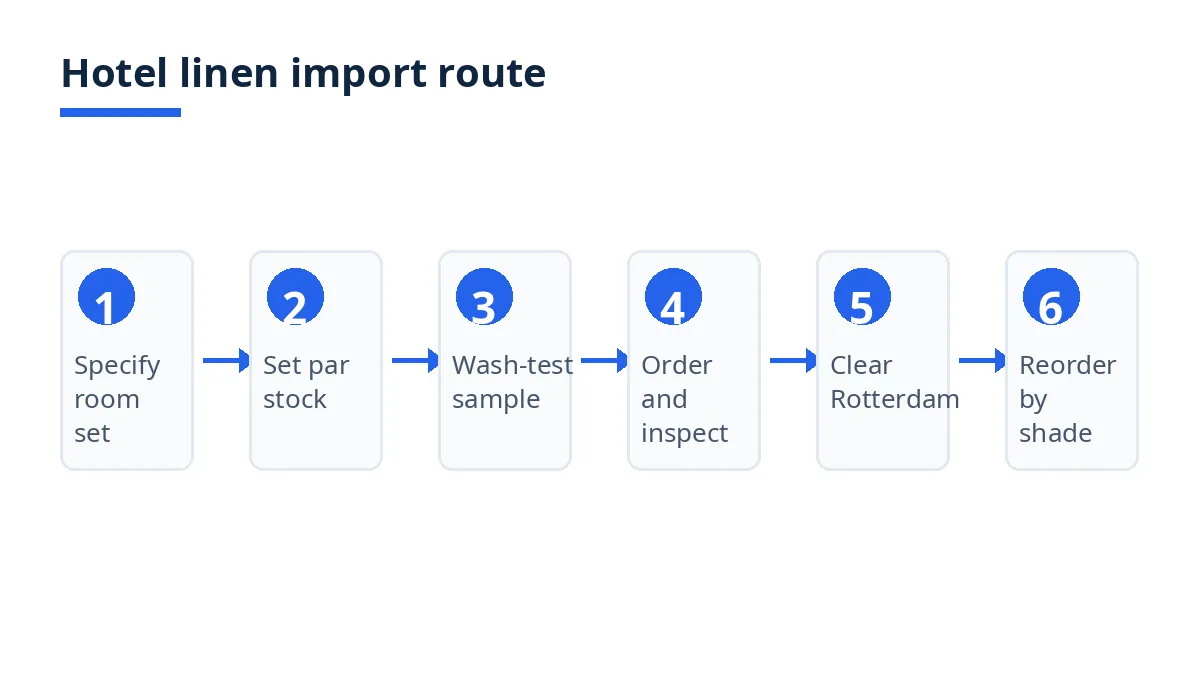
Calculate par stock by room type, bed type, and piece, from occupancy, turnaround, and loss rates.
Write the room-set specification: finished sizes, fiber and weave, laundry program, shade standard, Dutch labels, packing.
Classify every piece from heading 6302, confirm each code and duty line with your broker, and mark every heading indicative until confirmed.
Confirm the EBA position, the REX statement on origin, and the Article 23 decision, and cost the order at both duty rates.
Shortlist suppliers with hotel experience, send the identical specification, and compare quotes on the same basis.
Verify the supplier in three layers: documents, hotel capability, and payment discipline, and keep a qualified backup supplier.
Order samples in stages, wash the pre-production sample through the actual laundry program, and approve in writing.
Confirm the order in writing: purchase order, pro forma invoice, delivery and payment terms, inspection plan, labeling, packing, origin evidence, EORI, VAT, and shipment date.
Inspect during production and on packed goods, ship on the agreed term, file the Rotterdam declaration after unloading, and reconcile the landed cost.
Control repeat orders against the counter-sample, recheck certificates and origin evidence each shipment, and replenish par stock before a shortage stops turnover.
What is the typical MOQ for hotel linen from Bangladesh?
There is no single typical minimum. It is set per piece and usually per color, because fabric is woven and dyed in batches. Ask how it splits by piece, color, size, and par multiple, and whether it is counted in pieces, sets, dozens, or cartons.
How long does shipping take?
Production and transit time are separate, with no single typical figure for either. Sea transit takes weeks rather than days, varying by schedule, routing, transshipment, and season, plus unloading, CVB, declaration, clearance, and delivery at Rotterdam. Plan from the forwarder schedule and confirm the shipment date only after sample approval.
What import duty applies?
Duty follows the confirmed classification of each piece, the origin, and the preference in force on the entry date. Bed linen sits in heading 6302, with unprinted cotton bed linen at 6302.31 and cotton terry towels at 6302.60 as indicative lines.7 The listing consulted lists third-country duty of 12.00 percent on most 6302 lines, 6.90 percent on certain nonwoven lines, to be confirmed with a broker.8 Under Everything But Arms, least developed countries are granted full duty-free and quota-free access except arms and ammunition, subject to origin rules and a statement on origin.9 11 Confirm the line and preference with a broker before pricing at 0 percent.
How do I verify a supplier?
Check documents first, so name, address, and bank account agree across the trade licence, export registration, and invoices. Then check capability: fabric source, dyeing route, cutting and hemming, current hotel programs, and a finished room set in your construction and shade, washed through your laundry program. Pay only the company account named in the documents, and treat any badge as a document and photo review, not a factory inspection or guarantee.12
Next steps on Exportain
Read how to import from Bangladesh for the full process, then use the landed cost guide to build your Rotterdam calculation at both duty rates. When your specification and par calculation are ready, post an RFQ and compare quotes on the same specification, term, and VAT route, with broker-confirmed codes beside each piece.
Sources
- 3. Laundry Management and Linen Care. Expert Study Guides (accessed )
- How Linen Quality Impacts Laundry Operational Costs: A TCO Analysis. Linen Plus (accessed )
- Declaring goods to Customs. Business.gov.nl (accessed )
- VAT for businesses in the Netherlands. Business.gov.nl (accessed )
- Reverse-charge mechanism on import: Article 23. Belastingdienst (accessed )
- Harmonised System. European Commission (accessed )
- HS 2017 - Code 6302: Bed linen, table linen, toilet linen and kitchen linen. United Nations Statistics Division (accessed )
- Bedlinen, table linen, toilet linen and kitchen linen - Northern Ireland Online Tariff. GOV.UK (accessed )
- Trade arrangements. European Commission, Access2Markets (accessed )
- New Generalised Scheme of Preferences approved for application in 2027. European Commission, (accessed )
- REX system | Access2Markets. European Commission (accessed )
- About Exportain. Exportain (accessed )
- ISO 2859-1:2026 - Sampling procedures for inspection by attributes — Part 1: Sampling schemes indexed by acceptance quality limit (AQL) for lot-by-lot inspection. ISO (accessed )
- Regulation (EU) No 1007/2011 on textile fibre names and related labelling and marking of the fibre composition of textile products, Article 9: Multi-fibre textile products. legislation.gov.uk (accessed )
- Regulation (EU) No 1007/2011 on textile fibre names and related labelling and marking of the fibre composition of textile products, Article 16. European Union, (accessed )
- OEKO-TEX STANDARD 100 for textiles tested for harmful substances. Hohenstein (accessed )
- FCA & FOB Incoterms 2020 explained: Key differences. ICC Academy (accessed )
- landed cost
- import duty
- quality control
- buyer guide
- Bangladesh sourcing
- Hotel linen
- OEKO-TEX Standard 100
- Netherlands
About the author
Sourcing from Bangladesh?
Post a request for quotation and suppliers on Exportain can send you their quotes directly.
Post an RFQ


