

Hoodies and Sweatshirts From Bangladesh to USA: Step-by-Step Guide
USA hoodies and sweatshirts import guide: fleece, hood and decoration specification, supplier verification, samples, 6110 duty at 16.5% cotton and 32% man-made fiber, USA labeling, Incoterms, ISF, and a worked landed-cost example for 4,200 hoodies to Houston.
Short answer
To import hoodies and sweatshirts from Bangladesh to the USA, specify fleece weight, hood and pocket construction, and decoration, verify the supplier's documents and fleece capability, and approve a pre-production sample in bulk fleece. Classify cotton hoodies under 6110.20.20 at the 16.5% General rate in Revision 17 (2026) and man-made fiber hoodies under 6110.30.30 at 32%, confirm the line with your broker, settle USA fiber, origin, and care labeling, file the ocean Importer Security Filing, and price from landed cost.
On this page
Key takeaways
Hoodies and sweatshirts fall under heading 6110, and fiber decides the duty line: in Revision 17 (2026) of the United States schedule the General rate for cotton Other line 6110.20.20 is 16.5% and for man-made fiber Other line 6110.30.30 is 32%; your broker must confirm the line, the rate, and any additional duties for your exact garment on your entry date.
A hoodie specification must settle fleece weight and composition, hood and pocket construction, ribbing, drawstring treatment by wearer age group, decoration method and placement, labels, and packing, and bulk cutting should not start before the pre-production sample in bulk fleece with bulk decoration is approved in writing.
There is no single typical MOQ or transit time for this route: the minimum is set per style and per color, and transit must be planned from your forwarder's dated estimate for your actual route and USA port, with a buffer after inspection.
The USA label must show true fiber content, country of origin, and the responsible business identity, plus care instructions, and the label must match the actual bulk garment including hood lining, pocket, and ribbing; for children's sizes 2T through 12, no drawstrings are allowed at the hood and neck area.
Example figures only: 4,200 cotton hoodies at a 26,880 dollar product value, FOB Chattogram to the Port of Houston, give a landed cost of 8.52 dollars per hoodie, using duty at the 16.5% General rate plus freight, insurance, broker, port, inland delivery to Dallas, inspection, and bank lines.
A hoodie order for the USA is decided at the point of entry as much as at the factory. A buyer can approve a soft fleece, a clean print, and a fair price, and still face a problem at a USA port if the classification is wrong, the label does not match the garment, or the advance filing is late. This guide therefore works in the order a USA order should be managed: the garment is specified for fleece, hood, and decoration first, the supplier is checked against that specification, and the duty, label, and entry documents are settled before bulk production starts. It is written for a USA buyer placing a first or repeat hoodie and sweatshirt order with a Bangladeshi supplier, and it treats every figure in the worked example as an example figure only.
Why source hoodies and sweatshirts from Bangladesh
Bangladesh has a large knitwear chain, and hoodies and sweatshirts sit inside it. Fleece knitting, brushing, dyeing, cutting, sewing, and decoration are performed as regular production work rather than as occasional work, which matters because a hoodie depends on steps that a lighter knit does not: the fleece must be brushed evenly, the hood must hold its shape, the pocket must sit square, and a print or embroidery must survive washing on a brushed surface. A factory that runs fleece regularly will already have answers for those points, including how it controls shade across dye lots and how it sequences brushing and dyeing.
That depth is a reason to shortlist Bangladesh, not a substitute for checking one supplier. Capacity in a category does not prove that a particular factory knits its own fleece, brushes to your weight, or runs the decoration you need. Compare factories on the same written specification, and keep the comparison on fleece weight, hood construction, decoration method, size range, and packing, rather than on headline price alone.
Find and verify suppliers
Shortlist three to five suppliers that make hoodies and sweatshirts as part of current production, and send each one the same request for quotation. Ask for current fleece production, the fleece types knitted or sourced, hood and pocket constructions run regularly, the size range produced regularly, and the decoration methods run in-house, including screen print, sublimation where relevant, and embroidery. A supplier that outsources decoration should say so, and should name who performs it, because decoration approval and wash testing then depend on a second party.
Verification has three layers. The first is company identity. Ask for the trade licence, export registration, and tax documents, and check that the legal company name, address, and bank account name agree across every document, quotation, and invoice. A mismatch between the name on the quotation and the name on the bank account is a reason to pause, not a detail to resolve after payment.
The second layer is capability. Ask whether fleece is knitted in-house or bought in, how the hood is constructed and lined, how the kangaroo pocket is set, and how ribbed cuffs and hem are finished. Ask to see a finished hoodie from current production in a fleece close to the one you plan to order, and check the hood shape, pocket alignment, rib recovery, and brushed face with your own eyes before you discuss price in detail.
The third layer is payment discipline. Pay only to the company account named in the documents, never to a personal account, and verify any change of bank details through a separate channel before you send money. On Exportain, supplier profiles carry document and photo review badges. A badge records a review of documents and photos. It is not a factory inspection, not a guarantee of quality or delivery, and Exportain is not a party to the goods contract.
MOQ, pricing and samples
There is no single market MOQ for hoodies and sweatshirts from Bangladesh, and this guide states none. A supplier sets the minimum by style and by color, because fleece dyeing, brushing, and decoration each have batch limits. One color may carry a lower minimum than the same hoodie in four colors, because each color needs its own dye lot and its own decoration setup. Ask each supplier to state, in writing, whether the minimum applies per order, per style, per color, or per size, and what happens to the price when you fall below it.
Compare quotations only when they share the same specification, quantity breakdown, Incoterm with named place, and inclusions. A price that excludes print screens, embroidery digitizing, labels, or packing is incomplete, not lower. Ask each supplier to list what the unit price covers, including fleece weight, hood and pocket construction, decoration method and placement, label set, and export packing, then convert every quotation to the same basis, ideally to an estimated landed cost.
Samples are part of the contract, not a courtesy. Work through three stages. A development sample confirms the supplier understood the specification. A pre-production sample, made in actual bulk fleece with actual trims, labels, and decoration, is the physical standard for bulk production, and bulk cutting should not start before you approve it in writing. A shipment sample, taken from finished bulk production, lets you compare bulk goods with the approved sample before the goods leave. Keep one approved piece yourself, with a matching piece retained at the factory, and record every approval and correction in writing.
Quality control and certifications needed
A hoodie inspection should follow the points where hoodies fail, not a generic garment checklist. Check fleece weight and shade against the approved sample, brushing evenness across body and sleeves, hood symmetry and lining, pocket placement and stitching, ribbed cuff and hem recovery after stretching, drawstring length and finishing where a drawstring is specified, and decoration quality after a wash test agreed in advance. For print on fleece, check for cracking and fading after washing. For embroidery, check for puckering, thread breaks, and backing showing through the fleece. Agree the inspection stage, the sample size method, the acceptable quality levels, and the correction and re-inspection route in writing before production starts, and name who books the inspector.
Labels are a USA entry matter, not a packing afterthought. Federal law requires that most textile and wool products carry a label listing fiber content, country of origin, and the identity of the manufacturer or another business responsible for marketing or handling the product, and the Care Labeling Rule requires manufacturers and importers to provide instructions so consumers know how to clean the products they buy.1 The label must match the actual bulk garment, including any fiber in the hood lining, pocket, or ribbing that differs from the body fleece. Approve label artwork against the bulk fabric composition before production, not after packing.
For children's hoodies, treat drawstrings as a specification item with its own rule. Drawstrings are not allowed at the hood and neck area on children's upper outerwear in sizes 2T through 12, and waist and bottom drawstrings on children's upper outerwear in sizes 2T through 16 must meet set requirements, including limits on free-end length and attachments.2 If your order includes children's sizes, specify an alternative closure for the hood and neck area, such as snaps, buttons, or elastic, and confirm the size range and drawstring treatment in writing with your supplier and your USA compliance contact. This rule applies to children's upper outerwear only; do not apply it as a blanket rule to adult hoodies, and do not assume an adult drawstring specification is safe for a children's style.
For certifications, name what you require in the request for quotation and ask for the certificate, its scope, and its expiry date. A certificate for one factory, one product range, or one process does not cover a different factory or a different decoration method. Check that the scope matches your exact order, and treat a certificate as one check among others, alongside samples and inspection, rather than as a guarantee of a single shipment.
Incoterms, shipping and transit time
State the Incoterms 2020 rule, the named place, and the edition in the contract. The rule decides where delivery happens and where risk passes, and the two are not always the destination warehouse. Under FOB, delivery and risk transfer occur when the goods are on board the vessel nominated by the buyer at the named port of shipment, while under FCA the seller delivers when the goods are loaded on the means of transport arranged by the buyer or reach the other named place ready for unloading, depending on the named place.3 For containerised hoodie shipments, ask your forwarder whether FCA suits the container handover better than FOB before you accept a quoted term.
Under the C rules, the seller arranges and pays for transport to the named destination, but risk passes earlier, when the goods are handed to the carrier or placed on board, depending on the rule.3 Under DAP, risk transfers when the seller places the goods at the buyer's disposal, ready for unloading, at the named place of destination. Under DDP, the seller must also clear the goods for import, which is why DDP needs careful thought when the seller is outside the USA. In every case, import clearance and duty stay with the buyer except under DDP, so never compare a DDP price with an FOB price as if they covered the same work.
For ocean shipments, the Importer Security Filing is a separate filing from the entry itself. It is a mandatory USA Customs and Border Protection requirement for ocean cargo imports under which importers must electronically submit 10 specific data elements at least 24 hours before the cargo is loaded onto a vessel at the foreign port, and it applies to most containerised ocean shipments.4 Give your broker or forwarder the manufacturer, seller, buyer, ship-to, origin, and tariff data early, and do not treat the ISF as a document that can be completed after loading. This guide states no ISF filing fee, because the fee, where a service provider charges one, is a matter for your provider's schedule.
There is no single transit time for hoodies from Bangladesh to the USA, and this guide states none. Transit depends on the sailing schedule, the port pair, transshipment, and port handling at the time of shipment. Ask your forwarder for a dated estimate for your actual route and USA port, including the transshipment point where one applies, and plan your selling date backward from that estimate with a buffer after inspection, not from a quoted number of days in a sales message.
Import duty, taxes and documents
Hoodies and sweatshirts fall under heading 6110, which covers sweaters, pullovers, sweatshirts, waistcoats, and similar articles, knitted or crocheted.5 The duty line depends on fiber, so a cotton hoodie and a man-made fiber hoodie do not share a rate. The table below gives the General rates from Revision 17 (2026) of the United States schedule for the two "Other" lines most plain hoodies fall under. Treat these as that revision's national lines, and have your broker confirm the line, the rate, and any additional duties for your exact garment on your entry date, because fiber blend, construction, and wearer can move a style to a different line.
Line | Description | General rate, Revision 17 (2026) |
|---|---|---|
6110.20.20 | Of cotton, other | 16.5% |
6110.30.30 | Of man-made fibers, other | 32% |
The schedule also carries narrower lines, such as 6110.20.10 for cotton containing 36 percent or more by weight of flax fibers, at a different rate, which is why a blend must be classified from its actual composition rather than from the word "hoodie" on an invoice.5 Do not copy a rate from a polo, T-shirt, or jacket guide: each heading carries its own lines. Ask your broker to confirm the statistical suffix as well as the duty line, because the schedule reports sweatshirts separately by wearer within these lines.5
There is no single USA import tax figure to copy into a margin plan. Duty is charged on the customs value your broker confirms for your entry, and any additional duties, plus the state tax treatment that applies to your business, must be confirmed for your entry before you price. Build the duty line from the current schedule and broker confirmation for each order, and recheck it when the fiber or the supplier changes.
Entry documentation must match the shipment in every detail. Entry documentation required to secure release of merchandise must consist of the entry itself, evidence of the right to make entry, a commercial invoice, a packing list where appropriate, and other documents that may be required by Customs and Border Protection or other agencies for a particular shipment.6 Give your broker the commercial invoice, packing list, bill of lading, and label artwork early, and check that the names, quantities, values, fiber descriptions, and tariff lines agree across every document. A quantity or value mismatch between the invoice and the packing list is a delay at entry, not a paperwork detail.
Landed cost example
All figures in this section are example figures only. They are not a real price, freight rate, or charge for any product, route, or port, and they exist to show the method. The example uses 4,200 cotton hoodies, quoted FOB Chattogram, shipped to the Port of Houston and delivered to a warehouse in Dallas.
Line | Example figure (USD) |
|---|---|
Product cost: 4,200 hoodies at 6.40 FOB | 26,880.00 |
Ocean freight, Chattogram to Houston | 2,450.00 |
Cargo insurance | 210.00 |
Import duty at 16.5% on the 26,880.00 customs value in this example | 4,435.20 |
Customs broker fee | 285.00 |
Destination port and terminal charges | 410.00 |
Inland delivery to Dallas | 640.00 |
Pre-shipment inspection | 340.00 |
Bank and currency costs | 120.00 |
Total landed cost | 35,770.20 |
Landed cost per hoodie | 8.52 |
Before duty and delivery charges, each hoodie already costs more than the quoted 6.40, and the duty line alone adds 1.06 per hoodie in this example. Price from the 8.52 landed figure, not from the 6.40 FOB figure, and rebuild the table for your own quantity, port, and fiber, because a man-made fiber hoodie at the 32% line would produce a different duty line and a different per-unit total. A landed-cost method that leaves duty out is not a landed cost. For a full line-by-line method, see the Exportain landed-cost guide linked at the end of this article.7
Step-by-step import checklist
Work through this checklist in order, and do not start bulk production until the entry items are settled.
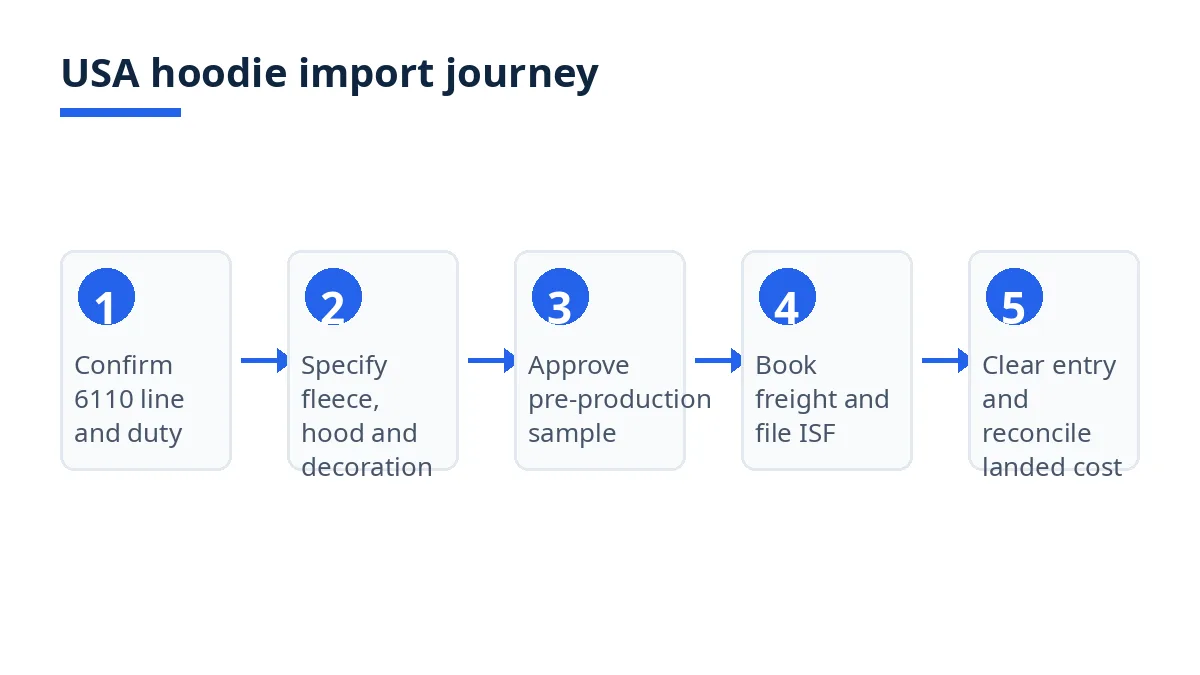
Appoint a USA customs broker and confirm the 6110 line, the General rate, any additional duties, and the dutiable value for your exact hoodie.
Write the full specification: fleece weight and composition, hood and pocket construction, ribbing, drawstring treatment by wearer age group, decoration method and placement, size range, labels, and packing.
Shortlist three to five fleece suppliers, verify documents and capability, and compare quotations on the same Incoterm and inclusions.
Approve the development sample, then the pre-production sample in bulk fleece with bulk decoration, in writing, before bulk cutting.
Approve label artwork against bulk composition, settle children's drawstring treatment where relevant, and agree inspection stages and quality levels.
Fix the Incoterms rule and named place, book freight, and send ISF data early enough for filing at least 24 hours before loading.
Prepare entry documents so invoice, packing list, bill of lading, and label data agree, and send them to your broker before arrival.
Rebuild the landed-cost table from current quotes and the confirmed duty line, and price from the landed figure.
Inspect before shipment, compare the shipment sample with the approved sample, and reconcile quantity and quality on delivery.
How Exportain helps
Exportain lets a USA buyer search Bangladeshi suppliers by product and category, review supplier profiles and the document and photo checks recorded on each profile, post a request for quotation with a full specification, and compare quotations in one thread. Use the profile checks as a shortlisting aid, then carry out your own document, sample, and inspection checks as described above. For the general import process that sits behind this product guide, the Exportain guide to importing from Bangladesh sets out the same sequence of specification, verification, samples, payment, and clearance in full.8
FAQs
What is the typical MOQ for hoodies and sweatshirts from Bangladesh?
There is no single typical MOQ. A supplier sets the minimum by style and by color, because fleece dyeing, brushing, and decoration each have batch limits. Ask each supplier to state whether its minimum applies per order, per style, per color, or per size, and to state the price effect of ordering below it, before you compare quotations.
How long does shipping take?
Shipping time has no single figure for this route. It depends on the sailing schedule, the port pair, transshipment, and port handling at the time of shipment. Ask your forwarder for a dated estimate for your actual route and USA port, and plan backward from that estimate with a buffer after inspection.
What import duty applies?
Duty depends on fiber and classification under heading 6110. In Revision 17 (2026) of the United States schedule, the General rate for the cotton "Other" line 6110.20.20 is 16.5%, and for the man-made fiber "Other" line 6110.30.30 it is 32%.5 Have your broker confirm the line, the rate, and any additional duties for your exact garment on your entry date.
How do I verify a supplier?
Check documents, capability, and payment discipline in that order. Confirm that the legal name, address, and bank account agree across documents, check current fleece, hood, pocket, and decoration capability against your specification, inspect a finished hoodie from current production, and pay only to the verified company account. Treat document and photo review badges as a shortlisting aid, not as an inspection or a guarantee.
Next steps on Exportain
Read the general guide: How to Import From Bangladesh
Browse suppliers: Bangladeshi Manufacturers and Exporters
Work through the method: Landed Cost for Imports From Bangladesh
Sources
- Textile, Wool, Fur, Apparel and Leather Matters. Federal Trade Commission (accessed )
- Drawstring Bulletin: Drawstrings on Children's Upper Outerwear. U.S. Consumer Product Safety Commission (accessed )
- Place of delivery & risk transfer in trade contracts. ICC Academy (accessed )
- Importer Security Filing (ISF). DP World (accessed )
- Harmonized Tariff Schedule of the United States, Chapter 61: Articles of apparel and clothing accessories, knitted or crocheted (Revision 17, 2026). United States International Trade Commission (accessed )
- 19 CFR 142.3 - Entry documentation required. Legal Information Institute, Cornell Law School (accessed )
- Landed Cost for Imports from Bangladesh. Exportain (accessed )
- How to Import from Bangladesh. Exportain (accessed )
About the author
Sourcing from Bangladesh?
Post a request for quotation and suppliers on Exportain can send you their quotes directly.
Post an RFQ


