Hoodies and Sweatshirts to UAE From Bangladesh: Costs, Duties and Suppliers
UAE-entry-first guide for buyers importing hoodies and sweatshirts from Bangladesh: Jebel Ali entry, supplier checks, MOQ and pricing, quality, shipping, duty, documents and a worked landed-cost example.
Short answer
For UAE buyers importing hoodies and sweatshirts from Bangladesh, decide the mainland or free-zone entry before ordering, confirm the tariff classification and duty with a UAE broker, and build the landed cost from the supplier price plus freight, insurance, duty and buyer-side charges. Use a sealed pre-production sample as the bulk standard, inspect before shipment, and ship Chattogram to Jebel Ali on a named Incoterm.

On this page
Key takeaways
Decide the UAE entry before ordering: mainland entry gives direct access to the local market, while goods in a free zone stay duty-exempt only while they remain in the zone or are re-exported, with duty applying on movement to the mainland.
The Dubai customs tariff is stated generally as 5 per cent of the CIF value, except for alcohol and cigarettes, but no product-specific rate is asserted here: your UAE broker confirms the rate for your goods under their actual tariff classification.
There is no single MOQ figure for hoodies and sweatshirts: the minimum is negotiated with the supplier and moves with fabric, colour count, size range and decoration, so agree the quantity per colour and per size in writing.
Use the worked example as a template, not a price: goods USD 8,400 plus freight and insurance give a CIF value of USD 9,415, duty at the general statement gives USD 471, buyer-side lines add USD 655, and the total landed cost before VAT is USD 10,541.
Why source hoodies and sweatshirts from Bangladesh
For a UAE-based buyer, the case for Bangladesh starts with the product itself. Hoodies and sweatshirts are knitwear, and Bangladesh has built its garment trade around knit production at scale, with factories that cut, sew, print, embroider and finish fleece garments in one production chain. That matters for a buyer who needs the same fleece hand-feel, colour and fit across repeat orders, because fewer hand-offs between separate workshops mean fewer chances for a shade or size to drift between the sample and the bulk run.
The buying question, though, is not whether Bangladesh can make the garment. It is whether the order can land in the UAE at a cost that still works after freight, duty, broker charges and inland delivery, and whether the shipment clears at Jebel Ali without a document or classification problem holding it at the port. This guide works from the UAE end backwards: it starts with the entry decision you must make before you order, then covers suppliers, quantities, pricing, quality, shipping, duty and documents, and finishes with a worked landed-cost example and a checklist.
Start with the entry decision, because it changes the rest of the plan. Decide before you order whether the goods will enter the UAE mainland, where they are released for sale in the local market, or whether they will stay in a free zone for storage, processing or re-export. Goods imported into a free zone are exempt from customs duties while they remain in the zone or are re-exported, and a 5% customs duty applies on the CIF value when goods move from the free zone to the mainland.1 A mainland setup, by contrast, allows direct, unrestricted access to the entire UAE local market, while a free-zone business that wants to sell into the mainland must appoint a local distributor, agent or third-party logistics provider.1 If you sell to UAE retailers, plan a mainland entry. If you hold stock for regional re-export, a free-zone entry may fit better. Confirm the entry with your UAE broker before you sign a purchase order, because changing it after the goods have shipped is far harder than choosing it at the start.
Find and verify suppliers
A good supplier search for hoodies starts with a specification, not with a list of factory names. Write down the fabric first: cotton fleece or a cotton-polyester blend, the fabric weight in grams per square metre, the fit, the size range, the colourways, and the trims, including zips, drawcords, ribbing and labels. Add the print or embroidery method, the packaging method, and the carton marking you need. Suppliers can only quote like-for-like when they receive the same specification, and a vague request for hoodies will return quotes that cannot be compared.
Shortlist suppliers by asking for evidence that matches your order, not by collecting brochures. Ask each supplier which hoodie styles they have produced recently, what fabric weights they run regularly, and whether they dye, print and embroider in-house or send that work out. Ask for a factory profile, audit reports they are willing to share, and references from buyers in the Gulf region where possible. Check the business registration details against the documents on the pro forma invoice, and make sure the company name, address and bank details match across every document. A mismatch between the invoice, the packing list and the payment instruction is a reason to pause, not a detail to sort out later.
Verification continues with the sample. Never approve bulk production from photographs alone. Approve a development sample for fit and construction, then a pre-production sample made in the actual bulk fabric, with the actual trims and the actual print or embroidery. Keep one sealed sample as the bulk standard, and write into the purchase order that bulk goods must match it for fabric, colour, measurement and workmanship. If a supplier will not provide a pre-production sample, or will not put the sample standard in writing, treat that as information about the supplier, and move on.
Payment terms are part of verification too. Agree the payment method, the deposit share, the balance trigger and the documents that release payment before production starts. A letter of credit, a telegraphic transfer against documents, or staged payments against inspection results each carry different risks, and the right choice depends on how well you know the supplier and how large the order is. Put the Incoterm, the port pair, the shipment window, the inspection right and the remedy for a failed inspection in the same written order, so there is one document both sides can point to if something goes wrong.
MOQ, pricing and samples
No single minimum order quantity applies to hoodies and sweatshirts from Bangladesh, and this guide gives no figure to copy into your plan. A minimum is a negotiated item between you and the supplier, and it moves with the fabric, the colour count, the size range and the decoration. A single colour in a standard fleece, ordered in one size curve, is easier to place in a smaller run than five colours with print and embroidery, because each colour and each decoration adds set-up work, dye lots and approval steps. Splitting a small quantity across many colours raises the unit cost even when the total piece count looks reasonable, so agree the quantity per colour and per size, not just the total.
Price follows the same logic. The unit price is driven by fabric weight and composition, yarn and dye costs, construction complexity, print or embroidery coverage, trim quality and order size. A heavyweight brushed fleece with full chest embroidery and a lined hood will cost more than a lightweight unlined pullover, and comparing the two on unit price alone tells you nothing. Compare quotations only after converting each one to the same basis: same fabric, same size curve, same decoration, same packing and the same Incoterm. Ask each supplier to break the price into fabric, trims, making, decoration and packing where possible, so you can see which line drives a difference rather than guessing.
Samples carry their own cost and timetable, and both should be agreed in writing: who pays for the sample and courier, how many revision rounds are included, and how long each round takes. Treat the sample stage as the cheapest place to find problems: a measurement error, a colour that shifts after washing, or a drawcord that frays can all be fixed at sample stage for little cost, while the same faults in a bulk shipment mean rework, delay or a rejected container.
Quality control and certifications needed
Quality control for hoodies needs to cover the points where fleece garments most often fail: fabric weight and shrinkage after washing, colour fastness, seam strength, zip and drawcord function, print and embroidery durability, and measurement consistency across sizes. Write these points into a quality standard before production, with tolerances for each measurement, a wash test method, and a rule for what happens to units that fall outside tolerance. A standard that lives only in an email thread will not survive a dispute; a standard attached to the purchase order will.
Inspection should happen at more than one stage. An inline inspection during production catches fabric and construction problems while they can still be corrected, and a final inspection before shipment checks the finished, packed goods against the sealed sample. Agree the sampling method, the defect classification, the accept and reject limits, and who inspects, in advance. A failed final inspection needs a written remedy agreed before it happens, whether that is rework, re-inspection, a price adjustment or cancellation.
Certifications should be requested for the product you are buying, not accepted as general claims. OEKO-TEX STANDARD 100 is an independent testing and certification system for textile raw materials, semi-finished and finished products at all stages of processing, and it confirms that products have been tested for harmful substances.2 The system tests all components of an article, including outer fabric, sewing threads, lining, dyes, finishes and prints, and accessories such as buttons, rivets or zips.2 If a supplier claims this certification for your hoodies, ask for the certificate number, check that it covers the product class that matches your garment, and confirm that it is still valid, since a certificate is valid for 12 months and can be renewed annually.2 Other certificates depend on the end customer: retail customers may ask for social compliance audit reports, fibre composition declarations, or care labelling that matches UAE retail requirements. Ask your customer what they require before production.
One broker question belongs on your pre-production list: ask your UAE broker before production whether any SABER-related question applies to this shipment, and what the broker needs from you or the supplier if it does. Do not build a timetable or budget around an assumed answer.
Incoterms, shipping and transit time
The Incoterm in your purchase order decides who pays for freight and insurance, who bears the risk at each stage, and where the seller's delivery obligation ends. For Chattogram to Jebel Ali, the common choices are FOB Chattogram, where the buyer arranges and pays for the main carriage, CIF Jebel Ali, where the seller arranges and pays for freight and minimum insurance to the named port, and DAP at a named UAE place, where the seller carries the goods to that place without clearing UAE import formalities. Name the Incoterm, the named port or place, and the Incoterms edition in the contract, and make sure the supplier's quotation uses the same term as the purchase order.
Shipping runs from Chattogram to Jebel Ali, the Dubai port that serves most Bangladesh to UAE container traffic. Plan the booking around the production finish date, and confirm the sailing schedule for your actual loading week with your forwarder. As a dated planning estimate only, a forwarder lane page for Chattogram to Jebel Ali showed an average FCL transit of 10 days 9 hours on sailings listed in late October 2026.3 Treat that figure as an estimate, not a promise: transshipment, port congestion and documentation delays can add days. Build a buffer between vessel arrival and any retail launch or customer delivery date.
Inland delivery inside the UAE is a separate leg, and it should be confirmed as a forwarder-confirmed option rather than assumed. Ask your forwarder whether delivery to your warehouse, free-zone facility or customer is included in the quotation, what the delivery window is, and what happens if the container is held for inspection. A quotation that ends at the port leaves haulage, container return and delivery appointments to you, and those items belong in the landed-cost table, not discovered after arrival.
Import duty, taxes and documents
Duty is the line buyers most often misjudge, because the headline rate tells only part of the story. The UAE government portal states the general position for Dubai plainly: the customs tariff is 5 per cent of the CIF value, except for alcohol and cigarettes.4 The same general 5 per cent rate on the CIF value is described as applying to most manufactured goods, with the duty base being the CIF value determined under the valuation rules.5 This guide states no product-specific UAE duty rate for hoodies and sweatshirts: your UAE broker confirms the rate that applies to your goods under their actual tariff classification, and that broker-confirmed figure is the one to use in your budget.
Import VAT is a separate charge and must be kept out of the landed-cost total in this guide. Guides on UAE import VAT describe a 5 per cent VAT applied to the sum of the CIF value and the customs duty for non-exempt imports entering mainland UAE.6 The conditional illustration in the landed-cost section below shows what that arithmetic would give on the example figures, and it is not added to the total, because your broker and your tax adviser must confirm what applies to your business, your entry type and your goods.
Documents decide whether a shipment clears on arrival or waits. The core set for a UAE import includes the commercial invoice, the packing list, the bill of lading, the certificate of origin and the customs declaration, with an insurance certificate where the terms require one.6 The invoice must match the packing list and the bill of lading on quantity, description, value and marks, and the tariff classification on the declaration must match the goods in the cartons. Importers must register for an emirate-specific customs code before filing declarations and clearing commercial shipments.5 Send the document set to the broker before the vessel sails, so a mismatch can be corrected while the goods are still at sea.
Landed cost example (table)
Every figure below is an example only, not a real price, freight rate or charge for any supplier, route or shipment. Replace each line with your own supplier quotation, forwarder quote and broker confirmation before you price an order. The duty line uses the general 5 per cent of CIF statement only, and your broker confirms the figure for your actual classification. The VAT illustration sits outside the total and is not part of the landed cost.
Cost line | USD |
|---|---|
Goods value, FOB basis in this example | 8,400 |
Ocean freight, Chattogram to Jebel Ali | 920 |
Marine insurance | 95 |
CIF value | 9,415 |
Import duty in this example, at the general 5% of CIF statement | 471 |
Jebel Ali port and terminal charges | 180 |
Customs broker fee | 150 |
Inland delivery to a Dubai warehouse, forwarder-confirmed option in this example | 230 |
Documentation and handling | 95 |
Buyer-side subtotal | 655 |
Total landed cost before VAT | 10,541 |
Read the table as a warning about headline prices. A goods value of USD 8,400 becomes USD 10,541 before VAT once freight, insurance, duty and buyer-side charges are added, and the buyer-side lines alone add USD 655. As a conditional illustration only, 5% of the CIF-plus-duty amount in this example (USD 9,415 plus USD 471) is USD 494. That illustration is not added to the total above, and your broker confirms what applies to your shipment. Re-run the table for every order, because a smaller quantity spreads the same fixed charges across fewer units.
Step-by-step import checklist
Work through these steps in order.
Decide the UAE entry: mainland or free zone, matched to your licence and your sales plan, and confirm it with your UAE broker.
Write the full specification: fabric, weight, fit, size curve, colourways, trims, decoration, packing and carton marking.
Shortlist suppliers, check registration and document consistency, and ask for evidence that matches your order.
Agree samples, sample costs, revision rounds and the sealed bulk standard in writing.
Compare quotations on one Incoterm basis, convert each offer to an estimated landed cost, and negotiate quantity per colour and per size.
Ask the broker the pre-production questions: classification, SABER-related questions, registration and the document set.
Place the purchase order with the Incoterm, port pair, shipment window, inspection right and remedy for a failed inspection.
Run inline inspection during production and final inspection before shipment against the sealed sample.
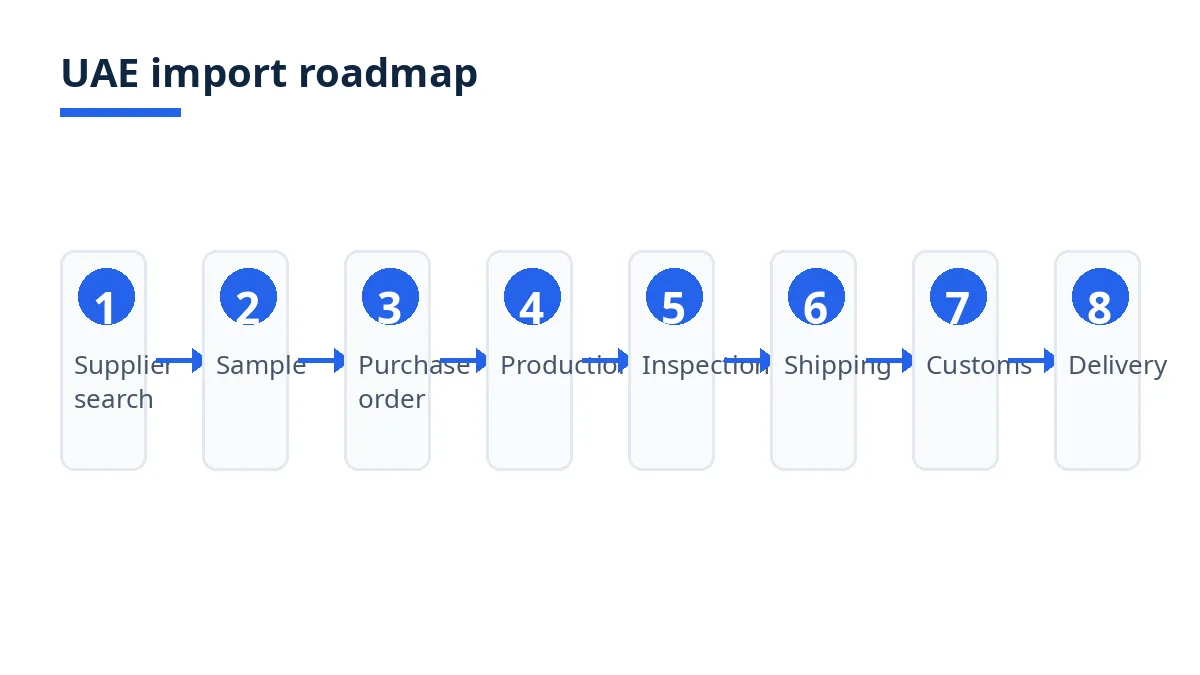
Check the document set against the goods before the vessel sails, and send it to the broker early.
Clear the Jebel Ali entry, settle the broker-confirmed duty and charges, and arrange the forwarder-confirmed inland delivery.
Check the delivered goods against the sealed sample on arrival, and record any shortage or defect claim within the agreed window.
How Exportain helps
Exportain connects UAE buyers with Bangladeshi suppliers through its marketplace, where you can search supplier listings, compare offers and request quotations with your specification attached. Use the platform to shortlist suppliers for hoodies and sweatshirts, to keep the specification, quotation and order documents in one thread, and to track the order stages from sample approval to shipment. When a supplier question needs a document, a revised sample or a changed delivery window, keep that change in writing on the order thread so both sides hold the same record.
FAQs
What is the typical MOQ for hoodies and sweatshirts from Bangladesh?
There is no single typical figure to quote, because a minimum is negotiated with the supplier and moves with fabric, colour count, size range and decoration. A single colour in a standard fleece is easier to place in a smaller run than several colours with print and embroidery, since each colour and decoration adds set-up work and approval steps. Agree the quantity per colour and per size in writing, compare quotations on the same specification, and treat any supplier minimum as a starting point for negotiation rather than a fixed market rate.
How long does shipping take?
Ocean transit is only one part of the timeline, and it should be read as a dated estimate. A forwarder lane page for Chattogram to Jebel Ali showed an average FCL transit of 10 days 9 hours on sailings listed in late October 2026.3 Production time, sample approval, booking, port handling, customs clearance and inland delivery all sit around that transit figure, so the full order timeline runs far longer than the sea leg alone.
What import duty applies?
This guide states no product-specific rate for hoodies and sweatshirts. The general statement on the UAE government portal is that the Dubai customs tariff is 5 per cent of the CIF value, except for alcohol and cigarettes.4 Your UAE broker confirms the rate that applies to your goods under their actual tariff classification, and that broker-confirmed figure is the one to budget. If your goods move from a free zone to the mainland, duty applies on the CIF value at that movement, as described in the entry section above.1
How do I verify a supplier?
Verify a supplier on documents, samples and written terms, not on claims alone. Check that the company name, address and bank details match across the profile, the pro forma invoice and the payment instruction. Approve a development sample and then a pre-production sample in the actual bulk fabric, keep a sealed sample as the bulk standard, and put the inspection right and the remedy for a failed inspection in the purchase order. For certifications, ask for the certificate number and validity, and check that the certificate covers your product: OEKO-TEX STANDARD 100, for example, tests all components of an article and confirms testing for harmful substances.2
Next steps on Exportain
Start with the general process in How to Import from Bangladesh, then work your figures through Landed Cost for Imports from Bangladesh before you accept a quotation. When you are ready to compare suppliers, browse Exportain suppliers and send your full specification with the request, so the quotes you receive can be compared on one basis. Send the broker the entry and classification questions at the same time, so the answers arrive while suppliers are still quoting, and keep the landed-cost table updated as each confirmed figure replaces an example figure.
Sources
- How to Import Goods into the UAE: A Free Zone vs. Mainland Comparison. Cross Link International (accessed )
- OEKO-TEX STANDARD 100 for textiles tested for harmful substances. Hohenstein (accessed )
- Chittagong to Jebel Ali FCL Shipping Rates | Schedules & Transit Time. Cogoport (accessed )
- Customs duty and tariff. UAE Government (accessed )
- UAE Customs Duty on Imports: Requirements and Calculation Guide. GlobalTradePlaza (accessed )
- VAT on Customs Duty in the UAE: Documents and Payment Process. Global Trade Plaza (accessed )
About the author
Sourcing from Bangladesh?
Post a request for quotation and suppliers on Exportain can send you their quotes directly.
Post an RFQ