

Hoodies and Sweatshirts to Spain From Bangladesh: Costs, Duties and Suppliers
Spain hoodies and sweatshirts import guide: 6110 classification, EBA 0 percent preference, Spanish VAT 21 percent and optional deferment, Spanish EORI, Valencia clearance, supplier verification, samples, Incoterms, transit, and a worked landed-cost example for 4,800 hoodies to Valencia.
Short answer
To import hoodies and sweatshirts from Bangladesh to Spain, classify the garment under heading 6110, confirm the 0 percent Everything But Arms preference and its origin proof with your broker, settle the Spanish VAT deferment decision and Spanish EORI before the first Valencia clearance, approve a pre-production sample in bulk fleece with a Spanish label, agree the Incoterm and inspection standard, and price from landed cost through Valencia.
On this page
Key takeaways
Hoodies and sweatshirts fall under heading 6110: men's or boys' cotton garments sit at 6110 20 91 and women's or girls' man-made fiber garments at 6110 30 99, and the tariff pages render no duty rate, so your broker must confirm the current line and supply the TARIC third-country figure for your exact garment on your entry date.
A qualifying Bangladeshi shipment may pay 0 percent under the Everything But Arms arrangement, which grants duty-free, quota-free access to the EU for exports of all products except arms and ammunition, but only where the origin claim is supported by correct proof of origin; without that proof, the broker's TARIC third-country figure applies.
Spanish import VAT at 21 percent is shown only as a conditional example on a broker-confirmed base: Spain offers an optional deferment for taxable persons established in Spain filing monthly returns, so decide with your tax adviser before the first Valencia clearance whether deferment fits, and settle a Spanish EORI number that matches your VAT position.
Example figures only: 4,800 hoodies at 6.15 EUR FOB Chattogram, arriving at Valencia for delivery to a Madrid warehouse with a valid EBA claim, give a landed cost of 7.06 EUR per hoodie, with import VAT at 21 percent shown only as a conditional example on a broker-confirmed base and left out of the total.
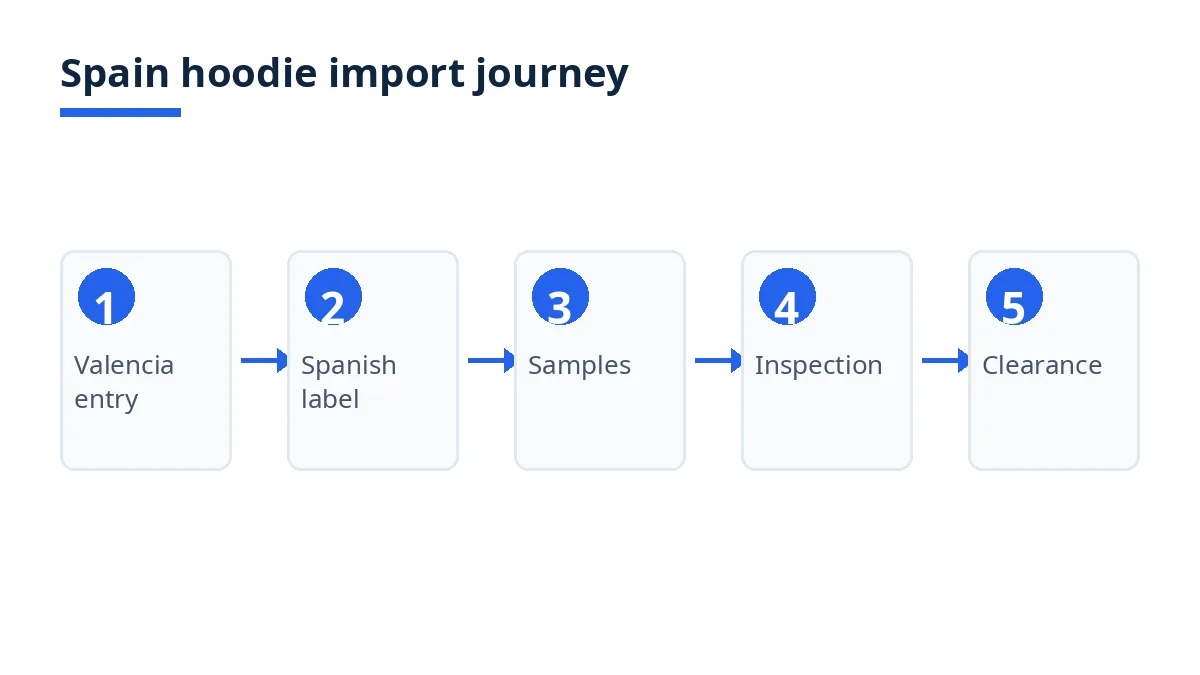
A hoodie order for Spain is decided at Valencia long before it reaches a warehouse in Madrid or a shop in Barcelona. The Spanish VAT route, the EORI position, the Spanish wording on the label, and the proof behind any duty preference are all entry questions, cheaper to settle before production than after discharge. This guide therefore follows a Valencia-entry order: Spanish tax and customs setup first, then classification and the preference claim, then Spanish labelling, and only then supplier selection, samples, freight, and landed cost. Every figure in the worked example is an example figure only, and every duty, tax, and transit statement that affects margin needs a broker confirmation for your exact garment on your entry date.
Why source hoodies and sweatshirts from Bangladesh
Bangladesh suits repeat hoodie programs because fleece production runs at volume, and the faults that matter on a hoodie are ones a buyer can check on a sample: evenly brushed fleece, a hood that holds its shape after washing, a pocket that stays square, ribbing that springs back, and decoration that grips a brushed surface. A factory that runs those steps daily will show it in the sample; a factory that does not will show that too, usually in the hood shape or the pocket alignment first.
The trade case for a Spanish buyer rests on preference, not only on factory price. As a least developed country, Bangladesh benefits from the most favorable regime available under the EU Generalised Scheme of Preferences, namely the Everything But Arms arrangement, granting duty-free, quota-free access to the EU for exports of all products except arms and ammunition.1 That preference is what lets a Valencia entry price differently from an entry in a market without such a scheme. It is never automatic, because it depends on classification, origin rules, and correct proof of origin.
Spain adds a distribution reason. Goods cleared at Valencia and released for free circulation can move onward within the EU single market without a second customs border, provided the first entry is clean.
Find and verify suppliers
Write the specification before asking for a price, with the Spanish market in it from the start. A usable hoodie specification covers fiber composition and fleece weight, hood construction and lining, pocket type and placement, ribbing at cuff and hem, drawstring treatment, size chart and fit, color and shade standard, decoration method and placement, packing, and label content for sale in Spain. Send the same specification to every supplier so quotations can be compared line by line. A supplier quoting against a lighter fleece or a different decoration method is offering a different garment, not a lower price.
Shortlist three to five fleece garment makers. Ask which steps each factory does in-house, whether it has shipped knitted garments to the EU before, and what proof of origin it supplied for those shipments. The Bangladesh Garment Manufacturers and Exporters Association site carries a member search and member lists, which lets you confirm that a company presents itself consistently as a member before you go further.2 Ask each supplier for its core business documents and check that they are consistent: legal company name and registered address, trade licence, Taxpayer Identification Number, Export Registration Certificate, and chamber or trade association membership documents where relevant. The company name on the quotation, proforma invoice, bank account, and shipping documents should be the same legal entity, or any difference should have a clear, documented explanation.
Supplier profiles and trust badges can help you shortlist, but a badge records which checks have been reviewed; it is not a factory audit, not an inspection of your goods, and not a guarantee of capacity, quality, or delivery. For a first order, ask the supplier to explain, in writing, how it would handle a failed inspection.
MOQ, pricing and samples
There is no single typical minimum order quantity for hoodies and sweatshirts from Bangladesh, because the minimum is usually set per style and per color, and sometimes per size, rather than per order. Ask each supplier to state exactly what its minimum applies to: per order, per style, per color, per size, or per fabric lot. A minimum of 500 pieces per color sounds small until it is multiplied across six colors and four sizes. Get the breakdown in writing before you compare prices, because two suppliers with the same headline minimum can be quoting very different commitments.
Price on the same basis. A quotation is not a number alone; it is a number plus a currency, an Incoterm, a named place, a quantity breakdown, and a validity date. Convert every offer to the same basis before you compare, and ask what the price includes and excludes: materials, trims, labels, packing, testing, and any charge for a sample, a size run, or a repeated test. A price that excludes testing is not lower than a price that includes it; it is incomplete.
Treat samples as part of the contract. A development sample confirms the supplier understood the specification. A pre-production sample, made with the actual materials, trims, labels, and packing intended for bulk production, is the physical standard both sides will later use to judge bulk goods. Approve it in writing and keep one sealed piece yourself before bulk production starts. A shipment sample lets you compare the bulk run with the approved sample before the goods leave Bangladesh.
Quality control and certifications needed
Agree the inspection standard before production: inspection level, sampling method, defect classification, and pass and fail limits in the order documents. A hoodie fails in ways a checklist catches only if the checklist names them: hood shape after washing, pocket alignment, drawstring finish, ribbing recovery, print or embroidery adhesion on brushed fleece, color shade, and size measurements against the approved chart.
Certifications here mean two different things. The first is the factory picture: the compliance schemes a factory declares and the test reports it can show for its materials and processes. Ask for the actual documents, not a list of scheme names, and check dates, scope, and the legal name on each document. The second is the product picture: the tests your Spanish customers, your insurer, or your own quality policy require, such as fiber composition testing and color fastness. Name the tests in the specification and agree who pays when a test fails and must be repeated.
Labelling is a compliance item, not a marketing item. Under Regulation (EU) No 1007/2011, the labelling or marking shall be provided in the official language or languages of the Member State on the territory of which the textile products are made available to the consumer, unless the Member State concerned provides otherwise.3 For Spain, that means Spanish wording on the label for garments sold to Spanish consumers: fiber composition in the standard fiber names, in Spanish, with any required statement where the product contains non-textile parts of animal origin. Approve the label artwork in writing, in Spanish, before bulk production, and check it against the approved sample, because a label corrected after production means relabelling or a rejected delivery.
Incoterms, shipping and transit time
The Incoterms rule in the quotation decides who arranges carriage, who bears risk at each point, and which cost lines are already inside the price. The place of delivery may be a factory, a port, or an inland destination, and it is determined by the terms of the contract, which may include one of the Incoterms 2020 rules.4 Under the 11 Incoterms 2020 rules, the transfer of risk coincides with delivery in general terms, but the C rules separate cost from risk: the seller arranges and pays for transport to the named destination, while risk passes earlier, when the goods are handed to the carrier or placed on board.4 Under CIF, the seller arranges insurance against the buyer's risk, but the buyer bears transit risk from loading on board, so check the level of cover named in the contract and budget for a top-up if it does not match the value and risk of the goods.
For most first orders, the practical choice is between FOB Chattogram and CIF Valencia, with DAP to the Spanish warehouse as the alternative when the seller takes the inland leg as well. Under FOB, you arrange and pay main freight and insurance, and risk passes when the goods are on board at Chattogram. Under CIF Valencia, the seller contracts carriage and insurance to Valencia, but risk still passes on board at Chattogram, so check the insurance wording as carefully as the freight price. Under DAP, delivery and risk transfer occur at the named place of destination, with the seller placing the goods at your disposal ready for unloading.4 Name the rule, the named place, and the edition in the contract, for example FOB Chattogram, Incoterms 2020, rather than writing FOB alone.
Transit is a dated estimate, never a promise. The opened freight calculator lists indicative Chattogram to Valencia sailings at 29 to 59 days, with the individual carrier figures shown as valid to late October 2026.5 Treat that range as sailing time only. Door-to-door time adds origin handling and export clearance, any transshipment, Valencia terminal handling and customs clearance, and inland delivery to your warehouse in Spain. Build the selling calendar from the door-to-door figure.
Import duty, taxes and documents
Classify first, price second. Hoodies and sweatshirts fall under heading 6110. The opened tariff pages confirm the heading and the descriptions: men's or boys' cotton knitted garments sit at 6110 20 91, and women's or girls' man-made fiber knitted garments sit at 6110 30 99.6 7 Those pages render no duty rate, so no third-country rate figure is asserted in this guide. Your broker must confirm the current line for your exact garment, fiber mix, and construction, and must supply the TARIC third-country figure for that line on your entry date.
On duty, confirm the preference position in writing before pricing. A qualifying Bangladeshi shipment may pay 0 percent under the Everything But Arms arrangement, which grants duty-free, quota-free access to the EU for exports of all products except arms and ammunition.1 That 0 percent figure is origin-proof dependent: without correct proof of origin, the preference cannot be claimed, and the broker's TARIC third-country figure on the entry date applies instead. Ask the supplier, before you order, exactly what origin document it will supply, in what form, and by what date relative to shipment, and ask your broker to confirm that the document supports the claim for your garment.
Spanish VAT is a separate tax from duty, and it needs its own step in the plan. The standard Spanish VAT rate is 21 percent, applied to most goods imported into mainland Spain and the Balearic Islands, as the opened Spain import VAT guide states it.8 Import VAT in Spain is charged when goods from outside the EU enter Spain and are released into free circulation, and it applies to the person who imports the goods, usually the consignee or the business named as importer in the customs declaration.8 Spain offers an optional deferment system, available to taxable persons established in Spain that file monthly VAT returns, under which customs does not ask for import VAT in cash and the amount instead appears in the monthly VAT return, so decide with your tax adviser before the first clearance whether deferment fits your setup or whether you will pay at the border.8 Keep the customs declaration and any linked import VAT certificate information in your files, because that documentation supports deduction through your periodic return.8
Settle the Spanish EORI position at the same time. If a Spanish or foreign company imports goods from third countries, it will normally need an EORI number to complete the customs procedures, and the EORI application in Spain is filed with the Spanish Tax Agency through its electronic office.9 For operators established in Spain with a Spanish tax identification number, the EORI is normally made up of the country code ES followed by the tax identification number.9 A Spanish buyer importing in its own name therefore settles two items before the first clearance: a Spanish VAT position and an EORI number that match each other in the customs system. If you buy on DAP, you are normally the importer of record and you use your own EORI and VAT position; if you buy on DDP, the seller takes on import clearance and Spanish VAT registration, which is a heavier commitment for the seller and needs to be agreed explicitly.
Assemble the documents file before the vessel sails: commercial invoice, packing list, bill of lading, origin document supporting any preference claim, and the customs declaration data your broker needs, including classification, customs value, and any certificates your product requires. Send the full set to your broker early enough for queries to be answered while the goods are still in transit.8
Landed cost example (table)
All figures below are example figures only, not a real price, freight rate, or charge for any product, route, or supplier. The example uses a valid EBA claim, so duty is 0 percent here, and import VAT at 21 percent is shown only as a conditional example on a broker-confirmed base and is left out of the total.
Line | Example figure (EUR) |
|---|---|
Product cost: 4,800 hoodies at 6.15 FOB Chattogram | 29,520.00 |
Ocean freight, Chattogram to Valencia | 2,650.00 |
Cargo insurance | 240.00 |
Subtotal before duty | 32,410.00 |
Import duty: 0 percent under a valid EBA claim | 0.00 |
Customs broker fee | 230.00 |
Valencia port and terminal charges | 390.00 |
Inland delivery, Valencia to a Madrid warehouse | 420.00 |
Pre-shipment inspection | 330.00 |
Bank and currency costs | 105.00 |
Total landed cost | 33,885.00 |
Landed cost per hoodie (33,885.00 divided by 4,800) | 7.06 |
Conditional example only: import VAT at 21 percent on an example base of 32,410.00, broker-confirmed base only, excluded from the total | 6,806.10 |
Arithmetic check: 4,800 multiplied by 6.15 equals 29,520.00; adding 2,650.00 and 240.00 gives 32,410.00; adding 230.00, 390.00, 420.00, 330.00, and 105.00 gives 33,885.00; dividing 33,885.00 by 4,800 gives 7.06 per hoodie after rounding. The VAT example is 21 percent of 32,410.00, which equals 6,806.10, and it is not part of the 7.06 figure. If the EBA claim failed, the duty line would change to the broker's TARIC third-country figure on the entry date, and the VAT base would need broker confirmation before any VAT figure was used.
Step-by-step import checklist
Work this list in Valencia-entry order, with the Spanish tax steps first because they cannot be fixed after shipment.
Settle the Spanish VAT step before the first clearance: decide with your tax adviser whether the optional import VAT deferment fits your setup, confirm your Spanish VAT position, and confirm how the customs declaration will record the import VAT.
Approve the Spanish label: fiber composition in the standard fiber names in Spanish, animal-origin statement where applicable, and label artwork checked against the approved sample.
Confirm the Valencia entry file: classification under heading 6110, broker-confirmed TARIC figure, and the EBA preference position with the origin document the supplier will supply.
Confirm the Spanish EORI position: an EORI number active for customs procedures, linked to your Spanish tax identification number where applicable, and validated before the first declaration.
Write the full specification: fiber and fleece weight, hood and pocket construction, ribbing, drawstring, size chart, color standard, decoration, packing, and tests required.
Shortlist three to five fleece garment makers, check their business documents for consistency, and keep the failed-inspection process in writing.
Approve the development sample, then the pre-production sample in writing, and hold bulk production until approval is given.
Compare quotations on the same Incoterm, currency, quantity breakdown, and validity date, and convert every offer to landed cost before deciding.
Agree the inspection standard, sampling method, defect limits, and re-inspection terms, and book inspection before the vessel is booked.
Agree the Incoterm, named place, and edition in the contract, confirm insurance cover, book freight on a door-to-door calendar from Chattogram to the Spanish warehouse, send the full document set to your broker while the goods are in transit, and reconcile landed cost against actual invoices at the warehouse.
How Exportain helps
Exportain provides a supplier directory where you can search Bangladeshi suppliers by product and category and review supplier profiles, including what each trust badge covers. You can post a request for quotation stating quantity, target price, destination, Incoterm, required certifications, and deadline, so suppliers in the category can quote against the same brief.
FAQs
What is the typical MOQ for hoodies and sweatshirts from Bangladesh?
There is no single typical figure that can be used for planning. Minimums are usually set per style and per color, and sometimes per size or per fabric lot, rather than per order. Ask each supplier to state exactly what its minimum applies to, get the breakdown across your full color and size range, and compare the total commitment, not the headline number.
How long does shipping take?
The opened freight calculator lists indicative Chattogram to Valencia sailings at 29 to 59 days, with the individual carrier figures shown as valid to late October 2026, as a dated estimate only.5 Door-to-door time is longer, because it adds origin handling, any transshipment, Valencia clearance, and inland delivery to your Spanish warehouse. Plan the selling calendar from the door-to-door figure.
What import duty applies?
That depends on classification, origin, and proof. Hoodies and sweatshirts fall under heading 6110, with men's or boys' cotton garments at 6110 20 91 and women's or girls' man-made fiber garments at 6110 30 99 on the opened tariff pages, which render no duty rate.6 7 A qualifying Bangladeshi shipment may pay 0 percent under the Everything But Arms arrangement, subject to correct proof of origin.1 Without that proof, the broker's TARIC third-country figure on the entry date applies.
How do I verify a supplier?
Start with the specification, then check the supplier against it. Confirm the factory makes fleece garments itself, ask for its core business documents and check that the legal name is consistent across quotation, invoice, bank account, and shipping documents, and use the BGMEA member search and member lists to confirm that a company presents itself consistently as a member.2 Ask how a failed inspection would be handled, in writing, and treat a badge as a record of checks reviewed, not as an audit or a guarantee.
Next steps on Exportain
Start with the general process in How to import from Bangladesh, then search the supplier directory for fleece garment makers and compare their profiles against the specification in this guide. Before you accept a quotation, work through the landed-cost method on your own quantities, so the Valencia entry, Spanish VAT treatment, and inland leg to your warehouse are all priced before you commit.
Sources
- EU trade relations with Bangladesh. European Commission, (accessed )
- BGMEA | Home. Bangladesh Garment Manufacturers and Exporters Association (BGMEA) (accessed )
- Regulation (EU) No 1007/2011 on textile fibre names and related labelling and marking of the fibre composition of textile products, Article 16. European Union, (accessed )
- Place of delivery & risk transfer in trade contracts. ICC Academy (accessed )
- Freight Rates Calculator: 20ft & 40ft Container Shipping Prices for Sea & Ocean Delivery from Bangladesh to Spain. Globy Logistics (accessed )
- HS Code 61102091 - Men's or boys' jerseys, pullovers, cardigans, waistcoats and similar articles, of cotton, knitted or crocheted. Tariffnumber (accessed )
- HS Code 61103099 - Women's or girls' jerseys, pullovers, cardigans, waistcoats and similar articles, of man-made fibres, knitted or crocheted. Tariffnumber (accessed )
- Guide to Import VAT in Spain for Foreign Companies. Commenda (accessed )
- EORI Number in Spain: What It Is, When You Need It and How to Apply. IR Global (accessed )
About the author
Sourcing from Bangladesh?
Post a request for quotation and suppliers on Exportain can send you their quotes directly.
Post an RFQ


