Hoodies and Sweatshirts to Saudi Arabia From Bangladesh: A Buyer's Import Checklist
Saudi Arabia buyers importing hoodies and sweatshirts from Bangladesh: Jeddah-first entry, supplier checks, MOQ and samples, quality and SABER position, shipping, duty and VAT, and a worked landed-cost example.
Short answer
Saudi Arabia-based buyers importing hoodies and sweatshirts from Bangladesh should open the Jeddah entry file first: appoint a Jeddah customs broker and ask the broker to confirm the SABER position for the goods before production starts, then shortlist knitwear suppliers, agree samples and inspection, and price on landed cost, not unit price alone.
On this page
Key takeaways
Open the Jeddah entry file before pricing: appoint a Saudi customs broker and ask the broker to confirm the SABER position for the hoodies and sweatshirts concerned before production starts, since a shipment without the required SABER documentation faces re-export rather than delay.
No single minimum order quantity figure applies: the minimum is negotiated per order, per style, per colour, or per size, and must be tested against the full quantity breakdown before a price is agreed.
Compare quotations only on the same Incoterm and the same included items, approve the pre-production sample in writing, and agree the AQL plan and the action and cost on inspection failure in the contract.
No product-specific Saudi duty rate is asserted: the broker confirms classification and rate before pricing, import VAT at 15 per cent is shown only as a conditional illustration on a broker-confirmed base, and inland delivery is booked only where a forwarder confirms the leg.
Before a hoodie order from Bangladesh to Saudi Arabia is priced, the Jeddah entry file should be opened. Appoint a Saudi customs broker for the Jeddah import entry, and ask that broker to confirm the SABER position for the hoodies and sweatshirts concerned before production starts. That question comes first because a shipment that reaches Saudi customs without the SABER documentation it requires faces re-export rather than a short delay, according to the conformity guide opened for this article.1 A re-exported container costs freight twice and misses the selling season. Everything else in this guide — supplier choice, price, inspection, and freight — sits behind that first broker conversation.
This guide is written for a buyer based in Saudi Arabia who wants to import hoodies and sweatshirts from Bangladesh in commercial quantities. It covers supplier checks, minimum order quantities and samples, quality checks and certificates, shipping terms, duty and tax lines, and landed cost. All money figures in the worked example are labelled examples only, not market prices. Where a rate or a procedure depends on the exact product and the broker advice for that shipment, this guide says so and gives no substitute figure.
Why source hoodies and sweatshirts from Bangladesh
Hoodies and sweatshirts are knitwear, and knitwear is now the larger half of Bangladesh apparel exports. Bangladesh exported USD 38.70 billion worth of ready-made garments in FY2025-26, and knitwear accounted for USD 20.62 billion of that total, a 53.3 per cent share of garment exports, according to Export Promotion Bureau data compiled by the Bangladesh Garment Manufacturers and Exporters Association (BGMEA).2 The same analysis notes that the knitwear sector built strong domestic backward linkages, including local spinning, knitting, and dyeing capacity.2 For a buyer, that depth matters in practical ways: fleece fabric, ribbing, dyeing, brushing, cutting, sewing, printing, embroidery, washing, and finishing capacity exist in the same manufacturing ecosystem.
That depth does not remove buyer risk. A large sector contains factories of very different size, equipment, and discipline, and a hoodie order exposes the differences quickly: fleece weight, loop-back versus brushed back, shrinkage after washing, colour fastness, drawcord safety for childrenswear, and print or embroidery durability are all points where two suppliers quoting the same style can deliver different garments. Treat the country base as a reason to shortlist several suppliers and compare them properly, not as a guarantee.
Find and verify suppliers
Start with a written specification before contacting any supplier. A useful specification for hoodies and sweatshirts states the style and fit, the fabric composition and weight in grams per square metre, the fleece type, the colour and shade standard, the size range and measurement chart with tolerances, construction details such as kangaroo pocket, hood lining, and ribbed cuffs and hem, drawcord and zip details, print or embroidery artwork and placement, labelling and care instructions, packing by carton, and quantity by style, colour, and size. The Exportain pillar guide for importing from Bangladesh makes the same point in general terms: a factory fills every gap in a description with its own assumptions, and those assumptions become disputes later if they were never written down.3 Send the same specification to every shortlisted supplier, so quotations can be compared line by line.
Build a shortlist of three to five suppliers who actually make knitwear of this kind. Useful signals include a fleece range already in production, export experience to Gulf markets where that is stated, and a willingness to share documents and answer detailed questions in writing.
Go beyond documents for an order of any size. Ask for reference buyers the supplier is willing to name, photographs of current fleece production rather than catalogue images, and a clear statement of who performs each step: knitting, dyeing, cutting, sewing, printing or embroidery, washing, and packing. For a first order, a small trial quantity, agreed as a trial in writing, tests communication, sample discipline, and delivery behaviour before a full programme depends on the supplier.
MOQ, pricing and samples
No single minimum order quantity figure describes hoodies and sweatshirts from Bangladesh, and this guide gives none. Minimum order quantity is a buyer-negotiated item that depends on the fabric, the colour count, the size breakdown, the decoration method, and the supplier capacity at the time of booking. A supplier may set its minimum per order, per style, per colour, or per size, and those four bases produce very different order shapes. Ask the supplier to state, in writing, which basis its minimum uses, and test the breakdown against it before agreeing a price.
Price comparison only works on a like-for-like basis. Compare quotations on the same Incoterm, the same specification, the same quantity breakdown, and the same included items: fabric, trims, labels, packing, testing, and inspection. A lower unit price that excludes testing or export packing, or quotes on a different shipping term, is not a lower price. Ask each supplier to confirm the price validity date, payment terms, sample terms, and lead time counted from a named event, such as sample approval or deposit receipt. Record every answer in writing with the quotation.
Treat samples as part of the contract, not as a courtesy. The usual sequence is a development sample to confirm the supplier understood the specification, a pre-production sample made with the actual materials, trims, labels, and packing intended for the bulk order, and a shipment sample taken from finished bulk production. Approve the pre-production sample in writing, keep one sealed or signed piece yourself, and make sure a matching piece is retained at the factory. Bulk production should not start before that written approval. Confirm sample and courier charges, and any credit against the bulk order, before the first sample is made.
Quality control and certifications needed
Agree the quality standard in the contract, not at the port. For hoodies and sweatshirts, the points that most often cause rejection are measurement drift outside tolerance, shade variation between dye lots, shrinkage and spirality after washing, poor print or embroidery durability, broken stitching, and incorrect labelling. Write the tolerance for each point into the specification, state the test method where one applies, and name the laboratory where a test result will be accepted.
Use sampling inspection on a stated plan. In apparel inspection, the Acceptable Quality Level is the maximum percent defective that, for sampling purposes, can be considered satisfactory as a process average.4 The sampling table published by the same guide shows, for a lot of 501 to 1,200 pieces, a sample of 80 pieces, with 5 defects accepted and 6 causing rejection at an AQL of 2.5.4 Agree the AQL level, the defect classification, and the inspection stage in the contract. Separate critical defects, which are safety or compliance failures, from major defects that affect appearance, fit, or function, and from minor cosmetic defects. State what happens on failure: sorting, rework, re-inspection, or rejection, and who pays for each step.
For chemical safety, OEKO-TEX Standard 100 is the certificate buyers most often ask about for skin-contact garments. It is an independent certification system for textiles tested for harmful substances, and the guide opened for this article describes testing for over 1,000 regulated and potentially harmful substances, including banned azo dyes, formaldehyde, heavy metals, and phthalates.5 The same guide distinguishes four product classes by skin contact, with Class II covering direct skin contact items, and notes that certificates are valid for 12 months and that every component of a finished garment must be certified for the garment to carry the label.5 Ask for the certificate number, check that the certified article list covers the fabric in the order, and confirm the validity dates cover the delivery window.
Saudi-side certification is a separate question, and it belongs to the broker, not to the supplier alone. Ask the broker, before production starts, to confirm the SABER position for the hoodies and sweatshirts concerned and the entry data the Jeddah filing will require. This guide asserts no SABER procedure, fee, or timeline, and no buyer should accept a supplier assurance on Saudi conformity in place of broker confirmation. The reason for the order of work is stark: the conformity guide opened for this article states that a product reaching Saudi customs without the required documentation registered in the SABER system faces re-export rather than delay.1
Incoterms, shipping and transit time
Compare every quotation on the same Incoterm, because the term decides which costs sit inside the price and which sit outside it. Under FOB Chattogram, the seller delivers the goods on board the vessel and clears them for export, while the buyer books and pays the main carriage and arranges insurance. Under CIF Jeddah, the seller also contracts and pays for carriage to Jeddah and buys insurance cover for the buyer risk, while risk still passes on board at Chattogram. Under DAP to a named Saudi place, the seller carries the goods to that place, while import clearance, duty, and import taxes normally remain with the buyer. A unit price on one term cannot be compared with a unit price on another term without converting both to landed cost. State the rule, the named place, and the Incoterms 2020 edition in the contract itself.
The sea lane for this guide runs from Chattogram to Jeddah. Chattogram handles about 90 per cent of the import-export business of Bangladesh, according to the freight guide opened for this article, and Jeddah is described in the same guide as the largest seaport in the Red Sea and a major gateway for trade to and from Saudi Arabia.6 Treat any inland leg, for example to Riyadh, as a separate item, booked only where a forwarder confirms it in writing for the actual address.6
Treat transit time only as a guide estimate, never as a fact about a booked sailing. The freight guide for the Bangladesh to Saudi Arabia lane gives an average of approximately 5 to 6 weeks for sea freight, and notes that weather, port congestion, and customs clearance procedures can affect the overall time.6 The same guide gives customs clearance of around 3 to 5 days in Bangladesh and up to 7 to 10 days in Saudi Arabia as lane estimates.6 Confirm the booked service, the sailing date, and the free days at Jeddah in writing before promising a retail date. File the entry data before arrival and book the inland leg before discharge.
Import duty, taxes and documents
This guide asserts no product-specific Saudi duty rate for hoodies and sweatshirts. Duty follows the product classification and the Saudi tariff for that product, so no example figure can stand in for the rate on a real order. Ask the broker to confirm the classification, the tariff rate for the goods concerned, and the customs value definition that applies, before pricing for resale. A copied rate from another product, another country, or an earlier year is the most dangerous figure in a landed cost calculation, because a wrong classification produces a confident, wrong total.
Import VAT is treated here only as a conditional illustration, kept out of the landed cost total below. Saudi Arabia applies a standard import VAT rate of 15 per cent, administered by the Zakat, Tax and Customs Authority (ZATCA), and the import VAT guide opened for this article describes import VAT as collected at importation before goods are released into free circulation.7 As an illustration only, on a broker-confirmed base of SAR 60,000, 15 per cent gives SAR 9,000. Ask the broker to confirm the base for the goods concerned; this guide asserts no VAT-base formula and adds no VAT figure to the example total. The same guide describes import VAT as recoverable through input tax credit for VAT-registered businesses using the goods for taxable activities, subject to its documentation conditions.7
The document set for the Jeddah entry is small, and the broker advice on each document matters more than the length of the list. The core set is the commercial invoice, the packing list, the bill of lading, the origin proof where a preference claim is intended, and the Jeddah import entry data the broker needs, together with the SABER-related documents the broker confirmed at the pre-production stage. The import VAT guide describes the customs declaration as filed electronically through the FASAH system, with pre-arrival declarations expediting clearance.7 Check that names, quantities, weights, values, and marks agree across every document before sailing.
Landed cost example
The table below uses labelled example figures only. The order quantity is an example quantity, not a minimum, and no figure in the table is a market price, a freight rate, or a charge that any buyer should copy into a real quotation. Duty is excluded from the total because no product-specific Saudi duty rate is asserted in this guide, and import VAT is excluded because it is shown only as a conditional illustration above.
Line | Example figure (USD) | Note |
|---|---|---|
Product cost: 6,000 hoodies at 4.35 FOB Chattogram | 26,100 | Example only |
Ocean freight, Chattogram to Jeddah | 2,140 | Example only, buyer-paid under FOB |
Cargo insurance | 235 | Example only |
Subtotal before duty and VAT | 28,475 | Sum of the three lines above |
Jeddah port and terminal charges | 365 | Example only |
Customs broker fee | 205 | Example only |
Inland delivery to a Riyadh warehouse | 330 | Example only, forwarder-confirmed leg only |
Pre-shipment inspection | 410 | Example only |
Bank and currency costs | 145 | Example only |
Buyer-side subtotal in this example | 1,455 | Before duty and import VAT |
Total landed cost before duty and VAT | 29,930 | Example total, duty and VAT excluded |
Landed cost per unit before duty and VAT | 4.99 | 29,930 divided by 6,000 |
Two lessons follow from the table. First, the per-unit cost before duty and VAT already stands at USD 4.99 against a quoted FOB price of USD 4.35, an increase of about 15 per cent from freight and shipment charges alone, before any duty is added. Second, the fixed per-shipment lines fall more heavily on a small order than on a large one, because they do not shrink with quantity. Rebuild this table from real quotations for every order, add the broker-confirmed duty figure, and treat VAT according to the buyer registration position.
Step-by-step import checklist
Use this sequence for a first order, and repeat it for every new style or supplier.
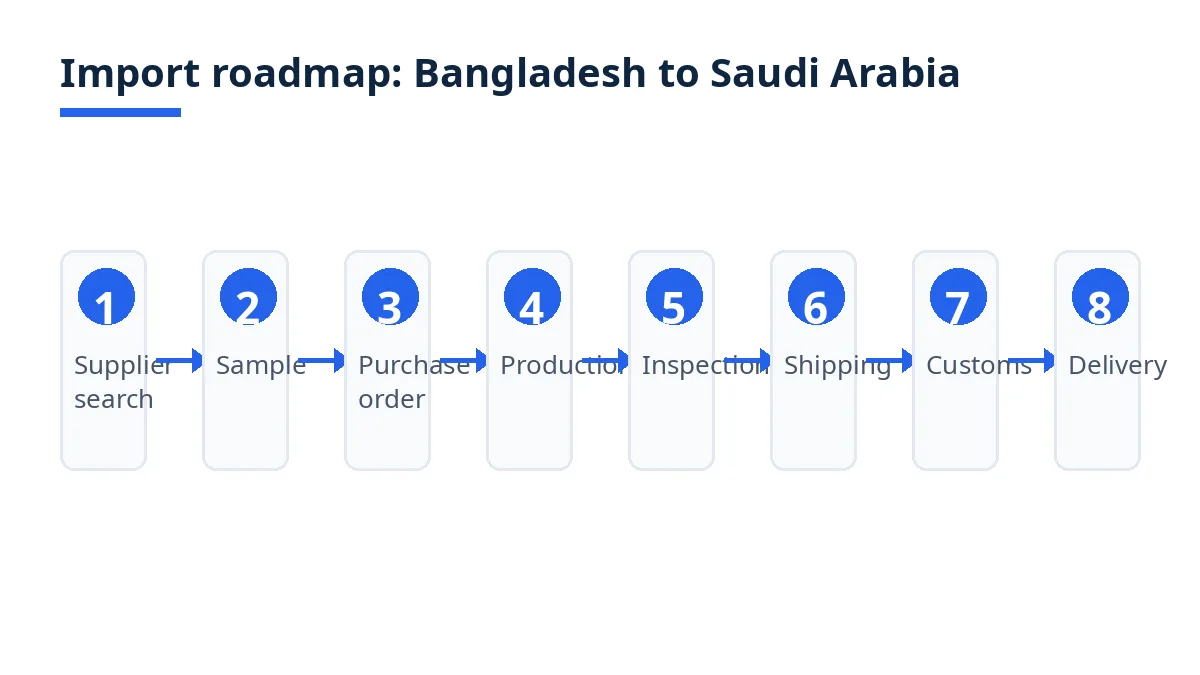
Write the specification, including fabric weight, fleece type, colours, sizes, construction, decoration, labelling, and packing.
Appoint the Jeddah broker and ask the broker to confirm the SABER position for the goods concerned before production starts.
Shortlist three to five knitwear suppliers and send each one the same specification and the same request for quotation.
Check business documents, confirm the legal name across documents, and ask about subcontracted steps.
Agree the minimum order basis in writing: per order, per style, per colour, or per size.
Compare quotations on the same Incoterm and the same included items, and confirm price validity and lead time.
Approve the development sample, then the pre-production sample in writing, and keep a sealed sample.
Agree the AQL plan, the defect classification, the inspection stage, and the action and cost on failure.
Confirm the certificate position with the broker and check certificate numbers, scope, and validity dates.
Sign the contract with the Incoterm, quantity breakdown, price, payment terms, inspection terms, and delivery definition.
Monitor production, confirm packing and marks, and check document consistency before sailing.
File the Jeddah entry data early, clear the goods at Jeddah, pay the broker-confirmed duty and VAT, and deliver inland only on a forwarder-confirmed leg.
How Exportain helps
Exportain lists Bangladeshi suppliers by product and category, and a buyer can search that directory for knitwear suppliers, review supplier profiles, and compare the information each profile shows, including location, main products, and the certifications the supplier has declared. A buyer can also post a request for quotation stating quantity, target price, destination, Incoterm, required certifications, and deadline, so suppliers in the category can quote against the same brief. Treat any trust badge on a profile as a record of which document and profile checks have been reviewed, not as a factory audit, an inspection of the goods, or a guarantee of capacity, quality, or delivery.
FAQs
What is the typical MOQ for hoodies and sweatshirts from Bangladesh?
There is no single figure, and this guide gives none. Minimum order quantity is negotiated per order and depends on the fabric, the colour count, the size breakdown, the decoration method, and the supplier capacity at booking. Ask the supplier to state in writing whether its minimum applies per order, per style, per colour, or per size, and test the full breakdown against that basis before agreeing a price.
How long does shipping take?
Treat transit only as a guide estimate. The freight guide for the Bangladesh to Saudi Arabia lane gives an average of approximately 5 to 6 weeks for sea freight, with weather, port congestion, and customs clearance able to affect the overall time.6 The same guide gives customs clearance of around 3 to 5 days in Bangladesh and up to 7 to 10 days in Saudi Arabia as lane estimates.6 Confirm the booked service and sailing date in writing, file the Jeddah entry data before arrival, and book the inland leg before discharge, rather than planning a retail date from a guide average.
What import duty applies?
No product-specific Saudi duty rate is asserted in this guide, because duty follows the product classification and the Saudi tariff for the goods concerned. Ask the Jeddah broker to confirm the classification and the rate for the exact hoodies and sweatshirts in the order, together with the customs value definition that applies, before pricing for resale.
How do I verify a supplier?
Start with the specification, then check the core business documents: legal company name and registered address, trade licence, Taxpayer Identification Number and VAT registration where applicable, and the Export Registration Certificate.3 Confirm the same legal name across the quotation, invoice, bank account, and shipping documents. Then go further for any serious order: reference buyers, production evidence, subcontracted steps, a trial order, and an independent inspection. Appoint the Jeddah broker early and ask the broker to confirm the SABER position before production starts, since a shipment without the required SABER documentation faces re-export.1
Next steps on Exportain
Continue with the general process in How to Import from Bangladesh, rebuild the worked example with real quotations using Landed Cost for Imports from Bangladesh, and review the eight buying steps in How to Source and Buy from Bangladesh. Each of those pages was confirmed live before linking.
Sources
- Certificate of Conformity for Exports to Saudi Arabia. QIMA (accessed )
- Knitwear dominance faces fresh pressure. TIMES of Bangladesh (accessed )
- How to Import from Bangladesh. Exportain (accessed )
- What is Acceptable Quality Level (AQL) and How to Read AQL Chart. Online Clothing Study (accessed )
- OEKO-TEX Standard 100: Frequently Asked Questions. XM Textiles (accessed )
- Bangladesh to Saudi Arabia Freight Rates. FWFreight (accessed )
- Guide to Import VAT in Saudi Arabia for Foreign Companies. Commenda (accessed )
About the author
Sourcing from Bangladesh?
Post a request for quotation and suppliers on Exportain can send you their quotes directly.
Post an RFQ