Hoodies and Sweatshirts to Netherlands From Bangladesh: Step-by-Step Guide
Netherlands hoodies and sweatshirts import guide: 6110 classification, EBA 0 percent preference, Dutch VAT 21 percent and Article 23, Rotterdam clearance, supplier verification, samples, Incoterms, transit, and a worked landed-cost example for 3,600 hoodies to Rotterdam.
Short answer
To import hoodies and sweatshirts from Bangladesh to the Netherlands, classify the garment under heading 6110, confirm the 0 percent Everything But Arms preference and its origin proof with your broker, settle Dutch EORI and Article 23 VAT deferral, approve a pre-production sample in bulk fleece, agree the Incoterm and inspection standard, and price from landed cost through Rotterdam.
On this page
Key takeaways
Hoodies and sweatshirts fall under heading 6110: men's or boys' cotton garments sit at 6110 20 91 and women's or girls' man-made fiber garments at 6110 30 99, and the tariff pages render no duty rate, so your broker must confirm the current line and supply the TARIC third-country figure for your exact garment on your entry date.
A qualifying Bangladeshi shipment may pay 0 percent under the Everything But Arms arrangement, which grants duty-free, quota-free access to the EU for exports of all products except arms and ammunition, but only where the origin claim is supported by correct proof of origin; without that proof, the broker's TARIC third-country figure applies.
Dutch import VAT at 21 percent is a conditional example only, with no VAT-base formula asserted: Article 23, as the opened Stripe guide states it, lets an established Dutch importer record import VAT on its next Dutch VAT return rather than pay at the border, while foreign entrepreneurs need a Dutch tax representative and a financial guarantee is mandatory.
Example figures only: 3,600 hoodies at 7.15 EUR FOB Chattogram, arriving at Rotterdam for delivery to Utrecht with a valid EBA claim, give a landed cost of 8.23 EUR per hoodie, with import VAT at 21 percent shown only as a conditional example on a broker-confirmed base and left out of the total.
A hoodie order bound for the Netherlands is cleared, taxed, and labeled under EU rules before it ever reaches a Dutch shop floor, so the Rotterdam entry position belongs at the front of the plan, not at the end of it. This guide works in that order: classification and the preference claim first, Dutch VAT and the Article 23 decision second, and only then supplier selection, samples, freight, and landed cost. Every figure in the worked example is an example figure only, and every duty, tax, and transit statement that matters to margin is tied to a broker confirmation for your exact garment on your entry date.
Why source hoodies and sweatshirts from Bangladesh
Bangladesh makes fleece garments at scale, and hoodies and sweatshirts sit at the center of that knitwear chain. The work a hoodie needs is heavier than the work a plain knit top needs: fleece must be knitted and brushed evenly, the hood must keep its shape after washing, the kangaroo pocket must sit square, and a print or embroidery must hold on a brushed surface. A factory that handles those steps daily will show it in its samples; a factory that only trades in fleece garments will not, which is why the supplier check below looks at what the factory does itself rather than what its catalog claims.
The trade case for a Dutch buyer adds a second reason. As a least developed country, Bangladesh benefits from the most favorable regime available under the EU Generalised Scheme of Preferences, namely the Everything But Arms arrangement, which grants duty-free, quota-free access to the EU for exports of all products except arms and ammunition.1 That preference is the reason a Rotterdam entry can price differently from an entry in a market without such a scheme, but it is never automatic: it depends on classification, origin rules, and correct proof of origin for the shipment in question, and your broker must confirm it before you price from it.
Find and verify suppliers
Write the specification before you ask for a price. A usable hoodie specification covers fiber composition and fleece weight, hood construction and lining, pocket type and placement, ribbing at cuff and hem, drawstring treatment, size chart and fit, color and shade standard, decoration method and placement, packing, and the label content for sale in the Netherlands. Send the same specification to every supplier so quotations can be compared line by line. A supplier that quotes against a lighter fleece or a different decoration method is not offering a lower price; it is offering a different garment.
Shortlist three to five suppliers that actually make fleece garments. Ask which steps each factory does in-house, whether it has shipped knitted garments to the EU before, what proof of origin it supplied, and how it labels garments for Dutch buyers. The Bangladesh Garment Manufacturers and Exporters Association publishes a member search and member lists on its site, which lets you confirm that a company presents itself consistently as a member before you go further.2 Ask each supplier for its core business documents and check that they are consistent: legal company name and registered address, trade licence, Taxpayer Identification Number, Export Registration Certificate, and chamber or trade association membership documents where relevant. The company name on the quotation, the proforma invoice, the bank account, and the shipping documents should be the same legal entity, or any difference should have a clear, documented explanation. Supplier profiles and trust badges can help you shortlist, but a badge records which checks have been reviewed; it is not a factory audit, not an inspection of your goods, and not a guarantee of capacity, quality, or delivery.
MOQ, pricing and samples
There is no single typical minimum order quantity for hoodies and sweatshirts from Bangladesh, because the minimum is usually set per style and per color, and sometimes per size, rather than per order. Ask each supplier to state exactly what its minimum applies to: per order, per style, per color, per size, or per decoration. If the minimum is above your needs, consolidation is the usual lever: fewer colors, one shared fleece color across two styles, or a single decoration method can bring an order inside a factory's minimum without changing the garment.
The unit price moves with fleece weight and composition, the number of colors in the dye lot, the decoration method, the size range, the packing method, and the quantity. Ask every supplier to quote on the same Incoterm and the same named place, and to state what is included and excluded: materials, trims, labels, testing, packing, and any sample or tooling charges. Treat samples as part of the contract, not as a courtesy. The three stages that matter are the development sample, which confirms the supplier understood your specification; the pre-production sample, made with the actual bulk fleece, trims, labels, and packaging, which you approve in writing and keep sealed as the standard for bulk production; and the shipment sample, taken from finished bulk production for comparison with the approved pre-production sample before the goods leave. Bulk cutting should not start before the pre-production sample is approved in writing. Comment on samples precisely, with measurements, colors, and construction points.
Quality control and certifications needed
Quality control for hoodies and sweatshirts needs to cover the points where fleece garments fail: fleece weight and composition against the specification, shade consistency across dye lots, hood shape and symmetry, pocket placement and stitching, ribbing recovery at cuff and hem, print or embroidery durability after washing, and measurement against the approved size chart. Agree in writing what happens to goods that fail: the inspection standard, who appoints the inspector, who pays for re-inspection, and whether failed cartons are repaired, replaced, or rejected.
Certificates need the same discipline as samples. Factories in Bangladesh commonly report assessments and certifications covering social compliance, chemical management, environmental management, and organic or recycled content, and industry pages list schemes including BSCI, WRAP, SMETA, ICS, Higg, ZDHC, Bluesign, ISO, OCS, GOTS, and OEKO-TEX among the assessments factories maintain.2 A certificate is only useful if it covers your product, your factory, and the current period, so ask for the certificate itself, check its scope and expiry date, and confirm that the name on it matches the legal entity making your goods. A certificate for a different factory, an expired certificate, or one whose scope excludes fleece garments does not support your order.
Incoterms, shipping and transit time
The Incoterms rules allocate cost, risk, and obligations between buyer and seller, and the rule you choose changes both the price you compare and the work you carry. Under the Incoterms 2020 rules, delivery and the transfer of risk are tied together, and the place of delivery depends on the rule chosen: under FOB, delivery and risk transfer occur when the goods are on board the vessel nominated by the buyer at the named port of shipment, while under the C rules the seller arranges and pays for transport to the named destination but risk still passes earlier, when the goods are handed to the carrier or placed on board.3 For Bangladesh to Netherlands garment orders, the rules buyers most often compare are FOB Chattogram, where you arrange and pay main freight beyond the port of loading; CIF Rotterdam, where the seller contracts for carriage and minimum insurance to Rotterdam; and DAP to a named Dutch place, where the seller carries more of the journey. Import clearance and duty stay with you under FOB, CIF, and DAP, so none of those rules removes the Rotterdam entry work in this guide.
For transit planning, one published overview estimates sea freight from Bangladesh to the Netherlands at around 30 days.4 Treat that figure as a dated estimate only: get a dated forwarder quotation for your actual route, sailing date, and volume, and add a buffer after inspection and before your retail date. Smaller shipments sent as less-than-container load take longer at both ends because of consolidation and deconsolidation, so confirm in writing who books freight and insurance, and which destination charges will be billed again at Rotterdam.
Import duty, taxes and documents
Hoodies and sweatshirts fall under heading 6110, which covers jerseys, pullovers, cardigans, waistcoats, and similar articles, knitted or crocheted. The tariff pages that confirm the heading also confirm the split buyers must get right: men's or boys' cotton garments sit at 6110 20 91, while women's or girls' man-made fiber garments sit at 6110 30 99, and the pages render no duty rate in their text.5 6 Your broker must therefore confirm the current line for your exact garment, by wearer, fiber, and construction, on your entry date, and must supply the TARIC third-country figure that would apply if no preference is claimed.
The preference position is the reason to confirm that line early. As a least developed country, Bangladesh benefits from the Everything But Arms arrangement, which grants duty-free, quota-free access to the EU for exports of all products except arms and ammunition.1 In this guide the EBA figure used is 0 percent, origin-proof dependent: if the supplier's proof of origin supports the claim for your shipment, duty at 0 percent is the working figure, and if the proof does not support the claim, the broker's TARIC third-country figure on the entry date applies instead. Never build a margin plan on a preference you have not confirmed for your exact product and shipment, and never copy a third-country rate figure from another market's guide into a Dutch entry.
Dutch import VAT is a separate charge from duty. When goods land in a Dutch port, the default rule is that 21 percent VAT is due immediately on the customs value, and Article 23 changes this by allowing a business to record the import VAT on its next Dutch VAT return rather than pay VAT at the border, deducting the same amount as input tax so the net effect on cash is zero where full deduction applies.7 Article 23 is designed for businesses established in the Netherlands that import regularly; foreign entrepreneurs cannot apply directly and need to appoint a Dutch tax representative, and a financial guarantee is mandatory.7 No VAT-base formula is asserted in this guide: the VAT base is whatever your broker confirms for your shipment, and the worked example below shows VAT only as a conditional example on a broker-confirmed base, left out of the landed cost total.
Your EORI number belongs in the same early pack as the VAT decision. When you first submit a customs declaration, or have one submitted on your behalf, or apply for an authorisation with Customs, you require an EORI number, and depending on your situation you can create this number yourself or have to apply for one, in both cases at no charge.8 Prepare the commercial invoice, packing list, bill of lading, proof of origin supporting any preference claim, and the inspection report, and send the full pack to your broker before the vessel reaches Rotterdam, so clearance, and any onward movement inside the EU, is not held up by a missing document.
Labeling for sale in the Netherlands follows the EU textile rules, not a supplier's house style. Regulation (EU) 1007/2011 requires the fiber composition of any product that is at least 80 percent textile fiber to be shown on a label, using the standard fiber names and the language of the country of sale, with a statement when the product contains non-textile parts of animal origin.9 For a Dutch sale that means Dutch wording on the label, checked against the actual bulk garment including hood lining, pocket fabric, and ribbing, since a label that matches the tech pack but not the garment will fail at the point it matters most: the shop floor, or a customer return.
Landed cost example (table)
The example below is original to this guide and uses example figures only. It covers 3,600 hoodies shipped FOB Chattogram and arriving at Rotterdam for delivery to a warehouse in Utrecht, a different quantity, port, inland destination, and per-unit figure from other hoodies guides. Duty is shown at zero because the example assumes a valid EBA claim supported by proof of origin; if that claim fails, the fallback is the broker's TARIC third-country figure on the entry date, which this guide does not assert.1
Line | Example figure (EUR) |
|---|---|
Product cost: 3,600 hoodies at 7.15 FOB Chattogram | 25,740.00 |
Ocean freight, Chattogram to Rotterdam | 2,450.00 |
Cargo insurance | 210.00 |
Subtotal before duty | 28,400.00 |
Import duty: 0 percent under a valid EBA claim | 0.00 |
Customs broker fee | 190.00 |
Destination port and terminal charges, Rotterdam | 360.00 |
Inland delivery, Rotterdam to Utrecht warehouse | 290.00 |
Pre-shipment inspection | 310.00 |
Bank and currency costs | 95.00 |
Total landed cost | 29,645.00 |
Landed cost per unit (29,645 divided by 3,600) | 8.23 |
Before duty and before VAT, each hoodie already costs 8.23 against a quoted 7.15, from freight and shipment charges alone. Two sensitivity figures matter for your pricing. First, if the preference claim failed, duty at the broker's TARIC third-country figure would be added to the 28,400 subtotal as the base your broker confirms, and that addition, not a guessed rate, is the number to price from. Second, import VAT at 21 percent is a conditional example only: on an example base of 28,400 it would be 5,964.00, but the actual base is for your broker to confirm, and a buyer who can deduct it in full leaves it out of landed cost and treats it as cash flow, while a buyer using Article 23 records it on the Dutch VAT return instead of paying it at the border.7
Step-by-step import checklist
This checklist runs in Rotterdam-entry-first order, which is the order that protects a Dutch margin: the entry position is settled before the supplier search, not after the order is placed.
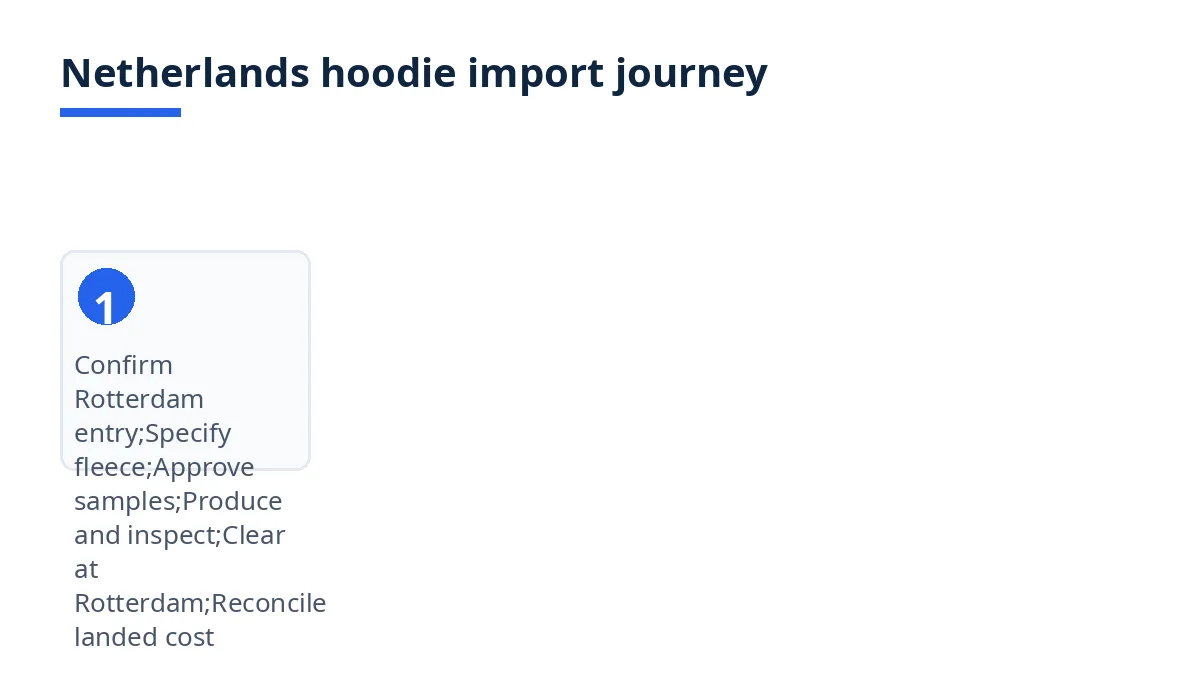
Confirm the Rotterdam entry position. Classify the garment under heading 6110, confirm the line and the EBA claim with your broker, and confirm what applies if the preference proof fails.
Settle EORI and the VAT route. Get the EORI number in place, decide with your tax adviser whether Article 23 deferral fits your setup, and confirm the VAT treatment for your shipment before you order.
Write the full specification. Settle fleece weight and composition, hood and pocket construction, drawstring treatment, size chart, shade standard, decoration, packing, and Dutch label content, and send the same specification to every supplier.
Shortlist and check suppliers. Compare three to five fleece makers on the same specification and Incoterm, check business documents and association membership, and add a factory visit, audit, or trial order proportionate to the risk.
Approve samples in writing. Move from development sample to pre-production sample in bulk fleece, keep a sealed approved piece, and do not start bulk cutting before written approval.
Agree terms and payment. Put the Incoterm, named place, quantity breakdown, price basis, delivery definition, inspection standard, and payment milestones in the purchase order, and confirm who books freight and insurance.
Monitor production and inspect. Inspect during production where the risk justifies it, run the final pre-shipment inspection against the approved sample, and agree in writing what happens to failed goods.
Book freight and prepare the broker pack. Confirm the sailing, the Rotterdam arrival, and the destination charges, and send the broker the invoice, packing list, bill of lading, proof of origin, and inspection report before arrival.
Clear at Rotterdam and deliver onward. Check the declaration, the duty and VAT treatment, and the delivered quantity against the order, then move the goods to the Utrecht warehouse or onward inside the EU as planned.
Reconcile and keep the file. Reconcile the actual landed cost per unit against the example table, record what the broker confirmed for the next order, and keep the full file, from specification to inspection report, for the next programme.
How Exportain helps
Exportain lists Bangladeshi suppliers by product and category. Buyers can search those profiles, compare the information each supplier has provided, and send an order request or post a request for quotation stating quantity, destination, Incoterm, required certifications, and deadline. Quotations received through the platform are recorded with their terms, so price, minimum quantity, lead time, Incoterm, payment terms, and validity can be compared on the same basis. Buyers can also look up freight and inspection providers listed on the platform when they arrange the shipment and the pre-shipment check.
FAQs
What is the typical MOQ for hoodies and sweatshirts from Bangladesh?
There is no single typical figure, because the minimum is usually set per style and per color, and sometimes per size, rather than per order. Ask each supplier to state exactly what its minimum applies to, and use consolidation, such as fewer colors or one shared fleece color across two styles, to bring an order inside a factory's minimum. A smaller trial order may be possible at a higher unit price, since the same setup cost is spread over fewer units.
How long does shipping take?
As a dated estimate only, sea freight from Bangladesh to the Netherlands takes around 30 days.4 Plan from a dated forwarder quotation for your actual route and sailing date, and add a buffer after inspection and before your retail date, since transshipment, congestion, and customs checks can extend the sailing time.
What import duty applies?
Hoodies and sweatshirts fall under heading 6110, with men's or boys' cotton garments at 6110 20 91 and women's or girls' man-made fiber garments at 6110 30 99.5 6 A qualifying Bangladeshi shipment may instead pay 0 percent under the Everything But Arms arrangement, which grants duty-free, quota-free access to the EU for exports of all products except arms and ammunition, but only where the origin claim is supported by correct proof of origin.1 Your broker must confirm the current line and the preference for your exact garment on your entry date, and must supply the TARIC third-country figure that applies if the preference is not proved.
How do I verify a supplier?
Check business documents and consistency first: legal company name and registered address, trade licence, Taxpayer Identification Number, Export Registration Certificate, and association membership where relevant, using the association's published member search as a first check.2 Compare suppliers on the same written specification and Incoterm, approve a pre-production sample in bulk fleece in writing, and add a factory visit, independent audit, or trial order proportionate to the size of the order. Treat reluctance to allow any independent check as information in itself.
Next steps on Exportain
Start with the general process in How to Import from Bangladesh, work through the cost method in Landed Cost for Imports from Bangladesh, and shortlist makers through the supplier directory. Use those pages alongside your broker's confirmation of classification, preference, VAT, and labeling for your exact garment, and keep the full order file for the next programme.
Sources
- EU trade relations with Bangladesh. European Commission, (accessed )
- BGMEA | Home. Bangladesh Garment Manufacturers and Exporters Association (BGMEA) (accessed )
- Place of delivery & risk transfer in trade contracts. ICC Academy (accessed )
- Shipping from Bangladesh to the Netherlands. ShipHub (accessed )
- HS Code 61102091 - Men's or boys' jerseys, pullovers, cardigans, waistcoats and similar articles, of cotton, knitted or crocheted. Tariffnumber (accessed )
- HS Code 61103099 - Women's or girls' jerseys, pullovers, cardigans, waistcoats and similar articles, of man-made fibres, knitted or crocheted. Tariffnumber (accessed )
- A Guide to the Article 23 License in the Netherlands. Stripe (accessed )
- How to obtain an EORI-number. Dutch Customs (accessed )
- EU Textile Labelling Regulation Revision Guide. Tappr (accessed )
About the author
Sourcing from Bangladesh?
Post a request for quotation and suppliers on Exportain can send you their quotes directly.
Post an RFQ