

Hoodies and Sweatshirts From Bangladesh to Germany: A Buyer's Import Checklist
Germany hoodies and sweatshirts import guide: Hamburg entry, EBA preference, 6110 classification, EU labeling, supplier checks, samples, Incoterms, transit, and a worked landed-cost example for 3,800 hoodies to Hamburg.
Short answer
To import hoodies and sweatshirts from Bangladesh to Germany, confirm the 6110 classification and the EBA 0 percent preference with your broker, settle the hoodie specification and EU fiber labeling, approve a pre-production sample in bulk fleece, agree the Incoterm and inspection standard, ship to Hamburg, and price from landed cost including freight, broker, port, inland delivery, inspection, and bank lines.
On this page
Key takeaways
The EBA preference figure used in this guide is 0 percent, applying only where the origin rule is met and the origin proof is accepted; if the preference is not proved, the broker's TARIC third-country figure on the entry date applies instead, and landed cost must be rebuilt on that figure before pricing.
Hoodies and sweatshirts fall under heading 6110, with cotton lines under 6110 20 and man-made fiber lines under 6110 30; your broker must confirm the full TARIC line for your exact garment on your entry date, and this guide asserts no third-country rate figure of its own.
A hoodie specification must settle fleece weight and composition, hood and lining, pocket, ribbing, drawstrings, size chart, color standard, decoration, packing, and EU label content, and bulk cutting should not start before the pre-production sample in bulk fleece is approved in writing.
Under Regulation (EU) No 1007/2011, the label must give fiber composition using the standard fiber names, in the official language of the member state where the goods are made available, which for a German sale means German; where the manufacturer is not established in the Union, the importer must ensure the label and the accuracy of its information.
Example figures only: 3,800 cotton hoodies at 5.90 euros FOB Chattogram, arriving at Hamburg with a proved EBA claim, give a landed cost of 7.08 euros per hoodie excluding import VAT, or 8.33 euros including a conditional 19 percent import VAT example on a broker-confirmed base.
For a German buyer, the first question about a hoodie order from Bangladesh is not the fleece weight. It is whether the shipment clears at Hamburg with the Everything But Arms preference intact, the EORI number on the declaration, and a label that meets EU fiber rules. Get that entry position wrong and a good fleece, a fair price, and a clean print will not save the margin. This guide follows that order on purpose: German entry first, then supplier selection, pricing, quality checks, shipping, duty, and a worked example in euros. Every figure in the example is an example figure only, and your broker must confirm classification, preference, VAT treatment, and labeling for your exact garment before you price.
Why source hoodies and sweatshirts from Bangladesh
Bangladesh has a deep knitwear chain, and hoodies and sweatshirts sit squarely inside it. The work a hoodie needs differs from the work a plain knit top needs: fleece must be knitted and brushed evenly, the hood must keep its shape after washing, the kangaroo pocket must sit square, ribbing must recover after wear, and a print or embroidery must hold on a brushed surface. Factories that make fleece goods every week have already solved those steps as routine production.
That category strength is a reason to look, not a reason to skip checks. A factory can be strong on fleece and weak on the exact decoration you need, or strong on adult sizes and untested on the size range you sell in Germany. Judge the factory that will cut your order, not the sector as a whole, on documents, samples, and inspection results for your style.
A German order also has a structural reason to start with the entry position. Bangladesh, as a least developed country, benefits from the EU's Everything But Arms arrangement, which grants duty-free, quota-free access for all exports except arms and ammunition.1 The EU's Generalised Scheme of Preferences page describes EBA in the same terms.2 That preference is valuable, but it is not automatic. It depends on classification, on the origin rule being met, and on origin proof that customs accepts.
Find and verify suppliers
Start with a written specification before asking any supplier for a price. A usable hoodie specification covers fabric composition and fleece weight in grams per square meter, hood construction and lining, pocket type and placement, ribbing, drawstring treatment, size chart and fit, color and shade standard, decoration method and placement, packing, and EU label content. Send the same specification to every supplier. A quotation against a lighter fleece or a different decoration method is not a cheaper offer; it is a different product.
Shortlist three to five suppliers that make fleece goods for export markets, and keep at least one backup you could actually use if the first choice fails during production. For each candidate, ask for the same core documents and check that they agree: legal company name and registered address, trade licence, Taxpayer Identification Number, Export Registration Certificate, and trade association membership where relevant. The name on the quotation, proforma invoice, bank account, and shipping documents should be the same legal entity, or any difference should have a clear written explanation.
Deeper checks should match the size of the order: a factory visit, an independent audit, reference buyers the supplier is willing to name, or a small trial order before a full program. A marketplace badge is not a factory audit, an inspection of your goods, or a guarantee of capacity, quality, or delivery.
MOQ, pricing and samples
There is no single typical MOQ for hoodies and sweatshirts from Bangladesh, because the minimum is usually set per style and per color, and sometimes per size, rather than per order. A factory sets its minimum from setup costs: fleece dyeing, cutting, decoration setup, and line changeover all cost the same whether the run is short or long. Ask each supplier to state exactly what its minimum applies to, in writing with the quotation. If the minimum is per color, reducing the color range, or sharing one fleece color across two styles, can bring an order inside the minimum without changing the total quantity.
Compare prices only on the same basis. A quotation states a unit price, a currency, an Incoterm with a named place, a quantity breakdown, a validity date, and what is included and excluded. Two prices on different Incoterms are not comparable, and a headline price that excludes testing, labeling, or packing is not cheaper than a fuller price that includes them. Convert every offer to the same basis, ideally to an estimated landed cost, before you decide. A smaller trial quantity at a higher unit price can still be good value, since the same setup cost is spread over fewer units.
Samples are part of the contract, not a courtesy. Work through three stages and keep approvals in writing. A development sample confirms the supplier understood the specification; comment precisely on measurements, materials, colors, and construction. A pre-production sample is made with the actual bulk fleece, trims, labels, and packing; approve it in writing, keep one sealed or signed piece yourself, and do not let bulk cutting start before that approval. A shipment sample, taken from finished bulk production, lets you compare the goods against the approved pre-production sample before they leave. A sample approved in a different fleece weight, color, or decoration method is not an approval of the bulk order.
Quality control and certifications needed
A hoodie quality plan should be written before production, not improvised at the final inspection. Set the inspection standard in the purchase order: which standard applies, who inspects, at what stages, and what happens to goods that fail. During-production inspection catches fleece, shading, and construction problems while they can still be corrected; a final pre-shipment inspection checks the finished goods against the approved sample. Agree in writing whether failed goods are repaired, replaced, or rejected, and who pays for re-inspection.
The checks that matter most on a hoodie are specific to the garment. Check fleece weight and composition against the specification, including hood lining, pocket fabric, and ribbing, because a lining or ribbing in a different fiber changes both the feel and the label. Check hood shape and size, pocket placement, drawstring treatment, stitch density, ribbing recovery, color and shade across body, hood, pocket, and ribbing, and decoration wash fastness on the brushed surface. Check measurements on a full size range, not on one sample size, and check packing, carton marks, and label content before the goods are sealed.
On certifications, ask what the supplier actually holds, and check the scope and expiry of each document rather than accepting a certificate name at face value. A certificate covering a different factory, product range, or expired period does not cover your order. If your German customers require specific test reports, name those tests in the specification and agree who commissions them, who pays, and what result counts as a pass. Do not add a certification claim to your product pages or packaging unless you have the document supporting it for your exact goods. For children's hoodies, ask your broker and testing provider about drawstring and safety requirements for the age range you sell, and settle them in the specification before production.
Incoterms, shipping and transit time
The Incoterm in the quotation decides who arranges carriage and insurance, where delivery happens, and where risk transfers, so it must be named with its place and edition in the contract. Under the Incoterms 2020 rules, delivery and risk transfer are tied together in all eleven rules, but the place of delivery is not always the same as the place of destination.3 Under FOB, delivery and risk transfer happen when the goods are on board the vessel at the named port of shipment, while under CIF the seller arranges carriage and insurance to the destination port but risk still transfers when the goods are on board at shipment.3 Under DAP, delivery and risk transfer happen at the named place of destination when the goods are placed at the buyer's disposal, ready for unloading.3 For containerized hoodies, ask your forwarder whether FCA serves the order better than FOB.3
For a German order, name Hamburg as the arrival port in the freight plan unless your forwarder gives a reason to use another German or nearby EU port. Naming the port in the contract prevents a seller under a C rule from choosing a cheaper nearby port that leaves you with unexpected inland costs. Confirm in writing which destination charges the freight already covers and which will be billed on arrival, and confirm the free-time period for container collection so storage and demurrage do not appear as a surprise line.
Transit time must be planned from a dated sailing schedule for your actual route, not from a general figure. As a dated estimate only, the CMA CGM week 40, 2026 schedule for Chattogram to North Europe shows a FAL2 sailing leaving Chattogram on 5 October 2026 arriving at Hamburg on 14 November 2026, and a FAL3 sailing leaving Chattogram on 2 October 2026 arriving at Hamburg on 17 November 2026, with arrival dates subject to change without prior notice.4 Plan from your forwarder's current schedule, add a buffer after inspection and before your retail date, and treat any transit figure without a date and a sailing as a guess, not a plan.
Import duty, taxes and documents
Classification comes first. Hoodies and sweatshirts fall under heading 6110, described as jerseys, pullovers, cardigans, waistcoats and similar articles, knitted or crocheted, with cotton lines under 6110 20 and man-made fiber lines under 6110 30, each split further by wearer and garment type.5 Your broker must confirm the full TARIC line for your exact garment on your entry date, because fiber, wearer, and construction details move the line. This guide asserts no third-country rate figure of its own: the broker's TARIC third-country figure on the entry date applies if the preference is not proved.
The preference position is the next line to confirm. Under EBA, Bangladesh benefits from duty-free, quota-free access for all products except arms and ammunition.1 In this guide the EBA preference figure is 0%, and it applies only where the origin rule is met and the origin proof is accepted. If the preference is not proved, the broker's TARIC third-country figure on the entry date applies instead, and landed cost must be rebuilt on that figure before pricing.
German import VAT is a separate line from duty. The German customs page states that the import VAT rate is currently set at 19 percent, with a reduced rate of 7 percent for selected goods such as food products and books.6 That same page states that where a tariff concession takes the form of an exemption from customs, only the import VAT and any applicable excise duty must be paid.6 This guide shows VAT only as a conditional example, on a broker-confirmed base, and never as part of a landed-cost total until your tax adviser confirms whether it is reclaimable through your VAT return.
Before the first shipment, confirm your EORI position. The EORI number is a unique number issued by the competent authorities in the European Union that allows customs to identify economic operators, and an operator established in the European Union applies for it in the member state where it is resident.7 There is an obligation to quote an EORI number on customs declarations, including the declarant and the consignee on import.7 A German buyer should therefore have its German EORI number ready, and its broker should have it on file, before the first declaration is lodged.
Labeling must be settled in the specification, not after production. Under Regulation (EU) No 1007/2011, labeling or marking of fiber composition is compulsory, and the regulation harmonizes textile fiber names so the same names are used across the Union.8 The regulation also provides that labeling or marking shall be provided in the official language or languages of the member state where the textile products are made available to the consumer, which for a German sale means German.8 Where the manufacturer is not established in the Union, the importer shall ensure the supply of the label or marking and the accuracy of the information on it.8 Check the label against the actual bulk garment, including hood lining, pocket fabric, and ribbing.
The broker pack should be sent before arrival, not after. As a minimum, prepare the commercial invoice, packing list, bill of lading, proof of origin for the EBA claim, and inspection report, and make sure the names, quantities, values, and garment descriptions agree across all of them. A quantity that differs between invoice and packing list is the kind of mismatch that holds a shipment at Hamburg while the retail date moves.
Landed cost example (table)
All figures below are example figures only, not a real price, freight rate, or charge for any product, route, or shipment. The example uses 3,800 cotton hoodies at 5.90 euros FOB Chattogram, arriving at Hamburg with a valid EBA preference claim, and inland delivery to a warehouse in southern Germany. Duty is 0 euros here because the EBA preference is assumed proved; if it is not proved, rebuild the table on the broker's TARIC third-country figure. Import VAT is shown only as a conditional example and is left out of the landed-cost total.
Line | Example figure (EUR) |
|---|---|
Product cost: 3,800 hoodies at 5.90 FOB Chattogram | 22,420.00 |
Ocean freight Chattogram to Hamburg | 2,450.00 |
Cargo insurance | 210.00 |
Subtotal before duty | 25,080.00 |
Import duty at 0% under a proved EBA claim | 0.00 |
Customs broker fee | 280.00 |
Hamburg port and terminal charges | 420.00 |
Inland delivery to warehouse in southern Germany | 640.00 |
Pre-shipment inspection | 350.00 |
Bank and currency costs | 120.00 |
Total landed cost excluding import VAT | 26,890.00 |
Landed cost per hoodie excluding import VAT | 7.08 |
Conditional import VAT example: 19% on a broker-confirmed base of 25,080.00 | 4,765.20 |
Total including that conditional VAT example | 31,655.20 |
Landed cost per hoodie including that conditional VAT example | 8.33 |
Read the table as a method, not as a price list. On this example, each hoodie already costs 7.08 euros against a quoted 5.90 euros before any VAT, from freight and shipment charges alone. Rebuild the table for every order from current quotations and the broker's current confirmation; pricing from the FOB figure alone gives away freight, inspection, broker, and delivery costs out of profit.
Step-by-step import checklist
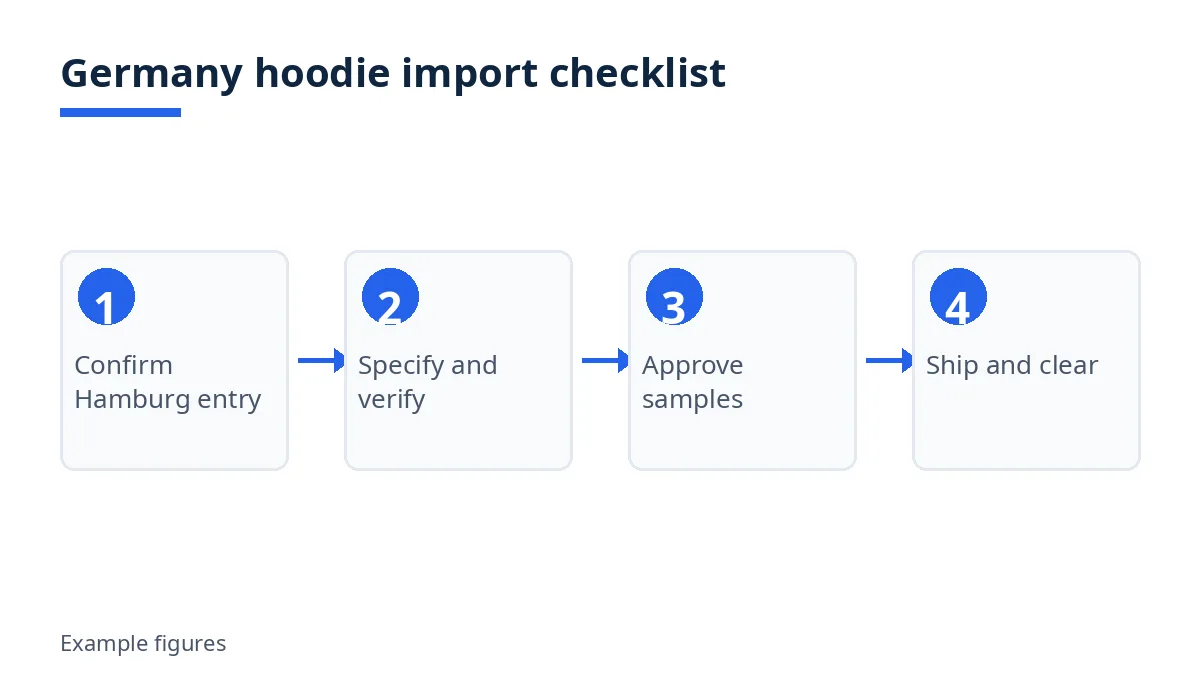
This checklist runs in German-entry-first order: entry position, then specification, supplier, samples, freight, and clearance.
Confirm the German entry position. Ask your broker to confirm the TARIC line, EBA origin rule and proof, fallback duty figure, 19 percent VAT treatment, and EU label content, and confirm your German EORI number is on file.
Write the hoodie specification. Settle fleece, hood and lining, pocket, ribbing, drawstrings, size chart, color standard, decoration, packing, and label content in one document.
Shortlist and check suppliers. Compare three to five suppliers on the same specification, check core documents, and add a visit, audit, or trial order proportionate to the order size.
Compare quotations on the same basis. Convert every offer to the same Incoterm and named place, check inclusions and exclusions, and build an estimated landed cost before choosing.
Approve samples in writing. Work through development, pre-production in bulk fleece, and shipment samples, and do not start bulk cutting before the pre-production approval.
Agree inspection and contract terms. Put the Incoterm, quantity breakdown, price basis, delivery definition, inspection standard, failure remedy, and payment milestones in the purchase order.
Book freight to Hamburg. Confirm the sailing, arrival port, destination charges, and container free time, and plan from the forwarder's current schedule with a buffer after inspection.
Send the broker pack before arrival. Send the invoice, packing list, bill of lading, proof of origin, and inspection report, and check that names, quantities, values, and descriptions agree.
Clear, check, and reconcile. Check the declaration, duty and VAT treatment, and delivered quantity against the order, reconcile actual landed cost per unit against the example table, and keep the full file.
How Exportain helps
Exportain lists Bangladeshi suppliers by product and category. Buyers can search those profiles, compare the information each supplier has provided, and send an order request or post a request for quotation stating quantity, destination, Incoterm, required certifications, and deadline. Quotations received through the platform are recorded with their terms, so unit price, minimum quantity, lead time, Incoterm, payment terms, and validity can be compared on the same basis. Buyers can also look up freight and inspection providers listed on the platform. Use that record alongside your broker's confirmation for your exact garment.
FAQs
What is the typical MOQ for hoodies and sweatshirts from Bangladesh?
There is no single typical figure, because the minimum is usually set per style and per color, and sometimes per size, rather than per order. Ask each supplier to state exactly what its minimum applies to, and use consolidation, such as fewer colors or one shared fleece color across two styles, to bring an order inside a factory's minimum. A smaller trial order may be possible at a higher unit price.
How long does shipping take?
As a dated estimate only, the CMA CGM week 40, 2026 schedule shows a FAL2 sailing leaving Chattogram on 5 October 2026 arriving at Hamburg on 14 November 2026, and a FAL3 sailing leaving Chattogram on 2 October 2026 arriving at Hamburg on 17 November 2026, with arrival dates subject to change without prior notice.4 Plan from a dated forwarder quotation for your actual route and sailing date, and add a buffer after inspection and before your retail date.
What import duty applies?
Hoodies and sweatshirts fall under heading 6110, with cotton lines under 6110 20 and man-made fiber lines under 6110 30.5 This guide asserts no third-country rate figure of its own. The EBA preference figure is 0%, applying only where the origin rule is met and the origin proof is accepted; if it is not proved, the broker's TARIC third-country figure on the entry date applies instead, and landed cost must be rebuilt on that figure before pricing.
How do I verify a supplier?
Check business documents and consistency first: legal company name and registered address, trade licence, Taxpayer Identification Number, Export Registration Certificate, and association membership where relevant. Compare suppliers on the same written specification and Incoterm, approve a pre-production sample in bulk fleece in writing, and add a factory visit, audit, or trial order proportionate to the order size.
Next steps on Exportain
Start with the general process in How to Import from Bangladesh, work through the cost method in Landed Cost for Imports from Bangladesh, and shortlist makers through the supplier directory. Use those pages alongside your broker's confirmation for your exact garment.
Sources
- EU trade relations with Bangladesh. European Commission, (accessed )
- Generalised Scheme of Preferences. European Commission (accessed )
- Place of delivery & risk transfer in trade contracts. ICC Academy (accessed )
- Week 40, 2026 - Chittagong to North Europe services. CMA CGM (accessed )
- Jerseys, pullovers, cardigans, waistcoats and similar articles, knitted or crocheted - UK Integrated Online Tariff. UK Integrated Online Tariff (GOV.UK) (accessed )
- Assessment of taxes and duties. German Customs (Zoll) (accessed )
- Using the EORI number. German Customs (Zoll) (accessed )
- Regulation (EU) No 1007/2011 on textile fibre names and related labelling and marking of the fibre composition of textile products. European Union, (accessed )
About the author
Sourcing from Bangladesh?
Post a request for quotation and suppliers on Exportain can send you their quotes directly.
Post an RFQ


