Hoodies and Sweatshirts to Canada From Bangladesh: A Buyer's Import Checklist
Canada hoodies and sweatshirts import guide: CBSA entry, LDCT origin proof, bilingual labelling, BN and CARM setup, supplier verification, samples, Incoterms, Halifax transit, GST treatment, and a worked CAD landed-cost example for 4,500 hoodies.
Short answer
For Canada, start with the border file: confirm your Business Number and import-export account, appoint a Canadian customs broker, and have the broker confirm heading 6110 classification, the LDCT position and origin proof for your exact garment before production. Approve a bulk-fabric sample with a bilingual English/French label, agree the Incoterm and inspection standard, then price from landed cost through your Canadian port of entry.
On this page
Key takeaways
Bangladesh is listed by the Canada Border Services Agency as eligible for the Least Developed Country Tariff, but the duty position for your shipment depends on the full 10-digit classification, the LDCT origin rules for apparel, and accepted Form B255 origin proof; your broker must confirm the LDCT rate for your exact tariff item before production.
Canadian textile labels must show required fibre content information bilingually in English and French, with permanent disclosure labels adjoining or contiguous where two labels are used, and dealer identity may be shown as the dealer's name and full postal address or as a Competition Bureau CA identification number; confirm label artwork with your broker before printing.
Before the first shipment, confirm your nine-digit Business Number and import-export (RM) account, complete CARM registration and broker delegation, and establish a value for duty even where duty treatment is zero, since the value can still affect taxes; the Commercial Accounting Declaration accounts for the goods through the CARM Client Portal.
Example figures only: 4,500 hoodies at 7.35 CAD FOB Chattogram, entered at Halifax for delivery to a Toronto warehouse, give a landed cost of 8.99 CAD per hoodie before duty and GST, with duty at zero only where the broker confirms LDCT duty-free treatment and origin proof is accepted, and GST at 5 percent shown only as a conditional example on a broker-confirmed base and left out of the total.
A hoodie order for Canada is settled in the border file before it reaches a shelf in Toronto or a warehouse in Montreal. The importer of record, the customs broker, the tariff treatment, the origin proof, and the bilingual label are all entry questions, and each one is cheaper to settle before production than after discharge. This guide therefore starts at the Canadian border and works back to the factory: entry setup first, then classification and duty, then labelling, and only then supplier selection, samples, freight, and landed cost. Every figure in the worked example is an example figure only, and every duty, tax, and transit statement that affects margin needs a broker or forwarder confirmation for your exact garment on your entry date.
Why source hoodies and sweatshirts from Bangladesh
Bangladesh suits repeat hoodie programs because fleece garments are made there at volume, and the faults that matter on a hoodie are ones a buyer can check on a sample before committing to bulk: even fleece brushing, hood shape after washing, square pocket alignment, ribbing recovery, and decoration grip on a brushed surface.
For a Canadian buyer, the case has a second leg: the border treatment. The Canada Border Services Agency lists Bangladesh as a country eligible for Most-Favoured-Nation, General Preferential Tariff, and Least Developed Country Tariff treatments in its 2026 list.1 That eligibility starts the duty conversation; it does not conclude it. Whether a particular shipment qualifies depends on classification, the origin rules, and accepted proof of origin, which is why the broker conversation comes before the purchase order.
Find and verify suppliers
Write the specification before asking for a price, with the Canadian market in it from the start. A usable hoodie specification covers fibre composition and fleece weight, hood construction and lining, pocket type and placement, ribbing at cuff and hem, drawstring treatment, size chart and fit, colour and shade standard, decoration method and placement, packing, and label content for sale in Canada. Send the same specification to every supplier so quotations can be compared line by line.
Shortlist three to five fleece garment makers. Ask which steps each factory does in-house, whether it has shipped knitted garments to Canada before, and what origin proof it supplied for those shipments. Use the Bangladesh Garment Manufacturers and Exporters Association member listings as one cross-check on a factory's standing.2 Then verify the business itself: request trade licence and export registration details, confirm the factory address and contact independently, and ask for two recent buyers who can confirm that bulk matched the approved sample.
Treat every claim as a document to be seen, not a statement to be accepted. Ask for the audit or assessment reports the factory relies on, check the scope and date on each, and confirm that the report covers the factory that will actually cut and sew your order. If a supplier cannot produce a report, name a Canadian shipment, or explain its origin proof, keep it off the shortlist.
MOQ, pricing and samples
No single MOQ figure governs hoodies and sweatshirts from Bangladesh, and this guide states none. The minimum for your order is a negotiated item that moves with fabric dye lots, the size curve, the decoration setup, and the factory's cutting plan. A single colour in a narrow size range behaves differently from a multi-colour program with a wide size curve, and a small order that splits a dye lot will price differently from one that fills it. Discuss the minimum openly with each shortlisted supplier, and record the agreed quantity, size breakdown, and colour breakdown in the purchase order.
Price the garment from its components, not from a single headline number. A usable quotation separates fabric, cutting and sewing, decoration, trims, packing, and any testing specified, and it states the Incoterm and the port so freight is not hidden inside the garment price. Compare quotations on the same specification, Incoterm, and packing, and ask what moves the unit cost before you approve: a heavier fleece, a different decoration method, or a different packing standard.
Samples decide the order. Ask for a prototype to confirm construction and fit, then a pre-production sample in bulk fabric, bulk trims, and the approved decoration, with the Canadian label attached. Measure it against the specification, wash it under the care method you will print, and approve it in writing with the measurements, wash result, and label text recorded. Bulk production should not start against an unmeasured sample.
Quality control and certifications needed
Agree the inspection standard in the purchase order, before production starts: an in-line check during sewing, an end-line check on finished garments, and a pre-shipment inspection on a defined sample of packed cartons, with the approved pre-production sample present at each stage. Record the checks in writing: measurements, fleece appearance, hood shape, pocket alignment, ribbing recovery, drawstring finishing, decoration placement, shade consistency, and packing and carton marking.
Certification here means documents you can check, not labels you can print. Ask the supplier which audit or assessment reports apply to the factory, confirm the scope, the auditor, and the date, and confirm that the report covers the production site on your order. The Bangladesh Garment Manufacturers and Exporters Association notes that factories maintain assessments across a range of international safety, compliance, and sustainability programs, so a supplier should be able to name its programs and produce the matching reports.2 Where a buyer requires a fibre or product certificate for a specific claim, require the certificate for the exact fibre lot and confirm that the label wording matches the certificate scope.
Canada adds one labelling check that must be cleared before bulk labels are printed. The Competition Bureau guide states that required fibre content information and any information directly relating to fibre content must be bilingual, in English and in French, except in areas where only one official language is used in consumer transactions, and that it may appear on two separate labels, one English and one French, provided permanent disclosure labels are adjoining or contiguous.3 The same guide states that dealer identity may be shown as the dealer's name and full postal address, or as a CA identification number obtained from the Competition Bureau for a dealer in Canada.3 Confirm the label artwork with your broker before printing, and confirm whether any additional product-safety requirement applies to a children's line.
Incoterms, shipping and transit time
The Incoterm decides who arranges freight and insurance, where risk passes, and where the price stops. Under the Incoterms 2020 rules, delivery and risk transfer are tied together, and the C-rules split cost from risk: the seller arranges and pays for transport to the named destination, but risk for that transport is borne by the buyer.4 For container shipments, the ICC Academy notes that FCA is typically a better choice than FOB even for maritime transport, because a container is handed over before it is on board.4 Under FOB, which is maritime only, delivery and risk pass when the goods are on board the vessel nominated by the buyer at the named port of shipment, while under CIF, also maritime only, risk passes at the same on-board point but the seller arranges and pays for freight and insurance to the named destination port.4 Under DAP, risk passes when the seller places the goods at the buyer's disposal, ready for unloading, at the named place of destination, and under DDP the seller is also required to clear the goods for import in the destination country, which can pose problems for a non-resident seller.4
Name the place precisely in every quotation: FCA Chattogram, CIF Halifax, and DAP Toronto are different obligations, and a vague destination port invites a dispute about terminal, inland cost, and risk. Confirm that the named term matches the party who will act as importer of record in Canada.
Transit time is a forwarder-confirmed estimate, never a promise. A guide updated November 24, 2024 gives 26 to 33 days for standard FCL ocean transit from Bangladesh to Vancouver, with transshipment through Singapore or Colombo.5 A separate forwarder guide gives about 4 to 12 weeks door-to-door for ocean freight from Bangladesh to Canada, with express courier at about 3 to 6 business days and economy air at about 5 to 10 business days.6 Use the Vancouver figure as a planning input, not as a Halifax figure: ask your forwarder for the current Halifax routing and the allowance for loading, release, and any inland leg, which is included here only as a forwarder-confirmed option.
Import duty, taxes and documents
Start with classification. Hoodies and sweatshirts are knitted garments under heading 6110, and Canada expands the international six-digit classification into a 10-digit Canadian tariff classification number for commercial goods, with the 2026 Canadian Customs Tariff in effect from January 1, 2026.7 Ask your broker to confirm the full 10-digit number for your exact garment, because fibre, gender, and construction change the line, and the line changes the duty treatment. A broker advance ruling on classification is available where you need greater certainty before importing.7
Next, settle the tariff treatment. Bangladesh is listed by the Canada Border Services Agency as eligible for the Least Developed Country Tariff, alongside the General Preferential Tariff and Most-Favoured-Nation treatments.1 The CBSA memorandum on the General Preferential Tariff and Least Developed Country Tariff rules of origin states that the amended regulations allow more apparel products imported from least developed countries into Canada to benefit from duty-free treatment, and that goods must be finished in a least developed country in the form in which they are imported into Canada.8 For apparel goods under the LDCT rules, the memorandum requires assembly in the least developed country, fabric cut in that country or in Canada, and fabric or parts knit to shape produced in a least developed country or Canada from yarns spun or extruded in a least developed country, a listed country, or Canada, with no further processing outside those places.8 Where goods originate under the LDCT textile and apparel provisions, the claim is tied to the Form B255 certificate of origin, with the criteria quoted in its field 6.8 Your broker must confirm the LDCT rate for your exact tariff item and the proof your shipment needs; this guide states no blanket duty rate, and if the origin claim is not proved, the broker confirms the fallback treatment for the entry instead of assuming the preference.
Tax follows duty. The Canada Border Services Agency states that, unless specifically exempted, an importer must pay 5 percent GST on items imported into Canada, and that the CBSA calculates duties owing based on the value of the goods in Canadian funds, with duty rates varying by the type of goods and the country of origin.9 A Canadian importing guide likewise notes that most imported goods are subject to 5 percent GST, and it works a duty and GST calculation from a value for duty, adding duty to reach a value for tax and applying GST to that total.7 In this guide, GST appears only as a conditional example on a broker-confirmed base, as shown in the landed cost table below. This guide states no provincial tax figure and no conclusion about whether GST paid is recoverable in your position; both points are for your broker and your tax adviser.
Before the first shipment, settle the importer file. A Canadian importing guide states that before importing commercial goods into Canada you need a nine-digit Business Number issued by the Canada Revenue Agency and an import-export (RM) program account, with registration now operating through CARM for most commercial importers.7 The same guide states that importers need a value for duty even when goods qualify for a zero-duty tariff treatment, because the value can still affect taxes, and that the Commercial Accounting Declaration is the digital document used to account for imported goods through the CARM Client Portal.7 Decide who will be the importer of record in the purchase agreement, register that party in CARM, delegate authority to your broker in the portal, and confirm the financial security position before the vessel sails. A broker files the entry, but the importer of record remains responsible for its accuracy.
The broker file should be complete before arrival: commercial invoice, packing list, bill of lading, origin proof where a tariff treatment is claimed, and the label artwork as approved for Canada. Send the set to the broker before the vessel reaches the Canadian port, so the entry can be prepared while the goods are still on the water.
Landed cost example
The table below is an original example built for this guide, using a Halifax entry with delivery to a Toronto warehouse. Every figure is an example figure only, not a quoted price, freight rate, or charge for any supplier, route, or shipment.
Line | Example figures (CAD) |
|---|---|
Product: 4,500 hoodies at 7.35 CAD FOB Chattogram | 33,075.00 |
Ocean freight, Chattogram to Halifax | 3,850.00 |
Cargo insurance | 420.00 |
Halifax port and terminal charges | 780.00 |
Customs broker fee | 495.00 |
Pre-shipment inspection | 610.00 |
Inland delivery, Halifax to Toronto, forwarder-confirmed option | 1,240.00 |
Subtotal before duty and GST | 40,470.00 |
Landed cost per hoodie before duty and GST | 8.99 |
Import duty | 0.00 only where the broker confirms LDCT duty-free treatment for this tariff item and the origin proof is accepted; otherwise the broker-confirmed rate applies |
Conditional GST example only: 5 percent on a broker-confirmed base of 33,075.00 CAD | 1,653.75 |
Total including that conditional GST example | 42,123.75 |
Per hoodie including that conditional GST example | 9.36 |
Read the table as a method, not as a price. The landed cost of 8.99 CAD per hoodie already exceeds the 7.35 CAD FOB figure before duty and GST, because freight, insurance, port, broker, inspection, and inland lines sit between the factory gate and the Toronto warehouse. Duty is shown at zero only on the stated condition: a broker-confirmed LDCT treatment for this tariff item with accepted origin proof. If that condition is not met, rebuild the table on the broker-confirmed rate before pricing. GST at 5 percent is shown only as a conditional example on a broker-confirmed base, left out of the 8.99 CAD figure; the 9.36 CAD figure includes that conditional example only.
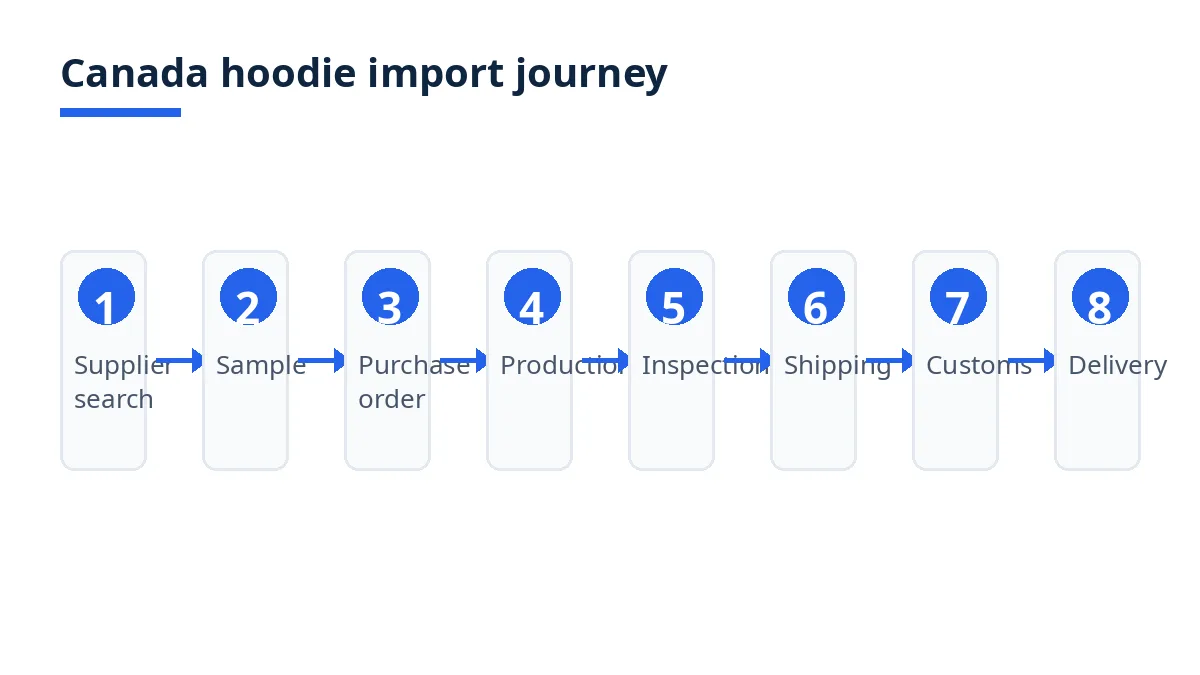
Step-by-step import checklist
Work through this list in order, and do not load bulk until the border items are closed.
[ ] Appoint a Canadian customs broker and confirm the importer of record for the order
[ ] Confirm Business Number and import-export (RM) account, and complete CARM registration and broker delegation
[ ] Confirm the 10-digit Canadian tariff classification for the exact garment with the broker
[ ] Confirm the LDCT position, the origin rule, and the origin proof required for the shipment
[ ] Approve the bilingual English/French label artwork and dealer identity with the broker
[ ] Write the full specification and send it unchanged to every shortlisted supplier
[ ] Verify each shortlisted supplier's business documents, factory, and origin-proof history
[ ] Agree quantity, size curve, colour breakdown, price, Incoterm, and inspection standard in the purchase order
[ ] Approve a pre-production sample in bulk fabric, bulk trims, and approved decoration, measured and wash-tested
[ ] Book freight on the confirmed Incoterm and named place, with the inland leg confirmed by the forwarder
[ ] Send the complete broker file before arrival: invoice, packing list, bill of lading, origin proof, label artwork
[ ] Inspect before shipment against the approved sample, and reconcile landed cost against actual charges after release
Each step below depends on the one before it.
How Exportain helps
Exportain connects Canadian buyers with Bangladeshi suppliers on one marketplace, so the supplier search, the specification exchange, and the order conversation start from the same record. A buyer can shortlist fleece garment suppliers, share the specification described in this guide, compare quotations on the same Incoterm and packing, and keep the sample approval, inspection standard, and broker file in the same order thread. Use that thread to record the border decisions: the broker-confirmed classification, the origin proof the supplier will provide, the label artwork approved for Canada, and the landed cost rebuilt for your quantity and port. A marketplace shortlist does not replace the broker, the forwarder, or the inspection.
FAQs
What is the typical MOQ for hoodies and sweatshirts from Bangladesh?
There is no single typical figure, and this guide states none. The minimum for your order is negotiated with the supplier and moves with fabric dye lots, the size curve, colour breakdown, decoration setup, and the factory cutting plan. Discuss it openly and record the agreed quantity, size breakdown, and colour breakdown in the purchase order.
How long does shipping take?
Transit time is a forwarder-confirmed estimate for your route. A guide updated November 24, 2024 gives 26 to 33 days for standard FCL ocean transit from Bangladesh to Vancouver, with transshipment through Singapore or Colombo.5 A separate forwarder guide gives about 4 to 12 weeks door-to-door for ocean freight from Bangladesh to Canada, with express courier at about 3 to 6 business days and economy air at about 5 to 10 business days.6 Ask your forwarder for the current Halifax routing and the allowance for loading, release, and the inland leg.
What import duty applies?
Duty depends on classification, origin, and proof. Bangladesh is listed by the Canada Border Services Agency as eligible for the Least Developed Country Tariff, and the CBSA origin memorandum sets the finishing, cutting, and yarn conditions for that treatment, with the claim tied to the Form B255 certificate of origin.1 8 Your broker must confirm the LDCT rate for your exact tariff item and the proof required; if the claim is not proved, the broker confirms the fallback treatment. GST at 5 percent appears here only as a conditional example on a broker-confirmed base, with no provincial tax figure and no conclusion about recovery.
How do I verify a supplier?
Verify documents, factory, and history together. Request trade licence and export registration details, confirm the factory address and contact independently, and cross-check the factory against Bangladesh Garment Manufacturers and Exporters Association member listings.2 Ask for recent buyers in a comparable market, for the audit or assessment reports covering the actual production site, and for the origin proof supplied on prior Canadian shipments. Then approve a pre-production sample in bulk fabric and decoration, measured and wash-tested, and inspect bulk against that sample before shipment.
Next steps on Exportain
Start with the general importing guide for Bangladesh, then shortlist suppliers and rebuild the landed cost method for your own order.
Confirm the Canadian border items with your broker before you place the order, and keep the broker-confirmed classification, origin proof, and label artwork with the purchase order.
Sources
- List of Countries and Applicable Tariff Treatments. Canada Border Services Agency (accessed )
- BGMEA | Home. Bangladesh Garment Manufacturers and Exporters Association (BGMEA) (accessed )
- Guide to the Textile Labelling and Advertising Regulations. Competition Bureau Canada (accessed )
- Place of delivery & risk transfer in trade contracts. ICC Academy (accessed )
- Shipping from Bangladesh to Vancouver. GoCubic (accessed )
- Worldwide Shipping Bangladesh to Canada. Jet Worldwide (accessed )
- How to Import Goods Into Canada: 8 Steps for New Importers. GHY International (accessed )
- Memorandum D11-4-4: Rules of Origin Respecting the General Preferential Tariff and Least Developed Country Tariff. Canada Border Services Agency (accessed )
- Importing by mail or courier - Paying duty and/or taxes on imported goods. Canada Border Services Agency (accessed )
About the author
Sourcing from Bangladesh?
Post a request for quotation and suppliers on Exportain can send you their quotes directly.
Post an RFQ