Hoodies and Sweatshirts to Australia From Bangladesh: Step-by-Step Guide
Australia hoodie import guide: Sydney entry through Port Botany, ABF N10 clearance, MOQ and pricing, quality and labelling checks, transit, duty and an AUD landed-cost example for 3,600 hoodies.
Short answer
To import hoodies and sweatshirts from Bangladesh to Australia, start with the Sydney entry and work backward: lock the garment specification, ask a licensed Australian customs broker to confirm classification, duty position, origin evidence and the tax base, verify supplier documents, and approve a pre-production sample with Australian label artwork before bulk production.
On this page
Key takeaways
Start at the Australian end: the specification, the Sydney classification, the origin evidence behind any duty position, and the label artwork are all settled before loading, or the container waits at Port Botany while paperwork catches up.
There is no standard MOQ to copy: each supplier sets its own minimum and counts it per order, per style, per colour or per size, so ask how it is counted and get the agreed method on the proforma invoice.
For a commercial consignment over AUD 1,000, the ABF requires an Import Declaration (N10) through a licensed customs broker, with duties, taxes and charges paid before release, and all entry documents kept for five years.
Use ShipHub's 26 August 2026 planning range of roughly 25 to 45 days for FCL and 35 to 55 days for LCL via transshipment hubs, then replace it with a dated forwarder sailing schedule for the actual loading week.
The AUD example for 3,600 hoodies lands at 9.85 per unit before duty and GST, and 10.84 per unit with the conditional GST example amount, before any duty figure: price from the landed figure, not the FOB figure.
Why source hoodies and sweatshirts from Bangladesh
Start at the Australian end, not the factory gate. A hoodie order from Bangladesh succeeds or stalls on four points settled before loading: the exact garment specification, the classification entered at Sydney, the origin evidence behind any duty position claimed, and the label artwork sewn into every piece. Get those four right and the rest of the order is logistics. Leave any one of them to arrival and the container waits at Port Botany while paperwork catches up.
Bangladesh suits this product because fleece and knitwear production runs at scale there. Knitted and crocheted apparel is the largest export category on the Bangladesh to Australia lane, so fleece knitting, dyeing, cutting, sewing, printing, embroidery and export packing are work Bangladeshi suppliers handle every week.1 That depth gives a buyer choice: several suppliers can make the same hoodie style.
Depth is not a substitute for specification. A hoodie fails in wear on details never written down: a hood that pulls the neckline out of shape, cuffs that lose recovery after washing, a pocket that gaps, or a print that cracks after a few washes. Write the specification before you ask for a price, and send the same document to every supplier.
The Sydney entry shapes the specification too. Your broker needs the fibre content, construction and correct description for the entry, and your labels need Australian care and origin information checked before production. Both checks are cheaper at the sample stage than at the port.
Find and verify suppliers
Shortlist three to five suppliers before negotiating price. That number is small enough to manage properly and large enough to give a real comparison. Include at least one supplier you would be comfortable using if your first choice failed during production. For repeat programmes, keep a qualified backup supplier warm rather than starting a fresh search under deadline pressure.
Search through supplier directories, trade association listings, referrals and marketplace profiles. On Exportain, the supplier directory lets you filter by product and category and read what each profile states about its products, location and declared certifications. Treat a profile as a starting point for questions, not as proof of capability.
Verification means checking documents and consistency. Ask each supplier for its legal company name and registered address, trade licence, tax identification and VAT registration where applicable, and its Export Registration Certificate. Check that the same legal name appears on the quotation, proforma invoice, bank account and shipping documents, and ask for a documented explanation of any difference.
Go deeper in proportion to the order size. For a first order, a video call showing the factory floor, reference buyers the supplier is willing to name, and a small trial order tell you more than a polished catalogue. For a larger programme, consider a factory visit or an independent audit, and agree in writing who pays for it. Reluctance to allow any independent check is itself information.
Ask directly about hoodie production, not garment production in general. Can the supplier show fleece it has knitted or sourced, hood construction samples, and print or embroidery work at the standard you need. Ask which parts happen in-house and which are subcontracted, and put the answer in the purchase order, because subcontracting changes who controls quality and lead time.
MOQ, pricing and samples
There is no standard minimum order quantity for hoodies and sweatshirts from Bangladesh that a buyer can safely copy into a plan. Each supplier sets its own minimum, and it may apply per order, per style, per colour or per size. A minimum that looks low per order can still be high once it is split across five colours and six sizes, so ask how the minimum is counted before you compare quotations.
Negotiate the minimum as part of the specification. If a colour or size falls below it, ask whether the supplier will run it at a surcharge, combine it with a repeat colour, or drop it from the range, and get the agreed position in writing on the proforma invoice.
Compare quotations line by line. A usable comparison covers unit price and currency, what is included (fabric, trims, labels, packaging, testing) and what is excluded, the minimum and how it is counted, lead time counted from a named event, the Incoterm and named place, payment terms, sample terms, and the date the price stops holding. Two prices on different Incoterms are not comparable, so convert every offer to the same basis before you decide.
Treat samples as part of the contract, in three stages. A development sample confirms the supplier understood the specification; expect corrections and often a second round. A pre-production sample uses the actual fabric, trims, labels and packaging intended for bulk, and bulk production should not start before you approve it in writing. Keep one sealed piece yourself, with a matching piece at the factory, so both sides judge bulk against the same standard. A shipment sample from finished bulk lets you compare production with the approved sample before the goods leave.
Agree sample costs, courier costs and timing in advance, and whether sample charges are credited against the bulk order. State in the purchase order that bulk must match the approved pre-production sample in fabric, weight, colour, measurements, construction and labelling, and that a mismatch found at inspection is a failed shipment, not a negotiation.
Quality control and certifications needed
Quality control for hoodies starts with numbers, not adjectives. Put measurable points in the specification: fabric type and weight, fibre content, hood and pocket construction, stitch expectations, drawcord length and end finish, print or embroidery method, colour references, a size chart with tolerances, and wash and colourfastness checks. "Good quality" is not a specification, and a supplier cannot be held to it.
Decide the inspection plan before production: an inspection during production, a pre-shipment inspection against the approved sample, and laboratory testing where your customers require it. Agree in writing who inspects, what sample size is drawn, what counts as a defect, and what happens if the shipment fails: rework, re-inspection at the supplier's cost, or cancellation.
Children's hoodies need extra care on drawcords and small parts, and any claim you plan to make on a swing tag or website needs evidence behind it. If your customers require a particular certification or test report, name it in the request for quotation, ask for the certificate with its scope and validity dates, and check that the scope covers the product and the factory concerned. A certificate for a different product, or one that has expired, is not evidence for your order.
Labelling is a quality point as well as a compliance point. Care labels are mandatory under Australian law and regulated by the Australian Competition and Consumer Commission, so care instructions must state cleaning, water temperature and other care methods clearly.2 Fibre content labelling is no longer mandatory under federal law, but listing percentages in descending order remains common practice, and New South Wales has its own fibre content labelling laws.2 Country of origin claims must be true, accurate and based on reasonable grounds, and the Australian Consumer Law defines "grown in", "produced in", "made in" and "packed in".3 Check every label claim against the actual production facts before printing, because relabelling a finished shipment is slow and expensive.
Packaging needs the same attention. Ask for ISPM-15 compliant treatment and marking on any solid wood packaging or dunnage, and confirm the position with your broker and forwarder before loading, since biosecurity rules cover wood packaging on this lane.1 Cartons should carry marks that survive handling, inner packs should match the packing list exactly, and barcodes should be tested on the sample shipment.
Incoterms, shipping and transit time
The Incoterm in the quotation decides who pays for each leg and who carries the risk. Incoterms 2020, published by the International Chamber of Commerce, answer who arranges and pays for transport, where risk transfers, and who handles clearance on each side.4 They say nothing about price, payment terms, ownership transfer, or defective goods, so those points still need contract clauses of their own.4
For a Chattogram to Sydney sea shipment, three terms cover most hoodie orders. Under FOB Chattogram, the seller loads the goods on board the vessel nominated by the buyer and clears them for export, and the buyer arranges ocean freight, insurance, import clearance and delivery from that point.4 Under CIF Sydney, the seller pays freight and minimum insurance to Sydney, but risk still transfers at loading, and the buyer handles import clearance and destination charges.4 Under DAP Sydney, the seller carries the goods to the named place ready for unloading, while the buyer still pays import duty and clearance.4 For containerised cargo handed to a carrier at a terminal, FCA is the term that matches the physical handover, since risk transfers when the container is handed to the buyer's carrier rather than at vessel loading.4
Choose the term that keeps your landed cost visible. FOB or FCA gives control over freight and a clean comparison, while DDP hides freight and duty inside one supplier-set price.4 Name the term, the place and the edition in the contract, for example "FOB Chattogram, Incoterms 2020".
Most Bangladesh to Australia cargo moves via transshipment hubs such as Singapore, Colombo, Port Klang or Tanjung Pelepas before continuing to Australia, which adds time compared with a direct route.1 ShipHub's Bangladesh to Australia guide, page-dated 26 August 2026, gives a current planning range of roughly 25 to 45 days for full container load and 35 to 55 days for less than container load, once consolidation and deconsolidation are added for LCL.1 Treat that range as a planning figure only, and get a dated sailing schedule from your forwarder for your actual loading week, since routing, sailing frequency and port congestion move the real figure.
Chattogram is Bangladesh's largest and busiest seaport and handles the large majority of containerised trade, while Port Botany is Sydney's main container terminal.1 Plan the Sydney leg in the same detail as the ocean leg: confirm whether your forwarder will move the container by rail to a Sydney intermodal terminal such as Moorebank or Enfield, or by road direct to your warehouse, and confirm the terminal free-time window so a late booking does not turn into storage charges. Air freight suits samples and urgent replenishment, but its cost per hoodie makes it a poor choice for bulk fleece.
Import duty, taxes and documents
Do not copy a duty rate from another product, another country or another year into your pricing. The rate for your hoodies depends on classification, customs value, origin and the tariff treatment in force on the entry date, and your licensed Australian customs broker must confirm all four points for your exact styles before you place the order.
Two timing points make early broker involvement worth the fee. First, Bangladesh's graduation from least-developed-country status changes the preference landscape: ShipHub's guide notes graduation scheduled for 24 November 2026, so a duty position from an earlier shipment cannot be assumed for a later one.1 Second, a file prepared before loading lets the broker lodge promptly, while a file started at arrival wastes the Port Botany terminal window.
For a commercial consignment over AUD 1,000 cleared into home consumption, the Australian Border Force requires an Import Declaration (N10), and all applicable duties, taxes and charges must be paid before the goods can be released.5 The declaration is a statement by the importer, or by a licensed customs broker acting as agent, covering the goods, the importer details, how the goods are transported, and the tariff classification and customs value.5 The ABF encourages first-time or infrequent importers to use a licensed customs broker, and the importer remains responsible even when a broker lodges it.5
Send the broker the full document set before arrival: commercial invoice, packing list, bill of lading, origin proof where a tariff treatment is relied on, and the insurance certificate where the buyer arranges cover. After you or your broker make an Import Declaration, you must keep all relevant documents for five years.5 File the entry number, classification note, origin evidence and payment receipts together.
Tax treatment needs the same broker-plus-adviser discipline. GST appears in the landed cost example below only as a conditional example amount on a broker-confirmed base, with no rate stated and no conclusion about recoverability. Your broker confirms the base and your tax adviser confirms the treatment for your business, and neither point should be guessed from a guide.
Landed cost example (table)
Example figures only. Every figure below is illustrative, not a real price, freight rate or charge for any supplier, route or shipment. Replace each line with your own supplier quotation, forwarder quote and broker confirmation before you price. Duty is left as a broker-confirmed figure because no single rate is correct for every hoodie style.
Line | Example figures (AUD) |
|---|---|
Product cost: 3,600 hoodies at 8.40 FOB Chattogram | 30,240.00 |
Ocean freight, FCL Chattogram to Sydney | 2,850.00 |
Cargo insurance arranged by the buyer | 310.00 |
Subtotal before duty and GST | 33,400.00 |
Subtotal per unit before duty and GST | 9.28 |
Import duty: broker-confirmed figure for these styles | Your figure |
Customs broker fee | 420.00 |
Port Botany terminal and destination charges | 610.00 |
Inland delivery to a Sydney warehouse | 480.00 |
Pre-shipment inspection | 550.00 |
Total before duty and GST | 35,460.00 |
Landed cost per unit before duty and GST | 9.85 |
Conditional GST example amount on the broker-confirmed base above | 3,546.00 |
Total with the conditional GST example amount, before duty | 39,006.00 |
Landed cost per unit with the conditional GST example amount, before duty | 10.84 |
Read the table as a warning about headline prices. A hoodie quoted at 8.40 already costs 9.85 before duty once freight, insurance, broker, terminal, inland and inspection lines are added, and 10.84 with the conditional GST example amount, before any duty figure at all. Price from the landed figure, not the FOB figure. Re-run the table for every order, because a smaller quantity spreads the same fixed charges across fewer units.
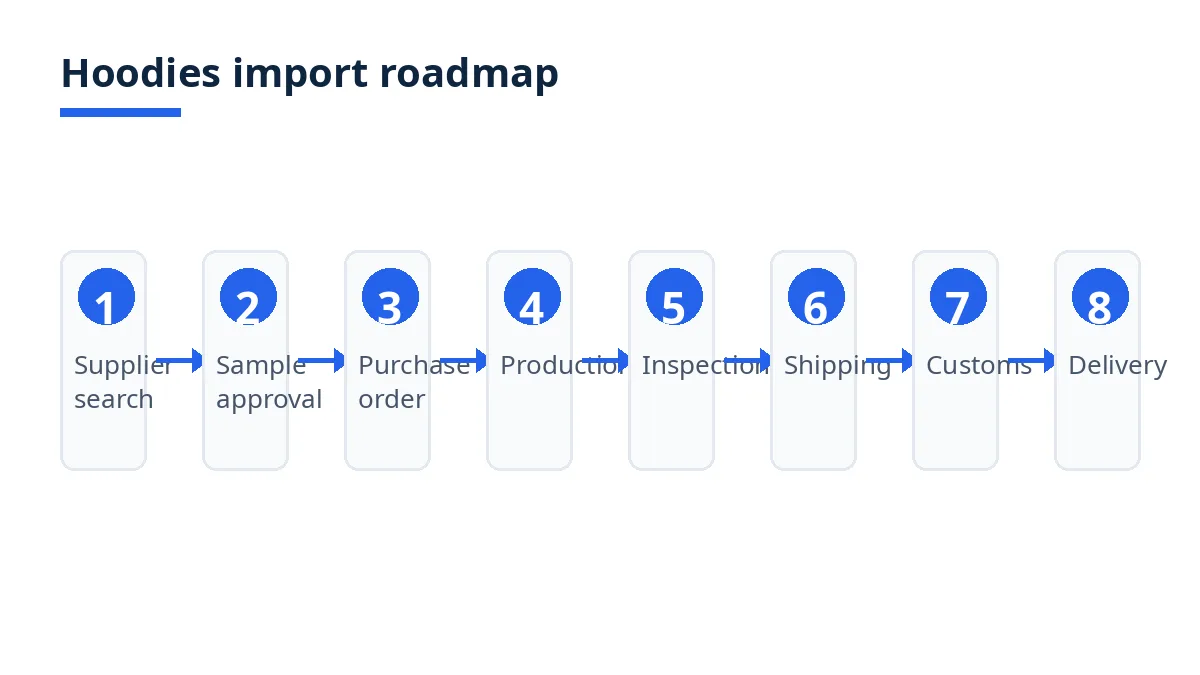
Step-by-step import checklist
Write the full hoodie specification: fabric, weight, fibre content, hood and pocket construction, drawcord finish, print or embroidery, colour references, size chart with tolerances, labelling and packaging.
Ask your licensed Australian customs broker to confirm classification, duty position, origin evidence and the tax base for those exact styles.
Shortlist three to five suppliers, request the core business documents, and check that the legal name is consistent across every document.
Send the same request for quotation to each supplier, stating specification, quantity breakdown, Incoterm and named place, required tests or certificates, packaging and labelling, and the dates for quotation and delivery.
Compare quotations on one basis, convert every offer to an estimated landed cost, and negotiate the minimum, lead time and payment terms in writing.
Approve a development sample, then a pre-production sample in the actual materials, and keep a sealed piece as the bulk standard.
Confirm label artwork, care instructions, origin claims and ISPM-15 packaging treatment before bulk production starts.
Agree the inspection plan, defect standard and remedy for a failed inspection, and book the inspection before the shipment date.
Send the broker the invoice, packing list, bill of lading, origin proof and insurance certificate before the vessel reaches Sydney.
Lodge the N10 entry through the broker, pay the duty, taxes and charges due, and move the container on the confirmed Sydney rail or road leg.
Check the delivered cartons against the packing list and the approved sample, record any shortage or defect promptly, and file the entry set for five years.
How Exportain helps
Exportain connects Australian buyers with Bangladeshi suppliers, exporters and trade service providers, and the platform records quotations, order terms and messages so both sides work from the same written record. Use the supplier directory to build the shortlist, post a request for quotation stating the full specification, and compare replies on price, minimum, lead time, Incoterm and validity in one thread.
Read trust badges for what they actually cover. A badge records which document and photo checks have been reviewed; it is not a factory audit, not an inspection of your goods, and not a guarantee of capacity, quality or delivery. Badges help you shortlist; they do not replace your own checks, samples and inspection decisions.
Exportain is not a party to the goods contract and does not inspect goods, book freight or clear customs. Your supplier contract, forwarder booking, inspection booking and broker entry remain your own arrangements, and the platform sits alongside them rather than replacing them.
FAQs
What is the typical MOQ for hoodies and sweatshirts from Bangladesh?
There is no typical figure you can safely plan around, because each supplier sets its own minimum and counts it differently. Ask whether it applies per order, per style, per colour or per size, and get the agreed counting method on the proforma invoice.
How long does shipping take?
For sea freight, ShipHub's Bangladesh to Australia guide, page-dated 26 August 2026, gives a planning range of roughly 25 to 45 days for full container load and 35 to 55 days for less than container load, with most cargo moving via a transshipment hub.1 Get a dated sailing schedule for your loading week, add clearance and the Sydney inland leg, and plan stock around the long end of the range.
What import duty applies?
No single rate applies to every hoodie, because duty depends on classification, customs value, origin and the tariff treatment in force on the entry date. Ask your licensed Australian customs broker to confirm the duty position for your exact styles, including the origin evidence required, and re-confirm it for each order, since preference treatment changes over time.5 Build your pricing from the broker-confirmed figure, not from a rate copied from another product.
How do I verify a supplier?
Request the core business documents, check that the legal name matches across the quotation, invoice, bank account and shipping documents, and ask for production evidence specific to hoodies. Add a video call or factory visit, reference buyers, and a small trial order in proportion to the order size. Approve a pre-production sample in the actual materials before bulk production, and agree the inspection plan and remedy for failure in writing.
Next steps on Exportain
Start with the general process in How to Import from Bangladesh, then work your figures through Landed Cost for Imports from Bangladesh before you accept a quotation. When you are ready to compare suppliers, use the buying steps on How to Source and Buy from Bangladesh to post a request for quotation with the full specification attached. Send the broker the classification questions at the same time, so the answers arrive while suppliers are still quoting.
Sources
- Shipping from Bangladesh to Australia. ShipHub (accessed )
- Clothing Labelling Requirements. Triton Store (accessed )
- Country of origin claims. ACCC (accessed )
- Incoterms 2020 Guide for Importers. Importivity (accessed )
- Import declarations. Australian Border Force (accessed )
About the author
Sourcing from Bangladesh?
Post a request for quotation and suppliers on Exportain can send you their quotes directly.
Post an RFQ