

USA Frozen Fish Imports From Bangladesh: Step-by-Step Guide
Frozen fish from Bangladesh to the USA, file-first: FDA Part 123 verification, the SIMP line check, HTS 0303/0304 classification, US labelling, supplier checks, and a USD 9.70 per kilogram landed-cost example.
Short answer
To import frozen fish from Bangladesh to the USA, fix the product form first, classify it on the exact 10-digit HTS line, and build the FDA Part 123 verification file before the order ships. Check whether the line is flagged under the Seafood Import Monitoring Program, agree the US label, confirm the Bangladesh export file in writing, file Prior Notice at least 8 hours before arrival by water, and enter the goods within 15 calendar days after landing.
On this page
Key takeaways
Fix the product form first: whole frozen fish falls under heading 0303 and fillets and other fish meat under heading 0304, and the form decides the tariff line, the duty position, the SIMP flag, and much of the label.
Build the written Part 123 verification file before the order ships, naming the product specifications and affirmative steps in the purchase order, and keep English records: without evidence of Part 123 processing conditions, entry will be denied.
Check the exact 10-digit line against the October 2026 SIMP trade monitoring list, including grouper, snapper, cod, and other-fish fillet and fish-meat lines, and collect chain of custody data lot by lot where the line is flagged.
Classify line by line on the Harmonized Tariff Schedule Revision 16 (2026): most frozen fish lines show Free General, but sardines on 0303.53.00 show 1.1 cents per kilogram, and fillet and fish-meat lines split by block and bulk presentation.
File Prior Notice and have it confirmed no less than 8 hours before arrival by water, enter the goods within 15 calendar days after landing, and rework the USD 9.70 per kilogram example landed cost with broker-confirmed duty and actual invoices.
A frozen fish order for the United States is settled when three files agree: the importer verification file under the seafood HACCP rule, the Seafood Import Monitoring Program chain of custody where the tariff line is flagged, and the customs entry. Fix the product form first: the form decides the tariff line, and the line decides the duty position, the monitoring flag, and much of the label.
This guide is for United States importers, wholesalers, processors, retailers, and food service buyers bringing frozen fish from Bangladesh into the United States. Every cost figure is an example figure, and every duty figure is indicative until a broker confirms it on the exact line for the entry date.
Start from the product form: whole frozen fish or fillets and fish meat
Frozen fish reaches the United States in two tariff worlds. Heading 0303 covers fish, frozen, excluding fish fillets and other fish meat of heading 0304; heading 0304 covers fish fillets and other fish meat, whether or not minced, fresh, chilled, or frozen.1 A whole frozen fish, a headed and gutted frozen fish, a frozen fillet, and frozen minced fish meat are not the same entry, even from the same species and plant.
Name the form in the same words everywhere: species and scientific name, wild-caught or farmed, whole or headed and gutted, fillet or other fish meat, skinned or not, block-frozen or individually packed, glazed or unglazed. State the presentation before requesting a price, and give a mixed container a separate line for each form.
Build the Part 123 verification file before the order ships
Seafood safety for imports runs through the fish and fishery products rule at 21 CFR Part 123, and the importer carries the verification duty. Every importer must either obtain the product from a country with an active memorandum of understanding or similar agreement with the Food and Drug Administration covering the product and documenting equivalency or compliance of the foreign inspection system, or have and implement written verification procedures.2 Ask the broker, in writing, whether any agreement covers the product, and if the answer is not a documented yes, build the written file.
The procedures must list product specifications designed to ensure the product is not adulterated, and affirmative steps chosen from the rule: lot HACCP and sanitation records, a certificate from a foreign government inspection authority or competent third party, regular inspection of the processor's facilities, an English copy of the HACCP plan with a written guarantee, or periodic testing with a written guarantee on file.2 Pick the steps before the order, name them in the purchase order, and keep English records of performance and results.2 Without evidence of Part 123 processing conditions, the product will appear adulterated and will be denied entry.2
Juice and seafood from suppliers in compliance with the HACCP regulations at 21 CFR Part 120 or 123 are exempt from the Foreign Supplier Verification Programs rule, with certain ingredients used by the importer under those regulations treated the same way.3
Check whether SIMP follows the line you are buying
The Seafood Import Monitoring Program is a risk-based traceability program requiring the importer of record to report key chain of custody data, from harvest to entry into United States commerce, for fish and fish products particularly vulnerable to illegal, unreported, and unregulated fishing or seafood fraud.4 More than 1,100 unique species, in 13 groups, are included.4
For frozen fish, the flag follows the tariff line. The October 2026 list flags frozen Atlantic cod (0303.63.0010), other frozen cod (0303.63.0090), frozen grouper (0303.89.0070), frozen snapper (0303.89.0067), frozen fish not specifically provided for (0303.89.0080), the "other" line at 0303.59.0000, and the Gadidae-family line at 0303.69.0000.5 It flags frozen fillets not specifically provided for (0304.89.1090, 0304.89.5091) and frozen other fish meat not specifically provided for (0304.99.1104, 0304.99.1109, 0304.99.1194, 0304.99.9190, 0304.99.9192).5 Ordering "assorted frozen fish" on an "other" line can therefore create a different monitoring file from ordering a named species on a named line.
Where the line is flagged, the importer of record reports the harvesting or producing entity, vessel name and flag state, authorization, farm or facility name, gear types, species code, landing dates and points, product form at landing, harvest area, and landing entity, plus its trade permit number, transshipment information, and processing records, and keeps chain of custody records.4 Collect it lot by lot before shipment, and ask the broker to check unflagged lines against the current list.
Classify on the exact 10-digit line and work the Free duty position line by line
Classification follows species, form, and presentation. The schedule opened for this guide is the Harmonized Tariff Schedule of the United States, Revision 16 (2026), Chapter 3.1 The column 2 rate is not the working rate for a Bangladesh order. The broker must confirm in writing, before a price is fixed, the General rate on the exact 10-digit line, whether any Special program applies, and whether any additional duty under Chapter 99 applies on the entry date.
Frozen whole fish other than the named groups falls on 0303.89.00, "Other," at Free General with a column 2 rate of 2.2 cents per kilogram.1 The herring, sardine, mackerel, cobia, and swordfish group (0303.51.00 to 0303.59.00) is mostly at Free General, as is frozen cod on 0303.63.00.1 One exception shows why the check is line by line: sardines, sardinella, brisling, or sprats on 0303.53.00 show a General rate of 1.1 cents per kilogram, not Free.1
Frozen fillets split by presentation as well as species. Tilapia (0304.61.00), catfish including Pangasius with basa and tra (0304.62.00), Nile perch (0304.63.00), and other fish of that group (0304.69.00) each show Free General with a 5.5 cents per kilogram column 2 rate.1 Cod, haddock, coalfish, hake, and Alaska pollock fillets (0304.71.00 to 0304.75.00) split into a block line, skinned and frozen into blocks over 4.5 kilograms for mincing, grinding, or cutting into uniform pieces, at Free General with a 2.8 cents per kilogram column 2 rate, and an "Other" line at Free General with a 5.5 cents per kilogram column 2 rate; other-fish fillets on 0304.89.00 follow the same split.1 Frozen other fish meat (0304.93.00, 0304.99.00) splits into bulk lines in containers over 6.8 kilograms at Free General with a 2.8 cents per kilogram column 2 rate, and other lines the broker must read line by line.1 Treat every rate here as indicative on Revision 16 (2026).
Agree the United States label: species name, allergen, origin and production method
The label is agreed before packing: carton, retail pack, and entry must name one product. Use the common or usual name from the Food and Drug Administration Seafood List as the broker confirms it, with the scientific name in the specification file, and never use a market name naming a different species.
Fish is a major food allergen: the Food and Drug Administration lists fish, with bass, flounder, and cod as examples, among the nine major food allergens, and requires labels to identify the food source names of major food allergens used to make the food.6 The source name is declared in parentheses after the ingredient name or in a "contains" statement next to the ingredient list.6 Agree the wording before artwork is approved, and approve the finished artwork, not a description of it.
Country of origin labeling adds a second origin statement for retail sale, requiring certain retailers, principally full-line grocery stores and supermarkets licensed under the Perishable Agricultural Commodities Act, to provide country of origin information at the point of purchase.7 Fish and shellfish, wild and farm-raised, are covered, including fillets, steaks, nuggets, and any other flesh, and must also be labelled at retail with the method of production: farm-raised, farmed, wild caught, or wild.7 Fix "Product of Bangladesh" and "wild" or "farm-raised" in the specification and confirm the method lot by lot.
Fix the weight basis on the label in the same words as invoice and packing list, state lot code and storage instruction on every carton, and check each against the verification file and entry.
Confirm the Bangladesh export file in writing for the exact line
No Bangladesh export document list is stated here: no Bangladesh Customs export-requirements page for a frozen fish line was opened in full. Do not borrow a list from a shrimp or dried fish order: the export file for one heading does not prove the file for another.
Ask the supplier, in writing, to name every export document, certificate, and clearance applying to the exact line, its issuing authority, and the stage at which it is issued, and to send them before loading. Ask the forwarder and broker to confirm which the entry needs, and hold the shipment if any document cannot be confirmed before loading.
Specify the fish so the invoice, carton and entry describe one product
Specification part | Fix in writing before quoting |
|---|---|
Species and origin | Species, scientific name, wild-caught or farmed, harvest or farming area wording as the broker confirms it for the label |
Product form | Whole, headed and gutted, fillet, or other fish meat; skinned or not skinned; block-frozen or individually packed |
Size and count | Size range or count per unit weight, uniformity rule, and how out-of-range pieces are treated |
Glaze and weight | Glaze basis, net weight basis, drained weight where required, and the weighing method |
Pack and carton | Pack weight, packs per carton, carton weight, carton marks, lot code, and label artwork approval |
File | Part 123 verification steps, SIMP data where the line is flagged, facility registration position, and the Prior Notice data set |
Shipment | Reefer requirement, agreed temperature range stated as a number, temperature record, and the loading and sailing plan |
Find and check suppliers against the United States file, not the price list
Shortlist suppliers whose current range already includes frozen fish in the species, form, and presentation the order needs, packed for export to the United States. Browse suppliers on Exportain and read each profile against the United States specification, not a headline price. Send three or four suppliers the identical specification and ask for the same reply format: species and form, size range and glaze basis, pack format, price inclusions, validity, and minimum per species, form, and presentation. Ask whether it can supply the Part 123 records, the SIMP data where the line is flagged, and the label artwork.
Verify in three layers before payment: company documents, so name, address, and bank account agree across trade licence, export registration, and invoices; capability and file, including current production, the HACCP plan and sanitation records, and the facility registration position; and payment discipline, paying only the company account named in the documents and verifying any bank detail change through a different channel. On Exportain, profiles carry document and photo review badges, not a factory inspection or a guarantee, and Exportain is not a party to the contract.
MOQ, pricing and samples without a stated typical minimum
There is no single typical minimum for frozen fish from Bangladesh, and this guide states none. The minimum is set per species, form, presentation, and pack format, because raw material is bought and processed in lots. Ask how it splits by species, form, presentation, and pack format, and get the split in writing.
Ask for the price on the identical specification, in United States dollars, with inclusions stated line by line: product price, packing, labelling, inspection where agreed, and the delivery term with its named place. Ask what the price excludes and whether it is quoted on net or glazed weight. Approve samples in stages, in writing, and keep one sealed counter-sample per form and presentation.
Cold chain, inspection and the reefer leg from Chattogram
Agree inspection before production: method, defect classes, acceptance limits, who inspects, when, and on what sample, plus what happens when inspection fails and how a failed lot is held.
Agree the frozen temperature range as a number, pre-cooling of the reefer, and a temperature record travelling with the consignment. No temperature figure is stated here. If the record shows a break, hold the lot.
Sea freight in reefer containers is the standard route for bulk frozen fish; build the sailing plan from the forwarder's current schedule, in three blocks: production time, sea transit, and clearance and delivery. No transit figure is stated here. State the delivery term in full in every document: rule, named place, and version, confirmed by forwarder and broker. The Incoterms 2020 rules allocate cost, risk, and obligations between seller and buyer.8 Under CIF, reserved for maritime trade, Institute Cargo Clauses (C) remains the default cover.8 Under FCA for carriage by sea, the parties may agree an on-board bill of lading procedure.8 Ask, in writing, who books the reefer, files the entry, pays duty and fees, and bears an examination hold.
File Prior Notice, enter the goods and keep the three files in agreement
The entry file has three clocks. The first is facility registration: the form for a foreign facility includes a United States agent section, and the agent is a person residing or maintaining a place of business in the United States whom the facility designates as its agent, acting as the communications link with the Food and Drug Administration.9 Ask the supplier to confirm, before the order, that the processing facility is registered, that the details match the invoice and Prior Notice, and that the agent named is current.
The second clock is Prior Notice: advance notice to the Food and Drug Administration on shipments of food imported into the United States, with fish and seafood listed among the examples covered.10 The Food and Drug Administration must receive and confirm Prior Notice before a food shipment arrives at the first United States port, and for shipments arriving by water, no less than 8 hours before arriving at the port of arrival.10 Confirmation means the notice was deemed facially complete, not that the shipment was approved.10 Food imported with inadequate Prior Notice is subject to refusal and must be held at the port of entry unless directed elsewhere.10 Build the data set from the specification and entry documents: FDA product code, common or market name, estimated quantity, lot identifier, manufacturer name with registration number or full address, country of production, shipper, anticipated arrival information, importer, owner, and consignee, carrier and mode, and any country to which the article has been refused entry.10 If any point changes after confirmation, a new Prior Notice is required and the clock restarts.10
The third clock is the customs entry. Documentation to secure release must consist of the entry on CBP Form 3461 or its electronic equivalent, evidence of the right to make entry, a commercial invoice, a packing list where appropriate, other documents required by CBP or other agencies, and identification of the United States buyer or delivery premises.11 Entry is required within 15 calendar days after landing.12 Send the full document set to the broker before arrival and check every document against the others line by line.
Landed cost example in United States dollars
Every number below is an example figure only, not a quote, for whole frozen fish on line 0303.89.00 shipped by sea from Chattogram to a United States East Coast port, with duty at the indicative Free General rate and no Special program or additional duty claimed. Confirm every line with the broker.
Per kilogram, net weight basis.
Cost element | Example figures (per kilogram) | How to obtain your figure |
|---|---|---|
Product price, FOB Chattogram | USD 7.80 | Pro forma invoice |
Freight and insurance, per kilogram | USD 1.10 | Forwarder quote |
Customs value, per kilogram | USD 8.90 | Price plus freight and insurance |
Duty at indicative Free General rate | USD 0.00 | Broker calculation on the exact line |
Port, examination, cold-store and broker fees, per kilogram | USD 0.42 | Broker and port invoices |
Delivery to cold store or plant, per kilogram | USD 0.38 | Local carrier quote |
Total landed cost, per kilogram | USD 9.70 | Sum of all lines above |
Work the calculation again after shipment, with the actual invoices.
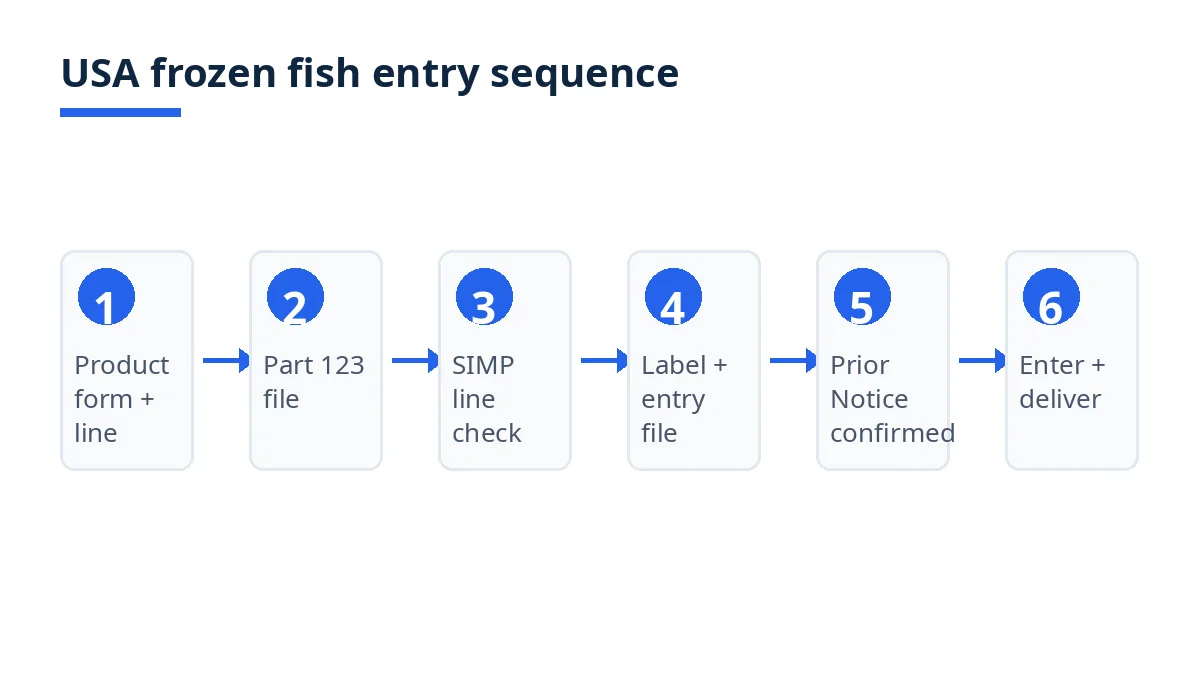
USA fish import sequence, step by step
Fix the product form, species, and presentation, named identically in every document.
Classify on the exact 10-digit line and confirm the duty position.1
Build the Part 123 verification file and record the Foreign Supplier Verification Programs exemption position.2 3
Confirm facility registration and the United States agent position.9
Confirm the Bangladesh export file in writing, before loading.
Send one specification to every supplier and compare quotes on the same terms.
Verify the supplier in three layers and approve samples stage by stage.
Agree inspection and the cold-chain range, and ship on the agreed delivery term.8
File Prior Notice, confirmed no less than 8 hours before arrival by water.10
Enter the goods within 15 calendar days after landing, with all files in agreement, and reconcile the actual landed cost.11 12
What is the typical MOQ for frozen fish from Bangladesh?
There is no single typical minimum, and no figure is stated here. Ask how it splits by species, form, presentation, and pack format, get the split in writing, and compare minimums only on the identical specification.
How long does shipping take?
Production time, sea transit, and United States clearance and delivery are separate blocks, and no combined figure is stated here. Plan from the forwarder's current sailing schedule for the exact port pair and sailing week, and keep production time separate from transit time.
What import duty applies?
Duty follows classification, species, form, presentation, and entry date. The example line is 0303.89.00, whole frozen fish described as "Other," at Free General with a column 2 rate of 2.2 cents per kilogram on Revision 16 (2026).1 Treat Free as indicative and have the broker confirm the rate, any Special program, and any additional duty on the exact 10-digit line. Sardines on 0303.53.00 show 1.1 cents per kilogram, so no rate transfers between lines.1
How do I verify a supplier?
Check company documents first, so name, address, and bank account agree across trade licence, export registration, and invoices. Then check capability and the United States file: current production, Part 123 records, SIMP data where flagged, facility registration, and label artwork.4 2 9 Then check the entry file in agreement before loading. Do not pay before all three layers are checked.
Next steps on Exportain
Read the general guide to importing from Bangladesh and the classification guide for frozen fish before you price, and use the landed cost guide for imports from Bangladesh for the full cost picture. When the form, line, and verification file are fixed, post a free RFQ with the United States port of arrival and delivery date. For the buying journey, see how to buy.
Sources
- Harmonized Tariff Schedule of the United States, Chapter 3. United States International Trade Commission (accessed )
- 21 CFR 123.12 — Special requirements for imported products. GovRegs (accessed )
- Final Rule on Foreign Supplier Verification Programs (FSVP) At-A-Glance. U.S. Food and Drug Administration (accessed )
- Seafood Import Monitoring Program Facts and Reports. National Oceanic and Atmospheric Administration, NOAA Fisheries (accessed )
- NMFS Trade Monitoring Program - Harmonized Tariff Schedule (HTS) Codes. NOAA Fisheries (accessed )
- Food Allergies: What You Need to Know. U.S. Food and Drug Administration (accessed )
- Country of Origin Labeling (COOL): Common Questions and Answers. USDA Agricultural Marketing Service (accessed )
- Incoterms® 2020. International Chamber of Commerce (ICC) (accessed )
- Food Facility Registration User Guide: Summary of Fields. U.S. Food and Drug Administration (accessed )
- Guidance for Industry: What You Need to Know About Prior Notice of Imported Food Shipments. U.S. Food and Drug Administration, (accessed )
- 19 CFR 142.3 - Entry documentation required. Legal Information Institute, Cornell Law School (accessed )
- 19 CFR 142.2 - Time for filing entry. Legal Information Institute, Cornell Law Institute (accessed )
About the author
Sourcing from Bangladesh?
Post a request for quotation and suppliers on Exportain can send you their quotes directly.
Post an RFQ


