France Frozen Fish Imports From Bangladesh: Buyer Checklist
One lot, one file: how a France buyer fixes species, origin, and form first, passes the SIVEP border file, classifies on the CN line, proves catch or farm origin, labels in French, and prices with a EUR 7.52 per kilogram landed-cost example.
Short answer
To import frozen fish from Bangladesh to France, fix one lot identity first: species and scientific name, wild-caught or farmed origin, and product form. Present the lot at a designated French border control post with a CHED filed in TRACES, a health certificate from a listed establishment, and catch proof through CATCH for wild-caught fish. Confirm the CN duty line, any preference route, and French import VAT with your broker and tax adviser before pricing.
On this page
Key takeaways
Fix one lot identity first: species and scientific name, wild-caught or farmed origin, and product form, kept identical in every document from specification to label.
Pass the French file through SIVEP: documentary, identity, and physical checks at a designated border control post, with Part I of the CHED notified in TRACES and the pre-notification deadline confirmed with the post in writing.
Classify on the exact line: freshwater fish on line 0303 89 10 00 shows an indicative third country duty of 8.00 percent, while other lines under subheading 0303 89 range from 0.00 percent to 22.00 percent, so the broker must confirm the TARIC rate.
Prove origin lot by lot: a flag-State-validated catch certificate submitted at least three working days before arrival for wild-caught fish, submitted through CATCH, plus a health certificate from an establishment on the current TRACES-NT list.
Agree the French label before production, with the Article 35 facts and the accepted French commercial designation, and rework the EUR 7.52 per kilogram example landed cost with broker-confirmed duty and adviser-confirmed VAT.
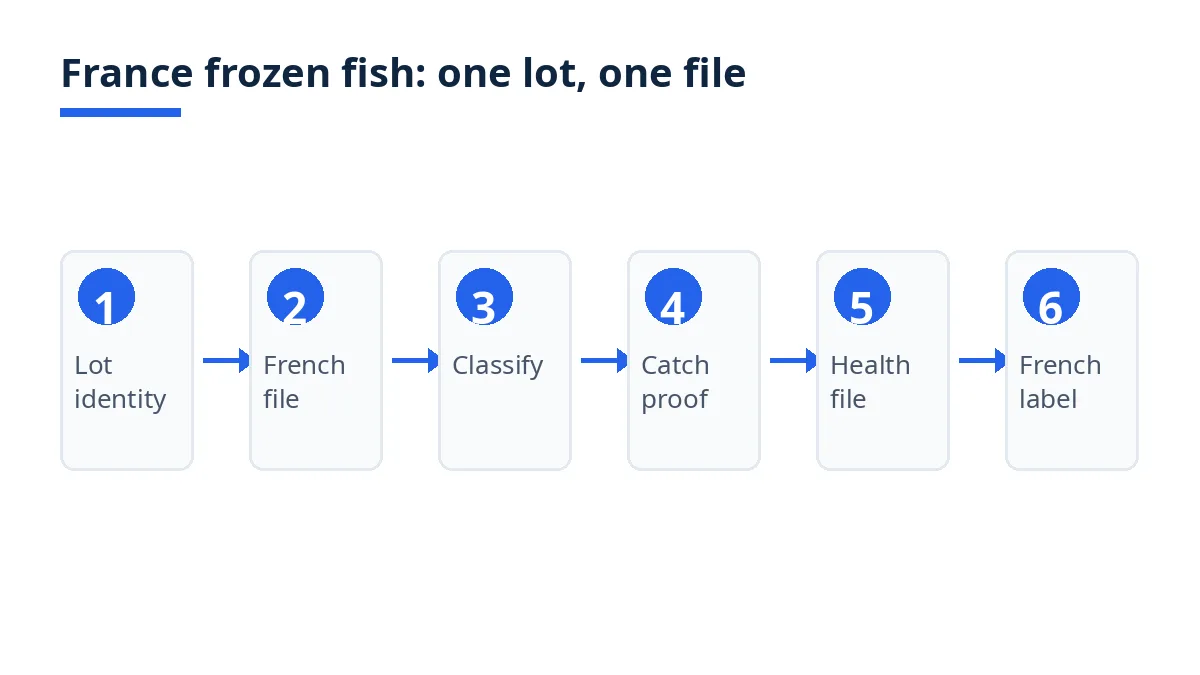
A France buyer does not order frozen fish in general. The buyer orders one lot: one species, one origin, one form, one pack, and one file that follows the lot from the plant in Bangladesh to the cold store in France. When any part of that identity changes, the customs line, the catch proof, the label, and the price can all change with it.
This guide is for France-based importers, wholesalers, processors, retailers, and food service buyers bringing frozen fish from Bangladesh into France. Every duty figure is indicative until a broker confirms it on the exact tariff line for the entry date. Every cost figure is an example figure only. No French port or border control post is named here: the buyer confirms the designated post for the lot with the broker and the French border service, in writing, before ordering.
Start with the lot, not the load: species, origin, and form as one identity
Fix the lot identity before requesting a price, and keep it fixed through every document. It has three parts: the species, given by its scientific name and the commercial designation the French buyer will use; the origin, wild-caught or farmed, decided lot by lot; and the product form, whole, headed and gutted, fillet, loin, or other fish meat, with the freezing method and pack format stated alongside it.
Do not mix species, origins, or forms in one lot unless the buyer, broker, and supplier have agreed in writing how each part is identified, proved, and labeled. A lot described one way on the invoice, another way on the health certificate, and a third way on the carton will fail at the border even when the fish is in order. The European Union requires traceability for imported food and feed, with products clearly identified and linked to documentation that allows origin, production, and movement to be traced.1 Record the identity in one specification document, sent identically to every supplier, the broker, and the French customer.
The French control file in one pass: SIVEP, the three checks, and the CHED
Frozen fish from a third country is a product of animal origin. Only goods of animal origin from countries authorised to export to the European Union are admitted, and consignments face documentary, identity, and physical checks at designated border control posts (BCPs) under Regulation (EU) 2017/625.1 All BCPs apply the same official control rules, so the choice of post turns on designation for the product category and the onward route.1
In France, the checks are carried out by SIVEP, the department of veterinary and phytosanitary border control, in three stages. Document checks run in all cases, verifying the health certificate, the pre-notification, and any other required document. Identity checks, sample-based for goods other than live animals, verify that the documentation matches the goods presented. Physical checks, also sample-based for goods other than live animals, examine the goods and may include sampling for testing.2 When the checks pass, SIVEP staff issue a Common Health Entry Document (CHED) for presentation to customs, and customs levy a fee for the import controls.2
The CHED runs through TRACES, the European Commission system for traceability, certification, pre-notification, and border-check outcomes.3 The operator responsible for the consignment must notify Part I of the CHED in TRACES, and the BCP officer validates Part II, the decision, after the checks; importers need to be registered with the relevant competent authority to use the system.3 Agree in writing before the order ships: the designated French BCP, who files Part I, and the pre-notification deadline that BCP applies. This guide states no deadline figure, because no French authority page opened for this article states one. A non-compliant consignment may be refused entry, destroyed, re-dispatched, or given special treatment, with reinforced controls possible on future consignments from the same origin.1
Classify the lot and settle duty and VAT before you price
Classification follows the lot identity. The tariff page for subheading 0303 89, "Other," lists 21 commodities with a third country duty for each line, with the date of trade shown as 1 January 2023.4 Freshwater fish on line 0303 89 10 00 shows 8.00 percent; redfish shows 7.50 percent; Orcynopsis unicolor shows 10.00 percent; sea bream, gilt-head sea bream, ray's bream, and monkfish show 15.00 percent.4 Euthynnus fish for the industrial manufacture of products of heading 1604 shows 0.00 percent, while other Euthynnus fish show 22.00 percent.4 No rate transfers between lines.
The same page carries notes that matter for form. Fillets include loins, defined as strips of meat with head, guts, fins, and bones removed, and the notes name fillet codes under heading 0304, including cod under 0304 71, tuna under 0304 49 and 0304 87, swordfish under 0304 45 and 0304 84, and marlin, sailfish, and spearfish under 0304 49 and 0304 89.4 A whole frozen fish and a frozen fillet from the same species are different classification questions. Ask the broker to confirm the heading and exact line on the EU TARIC line for the entry date, and treat every rate here as indicative.
Ask the broker in writing whether any preference or quota route applies to the exact line on the entry date, what origin rules and proof it requires, and whether the lot meets them. The landed-cost example claims no preference and no quota route. For French import VAT, the official tax bulletin states that supplies of foodstuffs for human consumption fall under the reduced rate of 5.5 percent, subject to limited exceptions such as confectionery, chocolate products, margarines, caviar, and alcoholic drinks.5 The rate, VAT base, and payment route for a specific import are for the broker and tax adviser; the example below applies 5.5 percent on the customs value plus duty as its stated example basis.
Prove wild catch or farm origin lot by lot: certificate, processing statement, and CATCH
For wild-caught fish, importation of fishery products obtained from illegal, unreported, and unregulated (IUU) fishing is prohibited, and fishery products may only be imported with a catch certificate conforming to the IUU Regulation, validated by the flag State of the vessel or vessels that made the catches, containing all the information in the Annex II specimen.6 The importer submits the validated certificate at least three working days before the estimated time of arrival, although the deadline may be adapted by product type, distance, or transport means.6 Build the three-working-day rule into the sailing plan as the default, and confirm any adaptation in writing.
Where the fish was processed in a third country other than the flag State, the importer must also submit the statement established by the processing plant and endorsed by its competent authorities, describing the unprocessed and processed products and quantities, confirming the processed products were made from catches with validated catch certificates, with the original or a copy of the catch certificate attached depending on whether the whole catch was used.6 Where verification is required, release is suspended and storage costs are borne by the operator; where refusal conditions are met, including a missing or unvalidated certificate, importation is refused.6
Since 10 January 2026, EU importers must submit catch certificates and related documents through CATCH, the EU-wide real-time system for the catch certification scheme, part of TRACES NT.7 Use of CATCH is compulsory for EU importers from that date, while use by non-EU exporters and authorities is voluntary but strongly recommended; where the exporter supplies paper documents, the EU importer enters the data manually in CATCH and attaches scanned copies.7 Ask at enquiry stage which route the documents will take. For farmed lots, ask the supplier and broker in writing what farm proof the French file requires, and record the answer lot by lot.
Health certificate and listed establishment: check TRACES-NT twice
Animals and animal products from non-EU countries can only enter the EU market with an official certificate, carrying a public health attestation and, for certain fish and fishery products, an animal health attestation.8 The certificate must be signed by the official veterinarians in the non-EU country, is always checked at border control posts, and may be paper or electronic, with the electronic form submitted through TRACES NT.8 A single mistake is sufficient for rejection, and an incorrect weight, while not a sanitary issue, will lead to rejection.8 Check the certificate line by line before shipment: species, form, quantity, weights, establishment name and approval number, and destination must agree with the invoice, packing list, and CHED.
The certificate only works if the processing establishment is listed. Animals and goods derived from them can only enter the EU from listed non-EU countries, published in Regulation (EU) 2021/404 for animal health and Regulation (EU) 2021/405 for public health, and only a listed country may propose establishments for listing.9 Establishments must comply with Annex III to Regulation (EC) No 853/2004, with fishery products in Section VIII, with compliance checked and guaranteed by the non-EU competent authority.9 The published lists are derived from TRACES-NT data, and their accuracy is the responsibility of the non-EU competent authority.9 Check the listing twice, at shortlist stage and again before shipment, and keep a dated record of both checks.
Label in French for the French buyer: Article 35 facts and the French commercial designation
Agree the label before production. Fishery and aquaculture products may be offered for sale to the final consumer or a mass caterer only if the marking or labelling indicates the commercial designation and scientific name, the production method using the words "caught," "caught in freshwater," or "farmed," the catch or farming area and the fishing gear category, whether the product has been defrosted, and the date of minimum durability where appropriate.10
The commercial designation is a French-list question. Member States draw up and publish a list of the commercial designations accepted in their territory, with scientific names, giving the species name in the official language or languages of the Member State.10 Confirm the accepted French designation for the exact species on the French list before artwork is approved: a trade name used in Bangladesh, or an English market name, is not a substitute. Where a mixed product consists of the same species from different production methods, the method for each batch must be stated.10
The area wording follows the production method. For fish caught at sea, the indication gives the FAO fishing sub-area or division in writing, or, for waters other than the Northeast Atlantic and the Mediterranean and Black Sea, the name of the FAO fishing area.10 For freshwater fish, it refers to the body of water of origin; for aquaculture products, to the country where the product reached more than half of its final weight or stayed for more than half of the rearing period.10 Voluntary information may be added only where it is clear, unambiguous, and verifiable, and a QR code may carry part or all of the Article 35 information.10 Approve the full French label text with the French customer and broker at sample stage, and never approve bulk production on an English-only artwork.
The Bangladesh-side file: get every document for the exact line in writing
No Bangladesh-side document list is stated in this guide, because no Bangladesh authority page was opened in full for this article. A list borrowed from a different fish line, heading, or year would mislead a buyer who relies on it. Treat the Bangladesh-side file as a written-confirmation step with a hard rule: the supplier names, in writing, every export document that applies to the exact lot, line, and form, and the shipment does not load until each named document is confirmed.
Ask for the list in the first enquiry, alongside the specification: who issues each document, what it must state about species, form, quantity, and weights, and whether any document depends on the lot being wild-caught or farmed or on the plant's listing status. Cross-check the answers against the broker's file, so both document sets describe the same lot. Where a document cannot be named or confirmed before loading, hold the shipment and resolve the gap in writing. A document discovered missing at the French border cannot be created retrospectively in a way the border will accept, and the cost is storage, re-dispatch, or destruction.1 Apply the same rule to the plant's food safety arrangements: ask what programme the plant runs and what records will be shown for the lot.
Write one specification so the certificate, carton, and label describe one product
One specification, sent identically to every supplier, keeps the lot identity intact. A specification that differs between suppliers cannot produce comparable quotations, and one that differs between the invoice and the label cannot pass the border. Fix every line below before quoting, and state the weighing and counting basis in the same document.
Specification line | Decide before quoting |
|---|---|
Species and names | Species, scientific name, and the accepted French commercial designation |
Origin per lot | Wild-caught or farmed, with the FAO area or farming country wording for the label |
Product form | Whole, headed and gutted, fillet, loin, or other fish meat; skinned or not skinned |
Size and count | Size range or count per unit weight, uniformity rule, and treatment of out-of-range pieces |
Glaze and net weight | Glaze percentage, net weight basis, drained weight where required, and weighing method |
Freezing method | Individually quick frozen or block frozen, freezing date record, and defrosted status for the label |
Pack format | Inner packs, master cartons, carton net weight, marks, lot coding, and label artwork approval |
Entry file | Catch or farm documents, health certificate model, establishment approval number, and BCP |
Delivery and inspection | Delivery term and named place, inspection plan, and cold chain record for the lot |
State whether every price is quoted on net weight or glazed weight, and rework every quotation to the same basis before comparing.
Find and check suppliers against the French file, not the price list
Shortlist processors whose current range already includes frozen fish for the European Union in the species, form, and presentation the order needs. Browse suppliers on Exportain and read each profile for the species, forms, and pack formats it actually runs, then send the identical specification to a small shortlist and ask for replies in the same format: species and presentation, glaze and weight basis, pack format, price inclusions, validity, and minimum per item and presentation.
Verification has three layers, all before any payment. First, listing: the plant appears on the current TRACES-NT establishment list for fishery products, with no restriction that excludes the lot, and the country is listed.9 Second, file discipline: ask for a sample document set from a recent EU shipment, with names and prices removed, and check that the health certificate, catch or farm documents, invoice, packing list, and CHED information agree on species, form, quantity, weights, and establishment.8 Third, lot discipline: a sample carrying the agreed French label, glaze, and count, with a temperature record, checked on arrival against the specification. On Exportain, profiles carry document and photo review badges: a review of documents and photos, not a factory inspection or a guarantee. Exportain is not a party to the contract for the goods, does not inspect goods, book freight, or clear customs. Pay only the company account named in the supplier documents, never a personal account, and verify any change of bank details through a separate channel before paying.
MOQ, pricing, and samples without a stated typical minimum
There is no single typical minimum for frozen fish from Bangladesh, and this guide states none. The minimum is set per species, form, presentation, and pack format, because raw material is bought and processed in lots and a freezing and packing run is set up per line and per carton size. Ask how the minimum splits across those points, and get the split in writing before comparing quotations. A minimum for whole fish does not transfer to fillets, and a minimum for one carton size does not transfer to another.
Compare prices only on the identical specification, delivery term, and document set, on the same weight basis. Ask for the price inclusions in writing: what the price covers up to which named place, which documents are included, and which charges sit outside the price. Samples work in stages: a development sample shows whether the plant can produce the presentation and count, and a pre-production sample, made under actual production conditions with the agreed French label attached, is the sample to approve for bulk. Do not approve bulk until the sample record is signed and glaze, count, and drained weight have been checked against the specification.
Quality control, cold chain, and the reefer leg
Quality control for frozen fish is cold chain and weight discipline, checked lot by lot. Agree the holding temperature in writing as a number, the temperature record for the container, and the check on arrival. Agree how net weight is verified: drained weight after thawing under an agreed method, the glaze percentage, and the tolerance on size and count. Agree the inspection plan before production: which cartons are opened, which checks run, what defect limits apply, and who decides whether a lot passes.
Sea freight in reefer containers is the standard route for bulk frozen fish. Plan from the forwarder's current sailing schedule in three blocks kept separate: production time, sea transit, and French border control, clearance, and onward delivery. The catch certificate deadline for wild-caught lots, at least three working days before estimated arrival,6 and the CHED pre-notification deadline confirmed with the BCP in writing, both sit inside the transit block. On arrival, check the temperature record, carton marks, and lot coding against the specification before the lot leaves the cold store.
Delivery terms: choose the rule that matches the container handover
Incoterms are eleven three-letter trade terms, published by the International Chamber of Commerce, that define who arranges and pays for transport, at what point risk passes from seller to buyer, and who handles export and import clearance.11 They say nothing about the price of the goods, the payment method, or when title transfers.11 Incoterms 2020 is the edition in force, in effect since 1 January 2020, and the edition must be named in the contract, because an older edition can still be agreed where both parties name it.11
Seven rules work for any mode of transport: EXW, FCA, CPT, CIP, DAP, DPU, and DDP. Four rules are for sea and inland waterway transport only: FAS, FOB, CFR, and CIF.11 For containerised frozen fish, the handover usually happens at an inland depot or terminal, not at the ship's rail, and FCA is the better fit: the seller delivers the goods, cleared for export, to a carrier or place named by the buyer, and risk passes on handover at that named point.11 Using a sea-only term such as FOB for a container that changes hands at an inland yard leaves the road leg to the port in a grey area over who carries the risk.11
Under CIF, the seller pays cost, freight, and a marine insurance policy to the destination port, while risk passes to the buyer once the goods are on board at origin, and the insurance required is the minimum level, Institute Cargo Clauses (C), for at least 110 percent of the contract value.11 Under CIP, the seller must buy all-risk cover at the level of Institute Cargo Clauses (A), also for at least 110 percent.11 Cost and risk points are not always the same: under the C-group rules the seller pays freight to the destination but hands off risk at origin.11 Under DAP, the seller carries cost and risk to the named destination, ready for unloading, and the buyer handles unloading and import clearance.11 State the rule, named place, and Incoterms 2020 version in every document. For a first France order, weigh FCA at the named place in Bangladesh against CIF to the French port of entry, and choose on the handover that actually happens, not the headline price.
Landed cost example in euros
A landed cost is the full cost of one kilogram of frozen fish, cleared and delivered to the buyer's cold store in France. Every number below is an example figure only, for 1,000 kilograms net weight of freshwater fish on line 0303 89 10 00, shipped by sea from Chattogram, with duty at the indicative 8 percent rate,4 import VAT at 5.5 percent on the customs value plus duty as the stated example basis,5 and no preference or quota route claimed. Confirm the duty rate, any preference or quota position, the VAT rate and base, and the payment route with the broker and tax adviser before using any figure as a budget.
Example figures: per kilogram, net weight, euros. Figures are rounded to two decimals; the total is the sum of the rounded lines.
Cost element | Example figures (per kg) | How to obtain your figure |
|---|---|---|
Product price, FOB Chattogram | 5.40 euros | Pro forma invoice |
Freight and insurance, per kg | 0.68 euros | Forwarder quotation |
Customs value, per kg | 6.08 euros | Price plus freight and insurance |
Duty at indicative 8 percent of customs value | 0.49 euros | Broker calculation on the TARIC line |
Import VAT at 5.5 percent in this example, on customs value plus duty | 0.36 euros | Broker and tax adviser |
SIVEP fee, port, clearance and broker fees, per kg | 0.35 euros | BCP, port and broker invoices |
Delivery to cold store, per kg | 0.24 euros | Local carrier quotation |
Total landed cost, per kg | 7.52 euros | Sum of all lines above |
The SIVEP control fee is a real charge: customs levy a fee for the sanitary and phytosanitary import controls.2 Its amount for the lot comes from the broker, not from this example. Rework the table with the broker-confirmed duty, the adviser-confirmed VAT basis, and actual invoices after the first shipment.
France fish import sequence, step by step
Fix the lot identity: species and scientific name, wild-caught or farmed origin, form, and pack.
Name the designated French BCP and agree the CHED filer and pre-notification deadline in writing.3 2
Classify on the exact line and confirm duty, preference, and VAT positions with the broker and tax adviser.4 5
Agree the catch or farm proof route per lot, including the CATCH route and the three-working-day catch deadline for wild-caught lots.6 7
Check the plant on the current TRACES-NT list, and recheck before shipment.9
Agree the French label facts and approve the French artwork at sample stage.10
Get the Bangladesh-side document list for the exact line in writing, and hold the shipment until every document is confirmed.
Send one specification to every supplier and compare quotations on the same weight basis and terms.
Verify the supplier in three layers and approve a pre-production sample with the French label.
Agree inspection, cold chain record, and weight verification before production.
Ship on the agreed delivery term, with the CHED filed and the catch certificate submitted on time.11
Clear the French border and customs with all documents in agreement, and reconcile the actual landed cost per kilogram.
What is the typical MOQ for frozen fish from Bangladesh?
There is no single typical minimum, and no figure is stated here. The minimum is set per species, form, presentation, and pack format, because raw material is bought and processed in lots and a freezing and packing run is set up per line and per carton size. Ask how the minimum splits across those points, get the split in writing, and compare minimums only on the identical specification.
How long does shipping take?
Production time, sea transit, and French border control, clearance, and delivery are separate blocks, and no combined figure is stated here. Sea transit takes weeks rather than days, so plan from the forwarder's current sailing schedule and add border-control time, the three-working-day catch-certificate deadline for wild-caught lots,6 the CHED pre-notification deadline confirmed with the BCP,3 and onward delivery to the cold store.
What import duty applies?
Duty follows the confirmed classification, entry date, and origin position. The example line is freshwater fish on line 0303 89 10 00, shown with a third country duty of 8.00 percent, while other lines under the same subheading range from 0.00 percent to 22.00 percent.4 Treat every rate as indicative, verify the rate on the EU TARIC line for the entry date, and confirm any preference or quota route, with its origin rules and proof, with the broker before fixing a price. Import VAT is separate: foodstuffs for human consumption fall under the reduced rate of 5.5 percent subject to limited exceptions,5 and the rate, base, and payment route for the lot must be confirmed with the broker and tax adviser.
How do I verify a supplier?
Check the establishment listing first: the plant must appear on the current TRACES-NT list for fishery products, with no restriction that excludes the lot, and the country must be listed.9 Then check file discipline on a recent EU shipment, with the health certificate, catch or farm documents, invoice, packing list, and CHED information in agreement.8 Then check lot discipline: a pre-production sample with the agreed French label, glaze, and count, and a temperature record. Recheck the listing before shipment, because listings change.
Next steps on Exportain
Read the general guide to importing from Bangladesh for the full process, and the classification guide for frozen fish to check the 0303 and 0304 lines before pricing. Use the landed cost guide for imports from Bangladesh for the full cost method, and see how to buy for the buying journey. When the lot identity, the French file, and the label are fixed, post a free RFQ with the species, form, glaze, and delivery term.
Sources
- Import controls of food and feed Q&As. European Commission (accessed )
- How are SPS border controls carried out?. French Ministry of Agriculture, (accessed )
- How should you carry out your SPS border control procedures (information systems)?. Ministry of Agriculture (France) (accessed )
- Other - Subheading 030389, Northern Ireland Online Tariff. GOV.UK (accessed )
- TVA - Liquidation - Taux réduits - Produits destinés à l'alimentation humaine. BOFiP, French tax administration (accessed )
- Council Regulation (EC) No 1005/2008, Chapter III: Catch certification scheme for importation and exportation of fishery products. legislation.gov.uk, (accessed )
- Frequently Asked Questions: What is new in the EU catch certification scheme after the amendment of the EU IUU Regulation. Sea-Fisheries Protection Authority (accessed )
- EU official health certificates for exports to the EU – explained. AGRINFO (accessed )
- Non-EU countries authorised establishments. European Commission (accessed )
- Regulation (EU) No 1379/2013 on the common organisation of the markets in fishery and aquaculture products. legislation.gov.uk, (accessed )
- Incoterms 2020 Explained: Complete Guide (2026 Update). Inecta (accessed )
About the author
Sourcing from Bangladesh?
Post a request for quotation and suppliers on Exportain can send you their quotes directly.
Post an RFQ