Australia Electrical Cable Imports From Bangladesh: Gateways and RCM
The state gateway, the RCM and responsible-supplier file, and the broker-confirmed duty and GST position decide an Australian cable import before price does. This guide works through each in decision order, with a worked landed-cost example in Australian dollars.
Short answer
Importing electrical cables from Bangladesh to Australia works when the state gateway, the conformity file, and the border file are settled before price is discussed. Choose the port by the delivery state and terminal, name the Australian responsible supplier and the EESS route for the exact cable, and have a customs broker confirm the heading 8544 code, any LDC preference, and the GST position in writing before the order is priced.
On this page
Key takeaways
Choose the gateway by delivery state and terminal: Melbourne for Victoria, Port Botany for New South Wales, Brisbane for Queensland, and the Fremantle area for Western Australia; confirm the terminal, storage terms, and onward service before comparing freight.
Settle the EESS scope answer for the exact cable first: in-scope equipment needs a registered Australian responsible supplier, the risk-level evidence and registration, and the RCM; New South Wales keeps its own declared and non-declared system.
No duty rate is stated in this guide: the broker must confirm the heading 8544 code, the measures in force, any LDC preference and the origin evidence, and the LDC position for Bangladesh on the import date, all in writing.
GST is 10% of the value of the taxable importation, which adds customs value, duty, transport, and insurance together; keep the finalised N10 and official receipt as the evidence for any GST credit, and keep all declaration documents for five years.
Price on a worked landed cost in Australian dollars with duty as a separate line to be inserted, GST shown as its own cash-flow line, and compare suppliers line by line on the same delivery basis.
An Australian cable order is settled at four points before price matters: the state gateway where the container lands, the Australian party who stands behind the cable's electrical safety, the standard the exact cable is built to, and the customs file that releases the drums. A buyer who starts from price and leaves those four points until later pays the difference in storage, retesting, or drums that cannot be put to their intended use. The sections below settle the four points in the sequence a buyer should take them.
Pick the Australian gateway by state and terminal
Australia has no single cable gateway. The right port follows the delivery state, because a container landed on the wrong coast buys a long inland leg across a continent. Start from the warehouse or project address, work back to the nearest container port, and confirm the terminal inside that port: the terminal decides where the container is unloaded, where drums sit if the box is held, and which onward service carries them to the buyer. A quotation naming only a city has not answered the gateway question.
For Victoria and the south-east, the Port of Melbourne is primarily a container port, with Swanson Dock East and West and Webb Dock East as its international container terminals, handling more than one-third of Australia's container trade.1 A Melbourne buyer should ask which dock area takes the vessel and where drums are unloaded if the container is opened at the port rather than delivered sealed. For New South Wales, Port Botany handles 99.6% of the container traffic in the state, or 2.8 million TEU a year, across three container terminals run by independent stevedores with 12 shipping berths, with on-dock rail at all three terminals and dedicated freight rail to Cooks River and Enfield.2 A Sydney buyer should ask which stevedore terminal receives the box, how much free storage time that terminal allows, and whether drums travel onward by rail or by road, since the two routes price differently.
For Queensland, the Port of Brisbane sits at Fisherman Islands at the mouth of the Brisbane River, with the equivalent of eight 300-metre container berths and 2,469 metres of quayline, leased and operated by three stevedores: DP World (Brisbane), Patrick Terminals, and Brisbane Container Terminals.3 The Brisbane Multimodal Terminal behind the terminals links rail, road, and the container terminals, with dual-gauge rail.3 A Brisbane buyer should confirm the berth operator, the rail or road leg to the warehouse, and the heavy-load position, since loads above 90 tonnes need the port operator's approval to move to the Fisherman Islands wharves.3 For Western Australia, Fremantle Port handles most of the state's container trade, and the long-term plan moves the primary container port to a new facility at Kwinana as the Westport program is built.4 A Perth buyer should confirm with the forwarder which Fremantle-area gateway applies to the shipment week.
Break-bulk drums change the question. A drum shipment that arrives loose, or a container that must be unpacked at the port so drums can be checked, needs a terminal and a warehouse that can receive, store, and reload heavy reels. Ask the forwarder to name the unpacking point, drum storage, reel-moving equipment, and the daily charge while drums wait.
Gateway | Suits | Onward leg to pin down | First question to answer |
|---|---|---|---|
Port of Melbourne (Swanson Dock, Webb Dock East) | Victoria, south-east delivery addresses | Road or rail from the named dock area | Which dock area takes the vessel, and where drums are unloaded |
Port Botany, Sydney | New South Wales, greater Sydney | On-dock rail to Cooks River or Enfield, or road direct | Which stevedore terminal receives the box, and the free-storage period that terminal allows |
Port of Brisbane, Fisherman Islands | Queensland, Brisbane and the south-east | Rail or road through the Brisbane Multimodal Terminal | Which berth operator, and the heavy-load position for the shipment |
Fremantle area, Perth | Western Australia | Road or rail from the Fremantle-area gateway | Which gateway applies in the shipment week, and what the Kwinana transition changes |
Settle the Australian conformity route before the construction is chosen
Australian electrical safety does not run on a single national certificate a Bangladeshi supplier can simply attach. It runs on state-based law, a national framework called the Electrical Equipment Safety System (EESS), and a responsible supplier in Australia or New Zealand who stands behind the equipment. Fix the route for the exact cable before choosing the construction: the route decides what evidence the supplier must produce, who registers what, and what mark the cable carries.
The first test is whether the cable is in scope for the EESS at all. In-scope electrical equipment is low voltage equipment rated above 50 V AC RMS or 120 V ripple-free DC and below 1,000 V AC RMS or 1,500 V ripple-free DC, designed or marketed as suitable for household, personal, or similar use, and the household test holds even when the maker also markets the equipment for commercial or industrial purposes.5 A cable bought only for an industrial installation, never designed or marketed for household-type use, sits outside that definition, but it still has to be electrically safe: equipment that is not in scope still needs to be electrically safe, and meeting the essential safety criteria of AS/NZS 3820:2009 is generally how that is shown.6 Get a written scope answer for the exact cable and its intended use, from the Australian party who will stand behind it, before ordering.
Where the cable is in scope, the EESS classifies it into three risk levels with rising evidence and registration duties.5 Level 3 equipment must be electrically safe and meet the relevant standard, carry the Regulatory Compliance Mark (RCM), hold a valid Australian or New Zealand certificate of conformity, and be registered in the national EESS database linked to the registered responsible supplier.5 Level 2 equipment must be electrically safe and meet the relevant standard, carry the RCM, be registered in the database linked to the responsible supplier, and have a compliance folder the responsible supplier keeps and makes available within 10 days when asked.5 Level 1 equipment must be electrically safe and meet the relevant standard, carry the RCM, have documentary evidence in English showing it met the standard when manufactured or imported, and be linked to the registered responsible supplier, with evidence kept for five years from the last day the item is manufactured or imported by that supplier.5
One cable type is named directly in the EESS classification document, and it matters for most building-cable orders. "Building wiring cable" covers a single or multicore cable insulated with polymeric materials with one to five conductors of stranded or solid copper, in a flat or circular laid-up configuration, sheathed or unsheathed, with active phase conductors of 0.5 mm2 to 16 mm2, insulation designated V-75, V-90, V-90HT, or X-90, for use at working voltages up to 450 V/750 V or 0.6/1 (1.2) kV.5 The definition excludes armoured, metallic screened, and metal sheathed cables, halogen free cables, cables with a fire rating, supply flexible cords, control cables whose conductor insulation is not individually coloured, cables with Class 5 or greater conductor flexibility, and cables outside the scope of AS/NZS 5000.1 or AS/NZS 5000.2, with AS/NZS 5000.1 as the class specification up to 0.6/1 (1.2) kV and AS/NZS 5000.2 up to 450/750 V.5 A cable outside that definition — armoured, screened, fire rated, flexible, or above 16 mm2 — needs a different route. Ask the responsible supplier to place the exact construction inside or outside the definition in writing, naming the standard and edition that applies.
The responsible supplier is the hinge of the whole route. The EESS framework requires the on-shore manufacturer or importer to meet all EESS requirements: categorize the equipment at Level 1, 2, or 3, ensure it meets the safety requirements, register the supplier and the equipment as the level requires, pay the registration fees, and mark the product with the RCM under AS/NZS 4417.1 and AS/NZS 4417.2.7 A second or later supplier in the chain must instead make sure the equipment came from a registered responsible supplier, that it is registered where Levels 2 and 3 require it, and that it carries the RCM.7 Name the Australian party before the order, confirm that party accepts the role for this cable, and record what evidence it will hold: a quotation promising RCM marking without naming the responsible supplier leaves the buyer holding a mark with nobody behind it.
New South Wales breaks the national pattern, and a Sydney buyer must handle it directly. Household electrical equipment safety in Queensland, Victoria, Western Australia, and Tasmania is regulated through the EESS, South Australia, the Northern Territory, and the Australian Capital Territory are transitioning to it, and New South Wales is not participating: it keeps its declared and non-declared classifications and requirements.8 Every jurisdiction requires equipment to be shown electrically safe and at a minimum to meet Australian and New Zealand electrical safety standards.8 Prepare a nationally sold cable as if every destination state will test it, and ask the delivery state's regulator or compliance adviser what it requires.
The RCM needs the same two-sided check. The mark is shared by the electrical safety arrangements and by the Australian Communications and Media Authority (ACMA) labelling arrangements, which cover electromagnetic compatibility, radiocommunications, and telecommunications. ACMA registration runs on the same national database, the EESS Platform: a supplier registers there, gives an Australian address and a representative's contact details, and selects "ACMA only" when the product does not have to meet the EESS equipment safety rules.9 ACMA-only registration is free; products that must meet the EESS safety rules carry fees and need each product registered.9 An RCM on a drum label therefore proves only what the party behind it registered for. Ask the responsible supplier to state in writing which arrangements the RCM covers for this cable, what evidence sits behind each, and where each registration can be checked.
The construction standards sit underneath the framework, and the buyer should name them on the order. AS/NZS 5000.1:2005 is the polymeric insulated cable standard for working voltages up to and including 0.6/1 (1.2) kV, and AS/NZS 5000.2 covers the 450/750 V range named in the EESS definition.5 10 Conductors answer to a separate international standard. IEC 60228:2023 deals with conductors in electric power cables and cords: it lists the permitted nominal cross-sectional areas, running from 0.5 mm2 at the bottom of the scale to 3,500 mm2 at the top, and it lays down wire-number, wire-size, and resistance requirements that are judged on the finished cable, not on the conductor before it is cabled.11 Have the quotation and the test evidence carry the conductor size together with the construction standard and its edition, and state that the size was checked on the finished cable. A trade size on its own, or a standard number with no edition beside it, gives the buyer nothing to match against the test report. Where the cable is a special type with its own Australian or New Zealand standard — aerial bundled, welding, flexible cord, or a fire-rated construction — name that standard instead.
Find and check suppliers against the Australian file
Send one identical brief to each shortlisted supplier: the delivery state and gateway, the construction, its standard and edition, the EESS scope answer with the responsible supplier already named, the quantities and drum arrangements, the delivery rule with its named places, and the warehouse arrival date the cable must meet. A set of replies priced against mismatched constructions, standards, or delivery rules gives no ranking worth using. Lay the replies side by side on a single table, with each supplier's written answers kept beside its quotation.
Check the business papers alongside the technical file. Request the registered legal name and address, matching the name that will appear on invoices and shipping documents, together with the trade licence, the taxpayer identification number and VAT registration where applicable, and the Export Registration Certificate (ERC), the registration an exporter needs in order to export from Bangladesh.12 Check names, addresses, and validity periods across the documents, and make sure the company name on the quotation, the proforma invoice, the bank account, and the shipping documents is the same legal entity, or that any difference has a clear documented explanation.12 On Exportain, read what each trust badge covers before relying on it: a badge records which document and profile checks were reviewed, not a factory audit, an inspection of the buyer's goods, or a guarantee of capacity, quality, or delivery, and membership alone never grants a badge.12
Score each supplier on three checks, taken in this order. First, does the technical evidence name the exact construction, standard, and edition requested, with test reports the buyer can read and a scope answer the responsible supplier has accepted? Second, does the supplier answer scope and standard questions directly, including which cables it will not cover and what changes when the construction falls outside the building-wiring-cable definition? Third, are drum, length, and remainder terms, and the delivery rule with its named places, given as figures and places rather than general assurances? A supplier who fails the first check yet quotes keenly will prove the dearest on the list, because retesting, relabelling, or a rejected delivery costs more than the deposit saved. Read a refusal to answer a scope question, or papers naming a different construction, as a failed check.
Treat the approval length as the reference the whole order is judged against. Put the approval in writing against the specification, hold back a retained length marked with the construction and the date it was approved, and require every production drum to match that length in construction, marking, and labelling. When a test report arrives, line up three names — the report, the approval length, and the production drums — and reject the shipment file if any one of them names a different construction. On a first order, include a trial length in the budget so the installer sees the real cable on site before the bulk drums ship. Settle who funds an independent check in the order, and read any refusal of independent checking as a warning sign.
Fix quantity, drum, and sample terms in writing
Work back from the installation, not forward from the drum. List the runs the installer will pull and the length each run needs, add the allowance for offcuts, waste, and spares, then convert that list into a drum schedule: total metres, metres per drum, the tolerance allowed on each drum, how short lengths and remainders are dealt with, drum ownership and return, and what a short or damaged drum costs in lost site time. Settle the unloading sequence with the installer ahead of loading, and put that sequence on the packing list so the warehouse releases drums in the order the site pulls them.
Ask what the minimum counts before accepting it. The figure may be set for one construction, one standard, or one production run, and each basis changes how much cable the buyer actually receives. Set the supplier's stated basis beside the installer's run lengths with the offcut, waste, and spares allowance added, and see whether the order still fits. If the minimum runs larger than the job needs, test what brings it down — smaller drums, a place on a combined production run, or delivery across two dates — and record the agreed figure in writing as a number of metres, not as an assurance that the quantity will work out.
Timber drums carry a biosecurity file of their own. ISPM 15 is the international standard for regulating wood packaging material in international trade, and Australia has incorporated its requirements into the conditions for importing solid wood packaging material, set out in the Biosecurity Import Conditions (BICON) system.13 The standard applies to raw wood packaging material including drums, cases, and spools or reels, while wood packaging made wholly of processed wood material such as plywood, particle board, or oriented strand board is exempt.13 Non-commodity timber in containerised cargo must be declared to the Department of Agriculture, Fisheries and Forestry and accompanied by appropriate documentation, including ISPM 15 compliance statements or evidence of alternative treatment, and timber packaging found non-compliant will be sent for treatment, export, or destruction at the importer's expense.13 Ask the supplier to state the drum material, the ISPM 15 mark or alternative treatment evidence for each drum, and the declaration wording the shipment will carry, before loading.
Convert every quotation to one delivery basis before ranking any of them. Each quotation should itemise the goods price, the freight and insurance position under its delivery rule, and the charges that fall on the buyer at the port, through customs, and on the inland leg to the warehouse. A single lump sum that names no delivery rule hides where the seller's costs stop and the buyer's begin, so two lump sums cannot be compared at all. Where a supplier changes the delivery basis mid-negotiation, redo the comparison from the start rather than adjusting the old ranking.
Move drums under Incoterms 2020, with no transit-time promise
Three questions sit behind the delivery rule: who arranges the carriage, who bears the risk while the drums are in transit, and who clears the goods. The sea and inland-waterway-only rules are four — FAS, FOB, CFR, CIF; CPT is any-mode; DPU is any-mode; DDP is any-mode (seller clears import customs, pays duty); FCA is any-mode. State the delivery place in full in the contract: the ICC Academy summary warns that an imprecise port name lets the seller choose a terminal the buyer never expected, leaving the inland cost with the buyer.14 For drums travelling in containers, FCA fits the Australian leg better than FOB even where the main leg is by sea: under FOB the risk stays with the seller until the goods cross onto the vessel, yet containerised drums spend their waiting time at the terminal before loading, and that waiting time is where handling damage happens.14 Where the purchase is on FOB terms, get the forwarder's written answer on who bears the risk during terminal handling.
Treat the C rules as insurance questions before anything else: the buyer pays for no carriage under them, yet bears the transit risk from an early point. Under CPT and CIP the buyer takes the transit risk once the carrier has the goods, and under CFR and CIF once the goods are loaded on board — while in each pair the seller still arranges and funds the carriage as far as the named destination.14 Insurance is the seller's duty only under CIP and CIF; under CPT and CFR it falls to the buyer.14 The D rules run the seller's duty through to the named destination itself: DAP delivers the goods ready for unloading, with the buyer collecting from the arriving vehicle; DPU adds unloading by the seller; DDP adds import clearance by the seller.14 DAP to a named warehouse suits many first Australian orders, since the seller runs the move to Australia while the buyer holds the customs file and the duty and GST position. Before agreeing DDP, confirm the seller holds an Australian Business Number (ABN), a GST position, and a customs broker arrangement. Under DDP, settle the GST evidence in the contract, since the buyer loses direct control of the declaration supporting a GST credit.
No sailing time is promised anywhere in this guide. Arrival moves with the sailing schedule, any transshipment, congestion at the terminal, and the rail or road leg onward from the port, so a figure borrowed from another route or another season would send the installer to site on the wrong day. Ask the carrier or forwarder for the sailing, the terminal arrival expected for the shipment week, and the onward service, then set the site date from those three answers with a buffer added for inspection and biosecurity checks.
The Australian border file: declaration, duty, GST, and biosecurity
Five parties each hold one piece of the border file, and the file only moves when every piece is present. The buyer holds the ABN and the GST position. The carrier holds cargo reporting and advance data. The broker holds the declaration and the classification, and prepares the duty and origin case. The supplier holds origin evidence and the commercial documents. The importer holds the biosecurity declaration for drums and packaging. Handing the whole file to "the forwarder" fails at the first ABF question, because no forwarder can supply an ABN or a GST position the buyer has not given.
Declarations clear the goods, and the value of the consignment decides which form applies. Declarations are used by importers, or licensed customs brokers acting for them, to clear imported goods into home consumption or into a licensed warehouse.15 An Import Declaration (N10) is required when a consignment has a combined value over AUD 1,000 and is being cleared into home consumption, and all applicable duties, taxes, and charges must be paid before the goods can be released.15 The declaration states the goods, the importer details, how the goods are being transported, and the tariff classification and customs value, and it is lodged in the Integrated Cargo System (ICS) or at an ABF counter.15 Goods valued at AUD 1,000 or less generally use a Self-Assessed Clearance (SAC) declaration instead, and the ABF encourages first-time or infrequent importers to use a licensed customs broker.15 Cable shipments will almost always exceed the AUD 1,000 line, so plan on an N10 lodged by the broker, with the importer still responsible for the declaration. After the declaration is made, all relevant documents must be kept for five years.15
Start classification at heading 8544. Under that heading, the Harmonized System groups insulated wire, cable, and other electric conductors, fitted with connectors or not, with optical fiber cables made of individually sheathed fibers.16 The six-digit lines below the heading divide the family into winding wire by metal, coaxial cable, ignition and other wiring sets built for vehicles, aircraft, or ships, conductors split by the 1,000-volt line and by whether connectors are fitted, and optical fiber cables.16 Classification of the exact construction is the broker's call: the subheading follows its voltage and fitting, and the code is then worked out to its full Australian tariff form, which sets the duty line. No duty rate appears in this guide: before pricing the order, the broker confirms the full Australian code, the general rate, and every measure applying on the arrival date, in writing.
Treat preference as a file to assemble, not a flag to claim, and start from Australia's own tariff source. The ABF lists eleven other preferential arrangements that give preferential rates of customs duty to goods that are the produce or manufacture of the countries and places each arrangement covers, including the LDC rate under the Australian System of Tariff Preferences for Developing Countries, with the countries covered set out in Schedule 1, Part 2 of the Customs Tariff Regulations 2004.17 Whether a cable construction earns that rate turns on four things: the classification, the origin rule written for that code, the origin evidence the supplier provides, and whether Bangladesh holds the LDC position on the import date. Get the broker's written confirmation of all four, and have the supplier assemble the origin evidence before loading. Do not build a margin on a preference the broker has not confirmed for the exact code and construction, and do not assume a preference that applied to an earlier shipment still applies: the broker confirms the position for the import date, every order.
GST is charged on top of duty, and it follows its own formula. GST is payable on most goods imported into Australia, and the Department of Home Affairs collects it; the GST payable is 10% of the value of the taxable importation, which is the sum of the customs value, any customs duty payable, the amount paid or payable to transport the goods to their place of consignment in Australia, the insurance cost for that transport, and any wine tax payable.18 GST is generally payable before the goods are released, unless the importer is registered under the deferred GST scheme, which lets a GST-registered importer defer payment until the first activity statement lodged after import.18 A GST-registered business importing goods as part of its activities may be able to claim a GST credit, but only with documentation showing the goods were imported and GST was paid or deferred when the goods were entered for home consumption, including the finalised import declaration and the matching official receipt.18 Keep the N10, the receipt, and the broker's duty and GST calculation with the order file, and have the accountant confirm whether the GST is a recoverable credit or a final cost before pricing.
An import processing charge also applies to goods over AUD 1,000, on top of duty and GST.15 This guide states no charge figure: the broker confirms the charge for the declaration type and lodgement method in writing, and the figure goes into the landed-cost table as its own line. Biosecurity sits alongside customs, not behind it. The drum and packaging declaration, the ISPM 15 evidence, and any referral to the Department of Agriculture, Fisheries and Forestry must be ready before arrival, because a biosecurity hold at the terminal charges storage while the file is fixed. Confirm with the broker who declares the timber, what wording the declaration uses, and where the drums are inspected if the department selects the consignment.
Border file item | Owner | Confirm before |
|---|---|---|
ABN, GST registration, deferred GST position | Buyer and accountant | First quotation comparison |
Cargo reporting, advance data, and the construction description | Carrier, using buyer data | Vessel departure from Chattogram |
Import declaration (N10), classification, customs value | Broker | Arrival at the Australian terminal |
Origin rule, origin evidence, and the LDC position | Broker with supplier | Loading in Chattogram |
GST calculation, credit evidence, import processing charge | Broker and accountant | Arrival at the Australian terminal |
Timber and packaging declaration, ISPM 15 evidence | Importer and supplier | Loading in Chattogram |
Worked landed cost in Australian dollars, with duty left to the broker
Treat the table as a worked illustration, not as a quotation: every figure is an example, and the duty row stays blank until the broker has confirmed the code, the measures in force, and any preference, in writing. The example runs on FOB Chattogram, Incoterms 2020, for 12,000 metres of a single construction, with GST shown as its own cash-flow line at 10% of the pre-duty taxable value. Substitute real quotations and broker-confirmed figures before pricing.
Line | Example figures (AUD) |
|---|---|
Product cost: 12,000 metres at 2.10 per metre, FOB Chattogram | 25,200.00 |
Ocean freight, Chattogram to the named Australian terminal | 2,400.00 |
Cargo insurance | 260.00 |
Subtotal before duty | 27,860.00 |
Import duty: broker-confirmed rate applied to the customs value | Your figure |
GST before duty: 10% of the subtotal above | 2,786.00 |
Customs broker fee | 385.00 |
Destination port and terminal charges | 512.00 |
Inland delivery to the Australian warehouse | 718.00 |
Inspection and testing | 486.00 |
Bank and currency costs | 158.00 |
Total cash outlay before duty, including GST | 32,905.00 |
Landed cost per metre before duty, excluding GST | 2.51 |
Check the arithmetic this way: 25,200.00 + 2,400.00 + 260.00 = 27,860.00; 10% of 27,860.00 = 2,786.00; 385.00 + 512.00 + 718.00 + 486.00 + 158.00 = 2,259.00; 27,860.00 + 2,786.00 + 2,259.00 = 32,905.00. Before duty and excluding GST, each metre already costs 30,119.00 / 12,000 = 2.51 against a quoted 2.10, about 20% higher. Add the duty figure divided by 12,000 to reach the final landed cost per metre, and add a further 10% of the duty figure to the GST line, because GST falls on duty as well as on customs value, transport, and insurance.18 Quoting the job from 2.10 alone would absorb freight, inspection, brokerage, and delivery, plus duty and the GST cash flow, into margin.
Import checklist for a first Australia order
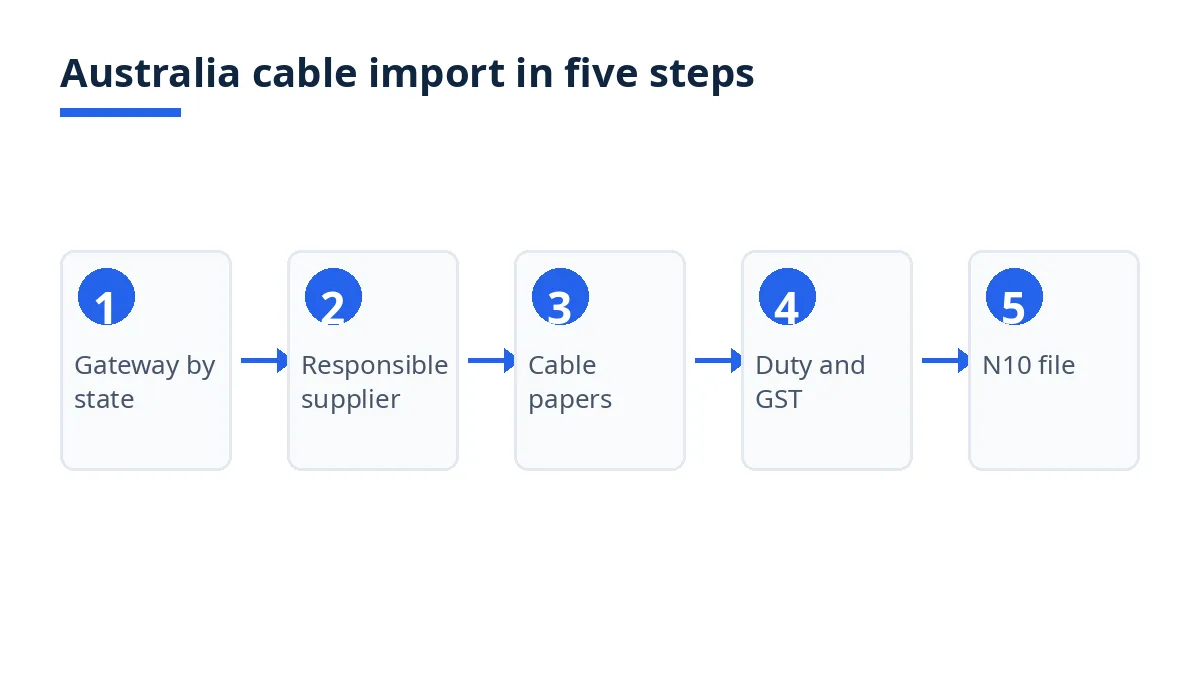
Work in this order, and record any change when a later step reopens an earlier one. First, fix the delivery state, warehouse address, gateway and terminal, and get the forwarder to confirm terminal, storage terms, and onward service in writing. Second, name the Australian responsible supplier and get the written EESS scope answer for the exact cable, including risk level and registration route. Third, settle the construction standard and edition, the conductor size measured on the finished cable, and test evidence naming the construction. Fourth, score suppliers on the Australian file and approve an approval length in writing. Fifth, settle quantity, drum, and length terms, with drum material and ISPM 15 evidence agreed and the unloading order written on the packing list. Sixth, settle the delivery rule with its named locations and confirm the cargo-report filer and the owner of each border-file piece. Seventh, have the broker confirm classification, duty line, LDC preference position, GST calculation, and import processing charge in writing, then rebuild the landed-cost table from those figures before pricing.
Questions Australia buyers ask before ordering
What order size will a Bangladeshi cable supplier require for Australia?
No figure is stated in this guide, because no single minimum covers every construction. The minimum may be set per construction, per standard, or per production run; ask the supplier to state its basis in writing, check that basis against the installer's run lengths with an allowance for offcuts, waste, and spares added, and ask what changes it — smaller drums, a combined production run, or a split delivery — before accepting it as fixed.
How long does shipping take from Bangladesh to Australia?
No sailing time is given in this guide. Arrival shifts with the sailing schedule, transshipment, congestion at the terminal, and the onward rail or road leg, so ask the carrier or forwarder for the sailing, the terminal arrival expected for the shipment week, and the onward service, then set the site date from those answers with a buffer for inspection and biosecurity checks.
What import duty and GST will an Australia buyer pay on electrical cables from Bangladesh?
The rate is not stated in this guide, because it turns on the full Australian tariff code for the exact construction and the measures current on the arrival date, and on whether the origin rule and the evidence behind it support a preference. The ABF lists an LDC rate arrangement, but the broker must confirm in writing the code, the general rate, the LDC preference position for Bangladesh on the arrival date, and every other applicable measure, and the confirmed figure goes into the landed-cost table before pricing.17 GST is separate: 10% of the value of the taxable importation — customs value, duty, transport to the place of consignment, and insurance — generally payable before release unless the deferred GST scheme applies.18
How should an Australia buyer vet a Bangladeshi cable supplier before a first order?
Brief every supplier identically, score the replies on evidence naming the exact construction and standard, direct answers on EESS scope and the responsible supplier, and drum and delivery terms given as numbers, and approve an approval length in writing with a retained length kept against it. Check the business papers — legal name, trade licence, taxpayer identification, and ERC — for consistency across the quotation, invoice, bank account, and shipping documents.12 Read a refusal to answer a scope question, or papers naming a different construction, as a failed check.
Next steps on Exportain
Use the step-by-step guide to importing from Bangladesh for the full sequence behind this Australia guide, shortlist suppliers through the supplier directory on Exportain, and test your numbers against the landed-cost worked example for Bangladesh imports before accepting a quotation. The ordering route is explained in buying on Exportain.
Post a free RFQ on Exportain and get quotes from verified Bangladeshi suppliers
Sources
- Port Infrastructure. Port of Melbourne (accessed )
- Trades Handled. NSW Ports (accessed )
- Shipping Handbook 2023. Port of Brisbane Pty Ltd (accessed )
- Westport (Kwinana port development). Infrastructure Australia (accessed )
- In-scope electrical equipment definitions, and risk levels. Electrical Equipment Safety System (EESS) (accessed )
- In-scope electrical equipment. Business Queensland (accessed )
- Selling Electrical Equipment in Australia. Electrical Equipment Safety System (EESS) (accessed )
- Equipment Safety in Australia and New Zealand. Electrical Regulatory Authorities Council (ERAC) (accessed )
- Step 4: register as a responsible supplier. Australian Communications and Media Authority (ACMA) (accessed )
- AS/NZS 5000.1:2005 | Standards Australia Store. Standards Australia (accessed )
- IEC 60228:2023 - Conductors of insulated cables. International Electrotechnical Commission, (accessed )
- How to Import from Bangladesh. Exportain (accessed )
- ISPM 15: The international standard for solid wood packaging material. Department of Agriculture, Fisheries and Forestry (DAFF) (accessed )
- Place of delivery & risk transfer in trade contracts. ICC Academy (accessed )
- Import declarations. Australian Border Force (accessed )
- Classification Detail — HS 2017 Code 8544: Insulated wire, cable and other electric conductors. United Nations Statistics Division (UNSD) (accessed )
- Other Preferential Arrangements. Australian Border Force (accessed )
- GST and imported goods. Australian Taxation Office (accessed )
About the author
Sourcing from Bangladesh?
Post a request for quotation and suppliers on Exportain can send you their quotes directly.
Post an RFQ