Denim Jeans From Bangladesh to USA: Step-by-Step Guide
USA denim jeans import guide: supplier checks, MOQ negotiation, wash and fit quality, 6203.42 and 6204.62 duty at 16.6% cotton, USA labeling, ISF, Incoterms, transit, and a worked landed-cost example for 3,600 jeans to New York.
Short answer
To import denim jeans from Bangladesh to the USA, settle classification, labeling, and the ocean filing with a customs broker before production. Classify cotton blue denim trousers under 6203.42.45 for men's and 6204.62.80 for women's at the 16.6 percent General rate in Revision 17 (2026), confirm the line for your exact fiber mix, match the label to the bulk garment, file the 10-element Importer Security Filing through your broker or designated agent, and price from landed cost.
On this page
Key takeaways
Start with the United States entry file: in Revision 17 (2026) the General rate for cotton blue denim trousers is 16.6 percent under 6203.42.45 for men's and 6204.62.80 for women's, while the Other lines for synthetic-fiber trousers are 27.9 percent for men's and 28.6 percent for women's; your broker must confirm the line, the rate, and any additional duties for your exact garment and entry date.
There is no single typical MOQ for denim jeans from Bangladesh: the minimum is negotiated per style, per color, and per wash, and it moves with the fabric mill minimum, the laundry lot minimum, and the size curve, so ask for each level separately in writing.
The label must match the bulk garment, including pocketing, lining, and stretch components: labels must accurately reflect fiber content, country of origin, and the manufacturer or marketer identity, and apparel labels must show a safe cleaning method.
For ocean cargo, the Importer Security Filing is a mandatory Customs and Border Protection requirement with 10 importer elements, filed by the importer or a designated agent; give your broker the full set early, with names, quantities, and values matching the invoice and packing list.
Example figures only: 3,600 men's cotton denim jeans at 11.00 dollars FOB Chattogram, shipped to the Port of New York with inland delivery to a New Jersey warehouse, give a landed cost of 14.09 dollars per jean, using duty at the 16.6 percent General rate plus freight, insurance, broker, port, inland, inspection, and bank lines.
Why source denim jeans from Bangladesh
Start a denim jeans order for the United States with the entry file, not with the lowest price. The classification, the label, and the ocean filing decide whether the shipment clears cleanly, and those items are cheaper to settle before production than to correct after the container is packed. Bangladesh is a practical place to look for denim jeans because the supply chain around woven garments is deep: fabric mills, laundry and wash plants, trim suppliers, and packing operations work in the same industrial areas, so a buyer can compare several suppliers on the same specification rather than depending on a single factory. That depth is a reason to shortlist the country, not a substitute for checking an individual supplier, an individual wash, or an individual fit.
Denim jeans are a fit and wash product first and a fabric product second. Two suppliers can quote the same fabric weight and still deliver jeans that fit differently, shrink differently, and wash to different shades. A buyer who specifies the fit block, the rise, the leg opening, the wash recipe in words and reference pieces, and the tolerance for each measurement gives every supplier the same target. A buyer who leaves those points open will receive whatever each factory assumes, and the differences will only appear at inspection, when rework is expensive and late.
The United States entry also shapes the specification. The fiber content on the label must match the bulk garment, the classification must match the garment as made, and the wash and trim choices must be consistent with both. Settle those points in the specification stage, and the rest of the order follows a cleaner path.
Find and verify suppliers
Build a shortlist of three to five suppliers who actually make denim jeans or legitimately supply them, and compare them on the same request for quotation. Ask each candidate for the same core documents and check that the names, addresses, and validity periods agree across them. The general import guide for Bangladesh lists the documents to request, including the legal company name and registered address, trade licence, Taxpayer Identification Number and VAT registration where applicable, and the Export Registration Certificate an exporter needs in order to export from Bangladesh.1 A supplier that ships regularly should have these papers ready and should not treat the request as unusual.
Record for every candidate whether the company manufactures the jeans itself or sources them from another factory, what its main products are, and what export markets it states. Inconsistencies between a profile, a document, and an answer to a direct question are worth exploring early, while walking away is still free. On Exportain, a trust badge records which document and profile checks have been reviewed; it is a document and photo review, not a factory audit, not an inspection of your goods, and not a guarantee of capacity, quality, or delivery. Read what each badge covers before you rely on it, and keep your own sample and inspection decisions separate from the badge.
Ask denim-specific questions before price becomes the focus. Which washes does the factory run in its own laundry, and which washes go to an outside laundry. How does it control shade across a bulk lot, and what reference does it keep for the approved wash. What happens when a fabric lot changes mid-order, and who approves the replacement. Can it show a recent shipment of a similar fit and wash, with the measurement report that went with it. A supplier that answers these questions in writing, with documents attached, is easier to manage than one that answers only with a price.
MOQ, pricing and samples
There is no single typical minimum order quantity for denim jeans from Bangladesh, and this guide gives no figure to copy. The minimum is a buyer-negotiated item, set per style, per color, and per wash, and it moves with the fabric, the laundry, and the size curve. A fabric mill may set its own minimum for a custom shade or a custom weight. A laundry may set a minimum lot for a wash recipe so the shade stays consistent. A size curve with many small sizes costs more in cutting and handling than a curve concentrated in core sizes. Ask each supplier to state the minimum separately for the order, the style, the color, and the wash, and to state what changes if you drop a color or a size.
Price the same way, line by line. A denim jeans quotation should state the fabric, the weight, the fiber composition, the wash, the trims, the labels, the packing, and the Incoterm with its named place. Two prices on different Incoterms are not comparable, and a price that leaves out wash, labels, or export cartons is not cheaper, only incomplete. Compare quotations in one table with the same columns for every supplier, and keep the written answers with the quotation so a verbal clarification does not disappear when the proforma invoice is raised.
Samples are the contract in physical form. Use three stages, and do not let bulk cutting start before the second stage is approved in writing. The development sample confirms that the supplier understood the fit and the wash direction. The pre-production sample, made with the actual fabric, trims, labels, and packing intended for bulk, is the standard bulk production will be judged against; keep one sealed or signed piece yourself, with a matching piece retained at the factory. The shipment sample, taken from finished bulk production, lets you compare the finished goods with the approved pre-production sample before the goods leave. Comment on samples with measurements, not with general praise or general complaint: state the measurement, the tolerance, and the correction required.
Quality control and certifications needed
Quality control for denim jeans is a measurement and wash discipline, not a general promise. Agree the inspection points before production: fabric inspection on arrival, cutting checks, in-line checks during sewing, wash checks after laundry, and a final inspection of finished, packed cartons. At each point, state who inspects, what report you receive, and what happens when a lot fails. A failed wash lot needs a defined remedy in writing, whether that is rewash, repair, or replacement, and a failed measurement needs a defined tolerance, not a negotiation after the fact.
The measurement set for jeans should cover waist, hip, rise, inseam, leg opening, and knee width, each with its tolerance, plus the size curve for the order. The wash set should cover shade against the approved reference, hand feel, and the condition of seams, rivets, buttons, zippers, and pocketing after washing. Check that labels, hang tags, and carton marks match the order and the label requirements in the next sections, because a correct garment in a wrongly labeled carton still creates a problem at the destination.
No single certification is named here as mandatory for every denim jeans order, because the requirement depends on your sales channel, your customer, and your market. Ask your customer and your broker which test reports or certificates your order needs, name them in the specification, and ask the supplier to state in writing which ones it can provide and from which laboratory. A certificate that arrives after shipment, or a test report for a different fabric lot, does not protect the order. Put the testing point in the production schedule, so results are available before the final inspection, not after the container is loaded.
Incoterms, shipping and transit time
Choose the Incoterm by what actually happens to the container, not by habit. Under Incoterms 2020, delivery and risk transfer vary by term, and the place of delivery is not always the same place as the destination.2 For containerized denim jeans, FCA is typically the better choice even for maritime transport, because risk passes when the goods are handed to the carrier at the named place, rather than waiting until the container is on board the vessel.2 Under FOB, which is maritime only, risk passes when the goods are on board the vessel nominated by the buyer at the named port of shipment.2 Under CIF, the seller arranges freight and insurance to the named destination port, but risk still passes when the goods are on board the vessel at the port of shipment.2 Under DAP, risk transfers when the seller places the goods at the disposal of the buyer, ready for unloading, at the named place of destination.2 State the rule, the named place, and the edition in the contract, and check which charges each party pays at the destination terminal, because destination handling is sometimes billed again on arrival.
Transit time is a forwarder estimate for your route and your port, never a fixed figure to copy into a delivery promise. As one dated example, a freight calculator listing valid to 4 November 2026 showed an indicative 49 days for a 40-foot container from Chattogram to New York with one carrier.3 That listing is an indicative estimate for that carrier, that container size, and that validity period, not a promise for your shipment. Ask your forwarder for a dated estimate for your actual route, your actual port pair, and your actual sailing, and add a buffer after inspection for port handling, customs examination, and inland movement. Inland delivery to your warehouse is a forwarder-confirmed option: ask the forwarder to price it for your actual delivery address and vehicle size, and confirm whether unloading is included, before you promise a delivery date to your customer.
Import duty, taxes and documents
Classify the jeans before you price them. Denim jeans fall under heading 6203 for men's or boys' trousers and heading 6204 for women's or girls' trousers in Chapter 62 of the United States schedule, which covers articles of apparel not knitted or crocheted.4 In Revision 17 (2026) of the schedule, the General rate for cotton men's trousers under line 6203.42.45, with blue denim as a statistical reporting line, is 16.6 percent, and the General rate for cotton women's trousers under line 6204.62.80, also with blue denim as a statistical reporting line, is 16.6 percent.4 For synthetic-fiber trousers, the schedule's Other lines are 27.9 percent for men's trousers under line 6203.43.90 and 28.6 percent for women's trousers under line 6204.63.90.4 Those figures are the General rates in the schedule as opened; they are not a final duty bill. Your broker must confirm the line, the rate, and any additional duties for your exact garment, your exact fiber mix, and your entry date, because a stretch denim blend is classified by its fiber composition and construction, not by the word denim alone.
The label is a separate entry item, and it must match the bulk garment. The Federal Trade Commission guidance states that product labels must accurately reflect fiber content, country of origin, and either the name or the Registered Identification Number of the manufacturer or marketer, and that apparel labels also must show a safe cleaning method.5 Fibers present in an amount of less than 5 percent of total fiber weight are generally designated as other fiber, rather than by generic name, except where a fiber has a definite functional significance at that amount, as the regulation provides.6 Check the label against the bulk garment, including pocketing, lining, and any stretch component, before packing, because a label that describes the sample but not the bulk is a mislabeled shipment.
For ocean cargo, the Importer Security Filing is a mandatory United States Customs and Border Protection requirement, under which importers must electronically submit 10 specific data elements.7 The filing responsibility typically falls on the importer or a designated agent, and a broker or forwarder can help keep the data complete and correct.7 The 10 importer elements are the seller, the buyer, the importer of record number, the consignee number, the manufacturer or supplier, the ship-to party, the country of origin, the Harmonized Tariff Schedule number, the container stuffing location, and the consolidator, as set out in the filing guidance.7 Give your broker the full set early, with the same company names and addresses that appear on the invoice and the packing list, so the filing, the entry, and the shipping documents agree.
The entry documents themselves are set out in the entry regulation, which requires the entry form or its electronic equivalent, evidence of the right to make entry, a commercial invoice, a packing list where appropriate, and any other documents required by Customs or another agency for the shipment.8 Keep the commercial invoice, packing list, bill of lading, and any test reports in one file, with the same quantities, weights, and values across them. A mismatch between the invoice quantity and the packing list quantity is a common cause of a customs query, and it is avoidable before shipment.
Landed cost example
All figures in this example are example figures only. They are not a real price, freight rate, or charge for any supplier, route, or shipment. The example uses 3,600 men's cotton denim jeans, priced FOB Chattogram, shipped to the Port of New York, with inland delivery to a New Jersey warehouse priced as a forwarder-confirmed option in the example.
Line | Example figures (USD) |
|---|---|
Product cost: 3,600 jeans at 11.00 FOB Chattogram | 39,600.00 |
Ocean freight, Chattogram to New York | 2,850.00 |
Cargo insurance | 210.00 |
Import duty: 16.6 percent of 39,600.00 customs value | 6,573.60 |
Customs broker fee | 240.00 |
Destination port and terminal charges | 380.00 |
Inland delivery to New Jersey warehouse | 420.00 |
Pre-shipment inspection | 350.00 |
Bank and currency costs | 110.00 |
Total landed cost | 50,733.60 |
Landed cost per jean | 14.09 |
The duty line uses the 16.6 percent General rate for cotton men's blue denim trousers from the schedule as opened, applied to the product value in the example, and your broker must confirm the line and the customs value for your actual entry.4 The landed cost method is set out in the landed cost guide, which adds every cost of the shipment together and divides by the number of good units received.9 Price from the landed cost per good unit, not from the FOB unit price, because freight, duty, broker, port, inland, inspection, and bank lines are real costs even when they sit outside the supplier quotation.
Step-by-step import checklist
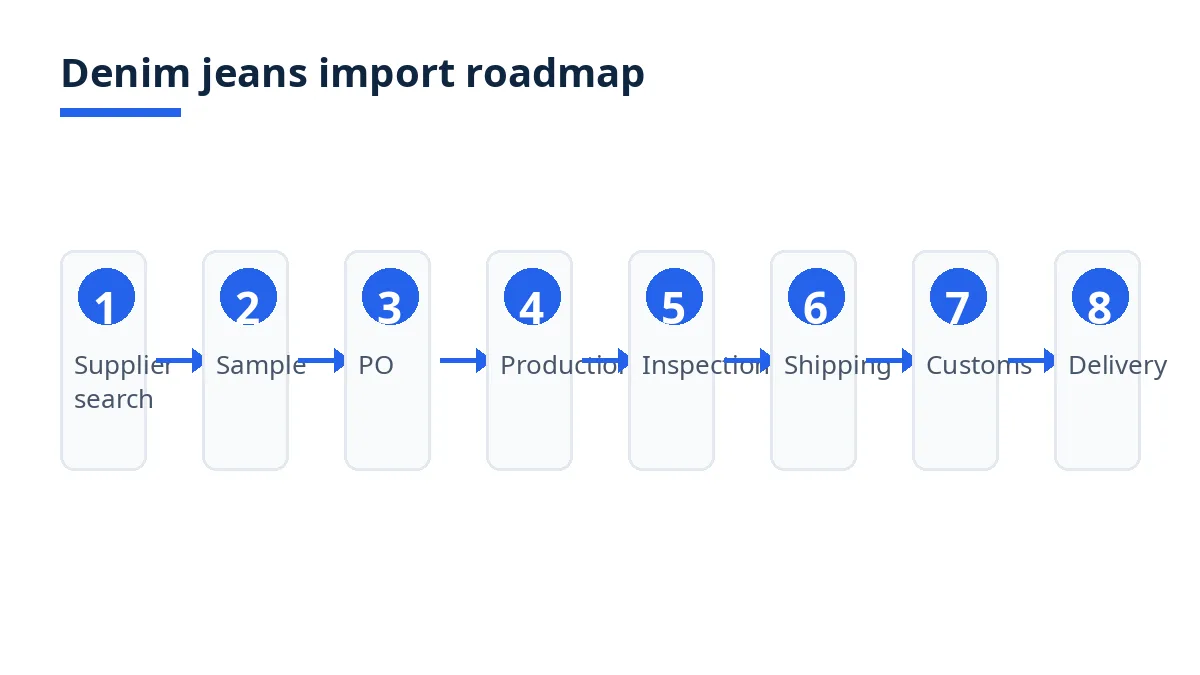
Confirm the United States entry items first: classification, label, and broker, before you discuss price in detail.
Write the full specification: fit block, measurements and tolerances, fabric weight and fiber composition, wash reference, trims, labels, and packing.
Shortlist three to five suppliers, request the same core documents from each, and check that names and addresses agree across them.1
Send the same request for quotation to every shortlisted supplier, on the same Incoterm with the same named place, and compare the replies line by line.
Agree the minimum order quantity separately for the order, the style, the color, and the wash, in writing, before you accept a quotation.
Approve the development sample, then the pre-production sample in bulk fabric, trims, labels, and packing, in writing, before bulk cutting starts.
Agree inspection points, the measurement and wash checks, and the remedy for a failed lot, and put testing in the schedule before final inspection.
Confirm the label against the bulk garment, including pocketing, lining, and stretch components, before packing.
Give your broker the 10 Importer Security Filing elements, the invoice, and the packing list early, with matching names, quantities, and values.7
Book freight on a dated forwarder estimate for your actual route and port, confirm inland delivery for your actual address, and add a buffer after inspection.
Reconcile the landed cost from the final quotation, the confirmed duty line, and the forwarder and broker charges, and price from the landed cost per good unit.
Compare the shipment sample with the approved pre-production sample, and do not release final payment terms until the agreed inspection result is in writing.
How Exportain helps
Exportain lists Bangladeshi suppliers by product and category, and buyers can search the supplier directory, review profiles, and filter for suppliers that hold trust badges recording which document and profile checks have been reviewed. Use the directory to build the shortlist, then run your own document checks, sample approvals, and inspection decisions, because a badge is a review of documents and photos, not a guarantee. The platform records quotations with unit price, minimum quantity, lead time, Incoterm, payment terms, and validity, so a counter-offer and an acceptance stay in the same thread and the agreed terms stay visible to both sides. That record helps when a later dispute turns on what was actually agreed, and it does not replace the sales contract, the specification, or the broker file.
FAQs
What is the typical MOQ for denim jeans from Bangladesh?
There is no single typical figure to quote. The minimum is negotiated per style, per color, and per wash, and it moves with the fabric mill minimum, the laundry lot minimum, and the size curve. Ask each supplier to state the minimum for each of those levels separately, and to state what changes if you drop a color or a size.
How long does shipping take?
Shipping time is a dated forwarder estimate for your route and port, not a fixed figure. One calculator listing valid to 4 November 2026 showed an indicative 49 days for a 40-foot container from Chattogram to New York with one carrier.3 Ask your forwarder for a dated estimate for your actual sailing and port pair, and add a buffer after inspection for port handling, customs examination, and inland movement.
What import duty applies?
In Revision 17 (2026) of the United States schedule, the General rate for cotton men's and women's blue denim trousers is 16.6 percent, under lines 6203.42.45 and 6204.62.80 respectively, and the Other lines for synthetic-fiber trousers are 27.9 percent for men's and 28.6 percent for women's.4 Your broker must confirm the line, the rate, and any additional duties for your exact garment and entry date.
How do I verify a supplier?
Request the same core documents from every candidate, including legal name and address, trade licence, tax and VAT registration where applicable, and the Export Registration Certificate, and check that names, addresses, and validity periods agree across them.1 Then confirm denim capability in writing: own or outside laundry, shade control, fabric lot change procedure, and a recent similar shipment with its measurement report. A trust badge records which checks have been reviewed; it does not replace your own sample and inspection decisions.
Next steps on Exportain
Read the general guide: How to Import From Bangladesh
Browse suppliers: Bangladeshi Manufacturers and Exporters
Work through the method: Landed Cost for Imports From Bangladesh
Sources
- How to Import from Bangladesh. Exportain (accessed )
- Place of delivery & risk transfer in trade contracts. ICC Academy (accessed )
- Freight Rates Calculator: Container Shipping Prices for Sea and Ocean Delivery from Bangladesh to United States. Globy Logistics (accessed )
- Harmonized Tariff Schedule of the United States, Chapter 62: Articles of apparel and clothing accessories, not knitted or crocheted (Revision 17, 2026). United States International Trade Commission (accessed )
- Cachet of Cashmere: Complying with the Wool Products Labeling Act. Federal Trade Commission (accessed )
- 16 CFR 303.3 - Fibers present in amounts of less than 5 percent. Legal Information Institute, Cornell Law School (accessed )
- Importer Security Filing (ISF). DP World (accessed )
- 19 CFR 142.3 - Entry documentation required. Legal Information Institute, Cornell Law School (accessed )
- Landed Cost for Imports from Bangladesh. Exportain (accessed )
About the author
Sourcing from Bangladesh?
Post a request for quotation and suppliers on Exportain can send you their quotes directly.
Post an RFQ