

Importing Denim Jeans From Bangladesh to UK: Costs, Duties and Suppliers
UK denim jeans import guide: GB EORI, broker and DCTS origin proof first, supplier checks, negotiated MOQ, UK fibre labelling, Felixstowe shipping, 12% third-country duty or 0% DCTS preference if confirmed, and a worked landed-cost example for 2,400 jeans to Felixstowe.
Short answer
To import denim jeans from Bangladesh to the UK, start with the UK entry file: a GB EORI, a UK customs broker, the commodity code, and DCTS origin proof. For men's cotton denim under code 6203423100 the tariff page as opened lists a 12.00 percent third-country duty, with a 0.00 percent DCTS Comprehensive rate subject to conditions, so your broker must confirm the line and origin proof for your shipment, then price from landed cost.
On this page
Key takeaways
Start with the UK entry file: a GB EORI, a UK customs broker, the commodity code, and DCTS origin proof. The tariff page as opened lists a 12.00 percent third-country duty for men's cotton denim under code 6203423100 and the same rate for women's code 62046231, with a 0.00 percent DCTS Comprehensive rate subject to conditions; your broker must confirm the line on the entry date.
There is no single typical MOQ for denim jeans from Bangladesh: the minimum is negotiated per style, per color, and per wash, and it moves with the fabric mill minimum, the laundry lot minimum, and the size curve, so ask for each level separately in writing.
The UK label must match the bulk garment: textile products sold in Great Britain must carry a label showing fiber content, and where components have different fiber contents the content of each must be shown, so check pocketing, lining, and stretch components against the bulk garment before packing.
Use transit time only as a planning figure: a UK to Bangladesh freight survey re-opened for this guide gives average sea freight times of 28 days for London Gateway to Chattogram and 30 days for Felixstowe to Mongla, within a general range of around 22 to 30 days, so get a dated forwarder estimate for your actual sailing.
Example figures only: 2,400 women's cotton denim jeans at 8.50 pounds FOB Chattogram, shipped to Felixstowe with inland delivery to a Manchester warehouse, give a landed cost of 10.91 pounds per jean, using duty at the 12.00 percent third-country fallback rate; import VAT is not in that total and must be shown separately by your broker.
Why source denim jeans from Bangladesh
Start a denim jeans order for the United Kingdom from the UK entry file, not from the lowest price. Before you compare supplier quotations, settle the port of entry, the customs broker, the commodity code, and the origin proof, because those four items decide what the shipment costs at the border and whether it clears without a query. A buyer who fixes the entry file first can judge every quotation against the same landed cost.
Bangladesh is a practical place to look for denim jeans because woven garment production there is supported by fabric mills, laundry and wash plants, trim suppliers, and packing operations in the same industrial areas. That depth lets you compare several suppliers on one specification instead of depending on a single factory. Treat that depth as a reason to shortlist the country, not as a substitute for checking an individual supplier, wash, or fit.1
Denim jeans are a fit and wash product first and a fabric product second. Two suppliers can quote the same fabric weight and still deliver jeans that fit differently, shrink differently, and wash to different shades. Specify the fit block, the rise, the leg opening, the wash recipe in words and reference pieces, and the tolerance for each measurement, and give every supplier the same target.
The UK entry also shapes the specification. The fiber content on the label must match the bulk garment, the classification must match the garment as made, and the wash and trim choices must be consistent with both. Settle those points in the specification stage. This guide keeps the UK port, the UK broker, and the UK label at the center of every stage, and it uses Felixstowe as the worked example port because it is the largest container port in the United Kingdom and the natural first choice for a first denim order.2
Find and verify suppliers
Build a shortlist of three to five suppliers who actually make denim jeans or legitimately supply them, and compare them on the same request for quotation. Ask each candidate for the same core documents and check that the names, addresses, and validity periods agree across them. The general import guide lists the documents to request, including the legal company name and registered address, trade licence, Taxpayer Identification Number and VAT registration where applicable, and the Export Registration Certificate an exporter needs in order to export from Bangladesh.1 A supplier that ships regularly should have these papers ready and should not treat the request as unusual.
Record for every candidate whether the company manufactures the jeans itself or sources them from another factory, what its main products are, and what export markets it states. Inconsistencies between a profile, a document, and an answer to a direct question are worth exploring early. On Exportain, a trust badge records which document and profile checks have been reviewed; it is a document and photo review, not a factory audit, not an inspection of your goods, and not a guarantee of capacity, quality, or delivery.1
Ask denim-specific questions before price becomes the focus. Which washes does the factory run in its own laundry, and which washes go to an outside laundry. How does it control shade across a bulk lot, and what reference does it keep for the approved wash. What happens when a fabric lot changes mid-order, and who approves the replacement. Can it show a recent shipment of a similar fit and wash to the United Kingdom, with the measurement report that went with it.
MOQ, pricing and samples
There is no single typical minimum order quantity for denim jeans from Bangladesh, and this guide gives no figure to copy. The minimum is a buyer-negotiated item, set per style, per color, and per wash, and it moves with the fabric mill minimum, the laundry lot minimum, and the size curve. Ask each supplier to state the minimum separately for the order, the style, the color, and the wash, and to state what changes if you drop a color or a size.
Price the same way, line by line. A denim jeans quotation should state the fabric, the weight, the fiber composition, the wash, the trims, the labels, the packing, and the Incoterm with its named place. Two prices on different Incoterms are not comparable, and a price that leaves out wash, labels, or export cartons is not cheaper, only incomplete. The general import guide makes the same comparison rule explicit: an FOB price excludes main freight and insurance, while a CIF price includes freight and at least minimum insurance to the named destination port, so convert every offer to the same basis before you decide.1
Samples are the contract in physical form. Use three stages, and do not let bulk cutting start before the second stage is approved in writing. The development sample confirms that the supplier understood the fit and the wash direction. The pre-production sample, made with the actual fabric, trims, labels, and packing intended for bulk, is the standard bulk production will be judged against; keep one sealed or signed piece yourself, with a matching piece retained at the factory. The shipment sample, taken from finished bulk production, lets you compare the finished goods with the approved pre-production sample before the goods leave. Comment on samples with measurements: state the measurement, the tolerance, and the correction required.
Quality control and certifications needed
Quality control for denim jeans is a measurement and wash discipline, not a general promise. Agree the inspection points before production: fabric inspection on arrival, cutting checks, in-line checks during sewing, wash checks after laundry, and a final inspection of finished, packed cartons. At each point, state who inspects, what report you receive, and what happens when a lot fails. A failed wash lot needs a defined remedy in writing, whether that is rewash, repair, or replacement, and a failed measurement needs a defined tolerance, not a negotiation after the fact.
The measurement set for jeans should cover waist, hip, rise, inseam, leg opening, and knee width, each with its tolerance, plus the size curve for the order. The wash set should cover shade against the approved reference, hand feel, and the condition of seams, rivets, buttons, zippers, and pocketing after washing.
The UK label rule is a separate check from the factory inspection, and it belongs in the specification, not in the packing stage. Textile products sold in Great Britain must carry a label showing fiber content, and where a product consists of two or more components with different fiber contents, the content of each must be shown; only permitted fiber names may be used.3 In practice, the bulk garment label must list the fibers by weight in descending order, must cover pocketing and lining where their content differs from the shell, and must use the same composition as the fabric actually shipped. Check the label against the bulk garment before packing, including any stretch component, because a label that describes the sample but not the bulk is a mislabeled shipment.
No single certification is named here as mandatory for every denim jeans order, because the requirement depends on your sales channel, your customer, and your market. Ask your customer and your broker which test reports or certificates your order needs, name them in the specification, and ask the supplier to state in writing which ones it can provide and from which laboratory. Put the testing point in the production schedule, so results are available before the final inspection, not after the container is loaded.
Incoterms, shipping and transit time
Choose the Incoterm by what actually happens to the container, not by habit. For a first UK order, the practical choice is usually between FOB Chattogram, CIF Felixstowe, and DAP at your UK warehouse. Under FOB, you control the main freight and insurance from the port of shipment; under CIF, the seller arranges freight and at least minimum insurance to Felixstowe, but you still need to confirm who pays destination terminal charges and who clears customs. Under DAP, the seller delivers to your named UK place ready for unloading. State the rule, the named place, and the Incoterms 2020 edition in the contract.
Transit time is a forwarder estimate for your route and your port, never a fixed figure to copy into a delivery promise. As a dated planning figure re-opened for this guide, a UK to Bangladesh freight survey gives average sea freight times of 28 days for London Gateway to Chattogram and 30 days for Felixstowe to Mongla, with sea freight between the two countries generally taking around 22 to 30 days depending on the ports, weight, and nature of the goods.2 Use that range only as a planning figure for a Chattogram to Felixstowe sailing, and ask your forwarder for a dated estimate for your actual sailing, port pair, and container size. Ask the forwarder to price inland delivery for your actual delivery address and vehicle size, and confirm whether unloading is included, before you promise a delivery date to your customer.
Import duty, taxes and documents
Classify the jeans before you price them. Denim jeans fall under heading 6203 for men's or boys' trousers and heading 6204 for women's or girls' trousers in the UK tariff. For men's cotton denim trousers, the UK Integrated Online Tariff commodity page for code 6203423100 lists a third-country duty of 12.00 percent, and the same page lists the standard VAT rate of 20.00 percent for the commodity.4 The heading listing for women's trousers shows the same 12.00 percent third-country duty for cotton denim under code 62046231.5 Those figures are the third-country rates in the tariff as opened; they are not a final duty bill. Your broker must confirm the line, the rate, and any additional measures for your exact garment, fiber mix, and entry date, because a stretch denim blend is classified by its fiber composition and construction, not by the word denim alone. UK tariff commodity pages are often snapshots for a past date, so confirm the current line on the entry date with your broker even when the rate looks familiar.
The preference position is separate from the third-country rate, and it depends entirely on origin proof. The same tariff page lists a 0.00 percent tariff preference for Developing Countries Trading Scheme Comprehensive Preferences for this commodity, subject to conditions.4 Bangladesh sits in the Comprehensive Preferences tier for least developed countries under the scheme, and the scheme guidance describes Comprehensive Preferences as the tier for least developed countries, with origin rules that must be met for the preference to apply.6 Do not build a margin plan on the 0 percent figure until your broker confirms that your jeans meet the origin rule and that the correct proof of origin is declared. If the origin proof fails, the fallback is the third-country rate.
Great Britain and Northern Ireland must not be mixed in one entry plan, and this paragraph is the separation point. This guide's GB steps cover imports into England, Scotland, and Wales. Postponed VAT accounting guidance covers goods imported into Great Britain from anywhere outside the UK, and separately goods imported into Northern Ireland from outside the UK and the EU, so the two destinations are handled under different rules.7 If your delivery address is in Northern Ireland, stop and take separate advice on the declaration, the EORI prefix, and the VAT treatment before you book freight, because a GB entry file does not transfer automatically. For GB imports, use a GB EORI number, and confirm whether an XI EORI is needed for any Northern Ireland movement.
Import VAT needs its own decision, in writing, before the declaration is made. Postponed VAT accounting lets a UK VAT-registered business declare and recover import VAT on the same VAT return instead of paying it upfront at the border, and the guidance states that your business must be registered for VAT in the UK to use it, with no approval needed.7 If someone imports goods on your behalf, you must tell them in writing that you want to use postponed VAT accounting, and they must have that written confirmation before they can proceed with the declaration.7 VAT is not in the table below: ask your broker to show it separately on the broker-confirmed base, at the standard rate the tariff page lists, and keep it outside the table total until confirmed.4
The entry documents are the file your broker works from, so keep them consistent. Keep the commercial invoice, packing list, bill of lading, origin proof, and any test reports in one file, with the same quantities, weights, and values across them. Give your broker the full file early, with the same company names and addresses that appear on the invoice and the packing list, so the declaration, the entry, and the shipping documents agree.
Landed cost example
All figures in this example are example figures only, not a real price, freight rate, or charge for any supplier, route, or shipment. The example uses 2,400 women's cotton denim jeans, priced FOB Chattogram, shipped to Felixstowe, with inland delivery to a Manchester warehouse as a forwarder-confirmed option in the example. The duty line uses the 12.00 percent third-country rate from the tariff page as opened, as the fallback when no preference is claimed or confirmed; if your broker confirms DCTS Comprehensive origin proof, the duty line changes and your broker must rework the total.4
Line | Example figures (GBP) |
|---|---|
Product cost: 2,400 jeans at 8.50 FOB Chattogram | 20,400.00 |
Ocean freight, Chattogram to Felixstowe | 1,950.00 |
Cargo insurance | 140.00 |
Import duty: 12.00 percent of 20,400.00 customs value in the example | 2,448.00 |
Customs broker fee | 220.00 |
Destination port and terminal charges at Felixstowe | 310.00 |
Inland delivery to Manchester warehouse | 380.00 |
Pre-shipment inspection | 260.00 |
Bank and currency costs | 85.00 |
Total landed cost | 26,193.00 |
Landed cost per jean | 10.91 |
Price from the landed cost per good unit, not from the FOB unit price, because freight, duty, broker, port, inland, inspection, and bank lines are real costs even when they sit outside the supplier quotation. The landed cost method is set out in the landed cost guide, which adds every cost of the shipment together and divides by the number of good units received.8 If the DCTS preference is confirmed, ask your broker for a revised total rather than simply deleting the duty line.
Step-by-step import checklist
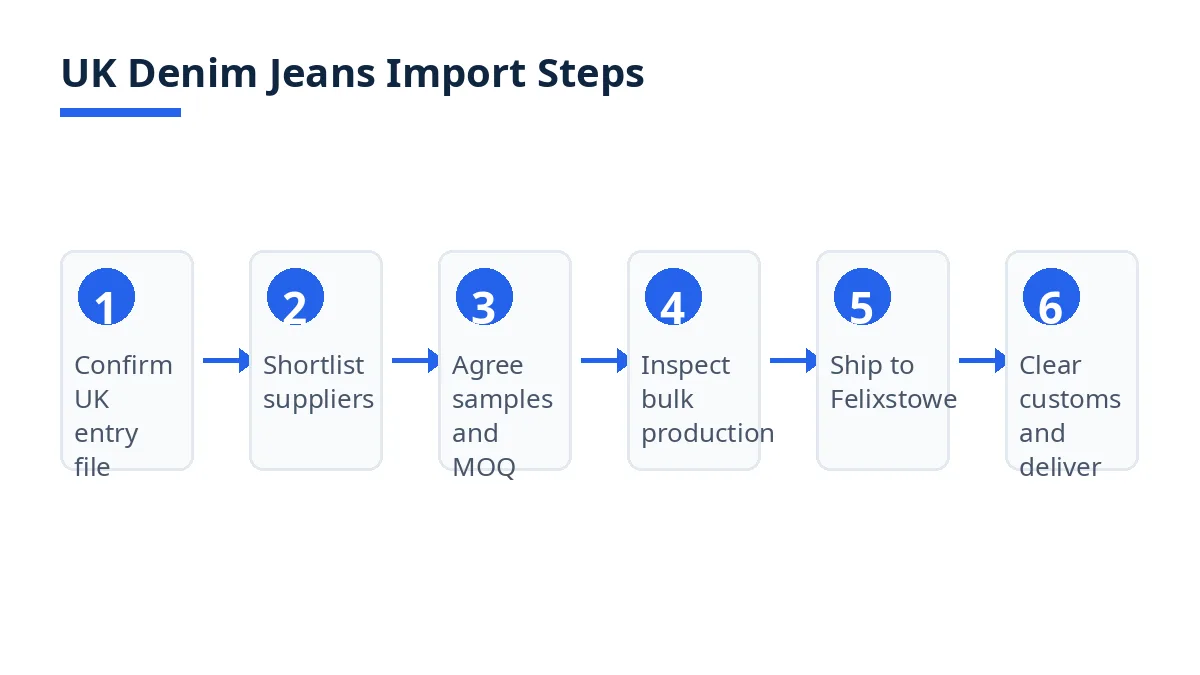
Confirm the United Kingdom entry items first: port of entry, broker, GB EORI, commodity code, and origin proof, before you discuss price in detail.
Write the full specification: fit block, measurements and tolerances, fabric weight and fiber composition, wash reference, trims, UK labels, and packing.
Shortlist three to five suppliers, request the same core documents from each, and check that names and addresses agree across them.1
Send the same request for quotation to every shortlisted supplier, on the same Incoterm with the same named place, and compare the replies line by line.
Agree the minimum order quantity separately for the order, the style, the color, and the wash, in writing, before you accept a quotation.
Approve the development sample, then the pre-production sample in bulk fabric, trims, labels, and packing, in writing, before bulk cutting starts.
Agree inspection points, the measurement and wash checks, and the remedy for a failed lot, and put testing in the schedule before final inspection.
Confirm the UK fiber label against the bulk garment, including pocketing, lining, and stretch components, before packing.3
Give your broker the invoice, packing list, bill of lading, and origin proof early, with matching names, quantities, and values, and confirm the tariff line for the entry date.4
Confirm in writing whether you will use postponed VAT accounting, and give your broker your VAT registration number if you will.7
Book freight on a dated forwarder estimate for your actual route and port, and confirm inland delivery for your actual address.2
Reconcile the landed cost from the final quotation, the confirmed duty position, and the forwarder and broker charges.8
Compare the shipment sample with the approved pre-production sample, and hold final payment terms until the agreed inspection result is in writing.
How Exportain helps
Exportain lists Bangladeshi suppliers by product and category, and buyers can search the supplier directory, review profiles, and filter for suppliers that hold trust badges recording which document and profile checks have been reviewed. Use the directory to build the shortlist, then run your own document checks, sample approvals, and inspection decisions, because a badge is a review of documents and photos, not a guarantee. The platform records quotations with unit price, minimum quantity, lead time, Incoterm, payment terms, and validity, so a counter-offer and an acceptance stay in the same thread and the agreed terms stay visible to both sides.
FAQs
What is the typical MOQ for denim jeans from Bangladesh?
There is no single typical figure to quote. The minimum is negotiated per style, per color, and per wash, and it moves with the fabric mill minimum, the laundry lot minimum, and the size curve. Ask each supplier to state the minimum for each of those levels separately, and to state what changes if you drop a color or a size.
How long does shipping take?
Shipping time is a dated forwarder estimate for your route and port, not a fixed figure. A UK to Bangladesh freight survey re-opened for this guide gives average sea freight times of 28 days for London Gateway to Chattogram and 30 days for Felixstowe to Mongla, within a general range of around 22 to 30 days.2 Ask your forwarder for a dated estimate for your actual Chattogram to Felixstowe sailing, and add a buffer after inspection for port handling, customs examination, and inland movement.
What import duty applies?
For men's cotton denim trousers under code 6203423100, the UK tariff page as opened lists a third-country duty of 12.00 percent, and the women's heading listing shows the same 12.00 percent for cotton denim under code 62046231.4 5 The same tariff page lists a 0.00 percent DCTS Comprehensive Preferences rate, subject to conditions, so your broker must confirm the origin rule and proof of origin before you rely on the preference.4 Confirm the current line on the entry date.
How do I verify a supplier?
Request the same core documents from every candidate, including legal name and address, trade licence, tax and VAT registration where applicable, and the Export Registration Certificate, and check that names, addresses, and validity periods agree across them.1 Then confirm denim capability in writing: laundry setup, shade control, fabric lot change procedure, UK shipping experience, and a recent similar shipment with its measurement report.
Next steps on Exportain
Read the general guide: How to Import From Bangladesh
Work through the method: Landed Cost for Imports From Bangladesh
Sources
- How to Import from Bangladesh. Exportain (accessed )
- Freight Shipping between UK and Bangladesh. DocShipper (accessed )
- Labelling of textiles - trade advice document. Liverpool City Council (accessed )
- Commodity code 6203423100: Of denim - UK Integrated Online Tariff. GOV.UK (accessed )
- Heading 6204: Women's or girls' suits, ensembles, jackets, blazers, dresses, skirts, divided skirts, trousers, bib and brace overalls, breeches and shorts - UK Integrated Online Tariff. GOV.UK (accessed )
- Update: Improved Rules of Origin under the Developing Countries Trading (DCTS) are now in effect.. GOV.UK (accessed )
- Check when you can account for import VAT on your VAT Return. GOV.UK (accessed )
- Landed Cost for Imports from Bangladesh. Exportain (accessed )
About the author
Sourcing from Bangladesh?
Post a request for quotation and suppliers on Exportain can send you their quotes directly.
Post an RFQ


