Importing Denim Jeans From Bangladesh to UAE: Costs, Duties and Suppliers
UAE buyer guide to importing denim jeans from Bangladesh: Jebel Ali entry, suppliers, MOQ, duty, VAT, labeling and landed cost.
Short answer
To import denim jeans from Bangladesh to the UAE, first settle the UAE entry: a trade license covering imports, an emirate customs code, and a linked tax registration number, plus a mainland or designated-zone entry route. Then specify fit, fabric and wash, verify the supplier, approve a pre-production sample, classify each style, and build the landed cost from a broker-confirmed duty rate before bulk production.
On this page
Key takeaways
Settle the UAE entry before choosing a factory: trade license covering import activity, an emirate customs code, a linked tax registration number, and a mainland or designated-zone entry route confirmed with your broker.
Men's or boys' cotton trousers sit in 6203.42, with denim trousers for men at the suffix 41 line in the schedule opened to show the structure; confirm the full UAE national code for each style with your broker before pricing.
The GCC Common External Tariff default is 5 percent on the CIF value, and import VAT at 5 percent then applies on the CIF value plus duty; VAT-registered buyers may use postponed VAT accounting where they meet the conditions.
There is no single typical MOQ, price or transit time for denim jeans from Bangladesh: every figure in this guide is an example figure, and bulk production should start only after a pre-production sample is approved in writing.
UAE textile labels must be in Arabic, or in both Arabic and English, stating fiber composition, country of origin and care instructions using internationally recognized symbols, with ESMA conformity often shown through an ECAS certificate.
Settle the UAE entry before you choose a factory. A denim jeans order from Bangladesh to the UAE is decided as much by three entry answers as by wash, fit or factory price: whether your trade license and customs code are in place, whether the goods will enter the mainland or stay in a designated zone, and how you will account for import VAT. Work through those three answers first. This guide is for UAE-based buyers: retailers, brands, wholesalers and private-label programs buying denim jeans made in Bangladesh for UAE sale or re-export. All prices, freight figures and minimums here are labelled example figures, not market rates.
Why source denim jeans from Bangladesh
Bangladesh has a denim base built around fabric, washing and sewing in close proximity, and that closeness matters because the wash decides shade, hand feel and measurements. A supplier that controls its wash process, or can name its wash plant, can repeat a shade across sizes and repeat orders. Choose Bangladesh for the program, not a single pair: jeans reward a relationship built around a fit block, a fabric library and a wash reference that carry across seasons.
The scale of that base is documented in recent trade reporting. According to 2025 data from the Office of Textiles and Apparel and Eurostat reported by The Daily Star, Bangladesh strengthened its position as the top denim supplier to the United States and the European Union, with annual denim exports exceeding $5 billion, a 25.97 percent United States share and a 29.88 percent European Union share in 2025.1 The same report puts operating denim mills at nearly 50, producing about 40 million yards a month, with local mills meeting around 70 percent of domestic demand.1 Those figures describe the supply base, not any single factory.
Find and verify suppliers
Where should you start the search?
Start with the UAE entry, then write the specification. Confirm your trade license covers import activity, your emirate customs code, and your linked tax registration number. Importers must register for an emirate-specific customs code before filing declarations, and the code is linked to the trade license.2 In Dubai that registration runs through Dubai Trade for Dubai Customs; other emirates run their own portals.2 Settle this before asking for quotations: a missing code or unlinked tax number can hold a shipment at the port after it has sailed.
Next, decide the entry route and put it in writing for your broker. Goods entering a free zone are treated as outside the customs territory for duty purposes, and customs duties become payable when goods move from a free zone into the UAE mainland.3 A shipment stored in a designated zone for re-export therefore follows a different route from one released for mainland sale, changing your landed cost and VAT position. Ask your broker to confirm the duty and VAT treatment for your route before you price.
Then write one specification and send it identically to every candidate: fit and pattern, fabric composition and weight, wash and shade reference, size curve, stitching and hardware, pocket and label construction, and packing. Ask every supplier for the same reply format: fabric, wash route, price inclusions, validity, minimum per style and wash, and lead time from sample approval. Browse suppliers on Exportain and read how to import from Bangladesh for the full process behind this guide.
How do you verify a supplier before you pay?
Verification has three layers: company documents (trade license, export registration and association membership where applicable, checked so legal name, address and bank account name agree); capability (denim capacity, fabric route, wash route, and recent jeans in your fits and washes); and payment discipline (pay only to the company account named in the documents, verifying any change of bank details through a separate channel before you pay).
On Exportain, supplier profiles carry trust badges. A badge is a review of documents and photos, not a factory inspection or a guarantee, and Exportain is not a party to the goods contract.4 The buying steps run from searching the catalogue and reviewing profiles, through an order request or RFQ, to comparing versioned quotations and settling payment directly with the supplier.4 Read what each badge covers, and add a video or in-person factory check for a first order.
MOQ, pricing and samples
What is the typical MOQ for denim jeans from Bangladesh?
There is no single typical minimum order quantity for denim jeans from Bangladesh. The minimum is set per style, and usually per wash and per colour, because fabric lots, washing batches and cutting plans are set up per style and wash. Ask each supplier how its minimum splits across style, wash, colour and size curve, and confirm it in writing before you approve samples.
How is the price built, and how should you compare quotes?
Fabric is usually the largest cost element in a denim jean, followed by cutting, sewing, washing and finishing, hardware, testing, packing and margin. Fabric use per pair depends on fit, size and wash, because washing shrinks the garment and the pattern must allow for it. Two quotes can differ because one assumes a lighter fabric, a simpler wash or cheaper hardware. Ask what each price is based on, in writing.
Compare quotes on the same basis: same fit, fabric, wash, size curve, delivery term and packing, with exclusions stated. Convert every offer to a landed cost per pair before you decide, using the method below, and keep the delivery term identical: an FOB price and a CIF price are not comparable until freight and insurance are added to the FOB figure.
Which samples do you need, and how do you approve them?
Work in stages: a development sample shows whether the factory understood the fit, and a pre-production sample, made in the actual production fabric, wash and trims, is the sample you approve for bulk. Shade, hand feel and measurements cannot be approved from a sample in substitute fabric or an unwashed state.
Test samples as your customers will wear and wash them: measure every size against your chart after washing to your care label, check shade across sizes, work the zip and buttons, and confirm label wording against the fabric bought. Approve in writing and keep one sealed counter-sample of each style and wash.
Quality control and certifications needed
Which quality checks are specific to denim jeans?
Against the approved sample and chart, check fabric composition and finished weight, measurements within your agreed tolerances, and consistency across the size curve. Then check construction pair by pair: seams, pockets, waistband and belt loops, zip and button function, wash consistency and shade matching, and hardware finish.
Agree the inspection method and defect limits before production. ISO 2859-1:2026 defines a system of acceptance sampling plans for inspection by attributes, and its summary states that AQL stands for acceptance quality limit, the maximum average percentage of defective items considered acceptable during random sampling.5 Inspect in stages: an inline check during sewing and washing, and a final random inspection on packed goods.
Which label rules apply in the UAE?
Agree label wording at sampling stage and check it before bulk label sewing begins: relabeling at the port costs time and money. UAE textile and garment labels must be in Arabic, or in both Arabic and English, and must state fiber composition, country of origin and care instructions using internationally recognized symbols.6 Check the finished label against the fabric bought.
Which certifications do you actually need?
No single certificate covers every denim order: a retailer may name a specific test, fiber scheme or factory audit in its supplier manual. Products must also conform to the Emirates Authority for Standardization and Metrology standards, covering colourfastness, flammability and the absence of harmful chemicals such as azo dyes and formaldehyde, and demonstrating conformity often requires an Emirates Conformity Assessment Scheme certificate.6 Name any such requirement in the specification, and check the matching report or certificate for scope, product, issuing body and date.
Incoterms, shipping and transit time
Which delivery term should a first order use?
Under the Incoterms 2020 rules, delivery takes place where the rule states, and risk passes from seller to buyer at the same point and time.7 For FOB, delivery and risk transfer occur when the goods are on board the vessel nominated by the buyer at the named port of shipment, and for containers the FCA rule is typically a better choice even for maritime transport, because a container is handed to the carrier before it is on board.7 Under the C rules, the seller arranges and pays for transport to the destination, but risk for that transport is borne by the buyer.7 Under DDP, the seller must clear the goods for import in the destination country, which may pose problems for the seller.7
For a first container order, weigh FOB at the Bangladeshi port against FCA at the named terminal. Under FOB the factory delivers on board and your forwarder handles the sea leg; under FCA delivery happens when goods are handed to your carrier, matching containerised cargo. State rule, place and edition in the contract, for example FCA Chattogram Container Terminal, Incoterms 2020.
Which UAE gateway and entry route should you choose?
Choose the gateway and entry route together, and put both in the booking instruction. Jebel Ali in Dubai is the container gateway used in this guide's example, with the Jebel Ali Free Zone alongside it, so a Dubai arrival suits a warehouse or re-export base nearby. An arrival in another emirate needs that emirate's customs registration. Confirm gateway, terminal free time and inland delivery before the goods sail, and keep a buffer between planned clearance and any customer commitment.
If the goods are for mainland sale, the declaration is for home consumption. If they stay in a designated zone, confirm with your broker what declaration covers the later mainland transfer, since that transfer is when duty becomes payable.3 The route on the booking must match the route on the declaration.
How long does shipping take?
There is no single typical transit time for denim jeans from Bangladesh to the UAE: sea freight is the standard bulk route and takes weeks rather than days, varying by port, routing, transshipment and season. Plan from your forwarder's current sailing schedule for Chattogram to your gateway, and add clearance and inland delivery. Keep production time separate: an order is ready only when sewing, washing, inspection and packing are finished.
Import duty, taxes and documents
How are denim jeans classified for duty?
Duty follows the classification of each style in the destination tariff, not the supplier's product name. The six-digit structure is shared across customs territories: men's or boys' cotton trousers sit in 6203.42, and the schedule opened to show how denim suffixes work lists trousers and breeches of denim for men at the suffix 41 line.8 Women's styles sit in heading 6204; knitted constructions, shorts and other fiber mixes each need their own line. Confirm the full UAE code for each style with your broker before you price or ship.
What import duty applies?
Your rate depends on each style's confirmed UAE code and the treatment in force at entry. The GCC Common External Tariff sets standard duty rates for goods entering any GCC member state, including the UAE, at a default of 5 percent, with certain goods at zero, 10 percent or higher rates.3 Most textiles and garments are subject to that 5 percent tariff on the CIF value at the first UAE port of entry.6 2
Treat that 5 percent as the default to confirm, not a rate to assume for every line: ask your broker to confirm the rate for your exact styles, naming the schedule and line. Bangladesh-origin goods do not enter under a GCC preference, which covers GCC-origin goods only, so do not price a GCC-origin zero rate into a Bangladesh shipment.3
What VAT and charges apply at the UAE border?
Import VAT is 5 percent on the CIF customs value plus any applicable customs duty.9 Article 48 of Federal Decree-Law No. 8 of 2017 defines the taxable value for imports as the customs value under the GCC Common Customs Law plus any customs duties and excise taxes due, so calculate duty first, add it to the CIF value, and then apply the VAT rate.9 For example, a CIF value of AED 100,000 with 5 percent duty gives a VAT base of AED 105,000 and VAT payable of AED 5,250.9
Whether that VAT is a final cost or a cash-flow item depends on your tax position. VAT-registered businesses may defer payment through postponed VAT accounting on the VAT return, where they meet the conditions.9 If you cannot recover the input tax, the VAT is a cost and belongs in the landed cost total. Keep your tax registration number identical across the declaration, invoice and tax portal.9 In a foreign currency, convert the CIF value to dirhams at the UAE Central Bank rate published on the declaration date.2
Which documents do you need for clearance?
The standard import set is the commercial invoice, packing list, bill of lading or air waybill, certificate of origin, insurance certificate where insurance forms part of the CIF value, and the customs declaration.9 The invoice should name each style plainly, for example men's cotton denim jeans, mid-blue wash, with composition, wash, sizes, quantities, unit prices, delivery term and HS code per line. Keep men's, women's, cotton and blended styles on separate lines matching their classifications. Quantities, weights and carton counts must agree across every document, and the certificate of origin must come from the competent authority in the exporting country.9 Officers cross-reference freight and insurance amounts, and any discrepancy halts release.9
Landed cost example
A landed cost is the full cost of one pair of jeans, ready to sell. Every number below is an example figure only, not a quote, and the duty rate shown is the GCC Common External Tariff default of 5 percent, to be confirmed by your broker for your exact styles.
Example figures: 4,000 pairs of men's cotton denim jeans, FOB Chattogram, sea freight to Jebel Ali, VAT shown separately as a cash-flow item for a VAT-registered buyer.
Cost element | Example figures (per pair, USD) | How to obtain your figure |
|---|---|---|
Product price, FOB | 9.60 | Confirmed pro forma invoice |
International freight | 1.20 | Forwarder quote per pair |
Insurance | 0.08 | Policy or forwarder quote |
CIF value | 10.88 | Sum of the three lines above |
Duty at 5 percent of CIF | 0.54 | Broker calculation from confirmed codes |
Port, clearance and broker fees | 0.40 | Broker invoices per pair |
Local delivery to warehouse | 0.30 | Local carrier quote per pair |
Total landed cost, before VAT | 12.12 | Sum of all lines above |
Import VAT at 5 percent of CIF plus duty | 0.57 | Tax adviser calculation; cash-flow item if recoverable |
VAT is not in the total: a VAT-registered buyer who can recover input tax treats it as cash flow. If you cannot recover it, add 0.57 per pair, taking the total to 12.69. Work the calculation twice: at quote stage, style by style, and again after shipment with actual invoices. See landed cost for imports from Bangladesh for the full method.
Step-by-step import checklist
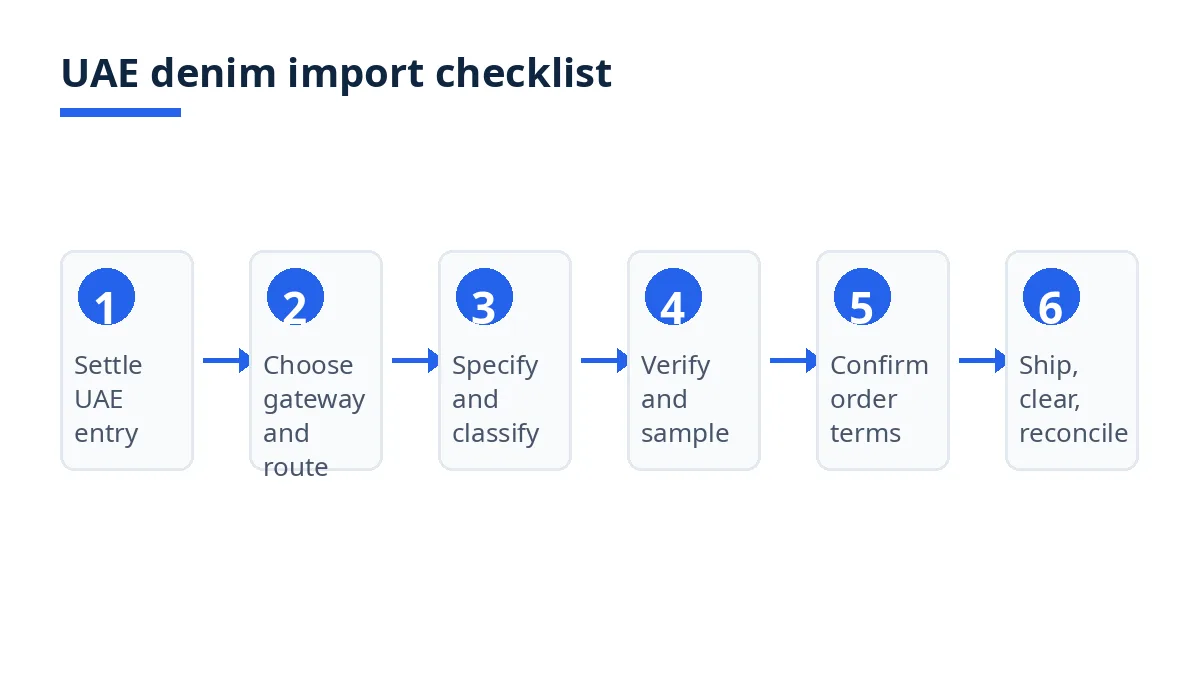
Settle the UAE entry: trade license covering import activity, an emirate customs code, a linked tax registration number, and a broker briefed with product, classification, value, origin and route.
Decide the entry route: mainland release, or designated-zone storage with a confirmed declaration for later mainland transfer, and put that route in the booking instruction.
Choose the gateway nearest your warehouse, and confirm terminal free time and inland delivery before the goods sail.
Write the specification style by style: fit, fabric, wash and shade reference, size curve, hardware, Arabic or Arabic-and-English labels, packing.
Classify every style, starting from 6203.42 for men's cotton trousers and 6204 for women's styles, and confirm each UAE code and duty rate with your broker, naming the schedule and line.
Shortlist denim suppliers on the identical specification, and verify documents, wash route and bank details before paying beyond samples.
Order samples in stages, wash and measure them against your chart, check shade and label wording, then approve a pre-production sample of each style and wash.
Confirm the order in writing: purchase order, pro forma invoice, delivery and payment terms, inspection plan with AQL limits, labeling, packing and shipment date.
Inspect during production and again on packed goods, checking wash, measurements and label wording.
Ship to the chosen gateway, clear customs with the confirmed code for each style, pay duty and account for VAT on the CIF-plus-duty base, and reconcile the actual landed cost.
How Exportain helps
Browse suppliers for Bangladeshi denim exporters, compare their ranges against your style and wash list, then post your specification as an RFQ and compare replies on the same terms, following how to buy. Exportain is a B2B marketplace where buyers post RFQs, receive quotations and message suppliers. It does not inspect goods, book freight or clear customs.
FAQs
What is the typical MOQ for denim jeans from Bangladesh?
There is no single typical minimum: it is set per style, usually per wash and per colour. Confirm the split in writing before you approve samples.
How long does shipping take?
Production time and transit time are separate, and neither has a single typical figure. Sea transit takes weeks rather than days and varies by gateway, routing and season. Plan from your forwarder's sailing schedule for Chattogram to your gateway, plus clearance and inland delivery.
What import duty applies?
Duty follows the confirmed UAE classification of each style and the treatment in force on the entry date. Men's or boys' cotton trousers sit in 6203.42, with denim trousers for men at the suffix 41 line in the schedule opened to show the structure.8 The GCC Common External Tariff default is 5 percent on the CIF value.3 Your broker must confirm the rate, naming the schedule and line, before you price; import VAT at 5 percent then applies on CIF plus duty.9
How do I verify a supplier?
Check company documents first, so that name, address and bank account agree across the trade license, export registration and invoices. Then check capability: denim capacity, fabric source and wash route, and recent jeans in your fits and washes. Keep payments to the company account named in the documents, and read what any badge covers before you rely on it: a badge is a document and photo review, not an inspection or a guarantee.4
Next steps on Exportain
Read how to import from Bangladesh for the full process, then work through landed cost for imports from Bangladesh with your own quotations and broker-confirmed duty figure. When ready, browse suppliers and compare denim ranges on the same specification before you post your RFQ.
Sources
- The rise of a denim empire. The Daily Star, (accessed )
- UAE Customs Duty on Imports: Requirements and Calculation Guide. GlobalTradePlaza (accessed )
- Customs Duties in UAE: GCC Common External Tariff. Nour Attorneys (accessed )
- How to source and buy from Bangladesh. Exportain (accessed )
- ISO 2859-1:2026 - Sampling procedures for inspection by attributes — Part 1: Sampling schemes indexed by acceptance quality limit (AQL) for lot-by-lot inspection. International Organization for Standardization (accessed )
- UAE Textile and Garment Import Regulations. Nour Attorneys (accessed )
- Place of delivery & risk transfer in trade contracts. ICC Academy (accessed )
- Chapter 62: T2025 - Articles of apparel and clothing accessories, not knitted or crocheted. Canada Border Services Agency (accessed )
- VAT on Customs Duty in the UAE: Documents and Payment Process. Global Trade Plaza (accessed )
About the author
Sourcing from Bangladesh?
Post a request for quotation and suppliers on Exportain can send you their quotes directly.
Post an RFQ