Importing Denim Jeans From Bangladesh to Spain: Costs, Duties and Suppliers
Spain-based buyers importing denim jeans from Bangladesh: Valencia or Barcelona entry, 21% Spanish VAT, EORI, 0% EBA duty with proven origin, supplier checks, wash and fit samples, and a worked Valencia landed-cost example.
Short answer
To import denim jeans from Bangladesh to Spain, settle the entry plan first: Valencia or Barcelona as arrival port, your EORI number, and Spanish import VAT at 21 percent. Classify each style, confirm the 0 percent Everything But Arms duty position with proven origin and the 12 percent fallback with your broker, shortlist suppliers on one written specification, approve a pre-production sample in production fabric and wash, and build the landed cost before bulk production.
On this page
Key takeaways
Men's cotton denim jeans sit on tariff line 6203.42.31, where the schedule opened for this guide lists a 12.00% third-country duty and a 0.00% GSP-EBA preference.
Everything But Arms grants least developed countries full duty-free and quota-free access to the EU Single Market for all products except arms and ammunition, subject to origin rules.
Spain's general VAT rate is 21%, and an EORI number is mandatory for customs clearance in the EU.
Valenciaport states that its facilities handle 40% of Spain's total imports and exports, making Valencia the practical default entry port for many Spain-based buyers.
There is no single typical MOQ, price or transit time for denim jeans, so confirm each one in writing for your exact fabric, wash, fit range and shipment date.
A Spain-based buyer importing denim jeans from Bangladesh works through the same chain as any EU importer, but with three decisions at the front of the order: the Spanish entry port, the Spanish VAT treatment, and the proof of origin that supports a zero duty rate. Settle those before bulk production.
This guide is for buyers in Spain who purchase denim jeans for retail, wholesale or private-label programmes. It covers supplier selection, minimum order quantity, pricing, quality control, shipping, duty, taxes and documents, with a worked landed-cost example for a Valencia arrival. All prices and shipment charges in the worked example are labelled as example figures.
Why source denim jeans from Bangladesh for Spain
Bangladesh has a deep garment and textile base, and denim is a category where fabric sourcing, washing and finishing sit close to sewing. That matters for jeans more than for a simple cut-and-sew item, because the wash decides the final look, hand feel and measurements. A supplier that controls its wash process, or works with a wash plant it can name and show, can repeat a shade across sizes and repeat orders.
For a Spanish programme, start from the range you will sell, not from a catalogue. Fix the fits first: straight, slim, tapered or relaxed, with the rise and leg opening for each fit. Then fix the fabric for each fit: cotton content, stretch content where stretch is wanted, fabric weight, and the wash family — rinse, stone wash, enzyme wash, bleached or dark indigo. A dark indigo jean and a heavily washed light jean are different products in production even when the pattern is the same, because washing changes measurements and shade batch by batch.
State the size curve as a buying decision. Spanish retail size curves differ by channel and customer, so state the size range, the ratio across sizes and the measurements for each size, and ask suppliers to quote against that curve. Work backwards from the date the jeans must be on the shelf, allow time for a second sample round, and treat any supplier date that leaves no room for a failed sample as a date that will slip.
The Spain entry decision: Valencia, VAT and EORI first
Choose the entry port before you compare freight quotes, because the port decides the inland leg and the customs office that handles the entry. Valencia is the practical default for many Spain-based buyers: Valenciaport states that its facilities handle 40 percent of Spain's total imports and exports, and that more than 100 regular shipping routes link the Iberian Peninsula with markets on five continents.1 Barcelona is the alternative for buyers in Catalonia and the north-east, where a shorter inland leg can offset a different ocean rate. Ask your forwarder to price both ports on the same Incoterm and container size, and compare the total to your warehouse.
An EORI number comes next. An Economic Operators Registration and Identification (EORI) number is mandatory for the clearance of customs operations in the customs territory of the EU, including import, and a person can hold only one valid EORI number at a time.2 A Spain-based company applies through the Spanish customs authority, and if you use a customs broker, give the broker your EORI number before the goods sail.
Spanish VAT is the third entry decision. The Spanish Tax Agency states that the general VAT rate is 21 percent, with reduced rates of 10 percent and 4 percent for specified goods and services.3 Denim jeans for retail sale fall under the general rate, so budget import VAT at 21 percent on the VAT base your broker confirms. If your business is VAT-registered and can reclaim import VAT, treat it as a cash-flow item; if you cannot reclaim it, it belongs in the landed cost in full.
Find and verify suppliers
Where should you start the search?
Start with a written specification, not with supplier names. A usable denim specification states the fit and pattern, fabric composition and weight, wash and shade reference, size curve and measurements, stitching and hardware, pocket and label construction, and packing. Send the identical specification to every candidate and ask for the same reply format: fabric assumed, wash route, price inclusions, validity, minimum per style and per wash, and lead time counted from sample approval.
Shortlist suppliers that already make denim jeans in the fits and washes you need. A garment factory that sews woven trousers but does not run denim washing will need a wash partner, and you should know who that partner is before you approve a sample. Ask for current denim styles the factory can show and whether fabric is bought from a named mill or from stock.
How do you verify a supplier before you pay?
Verification has three layers. The first is company documents: trade licence, export registration and association membership where applicable, checked so that the legal name, address and bank account name agree across every document. The second is capability: denim capacity, fabric sourcing route, wash route, and recent jeans the factory can show in your fits. The third is payment discipline: pay only to the company account named in the documents, and verify any change of bank details through a separate channel before you pay.
On Exportain, supplier profiles carry document and photo review badges. A badge is a review of documents and photos, not a factory inspection or a guarantee, and Exportain is not a party to the goods contract. Treat your own sample approval and inspection as the real quality control, and for larger programmes add a factory visit or an independent audit before the first bulk order.
MOQ, pricing and samples
What is the typical MOQ for denim jeans from Bangladesh?
There is no single typical minimum order quantity for denim jeans from Bangladesh. The minimum is set per style, and usually per wash and per colour, because fabric lots, washing batches and cutting plans are set up per style and wash. Ask each supplier how its minimum splits across style, wash, colour and size curve, and confirm it in writing before you approve samples.
How is the price built, and how should you compare quotes?
Fabric is usually the largest cost element in a denim jean, followed by cutting and sewing, washing and finishing, hardware and trims, testing, packing and the factory margin. Fabric use per pair depends on the fit, the size and the wash, because washing shrinks the garment and the pattern must allow for that shrinkage.
Compare quotes on the same basis: same fit and pattern, same fabric and wash, same size curve, same hardware, same packing, same delivery term and same payment terms. Ask each supplier to state what is excluded, for example wash testing, special packing, hang tags or carton marking. Ask what each price is based on, in writing, so a lower quote is judged as a different specification rather than accepted as a saving.
Which samples do you need, and how do you approve them?
Work in stages. A development sample shows whether the factory can construct the jean, set the pockets and waistband cleanly, and hit the pattern measurements. A pre-production sample, made in the actual production fabric, wash and hardware, is the sample you approve for bulk. Wash, shade and measurements cannot be approved from a sample in substitute fabric, because washing changes dimensions, shade and hand feel.
Test the samples as your customers will wear and wash them. Measure the waist, hip, inseam and leg opening against your size chart before and after a wash following your care label, check shade consistency across sizes and across the pair, and check hardware function under normal use. Approve in writing, keep one sealed counter-sample of each style and wash, and state that bulk production must match the approved sample.
Quality control and certifications needed
Which quality checks are specific to denim jeans?
Against the approved sample and size chart, check fabric composition and finished weight, finished measurements within your agreed tolerances, and consistency across the size curve. Then check construction pair by pair: waistband stitching, pocket setting and bartacks, fly construction, seam strength, hem finish, and hardware attachment. Then check the wash: shade against the approved sample, wash evenness, and shade matching between the two legs and between sizes.
Agree the inspection method and defect limits before production. ISO 2859-1:2026 defines a system of acceptance sampling plans for inspection by attributes, and its summary states that AQL stands for Acceptance Quality Limit, the maximum average percentage of defective items considered acceptable during random sampling.4 Inspect in stages: an inline check during sewing and washing catches a shade drift while correction is still possible, and a final random inspection on packed goods checks quantity, workmanship, measurements, labels and packing.
Which label and chemical rules apply in Spain?
Fibre labelling follows EU rules, and Spain applies them as an EU member state. Regulation (EU) No 1007/2011 covers textile fibre names and the labelling and marking of fibre composition, including the names and percentages that appear on textile products.5 Agree the label wording at sampling stage: fibre composition in descending order by weight, care instructions, size, and origin marking as your market requires. Check the finished label before bulk label sewing begins.
Chemical compliance is a specification decision, not a generic claim. Name the restricted substances and test methods your customers require in the specification, ask for the matching test report for the production fabric and wash, and check its scope, product covered, issuing body and date. A report for a different fabric, a different wash or an unwashed sample does not cover your bulk jeans.
Which certifications do you actually need?
No single certificate covers every denim order. What you need follows your market and your customer: a retailer may name a specific test, a fibre scheme or a factory audit in its own manual. Name any such requirement in the specification, ask for the matching report or certificate, and check its scope and date.
Incoterms, shipping and transit time
Which delivery term should a first order use?
The Incoterms 2020 rules set out, for each rule, where delivery takes place, and risk passes from seller to buyer at the same point and time as delivery.6 Under FOB, CFR and CIF the seller must place the goods on board the vessel.6 On customs, in all rules but EXW the seller must carry out export formalities, and in all rules but DDP the buyer must carry out import formalities.6 The same ICC Academy summary notes that the four sea rules, FAS, FOB, CFR and CIF, are only intended for port-to-port bulk or break-bulk shipments and are not suitable for container shipments, because a container is handed to the carrier before it is on board.6
For a first order shipped in containers, weigh FOB at the Bangladeshi port against FCA at the named terminal. Under FOB, the factory delivers the goods on board and your forwarder handles the sea leg. Under FCA, delivery happens when the goods are handed to your carrier, which matches how containerised cargo moves. For a buyer that wants the seller to carry the goods to Spain, DAP Valencia or DAP Barcelona puts delivery at the named place, with import clearance and duty still yours.
How long does shipping take?
There is no single typical transit time for denim jeans from Bangladesh to Spain. Sea freight is the standard route for bulk orders and takes weeks rather than days, varying by port, routing, transshipment and season. Plan from your forwarder's current sailing schedule for Chattogram to Valencia or Barcelona, and add clearance and inland delivery. Confirm carton details in the specification, because jeans are dense for their size and carton weight can limit a shipment before volume does.
Import duty, taxes and documents
How are denim jeans classified for duty?
Duty follows the classification of each style in the destination tariff, not the supplier's product name. For men's or boys' denim jeans of cotton, the schedule opened for this guide lists commodity code 6203.42.31, described as of denim.7 Women's and girls' styles sit in heading 6204, and knitted or stretch constructions, shorts, and jeans with a different fibre mix each need their own line. Confirm the full national code for each style before you price or ship.
The schedule opened for this guide lists a third-country duty of 12.00 percent on code 6203.42.31, and a GSP-EBA tariff preference of 0.00 percent.7 The EU's Everything But Arms scheme is a special arrangement for least developed countries, granting full duty-free and quota-free access to the EU Single Market for all products except arms and ammunition.8 A qualifying shipment from Bangladesh with proven origin can therefore enter at 0 percent. The preference is never automatic: it depends on classification, origin rules and correct proof of origin, so confirm the position with your customs broker before you price, and keep the 12 percent rate as your fallback.
What taxes and documents does a Spain arrival need?
Spanish import VAT at the general rate of 21 percent applies as described in the entry section, on the VAT base your broker confirms.3 Your EORI number must be on the customs paperwork, since an EORI number is mandatory for customs clearance in the EU.2 The document set for a standard sea shipment is: commercial invoice, packing list, bill of lading, certificate of origin or origin statement supporting the EBA claim, and any test reports or labels your customer requires. Give the broker the full set before the vessel sails, and check the invoice and packing list against the goods before shipment.
Landed cost example
Example figures: every figure below is illustrative, not a real price, freight rate or charge for any supplier, route or shipment. The duty line uses the two schedule rates from this guide, and the VAT line uses the Spanish general rate.
A Spain-based buyer orders 5,000 pairs of men's cotton denim jeans, quoted FOB Chattogram, Incoterms 2020, for arrival at Valencia.
Line | Example figures |
|---|---|
Product cost: 5,000 pairs at USD 8.50 FOB | USD 42,500.00 |
Ocean freight, Chattogram to Valencia | USD 2,200.00 |
Cargo insurance | USD 320.00 |
Subtotal before duty (CIF basis for this example) | USD 45,020.00 |
Import duty at 0% under EBA, with proven origin | USD 0.00 |
Import duty fallback at 12% if the preference fails | USD 5,402.40 |
Customs broker fee | USD 250.00 |
Destination port and terminal charges | USD 400.00 |
Inland delivery, Valencia to warehouse | USD 550.00 |
Pre-shipment inspection | USD 600.00 |
Bank and currency costs | USD 150.00 |
Total landed cost at 0% duty | USD 46,970.00 |
Landed cost per pair at 0% duty | USD 9.39 |
Import VAT at 21% on USD 45,020.00, shown separately | USD 9,454.20 |
The VAT line sits outside the landed total in this example because a VAT-registered buyer that can reclaim import VAT treats it as a cash-flow item. If you cannot reclaim it, add USD 9,454.20 to the total, which gives USD 56,424.20, or USD 11.28 per pair. If the EBA preference fails, add USD 5,402.40 to the duty line before VAT, and rework the VAT base with your broker. See the landed cost imports from Bangladesh guide for the full calculator table.
Step-by-step import checklist
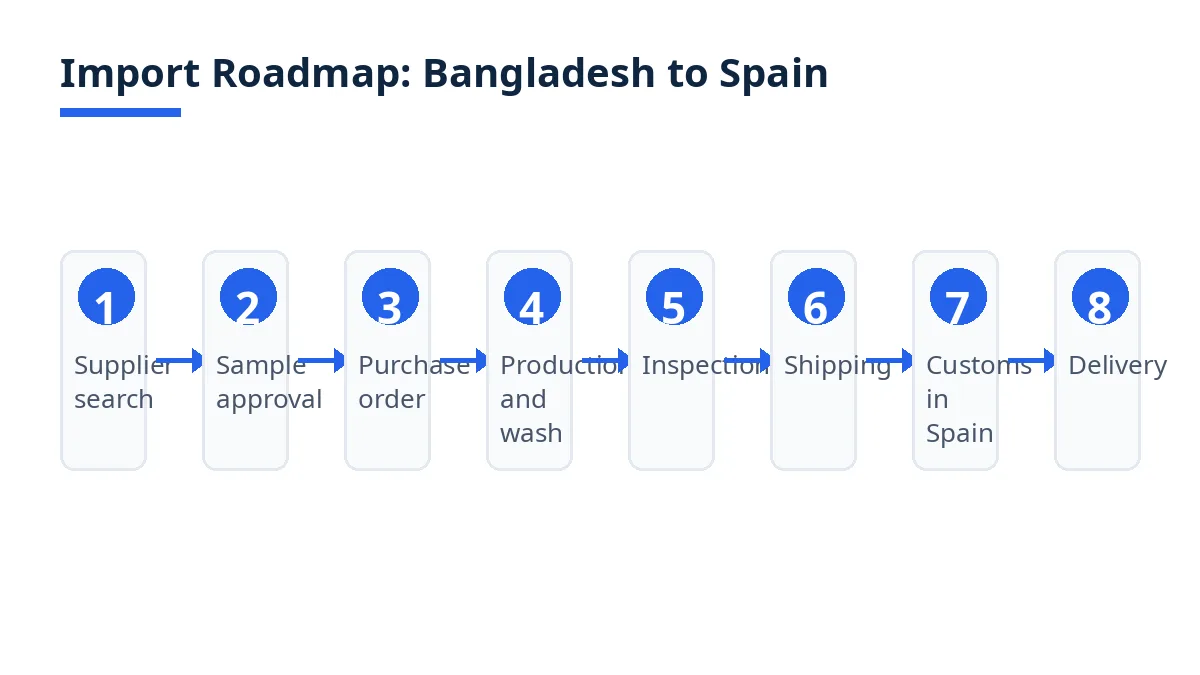
Fix the range: fits, fabric, wash family, size curve and measurements, hardware and packing.
Choose the entry plan: Valencia or Barcelona, EORI number in place, Spanish VAT treatment confirmed with your tax adviser.
Classify each style, confirm the 0 percent EBA position and the 12 percent fallback with your customs broker, and name the origin proof the supplier must provide.
Shortlist denim suppliers on the identical specification, and verify company documents, wash route and bank details.
Approve a pre-production sample in production fabric, wash and hardware, in writing, and keep a sealed counter-sample.
Agree the delivery term, inspection plan, defect limits and payment terms in the contract.
Book freight on your forwarder's current sailing schedule, and confirm carton count, dimensions and weight.
Give your broker the invoice, packing list, bill of lading and origin statement before the vessel sails.
Inspect during production and on packed goods, and hold shipment on a failed inspection until the failure is fixed and re-checked.
Clear at Valencia or Barcelona, pay duty and VAT as your broker confirms, and deliver to your warehouse.
How Exportain helps
Exportain is a B2B marketplace where buyers find Bangladeshi suppliers, post requests for quotation, receive quotations, message suppliers and place orders. Read how to buy for the steps from first search to shipment. Exportain is not a party to the goods contract and does not inspect goods, book freight or clear customs. Supplier badges record document and photo reviews, not factory inspections or guarantees.
FAQs
What is the typical MOQ for denim jeans from Bangladesh?
There is no single typical MOQ for denim jeans from Bangladesh. The minimum is set per style and usually per wash and per colour, because fabric lots, washing batches and cutting plans are set up per style and wash. Ask each supplier how its minimum splits across style, wash, colour and size curve, and confirm it in writing before you approve samples.
How long does shipping take?
There is no single typical transit time for denim jeans from Bangladesh to Spain. Sea freight is the standard route for bulk orders and takes weeks rather than days, varying by port, routing, transshipment and season. Plan from your forwarder's current sailing schedule for Chattogram to Valencia or Barcelona, and add clearance and inland delivery.
What import duty applies?
For men's or boys' cotton denim jeans on code 6203.42.31, the schedule opened for this guide lists a third-country duty of 12.00 percent and a GSP-EBA preference of 0.00 percent.7 A qualifying shipment with proven origin can enter at 0 percent under Everything But Arms.8 Confirm the position with your customs broker for your exact styles, and keep the 12 percent rate as your fallback.
How do I verify a supplier?
Verify in three layers: company documents with matching legal name, address and bank account name; capability, including the denim range, fabric route and wash route the supplier can show; and payment discipline, with payments only to the company account named in the documents. Add a pre-production sample in production fabric and wash, approved in writing, before bulk production.
Next steps on Exportain
Start with the range and the entry plan, then shortlist suppliers on one identical specification. Read the how to import from Bangladesh pillar guide, browse suppliers in the denim category, and work through the landed cost imports from Bangladesh calculator with your own quotations before you place the order.
Sources
- About us - Valenciaport. Port Authority of Valencia (Valenciaport) (accessed )
- Economic Operators Registration and Identification number (EORI). European Commission, Taxation and Customs Union (accessed )
- VAT tax rates. Spanish Tax Agency (Agencia Tributaria) (accessed )
- ISO 2859-1:2026 - Sampling procedures for inspection by attributes — Part 1: Sampling schemes indexed by acceptance quality limit (AQL) for lot-by-lot inspection. International Organization for Standardization (accessed )
- Regulation (EU) No 1007/2011 on textile fibre names and related labelling and marking of the fibre composition of textile products. European Union, (accessed )
- Insider thoughts: Bob Ronai on Incoterms 2020 Rules; What are they about?. International Chamber of Commerce (accessed )
- Commodity code 6203423100: Of denim - Northern Ireland Online Tariff. GOV.UK, HM Revenue and Customs (accessed )
- Trade arrangements. European Commission, Access2Markets (accessed )
About the author
Sourcing from Bangladesh?
Post a request for quotation and suppliers on Exportain can send you their quotes directly.
Post an RFQ