

Denim Jeans From Bangladesh to Saudi Arabia: A Buyer's Import Checklist
Saudi buyer checklist for importing denim jeans from Bangladesh: SABER conformity, supplier checks, MOQ and pricing, quality control, shipping through Jeddah or Dammam, duty, 15% import VAT and landed cost.
Short answer
To import denim jeans from Bangladesh to Saudi Arabia, settle the Saudi entry first: confirm SABER product and shipment conformity, the Saudi tariff line for each style, and import VAT at 15 percent, then choose a denim supplier on a written specification covering fabric, fit, wash and size curve. Verify the supplier, approve a pre-production sample, agree an inspection plan, and clear customs through Jeddah or Dammam with the broker-confirmed duty and VAT paid.
On this page
Key takeaways
Settle the Saudi entry before bulk production: SABER product and shipment conformity, the confirmed Saudi tariff line for each style, and 15% import VAT on the duty-inclusive value.
Denim jeans are textile products under SASO's textile regulation where they contain at least 80% textile fibres, with a SABER Product Certificate of Conformity valid for one year and a Shipment Certificate of Conformity for each shipment.
There is no single typical MOQ, price or transit time for denim jeans: confirm each one in writing for your exact fabric, fit, wash, size curve, route and shipment date.
Men's and women's denim jeans sit on different headings (6203 and 6204 in the schedule opened for this guide), with 6203.42 for cotton trousers and a blue denim suffix for men's trousers; confirm the full Saudi line with a broker.
Choose the gateway by sales region: Jeddah Islamic Port on the Red Sea for the west and centre, or King Abdulaziz Port in Dammam on the Gulf for the east, with inland delivery to Riyadh costed separately.
For a buyer in Saudi Arabia, a denim jeans order from Bangladesh is decided at the Saudi border before it is decided in the factory. The work that most often delays a first shipment is the Saudi entry: conformity through SABER, a customs entry with the correct denim line, import VAT at 15 percent, and a port choice that matches where the goods will be sold. Settle that entry first, then choose a supplier on a specification the supplier can actually make.
This guide follows that order for Saudi buyers, brands, retailers and wholesalers, working through suppliers, minimums, pricing, quality checks, delivery terms, shipping, duty, tax and documents in the order a buyer meets them. Every price, minimum and transit figure here is labelled as an example figure where it appears, because no single figure holds across fabrics, washes, sizes and routes.
Why source denim jeans from Bangladesh
Bangladesh has a long-established denim supply chain, with mills weaving denim fabric and factories cutting, sewing, washing and finishing jeans for export buyers. That chain matters because a jean is not one product: it is a fabric choice, a fit, a wash, a trim set and a size curve, and each choice changes cost, lead time and inspection. A supplier that already makes denim jeans is more likely to hold the washing and shade control the order needs.
Start by separating the product into decisions you control: fabric, cotton and stretch content, weight, construction, fit and size curve, wash and shade, trims, labelling and packing. A quote that does not name those items is not comparable with one that does.
The Saudi angle changes the order of work, not the product itself. Denim jeans are textile products, so they fall within the Saudi textile conformity system below, and as commercial goods they attract import VAT. A buyer who approves a wash before confirming that the same product can clear with its SABER shipment certificate risks holding finished goods at the port while paperwork catches up. Confirm the entry route, then approve the product.
Find and verify suppliers
Where should you start the search?
Start with a written specification, not a list of factory names. Write down fabric, weight, stretch, fit, size curve, wash, shade reference, trims, labelling and packing, and send the identical specification to every candidate. Browse suppliers on Exportain and read finding suppliers in Bangladesh.
Shortlist suppliers whose current range already includes denim jeans in the fits you need. Ask which fabrics it holds or buys, whether washing is in-house or subcontracted, how shade is controlled across a bulk lot, and what size curve it can grade. A finished pair from current production shows more than a catalogue photograph: seam strength, wash consistency, pocket setting, hem finish and shade matching.
How do you verify a supplier before you pay?
Verification has three layers: company documents (trade licence, export registration and association membership where applicable, checked so name, address and bank account agree); capability (fabric source, washing route, shade control and monthly capacity); and payment discipline (pay only the company account named in the documents, never a personal account, and verify any bank-detail change separately).
Read how supplier verification works on Exportain for what document and photo checks cover. On Exportain, supplier profiles carry document and photo review badges: a review of documents and photos, not a factory inspection or a guarantee, and Exportain is not a party to the goods contract. For a first order, add a video or in-person factory check.
MOQ, pricing and samples
What is the typical MOQ for denim jeans from Bangladesh?
There is no single typical minimum order quantity for denim jeans from Bangladesh, and this guide states none as a market fact. The minimum is set per style, and usually per wash and colour, because fabric is woven and dyed in batches, washing is run in lots, and a cutting plan is set up per size curve. A rigid jean in one wash and a stretch jean in three washes will not carry the same minimum, even from the same factory.
Ask each supplier how its minimum splits: by style, by wash, by fabric, and by size curve. Ask whether a second wash counts as a separate minimum, and what happens to the price when a size curve is incomplete. Treat every such figure as a quote for the named specification, not as a general market figure, and get it in writing before sampling.
How is the price built, and how should you compare quotes?
Denim fabric is usually the largest cost element in a jean, followed by cutting and sewing, washing and finishing, trims, testing, packing and the factory margin. Fabric use per pair depends on fit, size curve and wash, and detail such as whiskering, grinding, laser work and embroidery adds operations over a plain rinse wash.
Compare quotes on the same basis only: same fabric and weight, fit and size curve, wash and shade, trims, labelling, packing and delivery term. Ask each supplier to state what is excluded, for example wash chemicals, special trims or testing. A lower quote that assumes a lighter fabric, simpler wash or shorter size curve is a different product, not a saving.
Which samples do you need, and how do you approve them?
Work in stages. A development sample shows whether the factory can construct the jean and hold the fit. A pre-production sample, made in the actual production fabric, wash, trims and labelling, is the sample you approve for bulk. Shade, wash effect and fit cannot be approved from a sample in substitute fabric, because washing and finishing change dimensions, shade and hand feel.
Test samples as customers will wear and wash them: measure waist, hip, thigh, knee, leg opening and inseam against your size chart, check both legs for length and shade match, and wash one pair following your care label to check shrinkage and shade change. Approve in writing and keep one sealed counter-sample of each style and wash.
Quality control and certifications needed
Which quality checks are specific to denim jeans?
Against the approved sample and size chart, check fabric composition, finished weight, measurements across the size curve, and wash and shade consistency across sizes. Then check construction pair by pair: waistband, pocket setting and bartacks, fly, seam strength, rivet and button setting, hem finish and leg symmetry, plus wash evenness and any damage at stress points.
Agree the inspection method and defect limits before production. ISO 2859-1 sets out sampling schemes indexed by acceptance quality limit (AQL) for lot-by-lot inspection, with sample size code letters and master tables for normal, tightened and reduced inspection.1 Agree the lot size, inspection level, AQL for major and minor defects, and acceptance and rejection numbers in writing, so an inspector can apply the same rule to every lot. Inspect in stages: an inline check during sewing and washing catches a shade drift while correction is still possible, and a final random inspection on packed goods checks quantity, workmanship, measurements, labels and packing.
Which certifications do you actually need for Saudi Arabia?
This section separates a Saudi order from a denim order to another market, and it should be settled before bulk production. The Saudi Standards, Metrology and Quality Organization (SASO) published a Technical Regulation for Textile Products that applies to textile products placed on the Saudi market, including clothing, where the product contains at least 80 percent by weight of textile fibres.2 SASO's own notice gives the same scope, covering textile products of at least 80 percent textile fibres, including garments.3 A cotton denim jean sits squarely inside that scope, so plan for conformity work from the start.
Under the Saudi product safety programme, SALEEM, conformity runs through SABER, the online platform linking importers, certification bodies and Saudi Customs for product and shipment certificates.2 The sequence is importer registration, product registration with details and photographs, classification as regulated or non-regulated by HS code, a Product Certificate of Conformity (PCoC) for regulated products, valid for one year, and a Shipment Certificate of Conformity (SCoC) for each shipment.2 A second conformity body describes the same four steps, with a self-declaration instead of a product certificate for a non-regulated product.4
Textile products are tested from a mechanical, physical and chemical perspective, and must also meet the corresponding SASO and Gulf standards.4 That testing is why the pre-production sample matters twice over in a Saudi order: it is both your commercial approval and the product the conformity file describes. Agree with your Saudi importer or agent, before production, who holds the SABER account, which certification body will issue the certificates, what test reports the factory must supply, and what labelling the shipment will carry. Do not ship on the assumption that a shipment certificate can be arranged after the goods have left Bangladesh: it is part of the entry, not an afterthought.
Confirm fibre composition, care, size and origin marking with your importer, check the finished label before bulk label sewing, and keep the label artwork with the SABER product registration.
Incoterms, shipping and transit time
Which delivery term should a first order use?
The Incoterms 2020 rules set out, for each rule, where delivery takes place, and risk passes from seller to buyer at the same point and time as delivery.5 Under FOB, CFR and CIF the seller must place the goods on board the vessel, and in all rules but DDP the buyer must carry out import formalities.5 The four sea rules, FAS, FOB, CFR and CIF, are only intended for port-to-port bulk or break-bulk shipments and are not suitable for container shipments, because a container is handed to the carrier before it is on board.5
For a first containerised order, weigh FOB at the Bangladeshi port against FCA at the named terminal. Under FOB, the factory delivers the goods on board and your forwarder handles the sea leg. Under FCA, delivery happens when the goods are handed to your carrier, which matches how containerised cargo moves. If you want the seller to arrange freight and insurance to a Saudi port, CIF gives you that arrangement, but it does not move Saudi import formalities, SABER certificates or import VAT to the seller: those remain with you as buyer.
Which Saudi gateway should the shipment use?
Choose the gateway by where the goods will be sold, not by which port appears first on a forwarder quote. Mawani, the Saudi Ports Authority, oversees commercial and industrial ports in Saudi Arabia, including Jeddah Islamic Port, described as the busiest port handling general cargo and containers, and King Abdulaziz Port in Dammam.6 For most denim buyers, the choice is Jeddah Islamic Port on the Red Sea for the western region and onward distribution toward the central region, or King Abdulaziz Port in Dammam on the Gulf for the eastern region, with inland delivery to Riyadh costed separately in either case.
Ask your forwarder to quote the gateway and inland leg separately, and to name the port of discharge on the bill of lading exactly as it will appear on the customs entry and SABER shipment certificate.
How long does shipping take?
There is no single typical transit time for denim jeans from Bangladesh to Saudi Arabia. Sea freight is the standard route for bulk orders and takes weeks rather than days, varying by port, routing, transshipment and season. Plan from your forwarder's current sailing schedule, and add clearance and delivery. Keep production time separate: an order is ready only when every pair has finished sewing, washing, inspection and packing. Confirm pairs per carton, carton dimensions and weight in the specification, because denim is heavy for its size.
Import duty, taxes and documents
How are denim jeans classified for duty?
Duty follows the classification of each style in the Saudi tariff, not the supplier's product name. In the United States schedule opened for this guide, heading 6203 covers men's or boys' trousers and shorts, heading 6204 the women's or girls' equivalent, with 6203.42 for cotton trousers and a blue denim suffix for men's trousers.7 That schedule shows only how the denim split works: men's and women's jeans sit on different headings, and cotton denim sits apart from synthetic-fibre trousers.
What import duty applies?
This guide prints no Saudi duty rate as a fact, because no Saudi tariff schedule line for denim jeans was opened and confirmed in this run. Do not price from a generic percentage in a blog post. Ask your broker to confirm, in writing, the tariff line for each style, the rate on that line for the entry date, and the customs value base, and keep that confirmation with the order file. If a broker cannot name the schedule and line, pause rather than estimate.
The tax position, by contrast, is documented. ZATCA's VAT guideline states that VAT at 15 percent is imposed on all imports of goods into the Kingdom, regardless of classification or customs duty rate, subject to stated exceptions such as diplomatic and military exemptions, qualified medical goods and personal baggage.8 A separate explainer states that import VAT is charged on the total customs value including insurance and freight, plus customs duty, and that a VAT-registered importer can later claim it as input VAT where the goods are used for taxable business activities.9 Work the two charges in order: first the broker-confirmed duty, then 15 percent VAT on the duty-inclusive value, and treat the VAT as a cash cost at clearance even where it is later recoverable.
Which documents do you need for clearance?
The standard import set is the commercial invoice, packing list, bill of lading, proof of origin where claimed, and the SABER shipment certificate. The invoice should name each style plainly, for example men's cotton blue denim jeans, five-pocket, with composition, wash, sizes, quantities, unit prices and delivery term, on its own line. Quantities, weights and carton counts must agree across every document, and the invoice description must match the SABER product registration.
Landed cost example
A landed cost is the full cost of one pair of jeans, ready to sell in Saudi Arabia. Every number below is an example figure only, not a quote, and the duty figure is not a Saudi rate.
Example figures: 5,000 pairs, FOB Chattogram, sea freight to Jeddah Islamic Port, with a broker-confirmed duty figure still to be substituted for the example duty.
Cost element | Example figures (per pair) | How to obtain your figure |
|---|---|---|
Product price, FOB | $9.60 | Confirmed pro forma invoice |
International freight | $1.20 | Forwarder quote per pair |
Insurance | $0.08 | Policy or forwarder quote |
Duty | $0.54 | Broker calculation, confirmed codes |
Port, clearance and broker fees | $0.35 | Broker invoices per pair |
Local delivery to warehouse | $0.25 | Local carrier quote per pair |
Total landed cost | $12.02 | Sum of all lines above |
Import VAT is excluded from the total above, because a VAT-registered buyer can generally claim it as input VAT. Example figures: on a duty-inclusive $11.42 per pair ($10.88 CIF plus $0.54 example duty), 15 percent import VAT is $1.71 per pair, payable at clearance. A buyer who cannot claim input VAT should add that $1.71, giving $13.73 per pair on these example figures. Work the calculation twice: at quote stage, and again after shipment with the actual invoices. See landed cost for imports from Bangladesh for the full method.
Step-by-step import checklist
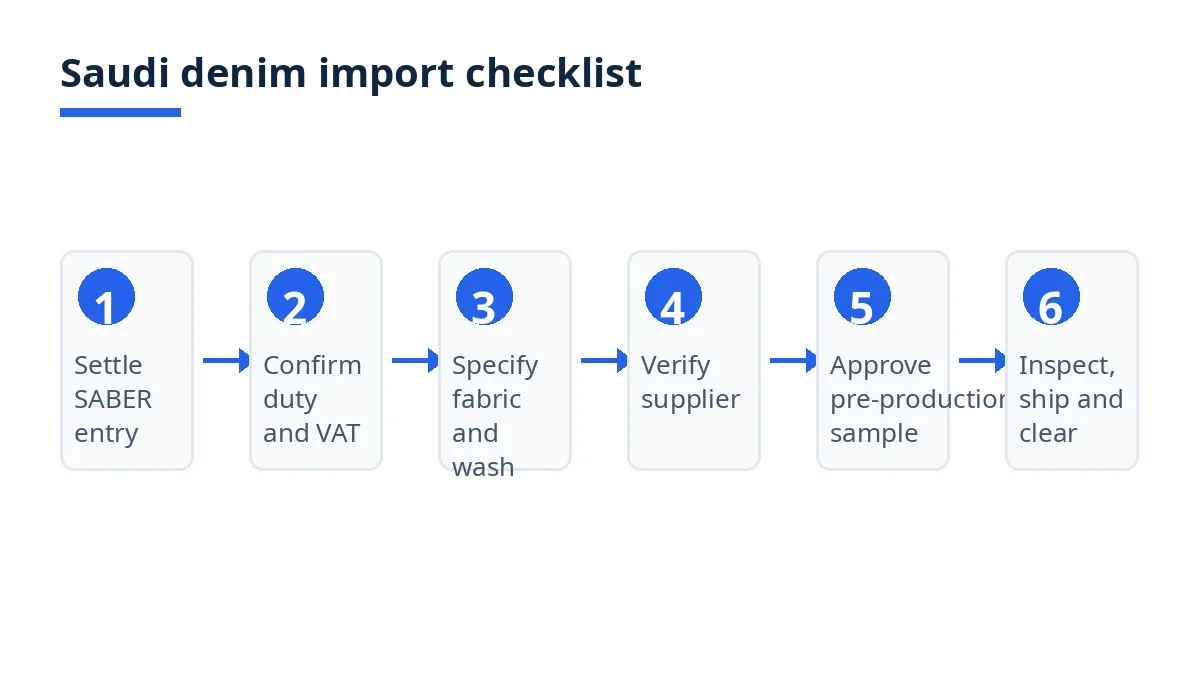
Settle the Saudi entry first: confirm who holds the SABER account, which certification body will issue the certificates, and which Saudi port will receive the goods.
Write the specification style by style: fabric, weight and stretch, fit and size curve, wash and shade, trims, labelling and packing.
Classify every style from headings 6203 and 6204, and confirm each full Saudi tariff line and duty rate with your broker in writing.
Shortlist suppliers whose current range includes denim jeans, and request comparable quotes on the identical specification and delivery term.
Verify the chosen supplier: documents, denim capacity, fabric source, washing route and shade control, plus a video or in-person factory check for a first order.
Order samples in stages, measure and wash them against your size chart, then approve a pre-production sample of each style and wash in production fabric and trims.
Confirm the order in writing: purchase order, pro forma invoice, delivery and payment terms, inspection plan with AQL limits, SABER test reports, labelling, packing and shipment date.
Inspect during production and again on packed goods against the approved samples, checking wash consistency, shade matching, measurements and labels.
Ship, clear customs with the confirmed code for each style, the SABER shipment certificate and the import VAT payment, and reconcile the actual landed cost.
How Exportain helps
Browse suppliers for Bangladeshi denim exporters and compare their ranges against your style and wash list, then post your specification as an RFQ and compare replies on the same terms before sampling. Read how to buy for the buyer journey, and how to import from Bangladesh for the full process. Exportain is a B2B marketplace where buyers post RFQs, receive quotations and message suppliers. It does not inspect goods, book freight or clear customs.
FAQs
What is the typical MOQ for denim jeans from Bangladesh to Saudi Arabia?
There is no single typical minimum. It is set per style and usually per wash and colour, because fabric is woven and dyed in batches and washing is run in lots. Ask how the minimum splits, and get it in writing for your exact specification.
How long does shipping take?
Production and transit times are separate, with no single typical figure. Sea transit takes weeks rather than days and varies by port, routing and season. Plan from your forwarder's sailing schedule, plus SABER clearance and inland delivery.
What import duty applies?
Duty follows the confirmed Saudi tariff classification of each style, and this guide prints no Saudi rate as a fact: ask your broker to confirm the schedule line and rate for each style in writing before you price. Import VAT is separate: ZATCA's guideline imposes VAT at 15 percent on all imports into the Kingdom, regardless of classification or duty rate, subject to stated exceptions.8 For a VAT-registered buyer, import VAT paid at clearance can generally be claimed as input VAT.9
How do I verify a supplier?
Check documents first, so name, address and bank account agree across the trade licence, export registration and invoices. Then check capability: fabric source, washing route, shade control and capacity. Pay only the company account named in the documents, approve a pre-production sample of each style and wash before bulk production, and confirm SABER test reports and labelling before shipment.
Next steps on Exportain
Read how to import from Bangladesh for the full process, then browse suppliers to shortlist denim exporters. When ready, use how to buy to post your requirement and compare quotes on the same terms.
Sources
- SIST ISO 2859-1:2003 - Sampling procedures for inspection by attributes, Part 1: Sampling schemes indexed by acceptance quality limit (AQL). International Organization for Standardization, (accessed )
- SASO Certificate of Conformity | SALEEM | SABER. TÜV SÜD (accessed )
- SASO Requests Public Opinion on Technical Regulation of Textile Products. Saudi Standards, Metrology and Quality Organization (SASO) (accessed )
- New SASO Regulations and the Effects on Textiles and Apparel Industry. UL Solutions (accessed )
- Insider thoughts: Bob Ronai on Incoterms 2020 Rules; What are they about?. International Chamber of Commerce (accessed )
- What Is the Role of the Saudi Ports Authority in Boosting National Trade?. Bayut, (accessed )
- Harmonized Tariff Schedule of the United States, Chapter 62: Articles of apparel and clothing accessories, not knitted or crocheted (Revision 17, 2026). United States International Trade Commission (accessed )
- VAT Guideline For the Retail Sector. Zakat, Tax and Customs Authority (accessed )
- VAT on Imports and Exports in Saudi Arabia (KSA). ClearTax, (accessed )
About the author
Sourcing from Bangladesh?
Post a request for quotation and suppliers on Exportain can send you their quotes directly.
Post an RFQ


