

How to Import Denim Jeans From Bangladesh to Italy: Step-by-Step Guide
How to import denim jeans from Bangladesh to Italy: Genoa entry, EBA duty, Italian VAT, supplier checks, fit and wash samples, labelling, shipping and a worked landed-cost example for Italy-based buyers.
Short answer
To import denim jeans from Bangladesh to Italy, settle the Italian entry first: confirm the 6203.42 or 6204.62 classification, prove origin for 0% duty under Everything But Arms or price at the 12% third-country rate, and settle Italian VAT at 22% and the EORI setup. Then specify fit, wash and shade, verify the supplier and laundry route, approve a pre-production sample, and clear through Genoa or La Spezia with matching documents.
On this page
Key takeaways
Italy is an EU entry: the duty line and preference are EU rules, while the VAT rate, EORI setup, Italian label language and port route are Italian decisions.
For cotton trouser lines in chapter 62, the schedule opened for this guide lists a 12.00% third-country duty and a 0.00% preference under GSP-EBA, proven by origin proof, not by default.
Men's cotton jeans sit in heading 6203, line 6203.42, and women's cotton jeans in heading 6204, line 6204.62, so a mixed order carries at least two classifications.
Under the revised EU GSP origin rules for least-developed countries, single-stage processing, manufacture from fabric, is allowed for textiles and clothing.
Italy's standard import VAT rate is 22%, charged on the customs value plus duty and incidental expenses up to the first place of destination in Italy.
An Italy-based buyer importing denim jeans from Bangladesh faces three decisions before price matters: whether the jeans qualify for 0% duty under Everything But Arms, how Italian import VAT at 22% will be handled at clearance, and whether the goods will enter through Genoa or another Italian port.
This guide works through the Italy entry first, then the denim steps for fit, wash and shade, and finishes with a landed-cost example for a Genoa arrival. It is for retailers, brands, wholesalers and importers based in Italy buying woven denim jeans from Bangladeshi suppliers.
The Italy entry decision: Genoa, VAT and origin before price
Start with the entry, not the catalogue. Italy applies EU customs law to goods arriving from outside the European Union, so a shipment from Bangladesh is an EU import under the EU Common Customs Tariff, applied at the Italian port of entry. What is Italian is the VAT rate, the importer's EORI and fiscal setup, the language of consumer information, and the onward route from the port to the warehouse.
Duty is the first entry decision. The tariff schedule opened for this guide lists, for trouser lines in chapter 62, a third-country duty of 12.00% and a 0.00% preference under GSP-EBA, the special arrangement for least-developed countries under Everything But Arms.1 The European Commission describes Everything But Arms as the most favourable regime under the EU Generalised Scheme of Preferences, granting duty-free, quota-free access to the EU for exports of all products except arms and ammunition.2 A preference applies only when the jeans meet the scheme's origin rules and the importer holds the required proof of origin. Price the order twice: once at 0% with the preference proven, and once at 12% without it.
VAT is the second entry decision. Italy's standard VAT rate is 22%, and reduced rates apply only to goods specifically listed in Italian VAT law.3 Import VAT is charged on the customs value plus duty and incidental expenses not already in the customs value, up to the first place of destination in Italy.3 For a VAT-registered importer who can deduct input VAT, it is mainly a cash-flow item; for one who cannot, it is a real cost. Decide who will act as importer of record, since that determines who pays import VAT and who needs an EORI number.
The third entry decision is the port and the importer. Genoa is the natural first port to test: it puts the goods inside Italy at entry, with onward trucking to Milan, Turin and Prato. La Spezia is the other Ligurian option to compare on the same sailing schedule. An EORI number issued by any EU member state is valid across the EU, so an existing German or Dutch EORI number can be used in Italy, but the declarant for the Italian entry must still be settled in writing.3
Why Bangladesh denim fits an Italian buyer
Bangladesh is a large denim supplier to the EU, and the supply base is deep enough for an Italian buyer to compare several suppliers on one specification. Textiles account for almost 94% of EU imports from Bangladesh, and Bangladesh is the largest beneficiary under Everything But Arms, with 19 billion euros of exports benefiting from the preferences in 2024 at a 96% utilisation rate.2 Denim weaving, laundry, washing, shade control and fit approval are established operations, and suppliers are used to EU labelling and chemical requirements. Depth does not remove the need to verify a supplier, approve samples and inspect bulk goods.
The Italian angle is the fit and wash programme, not volume alone. A single order can carry several fits, rises, leg shapes and washes, and that range is where orders fail. Shortlist by fit and wash capability, and ask each candidate which of your exact styles it already produces for the EU market.
Classify before you quote: men's and women's denim lines
Duty follows classification, and classification follows the garment, not the supplier's product name. Men's or boys' cotton trousers sit in heading 6203, line 6203.42. Women's or girls' cotton trousers sit in heading 6204, line 6204.62. A mixed order therefore carries at least two classifications, invoice lines and duty checks.
Separate the lines on every document. Fibre composition changes the line: a 100% cotton jean and a cotton-elastane blend can sit differently. Write the wearer, garment type, fibre composition, fabric construction and wash on the specification, and ask your broker to confirm the full code for each style before you accept a price. Classify an unclear style before sampling, since reclassification after production means repricing sewn goods.
Origin proof belongs in the same step. Under the revised EU GSP rules of origin for least-developed countries, single-stage processing, manufacture from fabric, is allowed for textiles and clothing instead of the two stages, manufacture from yarn, required before, so clothes made in Bangladesh can qualify even when made from imported fabrics.4 That makes the 0% preference usable for many denim orders, but it is not automatic: the goods must meet the origin rule for the line, and the importer must hold the proof the scheme accepts. Agree at order stage which proof will be supplied.
Find and verify suppliers for the Italian market
Where should an Italy buyer start the search?
Start with a specification, not factory names. Write down every style first: wearer, fit, rise, leg shape, size range, fabric composition and weight, stretch content, wash, colour, trims, labelling and packing. Then shortlist suppliers whose current range already includes woven denim jeans for the EU market. A knitwear-only or shirt-only supplier is not a close substitute, because denim cutting, laundry work and shade control use different operations.
Send every candidate the identical specification and ask for the same reply format: fabric assumed, wash route, price inclusions, validity and minimum per style, colour and size range. Browse suppliers on Exportain and compare replies on the same terms before choosing a factory for sampling. Ask each candidate to name the laundry route for your washes: in-house, a named partner, or one it has not used before.
How do you verify a supplier before you pay?
Verification has three layers. The first is company documents: trade licence, export registration and association membership where applicable, checked so that name, address and bank account name agree. The second is capability: denim capacity, fabric source and width, laundry and wash route, and shade-control method. A finished pair from current production shows fit consistency, wash evenness and shade matching across sizes.
The third layer is payment discipline. Keep payments to the company account named in the documents, never to a personal account, and verify any change of bank details separately. On Exportain, supplier profiles carry document and photo review badges: a review of documents and photos, not a factory inspection or a guarantee, and Exportain is not a party to the goods contract. For a first order, a factory visit or a small trial order is proportionate to the risk.
MOQ, pricing and samples: fit, wash and shade first
What is the typical MOQ for denim jeans from Bangladesh?
There is no single typical minimum order quantity for denim jeans from Bangladesh. The minimum is set per style and usually per colour and wash, because fabric is cut in batches, laundry loads are set per wash, and a cutting plan is set up per size range. A rigid five-pocket jean and a stretch skinny with three washes will not carry the same minimum. Ask how the minimum splits by style, colour, wash and size range.
How is the price built, and how should you compare quotes?
Fabric is usually the largest cost element in a jean, followed by cutting and sewing, laundry and washing, trims, testing, packing and the factory margin. Wash adds operations a plain fabric price hides: stone wash, enzyme wash, bleaching and hand finishing each cost laundry time and carry shade risk. Two quotes can differ because one assumes a lighter fabric, a simpler wash or less stretch. Ask what each price is based on, in writing, and compare quotes on the same basis: fit and size range, fabric, stretch content, wash, trims, delivery term and packing.
Which samples do you need, and how do you approve them?
Work in stages. A development sample shows whether the factory can cut the fit, sew the style and run the wash. A pre-production sample, made in the actual production fabric, wash, trims and labels, is the sample you approve for bulk.
Test the samples as your customers will use them: measure waist, hip, thigh, knee, leg opening and inseam against your size chart after washing, check that the wash shade matches across sizes and across the pair, and check trims and stitching under normal use. Approve in writing and keep one sealed counter-sample of each style and wash. Shade approval needs a tolerance in writing: reference shade, light source for comparison, and acceptable shade band.
Quality control, Italian labelling and chemical compliance
Which quality checks are specific to denim jeans?
Against the approved sample and chart, check fabric composition and finished weight, finished measurements within your agreed tolerances, and consistency across the size range. Then check construction pair by pair: seam strength, pocket and fly construction, waistband and belt-loop attachment, rivet and button setting, and wash evenness. A jean can pass measurement and still fail if one leg is lighter than the other.
Agree the inspection method and defect limits before production, and inspect in stages: an inline check during sewing and laundry, and a final random inspection on packed goods covering quantity, workmanship, measurements, labels and packing. Record findings by style, wash and carton.
Which label rules apply in Italy?
Fibre labelling applies to every jean sold in Italy, and consumer information in Italy is in Italian. Article 9 of Regulation (EU) No 1007/2011 states that a textile product shall be labelled or marked with the name and percentage by weight of all constituent fibres in descending order.5 Agree the wording at sampling stage and check that the percentages match the fabric you bought, because the labelled composition is also the composition your classification is built on. Approve the Italian label, care label and size marking as a set before bulk label sewing begins.3
Which chemical and test requirements apply?
The two most important EU-wide legal requirements for textiles are the REACH Regulation and Regulation (EU) No 1007/2011 on fibre names and labelling.6 Under REACH, importers must make sure their products do not contain restricted substances, or that concentrations are within acceptable limits, with limits defined in REACH Annex XVII and the list of Substances of Very High Concern.6 In clothing, restricted substances are most often found in synthetic dyes, metallic accessories, plastic components and preservatives.6 For denim, wash chemicals, dyes, trims and coatings are therefore in scope for testing, not only the base fabric. Name the tests in the specification and confirm that a report for a different fabric or wash does not cover your order.
Incoterms, Genoa routing and transit time
Which delivery term should a first order use?
The Incoterms 2020 rules define, for each rule, where delivery takes place and where risk passes from seller to buyer. Under FCA, the seller delivers and transfers risk at the agreed location, once the goods are delivered to the carrier or to the person designated by the buyer, and FCA suits any mode of transportation, including multimodal shipments.7 Under FOB, the seller delivers and transfers risk once the goods are loaded onto the vessel at the named port of shipment, and FOB is for maritime or inland waterway transportation only.7 The key difference between FCA and FOB lies in the place of delivery and the required modes of transport.7
For a first containerised order to Italy, weigh FCA at the named terminal against FOB at Chattogram. Under FCA, delivery happens when the goods are handed to your carrier, which matches how containerised cargo moves. State the rule, named place and edition in the purchase order, for example FCA Chattogram container terminal, Incoterms 2020.
How long does shipping take?
There is no single typical transit time for denim jeans from Bangladesh to Italy. Sea freight is the standard route for bulk orders and takes weeks rather than days, varying by port, routing, transshipment and season. Plan from your forwarder's current sailing schedule for the Genoa or La Spezia arrival, and add clearance and onward delivery. Keep production time separate: an order is ready only when every pair has finished sewing, laundry, inspection and packing. Ask whether the sailing is direct to an Italian port or transshipped through a hub port.
Import duty, Italian VAT and documents
What import duty applies?
Duty follows the confirmed classification of each style, the origin and the preference claimed on the entry date. For cotton trouser lines in chapter 62, the schedule opened for this guide lists a third-country duty of 12.00% and a 0.00% preference under GSP-EBA.1 Everything But Arms grants duty-free, quota-free access for all products except arms and ammunition.2 Read the 0% figure as a preference that must be proven: if the origin proof is missing, the fallback is the third-country rate. Confirm the current rate beside each style's code with your broker.
What about Italian VAT?
Italy applies a standard VAT rate of 22% to imports, with reduced rates only for goods specifically listed in Italian VAT law.3 The import VAT base is the customs value plus duty and incidental expenses not already in the customs value, up to the first place of destination in Italy.3 Work VAT into the cash-flow plan even when it is recoverable, since it is paid at clearance and recovered later.
Which documents do you need for clearance?
The standard import set is the commercial invoice, packing list, bill of lading or air waybill, and proof of origin where a preference is claimed. The invoice should name each style plainly, for example men's cotton five-pocket jean, straight fit, enzyme wash, with composition, size range, quantities, unit prices and delivery term, on its own line. Keep men's, women's, cotton and blended styles on separate lines matching their classifications. Quantities, weights and carton counts must agree across every document.
Landed cost example
A landed cost is the full cost of one pair of jeans, ready to sell in Italy. Every number below is an example figure only.
Example figures: 4,000 pairs of men's cotton jeans, FCA Chattogram, sea freight to Genoa, duty at 0% under Everything But Arms, onward delivery to a Milan warehouse.
Cost element | Example figures (per pair) | How to obtain your figure |
|---|---|---|
Product price, FCA | €9.80 | Confirmed pro forma invoice |
International freight | €0.85 | Forwarder quote divided by pairs shipped |
Insurance | €0.08 | Policy or forwarder quote |
Duty at 0% under Everything But Arms | €0.00 | Broker calculation from confirmed codes and origin proof |
Port, clearance and broker fees | €0.42 | Broker invoices divided by pairs |
Local delivery Genoa to Milan warehouse | €0.35 | Local carrier quote divided by pairs |
Total landed cost, excluding import VAT | €11.50 | Sum of all lines above |
Import VAT is not included in the total. At 22% on the customs value plus duty plus onward transport to the first destination in Italy, the example VAT base is €11.08 per pair and the example import VAT is €2.44 per pair. Work the calculation twice: at quote stage, style by style, and again after shipment with the actual invoices. If the origin proof fails, rerun the table at 12% duty. See landed cost for imports from Bangladesh for the full method.
Step-by-step import checklist for Italy
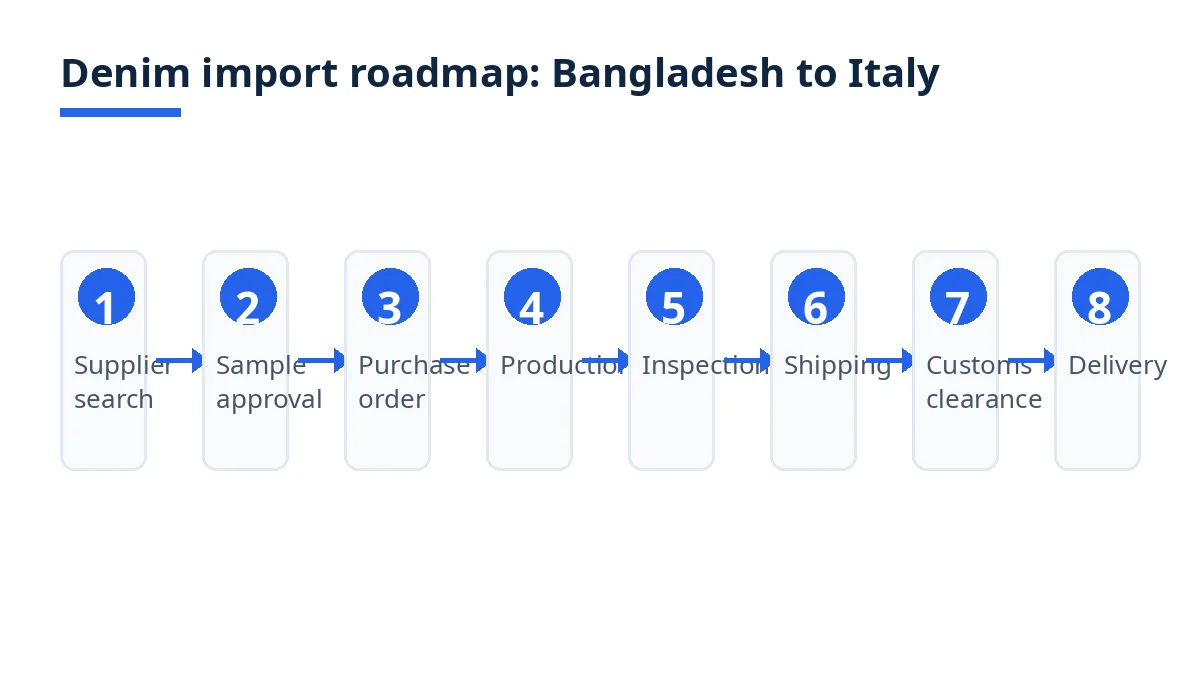
Settle the Italy entry first: port, importer of record, EORI number, Italian VAT treatment and origin proof for the 0% preference.
Classify every style, starting from 6203.42 for men's cotton jeans and 6204.62 for women's cotton jeans, and confirm each code and duty with your broker.
Write the specification style by style: wearer, fit, rise, leg shape, size range, fabric, stretch content, wash, colour, trims, Italian labels and packing.
Shortlist suppliers whose range includes woven denim jeans for the EU market, and request comparable quotes on the identical specification and delivery term.
Verify the chosen supplier: documents, denim capacity, fabric source, laundry and wash route, and a factory or laundry check for a first order.
Order samples in stages, measure after washing, check shade across sizes, and approve a pre-production sample of each style and wash in writing.
Confirm the order in writing: purchase order, pro forma invoice, delivery and payment terms, inspection plan, labelling, packing and shipment date.
Inspect during production and again on packed goods against the approved samples, checking shade, measurements and workmanship by style, wash and carton.
Ship, clear Italian customs with the confirmed code and origin proof for each style, and reconcile the actual landed cost including import VAT treatment.
How Exportain helps
Browse suppliers for Bangladeshi denim exporters and compare their ranges against your fit and wash list. Then post your specification and target quantity as an RFQ and compare replies on the same terms before you choose a factory for sampling. Exportain is a B2B marketplace where buyers post RFQs, receive quotations and message suppliers; it does not inspect goods, book freight or clear customs.
FAQs
What is the typical MOQ for denim jeans from Bangladesh?
There is no single typical minimum. It is set per style and usually per colour and wash, because fabric is cut in batches and laundry loads are set per wash.
How long does shipping take?
Production time and transit time are separate, and neither has a single typical figure. Sea transit to Genoa or La Spezia takes weeks rather than days and varies by routing and season.
What import duty applies?
Duty follows the confirmed classification of each style, the origin and the preference claimed on the entry date. For cotton trouser lines in chapter 62, the schedule opened for this guide lists a third-country duty of 12.00% and a 0.00% preference under GSP-EBA.1 Everything But Arms grants duty-free, quota-free access for all products except arms and ammunition.2 Confirm the current rate beside each style's code with your broker, and hold the origin proof before shipment.
How do I verify a supplier?
Check company documents first, so that name, address and bank account agree across the trade licence, export registration and invoices. Then check capability: denim capacity, fabric source, laundry and wash route, shade control and recent denim production for the EU market. Keep payments to the company account named in the documents.
Next steps on Exportain
Read how to import from Bangladesh for the full process, then work through landed cost for imports from Bangladesh with your broker's figures. When ready, read how to buy and post your specification as an RFQ.
Sources
- Commodity code 6204611000: Trousers and breeches. UK Government (accessed )
- EU trade relations with Bangladesh. European Commission, (accessed )
- Italy Import Regulations 2026: Customs, VAT & EORI. Lawzana (accessed )
- EC revises rules of origin in its GSP scheme. Textile Today, (accessed )
- Regulation (EU) No 1007/2011 on textile fibre names and related labelling and marking of the fibre composition of textile products, Article 9: Multi-fibre textile products. legislation.gov.uk (accessed )
- Textile Testing Requirements in the EU. Measurlabs, (accessed )
- FCA & FOB Incoterms 2020 explained: Key differences. ICC Academy (accessed )
About the author
Sourcing from Bangladesh?
Post a request for quotation and suppliers on Exportain can send you their quotes directly.
Post an RFQ


