

Denim Jeans From Bangladesh to Germany: A Buyer's Import Checklist
Germany denim jeans import guide: Hamburg entry file, German EORI and broker, EBA 0% preference with origin proof, negotiated MOQ, German fiber labeling, Chattogram to Hamburg shipping, and a worked landed-cost example for 3,000 jeans to Hamburg.
Short answer
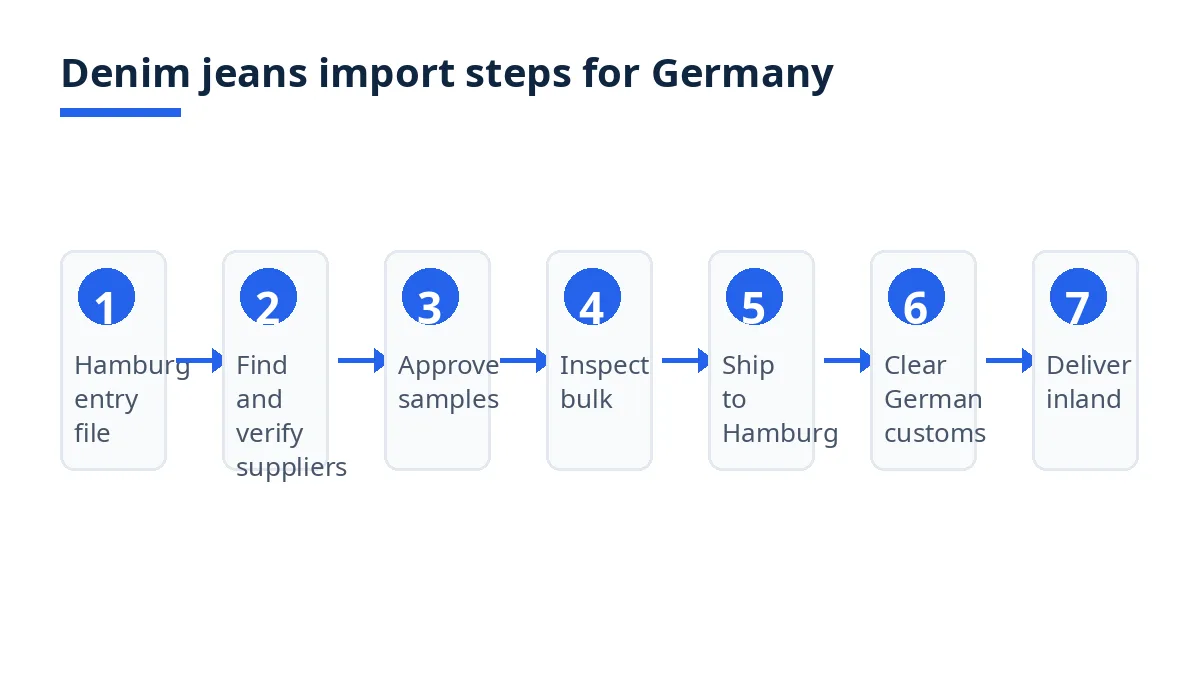
To import denim jeans from Bangladesh to Germany, start with the Hamburg entry file: a German EORI number, a German customs broker, the classification, and origin proof. For cotton trousers use 620342 for men's or boys' and 620462 for women's or girls', confirm the line with your broker, claim the 0 percent Everything But Arms preference only with a valid statement on origin, label fiber content in German, and price from landed cost.
On this page
Key takeaways
Start with the Hamburg entry file: a German EORI number, a German customs broker, the classification, and origin proof. The Everything But Arms preference figure is 0 percent, origin-proof dependent; if the proof is not in order, your broker must apply the TARIC third-country figure for your line on the entry date, and this guide asserts no product-specific third-country rate of its own.
There is no single typical MOQ for denim jeans from Bangladesh: the minimum is negotiated per style, per color, and per wash, and it moves with the fabric mill minimum, the laundry lot minimum, and the size curve, so ask for each level separately in writing.
The German label must match the bulk garment: under Regulation (EU) No 1007/2011 the fiber composition must be easily legible and given in the official language of the Member State where the product is made available, so jeans sold in Germany need fiber composition in German, covering pocketing, lining, and any stretch component.
Example figures only: 3,000 men's cotton denim jeans at 9.20 euros FOB Chattogram, shipped to Hamburg with inland delivery to a Hamburg-area warehouse, give a landed cost of 31,100.00 euros, or 10.37 euros per jean, at the 0 percent Everything But Arms preference in the example. German import VAT at 19 percent is not in that total and must be shown separately by your broker.
Why source denim jeans from Bangladesh
Start a denim jeans order for Germany from the Hamburg entry file, not from the lowest supplier price. Before you compare quotations, settle the port of entry, the German customs broker, the classification, and the origin proof, because those four items decide what the shipment costs at the border and whether it clears without a query. Fixing that file first lets you judge every quotation against the same landed cost, including the Hamburg-to-inland leg.
Bangladesh is a practical place to look for denim jeans because fabric mills, laundry and wash plants, trim suppliers, and packing operations sit in the same industrial areas. That depth lets you compare several suppliers on one specification, but it is not a substitute for checking an individual supplier, wash, or fit.
As a least developed country, Bangladesh benefits from the most favorable regime available under the European Union Generalised Scheme of Preferences, namely the Everything But Arms arrangement, which grants duty-free, quota-free access to the European Union for exports of all products except arms and ammunition.1 That preference is why this guide works Hamburg first: the duty question is the entry question, answered by the origin proof for your exact shipment, not by a general claim about Bangladesh.
Denim jeans are a fit and wash product first and a fabric product second. Two suppliers can quote the same fabric weight and still deliver jeans that fit differently, shrink differently, and wash to different shades. Specify the fit block, the rise, the leg opening, the wash recipe in words and reference pieces, and the tolerance for each measurement, and give every supplier the same target. The German entry also shapes the specification: label, classification, and wash choices must be consistent with the garment as made. Settle those points early, while changes are still cheap.
Find and verify suppliers
Build a shortlist of three to five suppliers who make denim jeans or legitimately supply them, and compare them on the same request for quotation. Ask each candidate for the same core documents and check that names, addresses, and validity periods agree across them. The general import guide lists the documents to request, including legal company name and registered address, trade license, Taxpayer Identification Number and VAT registration where applicable, and the Export Registration Certificate an exporter needs in order to export from Bangladesh.2
Record for every candidate whether it manufactures the jeans itself or sources them from another factory, what its main products are, and what export markets it states. On Exportain, a trust badge records which document and profile checks have been reviewed; it is a document and photo review, not a factory audit, not an inspection of your goods, and not a guarantee of capacity, quality, or delivery.2
Ask denim-specific questions before price becomes the focus. Which washes does the factory run in its own laundry, and which go to an outside laundry. How does it control shade across a bulk lot, and what reference does it keep for the approved wash. What happens when a fabric lot changes mid-order, and who approves the replacement. Can it show a recent shipment of a similar fit and wash to Germany, with its measurement report and the Hamburg forwarder or broker who handled the entry.
MOQ, pricing and samples
There is no single typical minimum order quantity for denim jeans from Bangladesh, and this guide gives no figure to copy. The minimum is buyer-negotiated, set per style, per color, and per wash, and it moves with the fabric mill minimum, the laundry lot minimum, and the size curve. Ask each supplier to state the minimum separately for the order, the style, the color, and the wash, and what changes if you drop a color or a size.
Price the same way, line by line. A quotation should state fabric, weight, fiber composition, wash, trims, labels, packing, and the Incoterm with its named place. Two prices on different Incoterms are not comparable, and a price that leaves out wash, labels, or export cartons is not cheaper, only incomplete. An FOB price excludes main freight and insurance, while a CIF price includes freight and at least minimum insurance to the named destination port, so convert every offer to the same basis before you decide.2
Samples are the contract in physical form. Use three stages, and do not let bulk cutting start before the second stage is approved in writing. The development sample confirms fit and wash direction. The pre-production sample, made with the actual fabric, trims, labels, and packing intended for bulk, is the standard bulk production will be judged against; keep one sealed or signed piece yourself, with a matching piece at the factory. The shipment sample, taken from finished bulk production, lets you compare finished goods with the approved pre-production sample before the goods leave. Comment on samples with measurements: state the measurement, the tolerance, and the correction required.
Quality control and certifications needed
Quality control for denim jeans is a measurement and wash discipline, not a general promise. Agree the inspection points before production: fabric inspection on arrival, cutting checks, in-line checks during sewing, wash checks after laundry, and a final inspection of finished, packed cartons. At each point, state who inspects, what report you receive, and what happens when a lot fails. A failed wash lot needs a defined remedy in writing, whether rewash, repair, or replacement.
The measurement set for jeans should cover waist, hip, rise, inseam, leg opening, and knee width, each with its tolerance, plus the size curve. The wash set should cover shade against the approved reference, hand feel, and seams, rivets, buttons, zippers, and pocketing after washing.
The German label rule is a separate check from the factory inspection, and it belongs in the specification, not in the packing stage. Under Regulation (EU) No 1007/2011, textile fiber composition descriptions must be easily legible, visible, and clear, and clearly visible to the consumer before purchase, including where the purchase is made by electronic means.3 The same regulation requires labeling in the official language of the Member State where the products are made available, unless that Member State provides otherwise.3 For jeans sold in Germany, that means fiber composition in German, matching the fabric actually shipped, covering pocketing, lining, and any stretch component where content differs from the shell. Check the German label against the bulk garment before packing: a label describing the sample but not the bulk is a mislabeled shipment.
No single certification is named here as mandatory for every denim jeans order, because the requirement depends on your sales channel, your customer, and your market. Ask your customer and your German broker which test reports or certificates your order needs, name them in the specification, and ask the supplier to state in writing which ones it can provide and from which laboratory. Put testing in the production schedule, so results are available before final inspection, not after loading.
Incoterms, shipping and transit time
Choose the Incoterm by what actually happens to the container, not by habit. For a first German order, the practical choice is usually between FOB Chattogram, CIF Hamburg, and DAP at your German warehouse. Under FOB, you control main freight and insurance from the port of shipment; under CIF, the seller arranges freight and at least minimum insurance to Hamburg, but confirm who pays destination terminal charges and who clears customs; under DAP, the seller delivers to your named German place ready for unloading. State the rule, the named place, and the Incoterms 2020 edition in the contract.
Hamburg is the worked example port in this guide because it is the largest port in Germany and the natural first entry point for a first German denim order.4 The port sits on the River Elbe, about 110 km upstream from the North Sea, and its rail terminal receives over 2,300 freight trains per week, which matters for the second half of the journey.4 Do not stop your plan at the Hamburg quay: price the Hamburg-to-inland leg separately, confirm whether unloading at your warehouse is included, and confirm the vehicle size that can reach your delivery address.
Transit time is a forwarder estimate for your route and port, never a fixed figure to copy into a delivery promise. As a dated planning figure re-opened for this guide, shipping from Bangladesh to Germany by sea takes three to six weeks.5 A reverse-direction Hamburg to Chittagong listing of about 39 days sits inside that range.6 Use three to six weeks only as a planning figure, and ask your forwarder for a dated estimate for your actual sailing, port pair, and container size. Add a buffer after inspection for port handling, customs examination, and the Hamburg-to-inland leg before you promise a delivery date.
Import duty, taxes and documents
Classify the jeans before you price them. For cotton trousers, the six-digit subheadings are 620342 for men's or boys' trousers of cotton, not knitted or crocheted,7 and 620462 for women's or girls' trousers of cotton, not knitted or crocheted.8 Your German broker must confirm the full tariff line for your exact garment, fiber mix, and entry date, because a stretch denim blend is classified by fiber composition and construction, not by the word denim alone.
The preference position is the duty position for a qualifying Bangladesh shipment, and it depends entirely on origin proof. As a least developed country, Bangladesh benefits from the Everything But Arms arrangement, which grants duty-free, quota-free access to the European Union for exports of all products except arms and ammunition.1 In this guide the preference figure is therefore 0 percent, origin-proof dependent. That figure is not a rate you can assume: if the origin proof is not in order, your broker must apply the TARIC third-country figure for your line on the entry date, and this guide asserts no product-specific third-country rate of its own. Ask your broker to show both positions in writing before you finalize the price.
Origin proof under the Generalised Scheme of Preferences is made by self-certification in the form of a statement on origin, made out by registered exporters in the Registered Exporter system, and unregistered exporters may make out statements on origin for consignments up to a stated value limit.9 Ask the exporter early whether it is registered, what statement on origin wording it will put on the commercial document, and what supplier declarations it holds for imported inputs. If it cannot answer before production, the preference is not yet secured, whatever the quotation says.
The German entry file starts with the EORI number. The EORI number is a unique number issued by the competent authorities in the European Union that allows customs to identify economic operators, and there is an obligation for economic operators to quote an EORI number on customs declarations.10 An operator established in the European Union applies in the Member State where it is resident, while operators from third countries are registered by the first Member State in which they wish to lodge a customs declaration.10 For a Germany-based buyer, that means a German EORI number, quoted on the declaration, held by the importer of record named on the invoice. Applying for an EORI number is free of charge and can be done via the Customs Portal, with the 0870 form series available during a transitional period until 30 September 2026.11 Confirm with your broker which route applies on your entry date, and do not let a forwarder file under another party's EORI number without a written explanation of who the importer of record is.
German import VAT needs its own decision, in writing, before the declaration is made. German customs states that the import VAT rate is currently set at 19 percent, with a reduced rate of 7 percent for selected goods such as food products and books.12 German customs also states that where a tariff concession takes the form of an exemption from customs duty, only the import VAT and any applicable excise duty must be paid.12 That is why the landed cost table below keeps VAT outside the total: ask your broker to show a 19 percent VAT illustration separately, on a broker-confirmed base. Nothing inside the table subtotal is a VAT figure.
The entry documents are the file your broker works from, so keep them consistent. Keep the commercial invoice, packing list, bill of lading, statement on origin, and any test reports in one file, with the same quantities, weights, and values across them. Give your broker the full file early, so the declaration, the entry, and the shipping documents agree.
Landed cost example
All figures in this example are example figures only, not a real price, freight rate, or charge for any supplier, route, or shipment. The example uses 3,000 men's cotton denim jeans, priced FOB Chattogram, shipped to Hamburg, with inland delivery to a warehouse in the Hamburg area as a forwarder-confirmed option in the example. The duty line uses the 0 percent Everything But Arms preference figure, origin-proof dependent; if your broker cannot confirm the origin proof, the duty line must be reworked with the broker's TARIC third-country figure for the entry date, and the total changes.1
Line | Example figures (EUR) |
|---|---|
Product cost: 3,000 jeans at 9.20 FOB Chattogram | 27,600.00 |
Ocean freight, Chattogram to Hamburg | 2,100.00 |
Cargo insurance | 165.00 |
Import duty: 0 percent Everything But Arms preference, origin proof confirmed in the example | 0.00 |
Customs broker fee, German broker | 240.00 |
Destination port and terminal charges at Hamburg | 340.00 |
Inland delivery to Hamburg-area warehouse | 290.00 |
Pre-shipment inspection | 275.00 |
Bank and currency costs | 90.00 |
Total landed cost | 31,100.00 |
Landed cost per jean | 10.37 |
Price from the landed cost per good unit, not from the FOB unit price, because freight, duty, broker, port, inland, inspection, and bank lines are real costs even when they sit outside the supplier quotation. The landed cost method adds every cost of the shipment together and divides by the number of good units received.13 German import VAT at 19 percent is not in this total: ask your broker to show it separately as a conditional illustration on a broker-confirmed base.12
Step-by-step import checklist
Confirm the Hamburg entry items first: port of entry, German customs broker, German EORI number, classification, and origin proof, before you discuss price in detail.10
Write the full specification: fit block, measurements and tolerances, fabric weight and fiber composition, wash reference, trims, German labels, and packing.3
Shortlist three to five suppliers, request the same core documents from each, and check that names and addresses agree across them.2
Send the same request for quotation to every shortlisted supplier, on the same Incoterm with the same named place, and compare the replies line by line.2
Agree the minimum order quantity separately for the order, the style, the color, and the wash, in writing, before you accept a quotation.
Approve the development sample, then the pre-production sample in bulk fabric, trims, labels, and packing, in writing, before bulk cutting starts.
Agree inspection points, the measurement and wash checks, and the remedy for a failed lot, and put testing in the schedule before final inspection.
Confirm the German fiber label against the bulk garment, including pocketing, lining, and stretch components, before packing.3
Confirm the Registered Exporter statement on origin wording and the supplier declarations behind it, in writing, before shipment.9
Give your German broker the invoice, packing list, bill of lading, and statement on origin early, with matching names, quantities, and values, and confirm the tariff line for the entry date.7 8
Confirm the EORI application route and the importer of record in writing, and confirm that applying for an EORI number is free of charge.11
Book freight on a dated forwarder estimate for your actual Chattogram to Hamburg sailing, and confirm the Hamburg-to-inland leg for your actual address.5
Reconcile the landed cost from the final quotation, the confirmed preference position, and the forwarder and broker charges, with German VAT shown separately.13 12
Compare the shipment sample with the approved pre-production sample, and hold final payment terms until the agreed inspection result is in writing.
How Exportain helps
Exportain lists Bangladeshi suppliers by product and category; buyers can search the directory, review profiles, and filter for trust badges recording which document and profile checks have been reviewed. Use the directory to build the shortlist, then run your own document checks, sample approvals, and inspection decisions: a badge is a review of documents and photos, not a guarantee. The platform records quotations with unit price, minimum quantity, lead time, Incoterm, payment terms, and validity, so a counter-offer and an acceptance stay in the same thread. For a Hamburg order, that thread should also name the German broker, EORI holder, classification, and origin statement in writing.
FAQs
What is the typical MOQ for denim jeans from Bangladesh?
There is no single typical figure to quote. The minimum is negotiated per style, per color, and per wash, and moves with the fabric mill minimum, the laundry lot minimum, and the size curve. Ask each supplier to state the minimum for each level separately, and what changes if you drop a color or a size.
How long does shipping take?
Shipping time is a dated forwarder estimate for your route and port, not a fixed figure. As a planning figure re-opened for this guide, shipping from Bangladesh to Germany by sea takes three to six weeks.5 A reverse-direction Hamburg to Chittagong listing of about 39 days sits inside that range.6 Ask your forwarder for a dated estimate for your actual sailing, and add a buffer for port handling, customs examination, and the inland leg.
What import duty applies?
For a qualifying Bangladesh shipment, the Everything But Arms preference figure is 0 percent, origin-proof dependent, because Bangladesh benefits from duty-free, quota-free access to the European Union for exports of all products except arms and ammunition.1 If the origin proof is not in order, your German broker must apply the TARIC third-country figure for your line on the entry date. This guide asserts no product-specific third-country rate of its own. Confirm classification under 620342 for men's or boys' and 620462 for women's or girls' with your broker for your exact garment.7 8
How do I verify a supplier?
Request the same core documents from every candidate, including legal name and address, trade license, tax and VAT registration where applicable, and the Export Registration Certificate, and check that names, addresses, and validity periods agree across them.2 Then confirm denim capability in writing: laundry setup, shade control, fabric lot change procedure, German shipping experience, and a recent similar shipment to Germany with its measurement report. Confirm the Registered Exporter position and statement on origin wording at the same stage.9
Next steps on Exportain
Read the general guide: How to Import From Bangladesh
Work through the method: Landed Cost for Imports From Bangladesh
Sources
- EU trade relations with Bangladesh. European Commission, (accessed )
- How to Import from Bangladesh. Exportain (accessed )
- Regulation (EU) No 1007/2011 on textile fibre names and related labelling and marking of the fibre composition of textile products. European Union, (accessed )
- Spotlight on Hamburg. Customs Support (accessed )
- Shipping from Bangladesh to Germany. ShipHub (accessed )
- Container shipping Hamburg to Chittagong. Container Shipping Service (accessed )
- UNSD Classification Detail: HS Code 620342. United Nations Statistics Division (accessed )
- UNSD Classification Detail: HS Code 620462. United Nations Statistics Division (accessed )
- Proof of origin. European Commission (accessed )
- Using the EORI number. German Customs (Zoll) (accessed )
- Requesting an EORI number and amending an operator's particulars. German Customs (Zoll) (accessed )
- Assessment of taxes and duties. German Customs (Zoll) (accessed )
- Landed Cost for Imports from Bangladesh. Exportain (accessed )
About the author
Sourcing from Bangladesh?
Post a request for quotation and suppliers on Exportain can send you their quotes directly.
Post an RFQ


