

Denim Jeans From Bangladesh to France: A Buyer's Import Checklist
Denim jeans from Bangladesh to France: tech pack, supplier checks, samples, 6203.42 and 6204.62 duty, Everything But Arms preference, Le Havre entry, French labels, EPR and landed cost for France buyers.
Short answer
To import denim jeans from Bangladesh to France, write a tech pack covering fabric, fit, wash, trims, French labels and packing, then shortlist suppliers and verify documents, capacity and laundry route. Approve a wash sample and a pre-production sample, confirm the 6203.42 or 6204.62 classification, claim Everything But Arms duty-free entry where the origin rules are met, and clear the goods at Le Havre or Marseille with your broker. Budget import TVA at 20 percent as a cash-flow item.
On this page
Key takeaways
Men's and boys' cotton denim jeans sit on the 6203.42 lines and women's and girls' on the 6204.62 lines, with a dedicated denim subline for men's jeans at 62034231.
The third-country duty rate on the denim trouser lines is 12 percent, while Bangladesh-origin goods that meet the Everything But Arms origin rules enter the EU duty-free and quota-free.
France charges TVA at the standard rate of 20 percent on most goods, which is a cash-flow item for a VAT-registered buyer rather than a final cost.
Labels for sale in France must carry fibre composition in French, and a business placing jeans on the French market must meet the French textiles extended producer responsibility rules.
Le Havre is the natural French entry port for most denim shipments, with the Seine corridor carrying goods onward toward the Paris region.
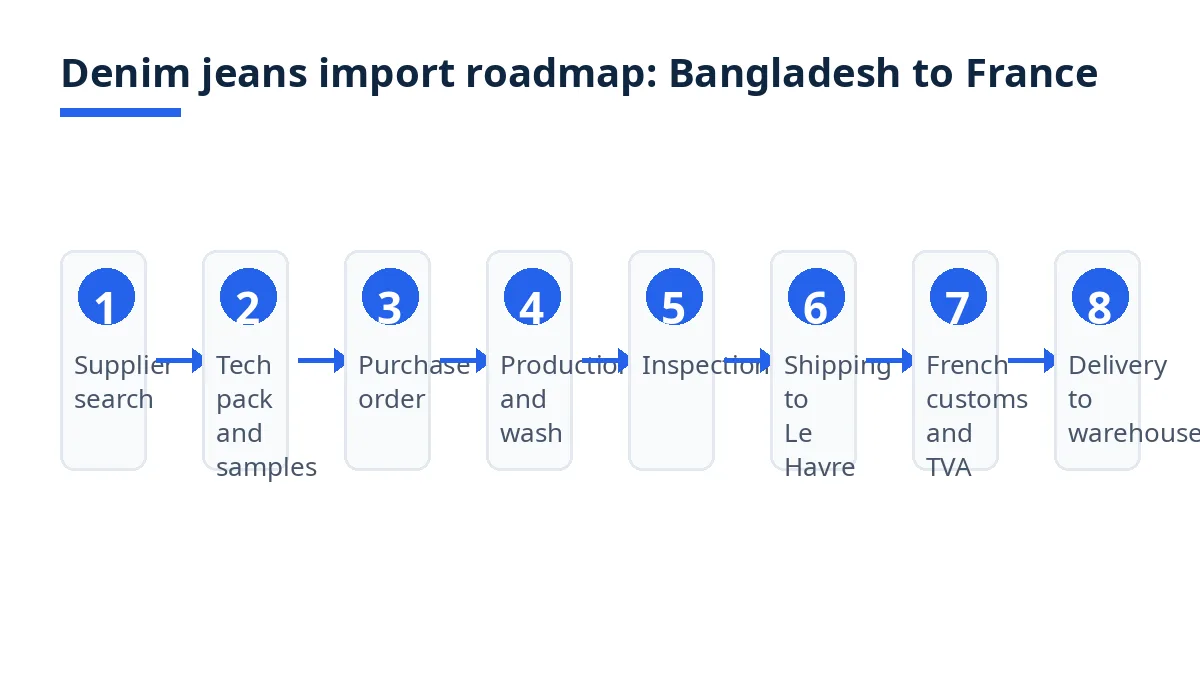
A France-based buyer importing denim jeans from Bangladesh faces one question before any other: how does a pair of jeans made in Dhaka or Chattogram reach a French warehouse, cleared, labelled and priced, without a surprise at customs or at the shop floor. This guide answers that question end to end, from supplier search to delivery, with the France-specific steps that a general import guide leaves out. It is written for brands, retailers, wholesalers and sourcing teams in France.
Why source denim jeans from Bangladesh
Bangladesh is a major denim source for the European Union, and the trade structure explains why French buyers look there first. Textiles account for almost 94 percent of the EU's total imports from Bangladesh, and Bangladesh was a major beneficiary under the EU's Everything But Arms arrangements, with 19 billion euros of exports benefiting from those preferences in 2024 at a 96 percent utilisation rate.1
Denim production in Bangladesh covers the full chain a jeans buyer needs: denim fabric weaving, cutting, sewing, laundry and wash, and finishing. That matters because jeans change during washing: waist, inseam, thigh and leg opening can move in the laundry, shade can shift between batches, and seam appearance can change after a stone or enzyme wash. A supplier that controls both sewing and washing gives you a shorter path to a consistent bulk result than one that outsources washing without oversight.
For a French buyer, there is a second reason to take Bangladesh seriously: the preference margin. If your jeans qualify under Everything But Arms, the duty line in your landed cost is zero rather than the 12 percent third-country rate. That margin is only real when the origin rules are met and the proof of origin is in order.
Find and verify suppliers
What should the tech pack contain before you contact anyone?
Write the tech pack before you ask for prices. A denim tech pack that a factory can quote accurately covers fabric, fit, wash, trims, measurements, labels and packing:
Fabric: fibre composition as your choice, for example 98 percent cotton and 2 percent elastane, fabric weight in ounces per square yard, weave, and stretch percentage where specified.
Fit and sizes: the fit block, the size range, and a measurement chart with tolerances for waist, inseam, thigh, knee and leg opening, measured after wash.
Wash: the wash recipe by name and reference sample, with the shade tolerance you will accept.
Trims: button, rivet, zip, label and thread specifications.
Labels and packing: fibre and care labels in French, hang tags, polybag, cartons per size ratio, carton marks and barcodes.
Send the identical tech pack to every candidate and ask for the same reply format: fabric assumed, price inclusions, validity, minimum per style and per wash, and lead time counted from a named event such as sample approval or deposit receipt. Browse suppliers on Exportain and compare candidates on the same terms before you narrow the list to three to five for sampling.
How do you verify a supplier before you pay?
Verification has three layers. The first is company documents: trade licence, export registration certificate and association membership where applicable, checked so that the legal name, address and bank account name agree across every document and quotation. The second is capability: monthly jeans capacity, whether denim fabric is woven in-house or bought in, laundry capacity and route, and which current jeans styles the factory can show from production. The third layer is payment discipline: pay only the company account named in the documents, never a personal account, and verify any change of bank details through a separate channel.
On Exportain, supplier profiles carry document and photo review badges; read what each badge covers on the how to buy pages. A badge is a document and photo review, not a factory inspection or a guarantee, and Exportain is not a party to the goods contract.
MOQ, pricing and samples
What is the typical MOQ for denim jeans from Bangladesh?
There is no single typical minimum order quantity for denim jeans from Bangladesh. The minimum is usually set per style and per wash, and often per colour, because denim fabric is woven and dyed in batches, laundry loads are set up per wash recipe, and a cutting plan is laid for a size range. A single-wash five-pocket jean in one shade will not carry the same minimum as a programme with three washes, two fits and a wide size range. Ask each supplier how its minimum splits by style, wash, colour and size range.
How is the price built, and how should you compare quotes?
Example figures: the structure below shows how a jeans price is built, with illustrative numbers only. Denim fabric is usually the main cost element, followed by cutting and sewing, laundry and wash, trims, labels, testing, packing and the factory margin. Two quotes can differ because one assumes a lighter fabric, a simpler wash, fewer sizes or a different delivery term, not because one factory is simply cheaper.
Compare quotes only on the same basis: same tech pack, same size range, same wash, same trims, same delivery term and same packing. Ask each supplier to state what is excluded, for example wash development charges, trim tooling, testing, or special packing.
Which samples do you need, and how do you approve them?
Work in stages. A development sample shows whether the factory understood the fit and construction. A wash sample, approved against your reference shade, shows whether the laundry can hit your colour repeatedly. A pre-production sample, made in the actual production fabric, trims, wash and labels, is the sample you approve for bulk. Measure it after wash against your chart, check shade against the approved wash sample, and check seam puckering, pocket placement, button and rivet setting, and label position. Approve it in writing and keep one sealed counter-sample.
Quality control and certifications needed
Which quality checks are specific to denim jeans?
Check jeans against the approved pre-production sample and measurement chart, not against a general idea of good jeans. The denim-specific checks are shade consistency across the order, wash effect consistency, measurements after wash within your agreed tolerances, seam strength and appearance, pocket and fly construction, button and rivet security, zip function, and shade matching between panels of the same pair.
Agree the inspection method and defect limits before production. ISO 2859-1:2026 defines a system of acceptance sampling plans for inspection by attributes, and its summary states that AQL stands for acceptance quality limit, the maximum average percentage of defective items considered acceptable during random sampling, used to determine sample sizes and acceptance and rejection thresholds.2 Inspect in stages: an inline check during sewing and laundry catches a wash drift early, and a final random inspection on packed goods checks quantity, workmanship, measurements, labels and packing.
Which France-specific label and producer rules apply?
Two France-specific rules separate this market from other EU destinations, and both must be designed in before bulk production.
First, labelling. Textile fibre composition descriptions must be provided in the official language or languages of the Member State where the products are made available to the consumer, unless that Member State provides otherwise.3 For France, that means fibre composition in French on the label, using the fibre names in Annex I of Regulation (EU) No 1007/2011, which includes cotton as fibre obtained from the bolls of the cotton plant.3 Agree the French wording at sampling stage and check that the percentages match the fabric you bought, because the labelled composition is also the composition your classification is built on.
Second, textiles extended producer responsibility. Under Article L.541-10 of the French Environmental Code, companies selling products in France must contribute to waste management either through an individual system or by joining an approved eco-organisation, and for textiles that organisation is Refashion.4 Producers concerned must register with the administrative authority, ADEME, and receive a unique identification number.4 The AGEC law also requires Triman signage and sorting information on clothing textiles, household linen and footwear.4 If you are the party placing the jeans on the French market, confirm your EPR registration and UID before the goods arrive.
Which certifications do you actually need?
No single certificate covers every jeans order. What you need follows your customers and your market: a retailer may name a specific test in its supplier manual, such as colour fastness, fabric strength or a restricted-substance list, and a claim such as organic cotton needs its own chain-of-custody evidence. Name any such requirement in the tech pack and check the report's scope, product covered, issuing body and date.
Incoterms, shipping and transit time
Which delivery term should a first order use?
The Incoterms 2020 rules set out, for each rule, where delivery takes place, and risk passes from seller to buyer at the same point and time as delivery.5 Under FOB, CFR and CIF the seller must place the goods on board the vessel.5 On customs, in all rules but EXW the seller must carry out export formalities, and in all rules but DDP the buyer must carry out import formalities.5 The same ICC Academy summary notes that the four sea rules, FAS, FOB, CFR and CIF, are only intended for port-to-port bulk or break-bulk shipments and are not suitable for container shipments, because a container is handed to the carrier before it is on board.5
For a first jeans order shipped in containers, weigh FOB at the Bangladeshi port against FCA at the named terminal. Under FOB, the factory delivers the goods on board and your forwarder handles the sea leg. Under FCA, delivery happens when the goods are handed to your carrier, which matches how containerised cargo moves.
How long does shipping take, and which French port should you use?
There is no single typical transit time for denim jeans from Bangladesh to France. Sea freight is the standard route for bulk orders and it takes weeks rather than days, varying by port, routing, transshipment and season. Plan from your forwarder's current sailing schedule, and add clearance and inland delivery.
For the French entry point, Le Havre is the natural first choice. The ports of Le Havre, Rouen and Paris form the Seine corridor river and sea port, serving a consumer catchment area centred on Paris and its surrounding region with a population of 25 million.6 That corridor suits buyers distributing to the Paris region and northern France. Marseille-Fos is the alternative for buyers distributing to southern France or the Mediterranean arc, where a northern entry would add an unnecessary inland leg.
Import duty, taxes and documents
How are denim jeans classified for duty?
Duty follows the classification of each style in the EU tariff, not the supplier's product name. Men's or boys' trousers of cotton sit in heading 6203.42, and women's or girls' trousers of cotton sit in heading 6204.62. Within the men's cotton trouser lines, the tariff carries a dedicated denim subline: commodity code 6203423100 covers trousers of denim.7 Confirm the full ten-digit code for each style with your broker, because fibre mix and construction can move a style to a different line.
What import duty applies?
Your rate depends on the classification, the origin and any preference in force on the entry date. The schedule opened for this guide shows a third-country duty of 12.00 percent on the denim trouser line 6203423100.7 That 12 percent figure is the rate that applies when no preference is claimed or when a preference claim fails. The same tariff structure shows a GSP-EBA tariff preference of 0.00 percent on the cotton trouser lines.8
For Bangladesh-origin jeans, the preference that matters is Everything But Arms. The EU's Everything But Arms scheme is a special arrangement for least developed countries, granting full duty-free and quota-free access to the EU Single Market for all products except arms and ammunition.9 The preference is not automatic: the goods must meet the scheme's origin rules and you must hold the correct proof of origin.
What about TVA and other taxes in France?
France applies TVA, its value added tax, at a standard rate of 20 percent for most sales of goods and services, with reduced rates of 10 percent, 5.5 percent and a special rate of 2.1 percent for defined categories.10 Jeans fall under the standard rate. Import TVA is charged on the customs value plus duty and ancillary charges up to the first point of destination, so the TVA base is larger than the goods price alone. For a VAT-registered French buyer, import TVA is normally recoverable through the VAT return, which makes it a cash-flow item at clearance rather than a final cost.
Which documents do you need for clearance?
The standard import set is the commercial invoice, packing list, bill of lading, and proof of origin where a preference is claimed. The invoice should name each style plainly, for example men's five-pocket denim jeans, 98 percent cotton and 2 percent elastane, mid-blue stone wash, with composition, sizes, quantities, unit prices and the delivery term on its own line. Quantities, weights and carton counts must agree across every document, and the proof of origin must match the goods and the invoice.
Landed cost example
A landed cost is the full cost of one pair of jeans, cleared and in your warehouse, ready to sell. Every number below is an example figure only, not a quote.
Example figures: 5,000 pairs of men's denim jeans, FOB Chattogram, sea freight to Le Havre, duty at 0 percent under Everything But Arms.
Cost element | Example figures (per pair) | How to obtain your figure |
|---|---|---|
Product price, FOB | €8.20 | Confirmed pro forma invoice |
International freight | €0.85 | Forwarder quote divided by pairs shipped |
Insurance | €0.07 | Policy or forwarder quote |
Duty at 0 percent under Everything But Arms | €0.00 | Broker calculation from confirmed codes and origin |
Port, clearance and broker fees | €0.30 | Broker invoices divided by pairs |
Inland delivery to warehouse | €0.35 | Haulier quote divided by pairs |
Pre-shipment inspection | €0.12 | Inspection company quote divided by pairs |
Total landed cost | €9.89 | Sum of all lines above |
Import TVA is not included in the total, because a VAT-registered buyer normally recovers it. At the 20 percent standard rate, the TVA cash outlay on this example would be 20 percent of the customs value plus duty, which is 20 percent of €9.12, or about €1.82 per pair, paid at clearance and recovered through the return. If the Everything But Arms claim failed, duty at the 12 percent third-country rate on the same €9.12 customs value would add about €1.09 per pair, taking the landed cost to about €10.98 before TVA.
Step-by-step import checklist
Write the tech pack style by style: fabric and weight, fit block and measurement chart after wash, wash recipe and reference shade, trims, French labels, and packing.
Classify every style, starting from 6203.42 for men's and boys' cotton jeans and 6204.62 for women's and girls', and confirm each full code with your broker.
Confirm the duty position: Everything But Arms at 0 percent if the origin rules are met, with the 12 percent third-country rate as your fallback figure.
Shortlist suppliers whose current range includes denim jeans, and request comparable quotes on the identical tech pack and delivery term.
Verify the chosen supplier: company documents, jeans and laundry capacity, fabric source, and a video or in-person factory check for a first order.
Order samples in stages, approve the wash shade and then a pre-production sample in production fabric, trims, wash and French labels, and keep one sealed counter-sample.
Confirm the order in writing: purchase order, pro forma invoice, delivery and payment terms, inspection plan with AQL and defect limits, labelling, packing and shipment date.
Register for French textiles EPR and confirm your UID and Triman and sorting information before the goods arrive.
Inspect during production and again on packed goods against the approved samples, checking shade, wash, measurements after wash and pair matching.
Ship to Le Havre or Marseille as priced for your warehouse, clear customs with the confirmed code and proof of origin, and reconcile the actual landed cost.
How Exportain helps
Browse suppliers for Bangladeshi denim exporters and compare their ranges against your tech pack. Then post your specification and target quantity as an RFQ and compare replies on the same terms before you choose a factory for sampling. The how to buy pages set out the eight steps from search to shipment on the platform. Exportain is a B2B marketplace where buyers post RFQs, receive quotations and message suppliers. It does not inspect goods, book freight or clear customs.
FAQs
What is the typical MOQ for denim jeans from Bangladesh?
There is no single typical minimum. It is set per style and per wash, and often per colour, because denim fabric is woven and dyed in batches and laundry loads are set up per wash recipe. Ask each supplier how its minimum splits by style, wash, colour and size range.
How long does shipping take?
Production time and transit time are separate, and neither has a single typical figure. Sea transit from Bangladesh to France takes weeks rather than days and varies by port, routing, transshipment and season.
What import duty applies?
Duty follows the confirmed classification of each style, the origin and the preference in force on the entry date. Men's and boys' cotton jeans sit in heading 6203.42 and women's and girls' in heading 6204.62, with a dedicated denim subline at 62034231.7 The third-country rate on the denim trouser lines is 12 percent, while Bangladesh-origin goods that meet the Everything But Arms origin rules enter the EU duty-free and quota-free.1 9
How do I verify a supplier?
Check company documents first, so that the legal name, address and bank account agree across the trade licence, export registration and invoices. Then check capability: jeans capacity, fabric source, laundry route and current jeans production. Keep payments to the company account named in the documents, and approve a pre-production sample in production fabric, wash and French labels before bulk production.
Next steps on Exportain
Read how to import from Bangladesh for the full process from specification to shipment, then work through the landed cost guide with your own quotations and your broker's duty confirmation. When ready, browse suppliers and post your denim tech pack as an RFQ to compare quotes on the same terms.
Sources
- EU trade relations with Bangladesh. European Commission, (accessed )
- ISO 2859-1:2026 - Sampling procedures for inspection by attributes — Part 1: Sampling schemes indexed by acceptance quality limit (AQL) for lot-by-lot inspection. International Organization for Standardization (accessed )
- Regulation (EU) No 1007/2011 on textile fibre names and related labelling and marking of the fibre composition of textile products. European Union, (accessed )
- The Extended Producer Responsibility (EPR). GINETEX (accessed )
- Insider thoughts: Bob Ronai on Incoterms 2020 Rules; What are they about?. International Chamber of Commerce (accessed )
- Who we are? | HAROPA PORT. HAROPA PORT (accessed )
- Commodity code 6203423100: Of denim - UK Integrated Online Tariff. GOV.UK (accessed )
- Commodity code 6204611000: Trousers and breeches. UK Government (accessed )
- Trade arrangements. European Commission, Access2Markets (accessed )
- Quels sont les taux de TVA en vigueur en France et dans l'Union européenne ?. French Ministry of Economy and Finance (accessed )
- landed cost
- import duty
- supplier verification
- quality control
- Incoterms 2020
- buyer guide
- Bangladesh sourcing
- Denim jeans
About the author
Sourcing from Bangladesh?
Post a request for quotation and suppliers on Exportain can send you their quotes directly.
Post an RFQ


