

Importing Denim Jeans From Bangladesh to Belgium: Costs, Duties and Suppliers
Belgium buyers importing denim jeans from Bangladesh: Antwerp entry, 0% EBA duty when origin is proven, 21% Belgian VAT, supplier checks, wash and fit samples, and a worked landed-cost example.
Short answer
To import denim jeans from Bangladesh to Belgium, classify each style, confirm 0% duty under Everything But Arms with proven origin, settle Belgian VAT and EORI before shipment, shortlist denim suppliers on one written specification, approve a pre-production sample in production fabric and wash, agree the delivery term and inspection plan, and build the landed cost for an Antwerp arrival before bulk production.
On this page
Key takeaways
Men's denim jeans of cotton sit on tariff line 6203.42.31, where the schedule opened for this guide lists a 12.00% third-country duty and a 0.00% GSP-EBA preference.
Everything But Arms grants least-developed countries full duty-free and quota-free access to the EU Single Market for all products except arms and ammunition, subject to origin rules.
Belgium applies a 21% standard VAT rate, and import VAT is normally due when goods from outside the EU are released for consumption in Belgium.
There is no single typical MOQ, price or transit time for denim jeans, so confirm each one in writing for your exact fabric, wash, fit range and shipment date.
A pre-production sample in production fabric and wash, approved in writing, is the standard against which bulk jeans should be judged.
A Belgium-based buyer importing denim jeans from Bangladesh faces three decisions before price matters: whether the goods qualify for 0% duty under Everything But Arms, how Belgian import VAT will be handled at clearance, and which port and delivery term the order will use.
This guide works through the Belgium entry first, then the supplier, sample and quality steps for a denim order, and finishes with a worked landed-cost example for an Antwerp arrival. It is for retailers, brands, wholesalers and importers based in Belgium buying woven denim jeans from Bangladeshi suppliers.
The Belgium entry decision: duty, VAT and port before price
Start with the entry, not the catalogue. A denim order for Belgium is an EU import under the EU Common Customs Tariff, and duty depends on classification, origin and the preference claimed on the entry date. The tariff schedule opened for this guide lists, for men's denim jeans on line 6203.42.31, a third-country duty of 12.00% and a 0.00% preference under GSP-EBA, the special arrangement for least-developed countries under Everything But Arms.1 The same schedule lists a general GSP preference of 9.60% for that line: the rate changes with the scheme, not just the product.1
The European Commission describes Everything But Arms as a special arrangement for least-developed countries granting full duty-free and quota-free access to the EU Single Market for all products except arms and ammunition.2 A preference applies only when the goods meet the scheme's origin rules and the importer holds the required proof of origin. Ask your broker, before you price, which proof your shipment needs. Price the order twice if you must: once at 0% with the preference proven, and once at 12% without it.
VAT is the second entry decision. Belgium applies a 21% standard VAT rate, plus reduced rates of 12% and 6% for specific categories.3 Import VAT is normally due when goods from outside the EU are released for consumption in Belgium, and the ET14000 authorisation can avoid pre-financing it at customs by postponing it to the periodic VAT return, where it can be reported and deducted in the same return if the deduction right exists.3 For a VAT-registered buyer who can deduct input VAT, import VAT is mainly cash flow; for a buyer who cannot, it is a real cost in the landed-cost total. Settle this with your accountant before the first shipment.
The third entry decision is the port. For most Belgium-bound denim orders, the port of Antwerp is the natural arrival point, with onward delivery to a warehouse in Belgium. Naming Antwerp fixes the customs conversation: your broker, EORI number and VAT treatment all attach to the Belgian entry. If you plan to clear in another EU port first, say so at the start, because the importer of record, VAT registration and declaration change with that choice.
Why Bangladesh denim fits a Belgium buyer
Bangladesh is a major denim supplier to the EU, and its position held through a mixed 2026. Bangladesh's denim exports to the European Union grew 12.71% year on year in August 2026 to 134.08 million euros, from 118.96 million euros a year earlier, according to Eurostat data reported by Prothom Alo.4 Total EU denim imports from the world rose 11.23% in the same month to 430.16 million euros, and Bangladesh's share of the EU's August imports stood at about 31.2%, up from about 30.8% a year earlier.4
Over January to August 2026, the picture was weaker: Bangladesh's shipments fell 5.85% to 869.13 million euros from 923.11 million euros, while total EU denim imports fell 4.40% to 2,956.21 million euros.4 Bangladesh's eight-month share slipped to 29.40% from about 29.9%, yet it remained ahead of Pakistan, the next supplier.4 For a Belgium buyer, the supply base is deep enough to compare several suppliers on one specification, and factories are used to EU labelling and wash standards. Depth does not remove the need to verify a supplier, approve samples and inspect bulk goods.
Classify before you quote: men's and women's denim lines
Duty follows classification, and classification follows the garment, not the supplier's product name. Men's or boys' cotton denim jeans sit in heading 6203, which covers men's or boys' suits, ensembles, jackets, blazers, trousers, bib and brace overalls, breeches and shorts other than swimwear, and the denim trouser line within it is 6203.42.31.1 Women's or girls' jeans sit in the parallel heading 6204, so a mixed order carries at least two classifications, invoice lines and duty checks.
Separate the lines on every document. A men's five-pocket jean, a women's skinny jean with elastane, a boys' jean and a denim short are not one line because they share a fabric. Fibre composition changes the line: a cotton jean and a cotton-elastane blend can sit differently. Write the fibre composition, wearer, garment type and fabric construction on the specification, and ask your broker to confirm the full code for each style before you accept a price.
Apply the same discipline to anything sold with the jeans: a denim jacket, skirt and jeans in one shipment are separate classifications, even with a shared wash. Classify an unclear style before sampling, since reclassification after production means relabelling or repricing sewn goods.
Find and verify suppliers
Where should a Belgium buyer start the search?
Start with a specification, not factory names. Write down every style first: wearer, fit, rise, leg shape, fabric composition and weight, stretch content, wash, colour, trims, labelling and packing. Then shortlist suppliers whose current range already includes woven denim jeans for the EU market. A knitwear-only or shirt-only supplier is not a close substitute, because denim cutting, laundry, shade control and fit approval use different operations.
Send every candidate the identical specification and ask for the same reply format: fabric assumed, wash route, price inclusions, validity and minimum per style, colour and size range. Browse suppliers on Exportain and compare replies on the same terms before choosing a factory for sampling.
How do you verify a supplier before you pay?
Verification has three layers. The first is company documents: trade licence, export registration and association membership where applicable, checked so name, address and bank account agree across every document. The second is capability: denim fabric source and width, in-house or bought-in laundry, wash capacity, monthly jeans capacity, and recent denim styles the factory can show.
The third layer is payment discipline. Keep payments to the company account named in the documents, never to a personal account, and verify any change of bank details separately. On Exportain, supplier profiles carry document and photo review badges: a review of documents and photos, not a factory inspection or a guarantee, and Exportain is not a party to the goods contract.
MOQ, pricing and samples
What is the typical MOQ for denim jeans from Bangladesh?
There is no single typical MOQ for denim jeans from Bangladesh. The minimum is set per style, usually per colour and wash, because fabric is woven and dyed in batches, laundry runs are set up per wash, and cutting plans are set per size range. A rigid indigo jean and a stretch skinny jean with a complex wash will not carry the same minimum. Ask how each minimum splits by style, colour, wash and size range.
How is the price built, and how should you compare quotes?
Fabric is usually the main cost element in a pair of jeans, followed by cutting and sewing, laundry and wash, trims, testing, packing and the factory margin. Wash adds operations a plain jean does not carry: enzyme wash, stone wash, bleach and softening, each with its own cost and shade risk. Two quotes can differ because one assumes a lighter fabric, a simpler wash, fewer sizes or a different trim set, so ask what each price is based on, in writing.
Compare quotes on the same basis: same style, fit, fabric, wash, trims, delivery term and packing. Ask what is excluded, for example wash development, trims, testing or freight. Example figures in this guide are labelled as examples throughout and are never a market price.
Which samples do you need, and how do you approve them?
Work in stages. A development sample shows whether the factory can cut your fit, sew cleanly and achieve the wash direction described. A pre-production sample, made in actual production fabric, wash and trims, is the sample you approve for bulk. Wash, shade and hand feel cannot be approved from substitute fabric, because laundry changes dimensions, shade and stretch recovery.
Test samples as customers will wear them: measure waist, hip, inseam and leg opening after wash, check shade consistency, pull trims and rivets, work the zip and button, and wash one pair per your care label to check shrinkage and colour loss. Approve in writing and keep one sealed counter-sample per style; bulk production should not start before that approval.
Quality control, labelling and chemical compliance
Which quality checks are specific to denim jeans?
Against the approved sample and size chart, check fabric composition, finished weight and measurements within your agreed tolerances, plus consistency across the size range. Then check construction pair by pair: seams, pocket attachment, waistband and belt-loop strength, zip and button function, rivet setting, hem finish and any distressing specified. Check wash shade against the approved sample, variation within the order, and pocket and leg-panel matching.
Agree the inspection method and defect limits before production. An inline check during sewing and laundry catches shade drift while correction is still possible, and a final random inspection on packed goods checks quantity, workmanship, measurements, labels and packing.
Which label rules apply to jeans sold in Belgium?
Fibre labelling applies to every pair. Regulation (EU) No 1007/2011 sets the EU rules on textile fibre names and related labelling and marking of fibre composition, and its labelling provisions require that textile products be labelled or marked to give an indication of their fibre composition whenever they are made available on the market.5 The same regulation places the obligation on the manufacturer, and where the manufacturer is not established in the Union, on the importer, to ensure the supply of the label or marking and the accuracy of the information it contains.5
Agree label wording at sampling stage and check that the percentages match the fabric bought, since the labelled composition is also the composition your classification rests on. Add care, size and origin marking as your Belgian sales channels require, and check the finished label before bulk label sewing begins. Name any chemical testing your customers require in the specification, and check the matching report's scope, product, issuing body and date.
Which certifications do you actually need?
No single certificate covers every jeans order. What you need follows your market and customer: a retailer may name a specific test or fibre scheme in its supplier manual. Name any such requirement in the specification, and check the matching report's scope before relying on it.
Incoterms, Antwerp routing and transit time
Which delivery term should a first order use?
The Incoterms 2020 rules set out, for each rule, where delivery takes place, and risk passes from seller to buyer at the same point and time as delivery.6 Under FOB, CFR and CIF the seller must place the goods on board the vessel, and in all rules but EXW the seller must carry out export formalities, while in all rules but DDP the buyer must carry out import formalities.6 The same ICC Academy summary notes that FAS, FOB, CFR and CIF are only intended for port-to-port bulk or break-bulk shipments and are not suitable for container shipments, because a container is handed to the carrier before it is on board.6
For a first containerised order to Antwerp, weigh FOB at the Bangladeshi port against FCA at the named terminal. Under FOB, the factory delivers goods on board and your forwarder handles the sea leg; under FCA, delivery happens when goods are handed to your carrier, which matches containerised cargo. Under DAP Antwerp, the seller arranges carriage, but import clearance, duty and VAT remain yours unless the contract says otherwise. State the rule, named place and Incoterms 2020 edition in the contract.
How long does shipping take?
There is no single typical transit time for denim jeans from Bangladesh to Belgium. Sea freight is the standard route for bulk orders and takes weeks rather than days, varying by routing, transshipment and season. Plan from your forwarder's current Chattogram to Antwerp sailing schedule, plus clearance and delivery. Keep production time separate: an order is ready only when every pair has finished sewing, laundry, inspection and packing.
Import duty, Belgian VAT and documents
What import duty applies?
Your rate depends on each style's classification, origin and the preference in force on the entry date. For men's cotton denim jeans on line 6203.42.31, the schedule opened for this guide lists a third-country duty of 12.00% and a GSP-EBA preference of 0.00%.1 If the preference is proven, the duty line is zero; if not, budget at 12%. Confirm the current rate beside each style's code with your broker before committing to a selling price.
Which documents do you need for clearance?
The standard import set is the commercial invoice, packing list, bill of lading or air waybill, and proof of origin where a preference is claimed. The invoice should name each style plainly, for example men's cotton five-pocket denim jeans, with composition, wash, quantities, unit prices and delivery term, on its own line. Keep men's, women's, cotton and blended styles on separate lines matching their classifications.
An EORI number is the other document to settle early. An Economic Operators Registration and Identification (EORI) number is a unique ID issued by EU customs authorities for importing and exporting across EU borders, and a business whose first shipment enters via an EU member state such as Belgium needs an EU EORI issued by that member state.7 One valid EU or XI EORI number covers all future EU shipments.7 Check it is valid before the first declaration.
Landed cost example
A landed cost is the full cost of one pair of jeans, ready to sell. Every number below is an example figure only, not a quote.
Example figures: 4,000 pairs of men's cotton denim jeans, FOB Chattogram, sea freight to Antwerp, duty at 0% under Everything But Arms with origin proven.
Cost element | Example figures (per pair) | How to obtain your figure |
|---|---|---|
Product price, FOB | €10.50 | Confirmed pro forma invoice |
International freight | €0.85 | Forwarder quote divided by pairs shipped |
Insurance | €0.07 | Policy or forwarder quote |
Duty at 0% under Everything But Arms | €0.00 | Broker calculation from confirmed codes and proven origin |
Port, clearance and broker fees | €0.30 | Broker invoices divided by pairs |
Local delivery to warehouse | €0.25 | Local carrier quote divided by pairs |
Inspection | €0.15 | Inspection company quote divided by pairs |
Total landed cost | €12.12 | Sum of all lines above |
Belgian import VAT at 21% is not included in the €12.12 total: for a VAT-registered buyer who can deduct input VAT, it is a cash-flow item at clearance or in the periodic return, not a final cost.3 Work the calculation twice, at quote stage and after shipment with actual invoices. If the preference fails, add duty at 12% of the customs value and reprice before you sell. See landed cost for imports from Bangladesh for the full method.
Step-by-step import checklist for Belgium
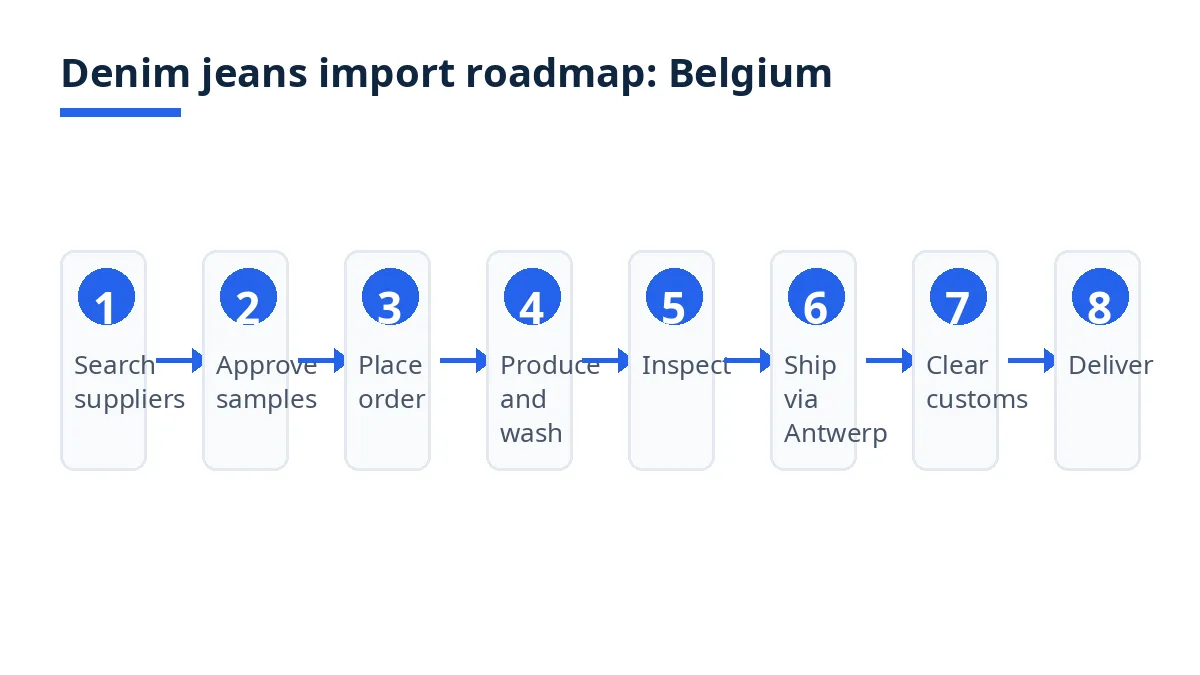
Confirm the Belgium entry first: Antwerp arrival, EORI number, VAT treatment and the preference proof your broker requires.
Classify every style, starting from heading 6203 for men's or boys' jeans and heading 6204 for women's or girls' jeans, and confirm each full code and duty with your broker.
Write the specification style by style: wearer, fit, fabric, stretch, wash, trims, labels and packing.
Shortlist denim suppliers whose range already includes woven jeans for the EU market, and request comparable quotes on the identical specification and delivery term.
Verify the chosen supplier: company documents, denim capacity, fabric source, laundry route and a video or in-person factory check for a first order.
Order samples in stages, measure and wash-test them, then approve a pre-production sample of each style in production fabric and wash.
Confirm the order in writing: purchase order, pro forma invoice, delivery and payment terms, inspection plan with defect limits, labelling, packing and shipment date.
Inspect during production and again on packed goods against the approved samples, checking shade consistency, measurements and trim function.
Ship, clear customs at Antwerp with the confirmed code and origin proof for each style, and reconcile the actual landed cost.
How Exportain helps
Browse suppliers for Bangladeshi denim exporters and compare their ranges against your style list. Then post your specification and target quantity as an RFQ and compare replies on the same terms before you choose a factory for sampling. Read how to buy for the buying steps on Exportain. Exportain is a B2B marketplace where buyers post RFQs, receive quotations and message suppliers. It does not inspect goods, book freight or clear customs.
FAQs
What is the typical MOQ for denim jeans from Bangladesh?
There is no single typical minimum. It is set per style and usually per colour and wash, because fabric is produced in batches, laundry runs are set up per wash, and a cutting plan is set up per size range.
How long does shipping take?
Production time and transit time are separate, and neither has a single typical figure. Sea transit from Bangladesh to Antwerp takes weeks rather than days and varies by port, routing, transshipment and season, so plan from your forwarder's current sailing schedule.
What import duty applies?
Duty follows the confirmed classification of each style, origin and preference in force on the entry date. For men's cotton denim jeans on line 6203.42.31, the schedule opened for this guide lists a third-country duty of 12.00% and a GSP-EBA preference of 0.00%.1 Everything But Arms grants least-developed countries full duty-free and quota-free EU access for all products except arms and ammunition, subject to origin rules.2 Belgian import VAT at 21% is separate from duty.3
How do I verify a supplier?
Check company documents first, so that name, address and bank account agree across the trade licence, export registration and invoices. Then check capability: denim capacity, fabric source, laundry route and recent denim production for the EU market. Keep payments to the company account named in the documents, and approve a pre-production sample of each style before bulk production.
Next steps on Exportain
Read how to import from Bangladesh for the full process, then check landed cost for imports from Bangladesh to rebuild the example with your own quotations. When ready, browse suppliers and compare denim suppliers on the same specification before you request samples.
Sources
- Commodity code 6203423100: Of denim - Northern Ireland Online Tariff. GOV.UK, HM Revenue and Customs (accessed )
- Trade arrangements. European Commission, Access2Markets (accessed )
- VAT rules in Belgium. Eurofiscalis, (accessed )
- Bangladesh's denim exports to EU rise 12.71pc in August. Prothom Alo, (accessed )
- Regulation (EU) No 1007/2011 on textile fibre names and related labelling and marking of the fibre composition of textile products. European Union, (accessed )
- Insider thoughts: Bob Ronai on Incoterms 2020 Rules; What are they about?. International Chamber of Commerce (accessed )
- An EU or XI EORI number is now mandatory for GB haulier EU imports. CustomsLink (accessed )
About the author
Sourcing from Bangladesh?
Post a request for quotation and suppliers on Exportain can send you their quotes directly.
Post an RFQ


