

Cotton T-Shirts From Bangladesh to Spain: Costs, Duties and Suppliers
A Spain-specific cotton t-shirt import guide: Spanish labeling, supplier verification and a 280-shirt trial lot, FCA and FOB terms, Valencia routing, Everything But Arms duty, 21% import VAT with November-option deferral, plus a EUR landed-cost example for 9,000 shirts to Madrid.
Short answer
To import cotton t-shirts from Bangladesh to Spain, specify the tee in full, verify the supplier documents and knit production, and approve a pre-production sample in production fabric with Spanish label artwork. Classify each style at 61091000, confirm Everything But Arms duty treatment and origin proof, register a Spanish EORI number, settle the 21 percent import VAT treatment with the broker, choose FCA or FOB to Valencia, and build the landed cost before bulk production.
On this page
Key takeaways
Cotton t-shirts, knitted or crocheted, classify at Combined Nomenclature code 61091000, and Everything But Arms grants Bangladesh duty-free, quota-free access to the EU except for arms and ammunition, subject to origin rules and proof; no third-country duty figure is asserted in this guide because the opened tariff page renders no rate.
Spain applies the general VAT rate of 21 percent to cotton t-shirts, and postponed import VAT accounting is available only to monthly filers that exercised the option in the November before the year of effect; other buyers pay import VAT on importation and deduct it through the return where entitled.
EU textile labeling must be given in the official language of the member state where the products are made available to the consumer, so a Spain program needs a Spanish label, with the full label artwork approved before bulk production.
The Spain verification case is a 280-shirt trial lot at General Inspection Level II: code letter G, a sample of 32 shirts, acceptance at 2 or fewer major defectives at AQL 2.5 and at 3 or fewer minor defectives at AQL 4.0.
Example figures only: 9,000 shirts through Valencia to Madrid give a landed cost of EUR 3.44 per shirt excluding import VAT, with conditional import VAT of EUR 6,051.15 if the broker confirms the customs value of EUR 28,815.00 as the VAT base.
A Madrid buyer planning a first Spanish retail drop of cotton t-shirts from Bangladesh faces two decisions before any price negotiation: the label must read correctly in Spanish, and the import VAT treatment must be settled before the goods reach Valencia. Get those two decisions right, and the rest of the order follows a familiar sequence of specification, verification, sampling, inspection, and clearance.
Bangladesh supplies cotton t-shirts to Spain under the European Union Everything But Arms arrangement, which grants duty-free, quota-free access for exports from least developed countries except arms and ammunition1. That preference is worth money only when the origin rules are met and the origin proof is in order, so this guide treats duty as a checked line, not an assumed one.
Why source cotton t-shirts from Bangladesh
Bangladesh has a deep knitwear base, and a cotton t-shirt program draws on spinning, knitting, dyeing, cutting, sewing, printing, and packing capacity that sits close together. For a Spanish buyer, that depth matters most at the sampling stage: a supplier that knits and dyes in-house can usually turn a corrected sample faster than a supplier that buys each input through intermediaries. Depth is not a guarantee about any single factory, and it does not replace the verification steps in the next section.
The commercial case also rests on fit with the Spanish market rather than on price alone. A tee built for the Spanish high street needs a Spanish label, a size curve that matches the buyer assortment, and a fabric weight that suits the selling season.
Find and verify suppliers
Start with a shortlist of three to five suppliers that actually knit or source cotton tees, rather than with the first reply to a broadcast inquiry. The Exportain pillar guide on importing from Bangladesh sets out the same sequence used here: specify first, shortlist second, verify before relying on any supplier2. Use the supplier directory to compare profiles on the same fields for every candidate: legal company name, location, main products, and the checks shown on the profile.
Verification means documents, not assurances. Ask every shortlisted supplier for its trade license, tax registration, Export Registration Certificate, and chamber or association membership documents where relevant, and check that the legal name matches across the quotation, the proforma invoice, the bank account, and the shipping documents. Any mismatch needs a written explanation before money moves. A trust badge on a profile records which document and photo checks have been reviewed; it is not a factory audit, not an inspection of the goods, and not a guarantee of capacity or delivery.
For a larger or longer-term program, add checks proportionate to the risk: a factory visit by the buyer or a representative, an independent factory audit, reference buyers the supplier is willing to name, and a small trial order before a full program. Agree in writing who pays for audits and visits. Reluctance to allow any independent check is information in itself, and it should weigh against that supplier in the comparison.
The Spain-specific verification case in this guide is a trial lot, not a first bulk order. A Madrid buyer places a 280-shirt trial lot with the leading candidate, inspects it under the sampling plan in the quality section, and only then confirms the 9,000-shirt program used in the landed-cost example.
MOQ, pricing and samples
No single minimum order quantity applies to cotton t-shirts from Bangladesh, and this guide states none. Each supplier sets its own minimum, and the minimum may apply per order, per style, per color, or per size. The only minimum that matters is the one written in the supplier quotation for the exact breakdown ordered, so ask the question in those terms: minimum per style, per color, and per size, and whether a surcharge applies below it.
Prices are likewise order-specific. A quotation is comparable only when every supplier quotes against the same specification, the same quantity breakdown, the same Incoterm with a named place, and the same packaging and labeling requirements. Compare quotations line by line: unit price and currency, what the price includes, sample terms, payment terms, lead time counted from a named event such as sample approval or deposit receipt, and the date the price expires. Two prices on different Incoterms are not comparable, and the cheapest headline number on the wrong basis is the most expensive mistake in this section.
Samples are part of the contract, not a courtesy. Work through three stages: a development sample that confirms the supplier understood the specification, a pre-production sample made with the actual fabric, trims, labels, and packaging intended for bulk, and a shipment sample drawn from finished production. Approve the pre-production sample in writing, keep one sealed piece, and do not allow bulk production to start before that approval. Sample charges, courier costs, and whether sample charges are credited against the bulk order all belong in the quotation, not in a later message thread.
Payment terms deserve the same written treatment. State when each payment falls due and against which document or milestone, and keep the agreed terms in the sales contract.
Quality control and certifications needed
Quality control starts with a written specification that an inspector can check: fabric composition and weight, measurements with tolerances, stitching and construction details, color standards, print or embroidery artwork, packaging, and labeling.
Labeling for Spain follows the European Union textile regulation. The regulation requires that labeling or marking be provided in the official language or languages of the member state where the textile products are made available to the consumer, unless that member state provides otherwise3. For goods sold in Spain, that means a Spanish label, and the fiber composition statement must be given in Spanish. Approve the full Spanish label artwork before bulk production, including care information and any buyer-specific markings, and check the approved artwork against the pre-production sample rather than against a digital proof alone.
Certifications work the same way as labels: name them specifically. If retail customers require a particular fiber, chemical, or social-compliance certificate, write the exact certificate name, the issuing body, and the scope into the request for quotation, and ask to see the certificate document with its scope and expiry date. A certificate name in a catalog is not evidence. Where the buyer requires laboratory testing, name the tests, the method, and who pays, and agree whether testing happens on the pre-production sample, during production, or both.
For finished-goods inspection, use an acceptance sampling plan agreed before production. The ISO 2859-1 tables set out how a lot size and inspection level give a code letter, and how that code letter gives a sample size with accept and reject numbers4. In the Spain trial case, a lot of 280 shirts at General Inspection Level II gives code letter G and a sample of 32 shirts. At AQL 2.5 for major defects, the lot is accepted at 2 defectives or fewer and rejected at 3 or more; at AQL 4.0 for minor defects, it is accepted at 3 or fewer and rejected at 4 or more. Critical defects, such as a safety hazard, are handled separately and are not averaged into the major and minor counts.
Incoterms, shipping and transit time
Choose the Incoterm with the named place before comparing freight figures, because the rule decides who arranges carriage, who bears risk at each point, and which cost lines already sit inside the price. Under FOB Chattogram, the buyer arranges and pays main freight and insurance, and risk passes when the goods are loaded on board. Under CIF Valencia, the seller pays freight and minimum insurance to Valencia, but risk still passes at loading, so the buyer still needs to understand the insurance cover. Under FCA, which suits containerized shipments, risk passes when the goods are handed to the buyer's carrier at the named place.
This guide uses no single transit time as a fact, because transit time depends on the sailing schedule, the routing, transshipment, and port conditions on the dates shipped. Ask the forwarder for a dated estimate for the actual sailing, and treat that estimate as the planning figure. A forwarder estimate that names the vessel schedule and the transshipment port is worth more than a general range copied from another guide.
The route in this guide runs from Chattogram to Valencia. The Port of Valencia sits on the Spanish Mediterranean coast and is described as the busiest port in the Mediterranean, serving as a central hub for Spanish trade with global markets5. From Valencia, the inland leg to a Madrid warehouse is a domestic road movement that the buyer's haulier quotes for the actual delivery address and vehicle size. Barcelona is the other large Spanish Mediterranean option, and the choice between Valencia and Barcelona belongs in the forwarder comparison, not in a default assumption. Confirm which destination charges the freight already covers and which will be billed on arrival, and confirm who bears storage and demurrage if collection is late.
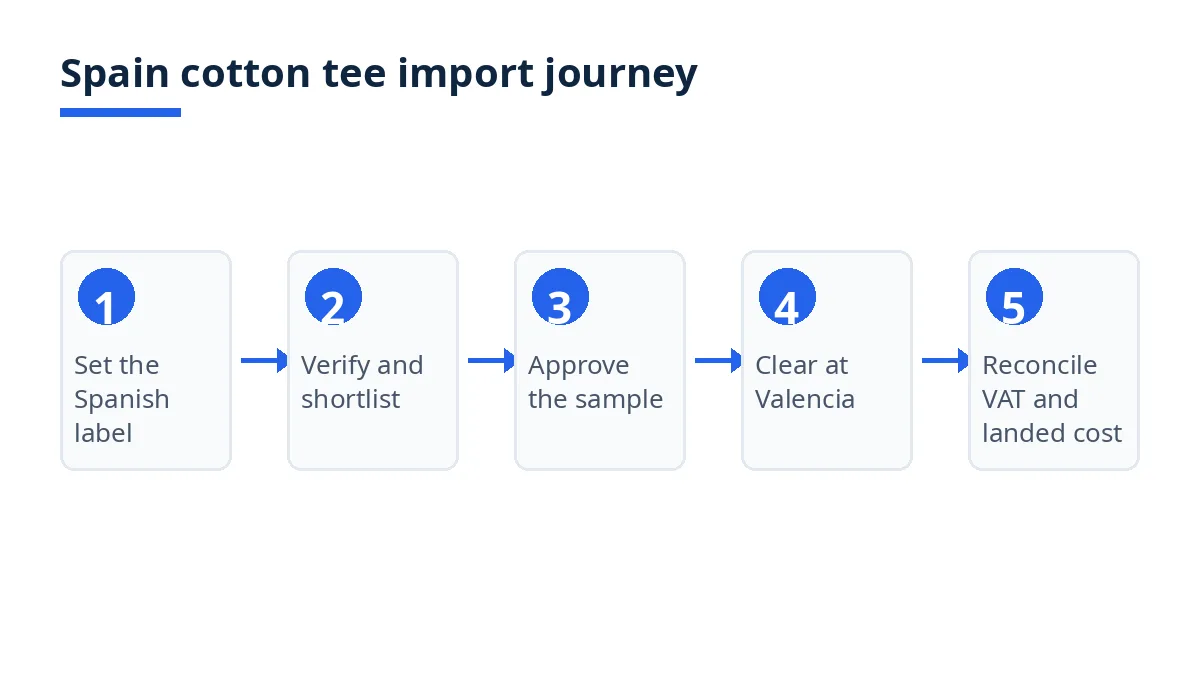
The diagram below traces the Spain journey from Spanish label approval to landed-cost reconciliation.
Import duty, taxes and documents
Classification comes first. Cotton t-shirts, knitted or crocheted, sit at Combined Nomenclature code 61091000, described as t-shirts, singlets and other vests of cotton, knitted or crocheted6.
On duty, this guide asserts no third-country rate figure of its own. The opened Combined Nomenclature page confirms the heading and description but renders no duty rate in its text, so no rate is copied from it. The operative preference figure is the Everything But Arms figure: Bangladesh, as a least developed country, benefits from duty-free, quota-free access for all products except arms and ammunition1. That 0 percent is a preference, and it depends on the origin rules being met and the origin proof being correct. If the preference is not proved on the entry, the broker tariff figure for 61091000 on the entry date applies instead, and the buyer should ask the broker for that figure in writing before pricing.
Spanish import VAT is charged at the general rate. The Spanish tax agency lists the general VAT rate as 21 percent, with reduced rates of 10 percent and 4 percent for the categories it names, and the reduced lists do not include clothing7. Import VAT is normally paid on importation and later deducted through the VAT return where the importer is entitled to deduct it, so for a VAT-registered buyer it is a cash-flow item rather than a final cost.
Spain also offers postponed import VAT accounting, and the conditions are narrow. The tax agency manual states that import VAT may be settled through self-assessment for the period in which the customs settlement document is received, provided the importer is a business or professional acting as such and has a monthly settlement period, and that the deferred-payment option must generally be exercised during the month of November before the year in which it takes effect8. A second opened source states the same monthly-filing limit, adds that eligible filers include businesses with turnover above 6 million euro, businesses in the Monthly Refund Registry, and VAT groups, and notes that Spain has not introduced a separate deferral that simply postpones payment by a number of days9. A buyer that has not opted in November, or that files quarterly, should therefore plan to pay import VAT on importation and to confirm the deduction timing with its tax adviser. This guide states no VAT-base formula: the broker confirms the VAT base from the customs declaration, and the landed-cost example below shows VAT only as a conditional figure on that basis.
Documents for the Spanish entry are assembled before shipment, not after arrival. The broker needs the commercial invoice, the packing list, the bill of lading, the origin proof for the preference claim, and the buyer EORI number, with values and quantities consistent across every document. An EORI number identifies the economic operator to customs, and an EU-based business applies for it from the customs or tax authority in the country where it is established10.
Landed cost example (table)
Example figures only: every figure in this table is illustrative for a single order, not a quoted price, freight rate, or charge for any supplier, route, or shipment. The example covers 9,000 unisex cotton t-shirts shipped FOB Chattogram, cleared at Valencia, and delivered to a Madrid warehouse. Duty is 0 under the Everything But Arms preference on the condition stated in the previous section, and import VAT is shown separately because its treatment depends on the buyer VAT position and the broker-confirmed base.
Line | Example figures (EUR) |
|---|---|
Product cost: 9,000 shirts at 2.95 | 26,550.00 |
Ocean freight, Chattogram to Valencia | 2,100.00 |
Cargo insurance | 165.00 |
Customs value (product plus freight plus insurance) | 28,815.00 |
Import duty at 0 percent under Everything But Arms | 0.00 |
Port and broker charges at Valencia | 780.00 |
Inland delivery, Valencia to Madrid | 640.00 |
Pre-shipment inspection | 520.00 |
Bank and currency costs | 210.00 |
Total landed cost excluding import VAT | 30,965.00 |
Landed cost per shirt excluding import VAT | 3.44 |
Conditional import VAT at 21 percent of 28,815.00, if the broker confirms that base | 6,051.15 |
The arithmetic is 26,550.00 plus 2,100.00 plus 165.00 equals a customs value of 28,815.00, and 28,815.00 plus 780.00 plus 640.00 plus 520.00 plus 210.00 equals 30,965.00. Divided by 9,000 shirts, the landed cost is 3.44 euro per shirt excluding import VAT. A buyer that can deduct import VAT treats the conditional 6,051.15 euro as cash flow, not as a cost; a buyer that has opted for postponed accounting settles it through the VAT return instead of at the border, subject to the November and monthly-filing conditions above. Recalculate the table from live quotations for every real order, because fixed per-shipment charges raise the per-unit cost sharply on smaller orders. The landed-cost method used here follows the same line-by-line approach, with duty completed from the destination tariff and broker confirmation.
Step-by-step import checklist
Write the full specification: fabric, weight, measurements, construction, colors, print or embroidery, packaging, and the Spanish label.
Shortlist three to five suppliers that knit or source cotton tees, and compare them on identical fields.
Request trade licenses, tax registration, Export Registration Certificates, and association documents, and reconcile the legal name across every document.
Run the 280-shirt trial lot through the agreed sampling plan before confirming the bulk program.
Agree the quotation in writing: unit price, currency, Incoterm with named place, minimum per style, color, and size, sample terms, payment terms, lead time from a named event, and price validity.
Approve the pre-production sample in writing, keep a sealed piece, and hold bulk production until approval.
Confirm classification at 61091000 for each style, the Everything But Arms origin proof, and the broker tariff figure that would apply if the preference were not proved.
Confirm the Spanish VAT position: general rate of 21 percent, whether postponed accounting applies under the November and monthly-filing conditions, and the broker-confirmed VAT base.
Book freight on the agreed Incoterm, take a dated forwarder estimate for the sailing, and confirm which destination charges are already covered.
Send the broker the commercial invoice, packing list, bill of lading, origin proof, and EORI number early enough for a pre-arrival check.
Inspect finished goods against the written specification and the agreed sampling plan, and hold shipment on a failed inspection until the remedy is agreed.
Reconcile the landed cost after delivery: actual quantities received, actual charges, duty paid, and import VAT treatment, and file the reconciliation with the order record.
How Exportain helps
Exportain connects Spanish buyers with Bangladeshi suppliers, and the platform is built around the same sequence this guide follows: search suppliers, compare quotations on identical terms, and settle terms in writing before production. A buyer can post a free RFQ stating quantity and breakdown, target price, destination, Incoterm, required certifications, and deadline, so suppliers in the category quote against the same brief. The how-to-buy guide walks through the eight platform steps from search to freight and inspection, and the supplier directory lets a buyer filter by the checks shown on each profile.
Exportain is not a party to the goods contract, and it does not inspect goods, book freight, or clear customs. Supplier verification on the platform records document and photo checks, and the buyer's own sampling, inspection, broker, and forwarder steps in this guide remain the buyer responsibility. Use the platform to run a cleaner comparison, and use the buyer's own checks to decide.
FAQs
What is the typical MOQ for cotton t-shirts from Bangladesh?
There is no single figure to quote, and any guide that prints one as a fact is guessing. Each supplier sets its own minimum, which may apply per order, per style, per color, or per size. Ask for the minimum in those exact terms in the quotation, and confirm whether a surcharge applies below it before comparing prices.
How long does shipping take?
This guide states no transit time as a fact, because the time depends on the sailing schedule, routing, transshipment, and port conditions on the shipped dates. Ask the forwarder for a dated estimate for the actual sailing, naming the vessel schedule and any transshipment port, and plan inland delivery from Valencia to the Madrid warehouse on the haulier quotation for the delivery address.
What import duty applies?
Cotton t-shirts, knitted or crocheted, classify at 610910006. Under Everything But Arms, Bangladesh benefits from duty-free, quota-free access except for arms and ammunition1, so the preference figure is 0 percent where the origin rules are met and the origin proof is correct. If the preference is not proved, the broker tariff figure for 61091000 on the entry date applies, and that figure should be confirmed in writing before pricing.
How do I verify a supplier?
Ask for the trade license, tax registration, Export Registration Certificate, and association documents, and check that the legal name matches across the quotation, proforma invoice, bank account, and shipping documents. Add a factory visit, an independent audit, named reference buyers, or a trial order where the order size justifies it, and treat a profile badge as a record of document and photo checks, not as a factory audit or a guarantee.
Next steps on Exportain
Start with the pillar guide to importing from Bangladesh for the full process, then work the landed-cost method for the order's own figures. When the specification is written, post a free RFQ so suppliers quote against the same brief,.
Sources
- EU trade relations with Bangladesh. European Commission, (accessed )
- How to Import from Bangladesh. Exportain (accessed )
- Regulation (EU) No 1007/2011 on textile fibre names and related labelling and marking of the fibre composition of textile products. European Union, (accessed )
- AQL Calculator | Sample Size and ISO 2859-1 Tool. AQMBD (accessed )
- 5 Largest Container Ports in Spain. Beacon (accessed )
- HS Code 61091000 - T-shirts, singlets and other vests of cotton, knitted or crocheted. tariffnumber.com (accessed )
- VAT: What it consists of (general rate 21 percent). Agencia Tributaria (accessed )
- VAT Manual: Introduction to VAT management (deferred payment of VAT on imports). Agencia Tributaria (accessed )
- VAT registrations and Simplifications: Spain VAT (Spanish import VAT deferral and postponed VAT accounting). Marosa (accessed )
- A guide to EORI numbers for e-commerce businesses. DHL (accessed )
About the author
Sourcing from Bangladesh?
Post a request for quotation and suppliers on Exportain can send you their quotes directly.
Post an RFQ


