

How to Import Cotton T-Shirts to Netherlands From Bangladesh: Step-by-Step Guide
A Netherlands-specific cotton t-shirt import guide: supplier verification, samples and AQL checks, FCA and FOB terms, EU duty, Dutch import VAT at 21 percent with Article 23 deferment, Dutch labelling, plus a EUR landed-cost example for 6,000 shirts to Rotterdam.
Short answer
To import cotton t-shirts from Bangladesh to the Netherlands, specify the tee in full, verify the supplier's documents and cotton-knit production, and approve a pre-production sample in production fabric. Classify each style at 61091000, confirm Everything But Arms duty treatment and origin proof, register a Dutch EORI number, settle Dutch-language labelling, choose FCA or FOB to Rotterdam, and check whether an Article 23 permit defers your 21 percent import VAT to your return. Build the landed cost before bulk production.
On this page
Key takeaways
Cotton t-shirts, knitted or crocheted, sit at Combined Nomenclature code 61091000, and the Everything But Arms scheme grants full duty-free and quota-free access to the EU Single Market for all products except arms and ammunition, subject to origin rules and proof; the Netherlands applies the EU common customs tariff, so there is no separate Dutch duty rate.
Dutch import VAT on cotton t-shirts is charged at the general tariff of 21 percent, and an Article 23 permit lets the VAT be declared on the VAT return instead of paid at the border; a foreign entrepreneur cannot apply directly but can engage a tax representative who applies and declares it.
EU textile labelling must be provided in the official language of the member state where the products are made available to the consumer, so a Netherlands order needs Dutch labelling, such as 100% katoen for a 100 percent cotton tee.
As an attributed standard-plan case, a lot of 501 to 1,200 shirts at General Inspection Level II and AQL 2.5 gives code letter J, a sample of 80 shirts, acceptance at 5 defectives or fewer, and rejection at 6 or more.
Example figures only: 6,000 women's cotton t-shirts to Rotterdam give a landed cost of EUR 3.50 per shirt excluding import VAT, with import VAT at 21 percent shown separately as a cash-flow line; if the preference is not proved, the broker's TARIC third-country figure for 6109.10 applies instead.
A Dutch buyer planning a spring collection starts with a date: the week the shirts must be on the shelf in the Netherlands. Count backwards from that date, and the whole import takes shape: production and sampling in Bangladesh, a sea leg to Rotterdam, Dutch customs clearance, and the inland leg to the warehouse. This guide follows that backwards timeline, with the Dutch rules that change the calculation: the EU tariff applied through the Netherlands, Dutch import VAT at 21 percent, and the Article 23 VAT deferment licence.
Why source cotton t-shirts from Bangladesh
Bangladesh is the European Union's largest trading partner in this product story for a reason. The EU was Bangladesh's largest trading partner, with a 21.5 percent share of Bangladesh's goods trade, and textiles accounted for almost 94 percent of EU imports from Bangladesh in 2025.1 That concentration means deep supporting industries around knitwear. For a Dutch buyer, the practical benefit is choice: several suppliers can usually quote the same tee.
Choice is not a guarantee. Category strength says nothing about an individual supplier's current cotton-knit capacity, its finishing quality, or its ability to hold a shade across 6,000 shirts. Treat Bangladesh as a strong shortlist pool, then verify each candidate against your own specification. The general process in Exportain's pillar guide covers the same sequence for any product; this guide adds the Netherlands-specific rules. Read the pillar guide first if this is your first import: How to Import from Bangladesh.
Find and verify suppliers
Start with a shortlist of three to five suppliers, not a single conversation. Search Exportain's supplier directory by product and category, and record the same facts for every candidate: legal company name, address, whether the company manufactures the tee itself or sources it from another factory, and capacity information it is willing to document. Browse the directory here: Bangladeshi Manufacturers and Exporters.
Then verify before you pay. Ask each shortlisted supplier for its core business documents and check the names match across them:
Legal company name and registered address, matching the name that will appear on invoices and shipping documents.
Trade licence, taxpayer identification number and VAT registration where applicable.
Export Registration Certificate, the registration an exporter needs in order to export from Bangladesh.
Chamber or trade association membership documents where relevant to the sector.
The name on the quotation, pro forma invoice, bank account and shipping documents should be the same legal entity. Any difference needs a clear, documented explanation. Where a supplier profile shows a trust badge, read what that badge covers before relying on it. A badge records which checks have been reviewed; it is not a factory audit or an inspection of your goods.
For larger orders, add checks proportionate to the risk: a factory visit, an independent audit, reference buyers, or a small trial order. Treat reluctance to allow any independent check as information in itself.
MOQ, pricing and samples
There is no single typical minimum order quantity for cotton t-shirts from Bangladesh. Minimums vary by supplier, by fabric, and by how the minimum is counted: per order, per style, per colour, or per size. A supplier that quotes a 1,000-shirt minimum per colour is making a very different offer from one that quotes 1,000 shirts across all colours and sizes. Ask which unit the minimum applies to, and get the answer in writing before you compare prices.
Price comparison needs the same discipline. Send every shortlisted supplier exactly the same request for quotation, and compare replies line by line: unit price and currency, inclusions and exclusions, Incoterm and named place, lead time counted from a named event, sample terms, payment terms, and the quotation expiry date. Two prices on different Incoterms are not comparable. Convert every offer to the same basis, ideally to an estimated landed cost, before you decide.
Samples are part of the contract, not a courtesy. Work through three stages:
Development sample. This confirms the supplier understood your specification. Expect comments, corrections and often a second round. Comment precisely, on measurements, materials, colours and construction.
Pre-production sample. Made with the actual materials, trims, labels and packaging intended for the bulk order. Approve it in writing and keep one sealed or signed piece yourself, with a matching piece retained at the factory. Bulk production should not start before this approval.
Shipment sample. Taken from finished bulk production so you can compare it with the approved pre-production sample before the goods leave.
Agree payment terms in writing too: when each payment becomes due, against which document or milestone, and on what exchange-rate basis for prices quoted in a currency other than euros.
Quality control and certifications needed
Cotton t-shirts fail in predictable places: shade variation between dye lots, shrinkage after washing, twisted side seams, broken stitches, and print that does not survive the wash the care label promises. Name the tests for each risk in your specification: fabric weight, shrinkage tolerance after a stated wash method, colourfastness, seam strength and print durability. "Good quality" and "export quality" are not specifications, and an inspector cannot test against them.
Agree the inspection plan in the purchase order, not at the port. The sampling system most apparel buyers use is ISO 2859-1, which sets the sample size from the lot size and inspection level, then sets accept and reject numbers from the chosen quality limit.2 The same reference tables give a worked case for your order: a lot of 501 to 1,200 shirts at General Inspection Level II gives code letter J and a sample of 80 shirts. At AQL 2.5 for major defects, the lot passes at 5 defectives or fewer and fails at 6 or more; at AQL 4.0 for minor defects, it passes at 7 or fewer and fails at 8 or more.2 Critical defects, such as a broken needle left in a garment, are normally set to zero tolerance. State the plan, the defect classes, and what happens on rejection.
Which label rules apply in the Netherlands
Labelling is where a Netherlands order differs from an order bound for another EU country. The EU textile labelling regulation requires fibre composition descriptions to be easily legible, visible and clear, and states that labelling or marking shall be provided in the official language or languages of the member state where the products are made available to the consumer, unless that member state provides otherwise.3 For a Dutch consumer market, that means Dutch: a 100 percent cotton tee carries "100% katoen", not only an English composition line. Agree the full label artwork, including fibre percentages, care symbols and importer identification, before bulk production.
Which certifications do you actually need
Separate legal requirements from buyer requirements. The labelling rule above is a legal requirement for the EU market. Certifications such as organic or substance-tested labels are claims you choose to make, and each claim needs its own evidence chain from fibre or chemical input to finished shirt. Do not let a supplier attach a certification claim to your label on the strength of a general factory certificate: ask which body issued it, which products and processes it covers, and whether it is current for your order. If your retail customer requires a specific certification, name it in the specification and budget for the audit or testing it requires.
Incoterms, shipping and transit time
Incoterms 2020 are the 11 standard trade terms published by the International Chamber of Commerce that define where the seller's responsibility for cost, risk and delivery ends and the buyer's begins.4 Seven rules work for any mode of transport and four are reserved for sea and inland waterway shipments.4 For containerised cotton tees from Bangladesh, three rules dominate the conversation:
FCA Chattogram (Free Carrier). The seller clears the goods for export and hands them to your carrier at the named place. This fits container shipments handed over at a terminal better than a sea-only term does.
FOB Chattogram (Free On Board). A sea-only rule under which risk passes when the goods are loaded on board the vessel. It remains common in Bangladesh garment trade, but it fits bulk or break-bulk loading better than a container handed over before loading.
CIF Rotterdam (Cost, Insurance and Freight). The seller pays freight and minimum insurance to Rotterdam, but risk still passes on loading at the origin port. Paying for freight is not the same as carrying the risk.
For a first order, FCA or FOB with your own forwarder usually gives the clearest control: you choose the carrier and hold the insurance decision. DAP shifts more of the journey to the seller but leaves import clearance and duty with you, and DDP should only be used where the seller can genuinely perform Dutch import clearance. Whatever term you choose, write it in full: rule, named place or port, and Incoterms 2020.
How long does shipping take
There is no single transit time for Chattogram to Rotterdam. The time depends on direct or transhipment routing, sailing schedule, congestion at transhipment and at Rotterdam, and clearance plus the inland leg. Build your selling date from a dated forwarder quote for your route, volume and sailing week, then add clearance, Rotterdam terminal handling, and inland delivery. The forwarder's quote is the only transit figure that belongs in your plan.
Import duty, taxes and documents
How are cotton t-shirts classified for duty
Cotton t-shirts, knitted or crocheted, sit at Combined Nomenclature code 61091000, described as t-shirts, singlets and other vests of cotton, knitted or crocheted.5 Classification follows the garment as made: a tee with a drawstring, a ribbed waistband or another tightening means at the bottom, or a woven rather than knitted construction, may fall elsewhere. Give your broker the full garment description and let the broker confirm the code for each style.
What import duty applies
The Netherlands is a member of the European Union, so the EU common customs tariff applies through the Netherlands. There is no separate Dutch duty rate for cotton t-shirts. The preference figure is the operative one for qualifying Bangladeshi goods: the Everything But Arms scheme is a special arrangement for least developed countries granting full duty-free and quota-free access to the EU Single Market for all products except arms and ammunition.6 The preference is not automatic: it depends on origin rules and proof of origin, and your broker must confirm it applies to your code and goods.
Two cautions belong in every Dutch order. First, the EU's renewed Generalised Scheme of Preferences Regulation was signed on 18 June 2026 and its new rules apply from 1 January 2027 for the next ten years.7 Confirm the scheme in force on your entry date rather than assuming the rules from a previous order still apply. Second, the tariff page opened for this guide confirms the heading and description for 61091000 but does not display a duty rate in its text, so this guide asserts no third-country rate figure of its own. If the preference is not proved, use the broker's TARIC third-country figure for 6109.10 on the entry date.
What Dutch import VAT applies, and how is it treated
Dutch import VAT on cotton t-shirts is charged at the general tariff of 21 percent, the rate the Dutch business portal describes as the most common rate, applying to all other products and services unless an exemption or a reverse charge applies.8 The VAT base is the customs value plus any duty plus transport, handling and insurance to the first EU destination. If you are VAT-registered and entitled to deduct, the VAT is a cash-flow item: paid at the border and recovered through your return.
The Netherlands offers a cleaner cash-flow route than most EU entry points. Under the reverse-charge mechanism on import, you are not required to pay the VAT on import immediately; the VAT can instead be paid when you file your VAT return, provided you hold an Article 23 permit.9 A foreign entrepreneur cannot apply for an Article 23 permit directly, but can engage a tax representative who applies for the permit; the representative then declares the VAT on the return for the period and deducts it as input tax on the same return, so no VAT is paid in advance on import.9 For a buyer importing regularly through Rotterdam, the permit is worth applying for early: it turns a border payment into a return entry and removes the reclaim lag that ties up working capital between arrival and refund.
Which documents and registrations do you need for clearance
Give your broker a complete set before the vessel sails:
Commercial invoice and packing list, with quantities per style, colour and size matching the cartons.
Bill of lading or airwaybill, matching the invoice parties and quantities.
Proof of origin for the preference claim, where the broker confirms one is needed.
Your EORI number and your Dutch VAT identification, where applicable.
The Article 23 permit details, if you hold one, so the declaration claims the deferment correctly.
The EORI number is the customs identification for economic operators: a unique number issued by the competent authorities of the European Union, with an obligation to quote it on customs declarations.10 A Dutch buyer normally registers in the Netherlands; the same number is valid across the EU. Confirm with your broker whether your route needs a Dutch EORI, a fiscal representative, or both, and settle that question before the first shipment.
Landed cost example (table)
The table below uses example figures only, not a real price, freight rate or charge. Replace every line with your own quotations and your broker's figures. The order is 6,000 women's cotton t-shirts shipped FCA Chattogram to Rotterdam, then delivered to a warehouse near Utrecht.
Cost element | Example figures (per shirt) | How to obtain your figure |
|---|---|---|
Product price, FCA Chattogram | EUR 2.95 | Confirmed pro forma invoice |
International freight to Rotterdam | EUR 0.24 | Forwarder quote divided by shirts shipped |
Insurance | EUR 0.02 | Policy or forwarder quote |
Customs value (product plus freight plus insurance) | EUR 3.21 | Sum of the three lines above |
Duty at 0 percent under Everything But Arms | EUR 0.00 | Broker calculation from confirmed code and origin proof |
Rotterdam port, clearance and broker fees | EUR 0.11 | Broker and terminal invoices divided by shirts |
Inland delivery to warehouse | EUR 0.07 | Haulier quote divided by shirts |
Inspection and testing | EUR 0.08 | Inspection company quote divided by shirts |
Bank and currency costs | EUR 0.03 | Bank charges divided by shirts |
Total landed cost, excluding import VAT | EUR 3.50 | Sum of all lines above, excluding the VAT line below |
Import VAT at 21 percent, cash-flow only | EUR 0.67 | 21 percent of the customs value, declared on the return under Article 23 or paid at the border and reclaimed if VAT-registered |
The arithmetic: EUR 2.95 plus EUR 0.24 plus EUR 0.02 gives a customs value of EUR 3.21. Duty at 0 percent adds nothing. Port, clearance, inland, inspection and bank lines add EUR 0.29, giving EUR 3.50 per shirt excluding import VAT. Import VAT at 21 percent of EUR 3.21 is EUR 0.67 per shirt, shown separately because a VAT-registered buyer recovers it or, under Article 23, never pays it at the border. If the preference is not proved, the duty line becomes the broker's TARIC figure for 6109.10 on the entry date, and the VAT base rises with it. For the method behind this table, see Exportain's landed-cost guide: Landed Cost for Imports from Bangladesh.
Step-by-step import checklist
Work backwards from your selling date, and do not start bulk production until earlier steps are closed in writing.
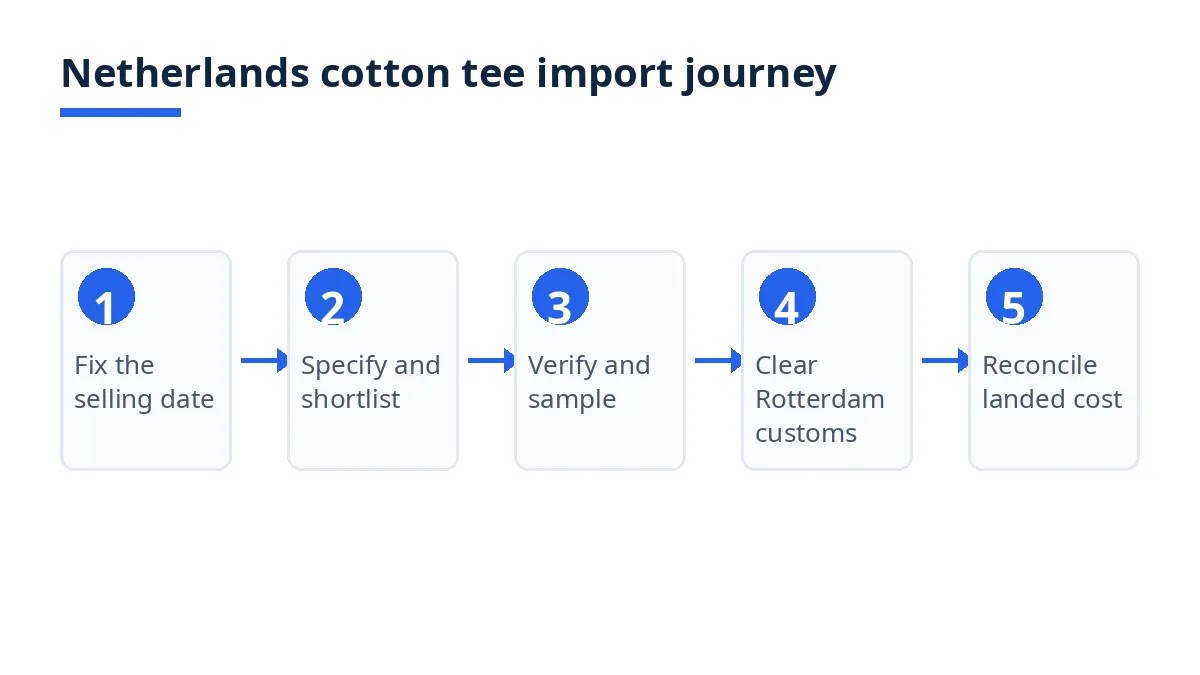
Fix the selling date and the Rotterdam arrival week it requires.
Write the full specification: fabric, weight, construction, measurements, colours, packaging and Dutch labelling.
Shortlist three to five suppliers and verify documents and name consistency.
Send the same RFQ to every shortlisted supplier and compare on a landed-cost basis.
Approve the development sample, then the pre-production sample in production fabric.
Agree the Incoterm with its named place, the payment terms, and the AQL inspection plan in the purchase order.
Confirm classification at 61091000, the preference claim and the origin proof with your broker.
Settle EORI registration and, where applicable, the Article 23 permit or fiscal representative.
Book freight on a dated forwarder quote and confirm insurance cover for the full journey.
Pass the complete document set to your broker before the vessel sails.
Inspect at the factory against the approved sample and the agreed AQL plan.
Clear through Rotterdam, reconcile the landed cost against the quotation, and record every variance for the next order.
How Exportain helps
Exportain connects international buyers with Bangladeshi suppliers and trade-service providers through a supplier directory and a request-for-quotation system. A Dutch buyer can search for cotton t-shirt suppliers, compare profiles, and post one RFQ that suppliers quote against on the same brief. Post a free RFQ on Exportain here: Post a free RFQ on Exportain.
Use the platform for shortlisting and comparison, and keep your own verification, sampling and inspection discipline on top of it. The directory narrows the search; your specification, sample approvals and broker confirmation close the order.
FAQs
What is the typical MOQ for cotton t-shirts from Bangladesh?
There is no single typical minimum. Minimums differ by supplier, by fabric and by how the minimum is counted: per order, per style, per colour or per size. Ask which unit the minimum applies to and get the answer in writing before comparing prices.
How long does shipping take?
There is no fixed transit time for Chattogram to Rotterdam. It depends on routing, sailing schedule, port congestion, clearance and the inland leg. Plan from a dated forwarder quote for your sailing week, plus clearance and inland delivery time.
What import duty applies?
For qualifying Bangladeshi goods, the Everything But Arms preference grants duty-free and quota-free access to the EU Single Market, subject to origin rules and proof of origin.6 The Netherlands applies the EU common customs tariff, so there is no separate Dutch duty rate. If the preference is not proved for your shipment, the broker's TARIC third-country figure for 6109.10 on the entry date applies instead.
How do I verify a supplier?
Request the core business documents, check that the legal name matches across the quotation, invoice, bank account and shipping documents, and read what any profile badge actually covers. For larger orders, add a factory visit, an independent audit, reference buyers, or a trial order.
Next steps on Exportain
Read the general process first: How to Import from Bangladesh.
Work through the cost method with your own figures: Landed Cost for Imports from Bangladesh.
Shortlist suppliers in the category: Bangladeshi Manufacturers and Exporters.
Sources
- EU trade relations with Bangladesh. European Commission, (accessed )
- AQL Calculator | Sample Size and ISO 2859-1 Tool. AQMBD (accessed )
- Regulation (EU) No 1007/2011 on textile fibre names and related labelling and marking of the fibre composition of textile products. European Union, (accessed )
- Incoterms 2020: A Practical Guide for Exporters. Reidel Law Firm (accessed )
- HS Code 61091000 - T-shirts, singlets and other vests of cotton, knitted or crocheted. tariffnumber.com (accessed )
- Trade arrangements. European Commission, Access2Markets (accessed )
- Generalised Scheme of Preferences. European Commission (accessed )
- VAT rates and exemptions. Business.gov.nl (accessed )
- Reverse-charge mechanism on import: Article 23. Belastingdienst (accessed )
- Using the EORI number. German Customs (Zoll) (accessed )
About the author
Sourcing from Bangladesh?
Post a request for quotation and suppliers on Exportain can send you their quotes directly.
Post an RFQ


