

Cotton T-Shirts From Bangladesh to Italy: Step-by-Step Import Guide
An Italy-specific cotton t-shirt import guide: supplier verification, samples and AQL checks, FCA and FOB terms, EU duty under Everything But Arms, Italian import VAT at 22 percent paid at the border, Italian-language labeling, plus a EUR landed-cost example for 5,000 shirts through Genoa to Milan.
Short answer
To import cotton t-shirts from Bangladesh to Italy, specify the tee, verify the supplier's documents and cotton-knit production, and approve a pre-production sample in production fabric with Italian label artwork. Classify each style at 61091000, confirm Everything But Arms duty treatment and origin proof, use an Italian EORI number, pay import VAT at 22 percent at the border unless an authorized deferral applies, choose FCA or FOB to Genoa, and build the landed cost before bulk production.
On this page
Key takeaways
Cotton t-shirts, knitted or crocheted, sit at Combined Nomenclature code 61091000, and the Everything But Arms scheme grants full duty-free and quota-free access to the EU Single Market for all products except arms and ammunition, subject to origin rules and proof; Italy applies the EU common customs tariff, so there is no separate Italian duty rate.
Italian import VAT on cotton t-shirts is charged at the standard rate of 22 percent and is normally paid on arrival to the customs authorities, because postponed import VAT accounting does not exist in Italy; deferral is available only by a separate authorization with a bank guarantee, allowing payment by the last day of the month following importation.
EU textile labeling must be provided in the official language of the member state where the products are made available to the consumer, so an Italy program needs an Italian label, with the full Italian label artwork approved before bulk production together with the pre-production sample.
As an attributed standard-plan case, a trial lot of 400 shirts at General Inspection Level II gives code letter H and a sample of 50 shirts, accepting at 3 defectives or fewer and rejecting at 4 or more at AQL 2.5, and accepting at 5 or fewer and rejecting at 6 or more at AQL 4.0.
Example figures only: 5,000 shirts to Milan through Genoa give a landed cost of EUR 3.38 per shirt excluding import VAT; if the broker confirms the VAT base as EUR 15,745.00, import VAT at 22 percent would be EUR 3,463.90 as a cash-flow line, and if the preference is not proved, the broker's TARIC third-country figure for 6109.10 applies instead.
A Milan buyer placing a first Italian retail order for cotton t-shirts from Bangladesh faces two decisions that shape the whole program before bulk production starts. The first is the label: the fiber statement must be ready in Italian, not added when cartons are already packed. The second is cash flow at the border: Italy has no postponed import VAT accounting that moves the tax onto the VAT return, so the buyer plans to pay import VAT on arrival unless a separate authorized deferral is in place.
Why source cotton t-shirts from Bangladesh
Bangladesh is a natural first place to look for cotton t-shirts because its garment sector is built around knitwear production at scale, with supporting spinning, knitting, dyeing, and finishing capacity around the factory base. That depth is a reason to shortlist Bangladesh, not a promise about any single supplier, so the checks in this guide still apply to every factory on the list.
There is also a trade reason specific to the EU route. Bangladesh, as a least developed country, benefits from the EU Everything But Arms arrangement, which grants duty-free, quota-free access for all exports except arms and ammunition.1
For an Italy program, the destination side matters as much as the factory side. The goods arrive at an Italian port, clear Italian customs, and are sold to Italian consumers under Italian-language labeling.
Find and verify suppliers
Start with a shortlist of three to five suppliers who actually knit and sew cotton t-shirts. Record the same facts for every candidate: legal company name, factory location, whether the company manufactures the tee itself or sources it elsewhere, main export markets, and quantities it is willing to document.
Verification comes before price negotiation. Ask each shortlisted supplier for its core business documents and check that the same legal name appears on the quotation, the proforma invoice, the bank account, and the shipping documents. Request the trade license, the taxpayer identification number and VAT registration where applicable, and the Export Registration Certificate that an exporter needs in order to export from Bangladesh.
One check catches a mismatch that a price comparison never shows. If the name on the bank account differs from the name on the quotation, stop and ask for a written explanation and corrected documents before paying anything. The same rule applies to addresses and validity periods.
Classify the product early, with your broker, rather than leaving classification to the shipping week. Cotton t-shirts, singlets, and other vests of cotton, knitted or crocheted, sit at Combined Nomenclature code 61091000.2 That code drives the duty treatment, the origin proof, and the customs entry, so confirm it for each style before bulk production.
On Exportain, a badge records which document and photo checks have been reviewed; it is not a factory audit, not an inspection of your goods, and not a guarantee of capacity, quality, or delivery. Badges help you shortlist. They do not replace your own document checks, samples, and inspection decision.
MOQ, pricing and samples
There is no single minimum order quantity for cotton t-shirts from Bangladesh that a buyer can safely copy into a plan, because the minimum depends on the supplier, the fabric, the color count, and whether it applies per order, per style, per color, or per size. Treat any minimum you are given as an item to confirm in the supplier written quote, stated with its own basis, and compare suppliers on the same basis.
Compare quotations only when they share the same specification, quantity breakdown, Incoterm and named place, sample terms, payment terms, and validity date. A price that excludes labels, packing, testing, or freight is incomplete, not cheaper. Convert every offer to an estimated landed cost before you choose a supplier.
Samples are part of the contract, not a courtesy, and each stage needs written approval. The development sample confirms the supplier understood the specification. The pre-production sample, made in the production fabric with the production trims, labels, and packing, is the standard bulk production is judged against, so keep a sealed or signed piece yourself, with a matching piece held at the factory. The shipment sample, taken from finished bulk production, lets you compare what is about to ship with the approved pre-production sample. Bulk production should not start before pre-production approval.
Quality control and certifications needed
Quality control has two layers: the physical product and the label that travels with it. The specification should state fabric weight, fiber composition, measurements and tolerances, stitching and construction, color standards, print or embroidery method, and packing. Vague words such as good quality or export quality are not specifications, because no inspector can measure them.
For inspection, agree an acceptance sampling plan before production, not after a dispute. A widely used approach is acceptance sampling under ISO 2859-1, in which a random sample is drawn from the finished lot and the lot passes or fails on the number of defectives found.3
A worked standard-plan case shows how the numbers behave, and it is deliberately different from the landed cost order below. Take a trial lot of 400 shirts, inspected at General Inspection Level II. The lot size band 281 to 500 gives code letter H, and code letter H gives a sample of 50 shirts.3 At AQL 2.5 for major defects, the plan accepts at 3 defectives or fewer and rejects at 4 or more; at AQL 4.0 for minor defects, it accepts at 5 or fewer and rejects at 6 or more.3 Recalculate the plan for every lot.
Italian-language labeling and certification claims
Labeling is where an Italy program most often differs from a program bound for another EU country. Under Regulation (EU) No 1007/2011, labeling must be provided in the official language of the member state where the products are made available to the consumer, unless that member state provides otherwise.4 For Italy, that means an Italian label: a 100 percent cotton tee carries its fiber statement in Italian, and the full Italian label artwork should be approved before bulk production, together with the pre-production sample. An English-only label does not satisfy the Italian requirement, and relabeling finished cartons in Italy costs time, labor, and retail dates.
Keep legal requirements separate from buyer requirements. The labeling rule above is a legal requirement for the EU market. Certifications such as organic or substance-tested claims are claims you choose to make, and each claim needs its own evidence chain from fiber or chemical input to finished shirt. Do not let a supplier attach a certification claim to your label on the strength of a general factory certificate: ask which body issued it, which products and processes it covers, and whether it is current for your order.
Incoterms, shipping and transit time
Incoterms 2020 are the 11 standard trade terms published by the International Chamber of Commerce that define where the seller responsibility for cost, risk, and delivery ends and the buyer begins.5 Seven rules work for any mode of transport and four are reserved for sea and inland waterway shipments.5 For containerized cotton tees from Bangladesh, three rules dominate the conversation.
FCA Chattogram (Free Carrier). The seller clears the goods for export and hands them to your carrier at the named place. This fits container shipments handed over at a terminal.
FOB Chattogram (Free On Board). A sea-only rule under which risk passes when the goods are loaded on board the vessel.
CIF Genoa (Cost, Insurance and Freight). The seller pays freight and minimum insurance to Genoa, but risk still passes on loading at the origin port. Paying for freight is not the same as carrying the risk.
For a first order, FCA or FOB with your own forwarder usually gives the clearest control. Whatever term you choose, write it in full: rule, named place or port, and Incoterms 2020.
The arrival port for this guide is Genoa. Genoa, on the Ligurian coast in northwestern Italy, is the country largest seaport and serves as the main maritime gateway for northern Italy, with container terminals including PSA Genova Pra and on-site customs clearance.6 For a Milan delivery, Genoa keeps the inland leg short, and the forwarder quote for that leg should be obtained for the actual warehouse address.
Transit time is not a figure to copy from a guide. Ask your forwarder for a dated transit estimate for your sailing, your route, and your volume, and plan retail dates from that written estimate.
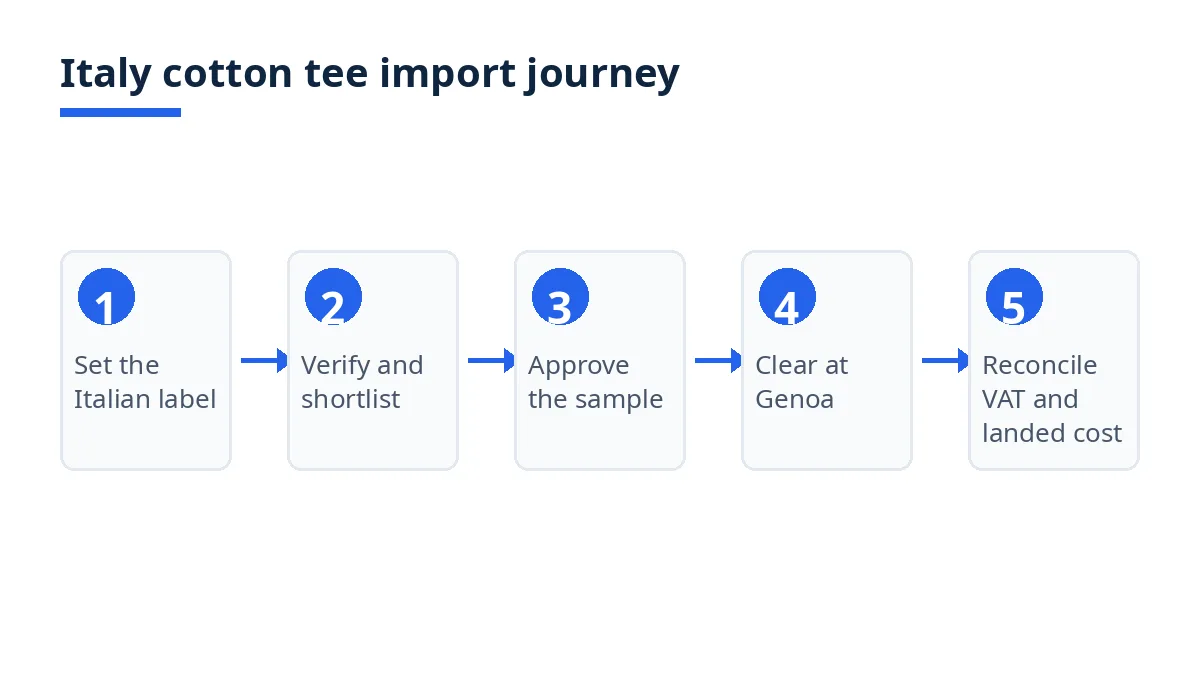
The diagram below sets out the Italy journey in five stages.
Import duty, taxes and documents
Duty on this route follows EU rules, not a separate Italian schedule, because Italy applies the EU common customs tariff. The Access2Markets trade arrangements page states that the Everything But Arms scheme is a special arrangement for least developed countries, granting full duty-free and quota-free access to the EU Single Market for all products except arms and ammunition.7
The opened tariff page for 61091000 confirms the heading and the description, but a search of its rendered text for the word duty returns no match, so it displays no duty rate in its text.2 This guide therefore prints no third-country rate figure of its own. The operative duty figure is the preference figure: 0 percent, dependent on origin rules and on origin proof. If the preference is not proved, the broker tariff third-country figure for 6109.10 on the entry date applies instead, and your broker must supply that figure from the tariff before you price.
Italian import VAT is the cash-flow point that separates Italy from several other EU destinations. Italy applies a standard VAT rate of 22 percent to most goods and services, with reduced rates for listed categories that do not include clothing.8 Your broker confirms the rate for your exact product before entry. Import VAT is normally paid on arrival, directly to the customs authorities, with the customs document used as proof of payment.9 Postponed import VAT accounting does not exist in Italy: it is not possible to report import VAT in the VAT return as input and output.9 The VAT therefore leaves your account at the border rather than being settled through a later return.
A deferral route does exist, but it is an authorization, not a default. Deferring import VAT allows payment by the last day of the month following the month of importation, a bank guarantee must be given by the importer, and the deferral must be requested on a separate application to the tax authorities, with the customs authorities issuing an authorization once the terms are agreed.9 The opened source illustrates the timing with an import on January 15, where deferred import VAT can be paid by February 28.9
Two numbers must be ready before the entry is filed. The first is the EORI number, a unique number issued by the competent authorities in the European Union that allows customs to identify economic operators, and there is an obligation to quote an EORI number on customs declarations.10 An operator established in the European Union applies for the EORI number in the member state where it is resident, so an Italy-based buyer applies in Italy.10 The second is the Italian VAT number, which must match the entry and the VAT treatment the broker files.
The document set for the entry should be complete before the goods leave Bangladesh: commercial invoice, packing list, bill of lading or other transport document, origin proof in the form your broker specifies for the preference, and supplier documents that match the invoice name. An undocumented preference cannot be used.
Landed cost example (table)
Example figures only: every figure in this table is illustrative, not a real price, freight rate, or charge for any product, route, or supplier. The example is a 5,000-shirt order, quoted FOB Chattogram, shipped to Genoa, and delivered to a Milan warehouse, using different figures from the Germany, Netherlands, Belgium, and France guides. Duty is 0 percent under the Everything But Arms preference, on the condition that origin proof is accepted.
Line | Example figures (EUR) | Per shirt (EUR) |
|---|---|---|
Product cost: 5,000 shirts at 2.90, FOB Chattogram | 14,500.00 | 2.90 |
Ocean freight, Chattogram to Genoa | 1,150.00 | 0.23 |
Cargo insurance | 95.00 | 0.019 |
Customs value (product plus freight plus insurance) | 15,745.00 | 3.149 |
Import duty at 0 percent under Everything But Arms, preference proved | 0.00 | 0.00 |
Port and broker charges at Genoa | 420.00 | 0.084 |
Inland delivery, Genoa to Milan warehouse | 380.00 | 0.076 |
Pre-shipment inspection | 260.00 | 0.052 |
Bank and currency costs | 110.00 | 0.022 |
Total landed cost excluding import VAT | 16,915.00 | 3.38 |
Import VAT at 22 percent, cash-flow line only | See note below | See note below |
The arithmetic is: product 14,500.00 plus freight 1,150.00 plus insurance 95.00 gives a customs value of 15,745.00. Adding port and broker charges of 420.00, inland delivery of 380.00, inspection of 260.00, and bank costs of 110.00 gives 16,915.00 excluding import VAT, which is 3.38 per shirt when rounded from 3.383. If the preference is not proved, the broker tariff third-country figure for 6109.10 on the entry date replaces the 0.00 duty line, and the total must be recalculated before pricing.
Import VAT note, example figures with a condition: if your broker confirms the VAT base for this example as 15,745.00, import VAT at 22 percent would be 3,463.90, payable on arrival unless an authorized deferral applies, and shown here as a cash-flow line, not as part of the 3.38 landed cost. The opened sources do not state the VAT base formula, so do not use any other base without broker confirmation.
Step-by-step import checklist
Write the full specification: fabric, fiber composition, weight, measurements and tolerances, construction, colors, print or embroidery, packing, and the Italian label artwork.
Shortlist three to five suppliers who knit and sew cotton t-shirts, and record the same facts for every candidate.
Request and check core business documents, and resolve any name, address, or validity mismatch in writing before paying anything.
Confirm classification at 61091000 for each style with your broker, and confirm the Everything But Arms preference and the origin proof form.
Send every supplier the same request for quotation, with quantity by style, color, and size, Incoterm and named place, sample terms, payment terms, and validity date.
Compare quotations on estimated landed cost, not on headline unit price, and confirm the minimum quantity basis in the supplier written quote.
Approve the development sample, then the pre-production sample in production fabric with Italian label artwork, in writing, before bulk production.
Agree the sampling plan for the finished lot, including defect classes and acceptance numbers, and book inspection before shipment.
Confirm the Italian EORI number and the Italian VAT number with your broker, and confirm whether an import VAT deferral authorization is in place.
Choose FCA or FOB to Genoa, and obtain a dated forwarder transit estimate and inland quote to the Milan warehouse.
Check the shipment sample against the approved pre-production sample, confirm the document set matches the invoice name, and release shipment only when the check passes.
On arrival at Genoa, clear customs with the complete entry, pay import VAT on arrival unless deferral is authorized, and keep the customs payment proof with your VAT records.
How Exportain helps
Exportain connects international buyers with Bangladeshi suppliers, exporters, and trade service providers, and you can use it to shortlist suppliers and compare quotations on the same brief. Browse the supplier directory by product and category, and read How to source and buy from Bangladesh. Exportain is not a party to the goods contract and does not inspect goods, book freight, or clear customs, so your broker, forwarder, and inspector remain separate appointments that you confirm yourself.
When the specification is ready, post a free RFQ so suppliers in the category can quote against the same brief, with the same quantity breakdown, Incoterm, and Italian label requirement.
FAQs
What is the typical MOQ for cotton t-shirts from Bangladesh?
There is no typical minimum quantity to quote as a fact, because the minimum depends on the supplier, the fabric, the color count, and whether it applies per order, per style, per color, or per size. Confirm the minimum and its basis in the supplier written quote, and compare suppliers on the same basis before you choose.
How long does shipping take?
Shipping time is not a fixed figure for this route, and this guide states no average transit time as a fact. Ask your forwarder for a dated transit estimate for your sailing, your route, and your volume, and plan retail dates from that written estimate plus a buffer for customs examination and inland delivery from Genoa to your warehouse.
What import duty applies?
Duty is 0 percent under the Everything But Arms preference, provided origin rules are met and origin proof is accepted.7 The opened tariff page for 61091000 confirms the heading and description but displays no duty rate in its text, so this guide prints no third-country figure of its own.2 If the preference is not proved, the broker tariff third-country figure for 6109.10 on the entry date applies, and your broker must supply it before you price.
How do I verify a supplier?
Request core business documents, including the trade license, taxpayer identification and VAT registration where applicable, and the Export Registration Certificate, and check that the same legal name appears on the quotation, the proforma invoice, the bank account, and the shipping documents. Resolve any mismatch in writing before paying anything, confirm classification and preference treatment with your broker, and approve a pre-production sample in production fabric with Italian label artwork before bulk production.
Next steps on Exportain
Start with the specification and the Italian label artwork. Read How to import from Bangladesh for the general process, use Landed cost for imports from Bangladesh to rebuild the example with your own quotes, and post a free RFQ when the brief is ready.
Sources
- EU trade relations with Bangladesh. European Commission, (accessed )
- HS Code 61091000 - T-shirts, singlets and other vests of cotton, knitted or crocheted. tariffnumber.com (accessed )
- AQL Calculator | Sample Size and ISO 2859-1 Tool. AQMBD (accessed )
- Regulation (EU) No 1007/2011 on textile fibre names and related labelling and marking of the fibre composition of textile products. European Union, (accessed )
- Incoterms 2020: A Practical Guide for Exporters. Reidel Law Firm (accessed )
- Port of Genoa – Italy’s Premier Mediterranean Gateway. Unisco (accessed )
- Trade arrangements. European Commission, Access2Markets (accessed )
- Italian VAT rates and VAT compliance. Avalara (accessed )
- VAT registrations and simplifications | Italy VAT. Marosa (accessed )
- Using the EORI number. German Customs (Zoll) (accessed )
About the author
Sourcing from Bangladesh?
Post a request for quotation and suppliers on Exportain can send you their quotes directly.
Post an RFQ


