

Cotton T-Shirts From Bangladesh to Germany: A Buyer's Import Checklist
A Germany-specific cotton t-shirt import checklist: supplier verification, samples and AQL checks, FCA and FOB terms, EU duty and German import VAT, EORI and labelling, plus a EUR landed-cost example for 8,000 shirts to Hamburg.
Short answer
To import cotton t-shirts from Bangladesh to Germany, specify the tee in full, verify the supplier's documents and current cotton-knit production, and approve a pre-production sample in production fabric. Classify each style at 61091000, confirm Everything But Arms duty treatment and origin proof, register the EORI number, settle German-language labelling, choose FCA or FOB, and build the landed cost before bulk production.
On this page
Key takeaways
Cotton t-shirts, knitted or crocheted, sit at Combined Nomenclature code 61091000, and the LDC preferential schedule lists 6109.10 of cotton at 0 percent; the Everything But Arms scheme grants full duty-free and quota-free access to the EU Single Market for all products except arms and ammunition, subject to origin rules and proof.
A German buyer needs an EORI number quoted on the customs declaration, and since ATLAS release 8.4 an economic operator must use an EORI number; from 1 October 2026 the Customs Portal is mandatory for EORI applications, cancellations, and master-data changes.
German import VAT on cotton t-shirts is at the standard 19 percent rate on a base of customs value plus duties plus transport, handling, and insurance to the first EU destination; Germany has no UK-style postponed VAT accounting, but deferred import VAT is due by the 26th of the second month following import, and a VAT-registered business reclaims it as input VAT.
As an attributed standard-plan case, a lot of 1,201 to 3,200 shirts at General Inspection Level II and AQL 2.5 gives code letter J, a sample of 50 shirts, acceptance at 3 defectives or fewer, and rejection at 4 or more.
Example figures only: 8,000 men's cotton t-shirts to Hamburg give a landed cost of EUR 3.61 per shirt excluding import VAT, with import VAT at 19 percent shown separately as a reclaimable cash-flow line; if the preference is not proved, the broker's TARIC third-country figure for 6109.10 applies instead.
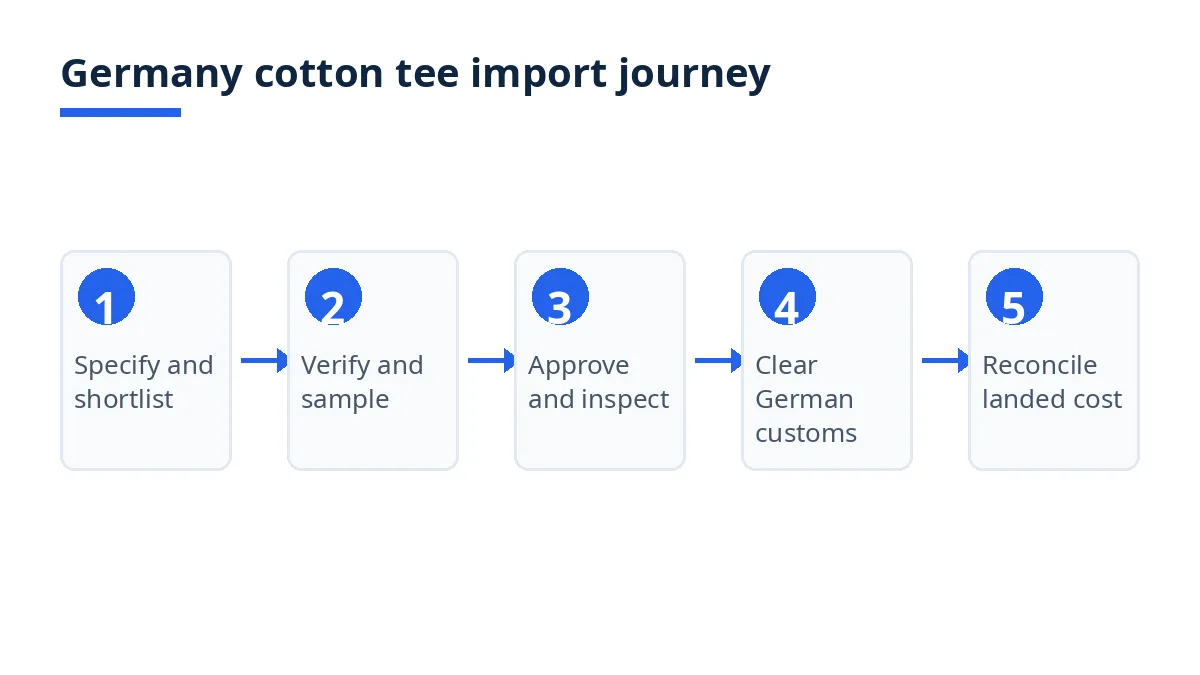
Plan a German cotton t-shirt import backwards from the date the shirts must be on sale in Germany, A buyer in Hamburg or Munich who needs stock for a spring drop has to allow time for specification, sampling, bulk production, inspection, sea transit to Hamburg, German customs clearance, and delivery to the warehouse, and each stage can only start once the previous one is signed off.
The product in this guide is a knitted cotton t-shirt, not a woven shirt and not a blended tee sold under a cotton name. That distinction matters from the first specification, because fibre content drives the tariff code, the label, and the tests.
Why source cotton t-shirts from Bangladesh
Bangladesh is a knitwear country first for a buyer of cotton t-shirts, and the export figures show why the shortlist should start there. In fiscal year 2024-25, Bangladesh apparel exports reached 39.35 billion dollars, and knitwear exports within that total reached 21.16 billion dollars, with growth of 9.73 percent.1
The second reason to source from Bangladesh for Germany is the EU preference position, which changes the duty line in a way no supplier discount can match. Everything But Arms is a special arrangement for least developed countries, granting full duty-free and quota-free access to the EU Single Market for all products except arms and ammunition.2 For a German buyer, that means the duty question is not only what the tariff rate is, but whether the specific shipment qualifies for the preference and can prove it. A shipment that qualifies and a shipment that does not qualify are priced differently even when the shirts are identical, so origin proof belongs in the order documents, not in a later conversation with the broker.
Find and verify suppliers
Start with a specification the supplier cannot fill with guesses
Write the t-shirt before you ask for a price. State the fibre composition as a percentage, the fabric weight you want, the knit construction, and the finish, for example enzyme washed or silicone softened, as your own choices. Add a size chart with finished measurements for every size, tolerances you will accept, stitching and seam requirements, neck rib construction, hem finish, label positions, print or embroidery artwork, and packing, shirts per polybag, per inner carton, and per export carton, with carton marks.
Send that identical specification to three to five suppliers whose current range includes cotton knitwear for the EU market. Ask each one to reply in the same format: fabric assumed, weight, composition, price basis, validity date, minimum per style and per colour, sample timing, production timing from approved pre-production sample, and packing. A reply that changes the fabric weight, drops a size, or quotes on a different delivery term is not a cheaper offer. It is a different shirt.
How do you verify a supplier before you pay?
Verification has three layers, and all three should be complete before a deposit is paid. The first layer is documents: trade licence, export registration, tax documents, and association membership where applicable, checked so that the legal name, address, and bank account name agree across every document and across the quotation, pro forma invoice, and shipping documents.
The second layer is capability. Ask whether knitting, dyeing, cutting, sewing, and printing or embroidery are in-house or bought in, and which step is subcontracted. For a first order, a video walkthrough of the cutting and sewing floors, with the current production visible, is worth more than a brochure.
The third layer is payment discipline. Pay only to the company account named in the documents, never to a personal account, and verify any change of bank details through a separate channel before you act on it. A document and photo review badge is not a factory inspection or a guarantee, and Exportain is not a party to the goods contract.
MOQ, pricing and samples
What is the typical MOQ for cotton t-shirts from Bangladesh?
There is no single typical minimum order quantity for cotton t-shirts from Bangladesh, and a guide that prints one number for every buyer would mislead most of them. The minimum is usually set per style and per colour, because fabric is knitted and dyed in batches, cutting is laid out per size curve, and print screens or embroidery set-ups are made per artwork.
Ask each supplier how its minimum splits: per style, per colour, per size curve, and per artwork. For a German buyer planning repeat drops, the useful question is not only the first-order minimum, but the minimum for a repeat colour. A repeat that falls below the dye-batch minimum can cost more per shirt than the first order, or arrive in a different shade.
How is the price built, and how should you compare quotes?
Fabric is usually the largest cost element in a cotton t-shirt, followed by cutting and sewing, dyeing or finishing, trims, print or embroidery, labels, packing, testing, and the factory margin. Fabric use per shirt depends on the size curve, the fit, and the cutting waste, so two suppliers quoting the same style can differ because one assumes a lighter fabric, a shorter body length, or a different size mix. Ask what each price assumes, in writing, and compare only quotes built on the same specification, size curve, fabric weight, print method, packing, and delivery term.
Which samples do you need, and how do you approve them?
Work in stages, and do not let bulk production start on a development sample. A development sample shows whether the factory understood the cut, the neck construction, and the fit. A pre-production sample, made in the actual production fabric, colour, print, labels, and packing, is the sample you approve for bulk. Fit, shade, print quality, and shrinkage cannot be approved from a sample in substitute fabric, because dyeing and finishing change dimensions and colour.
Quality control and certifications needed
Which quality checks are specific to cotton t-shirts?
Check against the approved sample and size chart first, then by construction. Check fabric composition and weight, finished measurements by size, and consistency across the size curve.
Agree the inspection method before production, not at the port. ISO 2859-1 defines sampling plans indexed by acceptance quality limit, and the opened sampling guide explains that the lot size, inspection level, and chosen AQL translate into a sample size and acceptance and rejection numbers.3 The same guide lists 2.5 for major defects and 4.0 for minor defects as the most common default for everyday knitwear.3 As a worked standard-plan case, a lot of 1,201 to 3,200 shirts at General Inspection Level II and AQL 2.5 gives code letter J, a sample of 50 shirts, acceptance at 3 defectives or fewer, and rejection at 4 or more.3 Those are attributed standard-plan figures, not a supplier promise, and your order should state the standard, level, AQL values by defect class, and inspection stage in writing.
Which label rules apply in Germany?
Fibre labelling is an EU rule, and Germany applies it in German. A textile product shall be labelled or marked with the name and percentage by weight of all constituent fibres in descending order.4 For a 100 percent cotton t-shirt, the label states cotton at 100 percent. For a cotton and elastane blend, the label states each fibre and its percentage in descending order, and the composition on the label must match the fabric actually bought, because the labelled composition is also the composition the tariff classification is built on.
The labelling or marking shall be provided in the official language or languages of the Member State on the territory of which the textile products are made available to the consumer, unless the Member State concerned provides otherwise.5 For shirts sold in Germany, that means German fibre names on the consumer label.
Which certifications do you actually need?
No single certificate covers every cotton t-shirt order for Germany. What you need follows your customer, your sales channel, and your own product rules. A German retailer may name a specific test or scheme in its supplier manual, for example chemical testing of the finished fabric, or a social or environmental audit scheme it recognises. Name any such requirement in the specification, ask for the matching report or certificate, and check its scope, the product and fabric it covers, the issuing body, and the date. A report for a different fabric, a different colour, or an untested blend does not cover your order.
Incoterms, shipping and transit time
Which delivery term should a first order use?
The Incoterms 2020 rules set out, for each rule, where delivery takes place, and risk passes from seller to buyer at the same point and time as delivery.6 Under FOB, CFR, and CIF, the seller must place the goods on board the vessel.6 On customs, in all rules but EXW the seller must carry out export formalities, and in all rules but DDP the buyer must carry out import formalities.6 The same summary notes that the four sea rules, FAS, FOB, CFR, and CIF, are only intended for port-to-port bulk or break-bulk shipments and are not suitable for container shipments, because a container is handed to the carrier before it is on board.6
For a first container order to Hamburg, weigh FCA at the named terminal against FOB at Chattogram. Under FCA, delivery happens when the goods are handed to your carrier, which matches how containerised cargo moves from a factory to a terminal. Under FOB, delivery is on board the vessel, which can leave a gap between handover at the terminal and loading that the contract must allocate.
How long does shipping take?
There is no single typical transit time for cotton t-shirts from Bangladesh to Germany, and a guide that prints one number would hide the variation that matters. Sea freight is the standard route for bulk orders, and it takes weeks rather than days, varying by port, routing, transshipment, and season. Plan from your forwarder's current sailing schedule for Chattogram to Hamburg, and add German customs clearance and inland delivery to your warehouse.
Import duty, taxes and documents
How are cotton t-shirts classified for duty?
Duty follows the classification of each style in the EU tariff, not the supplier's product name. The Combined Nomenclature code for this product is 61091000, described as t-shirts, singlets and other vests of cotton, knitted or crocheted.7 Heading 6109 covers t-shirts, singlets and other vests, knitted or crocheted, and the cotton line sits at 6109.10.
What import duty applies in Germany?
Germany applies the EU common customs tariff, so there is no separate German duty rate for cotton t-shirts. The rate that applies to your shipment depends on the code, the origin, and any preference in force on the entry date. For qualifying Bangladeshi-origin goods, the preference position is duty-free: Everything But Arms grants full duty-free and quota-free access to the EU Single Market for all products except arms and ammunition.2 The LDC preferential schedule opened for this guide lists 6109.10 of cotton at a rate of 0.8
That 0 percent is a preference, not an automatic right. It depends on the goods meeting the origin rules of the scheme and on the proof of origin your broker requires for the entry. If the preference is not proved, budget at the third-country rate shown in TARIC for 6109.10 on your entry date, confirmed by your broker, and do not build a margin plan on 0 percent until the origin position is documented. The fetched TARIC-linked tariff page confirmed the 61091000 heading and description but did not display a rate in its text, so this guide asserts no third-country figure of its own: the broker's TARIC figure for your entry date is the figure to use.
What German import VAT applies, and how is it treated?
Import VAT is separate from duty, and for a German buyer it is usually a cash-flow item rather than a final cost, but only if the reclaim position is set up correctly. Goods from non-EU countries must undergo customs processing when imported into Germany, and the customs declaration allows customs to collect import duties and verify compliance with import regulations.9 Import VAT is equivalent to VAT and is 7 percent or 19 percent.9 Cotton t-shirts fall under the standard rate, so plan at 19 percent, not 7 percent, and confirm the rate with your tax adviser for your exact goods.
The VAT base is the customs value plus any import duties plus transport, handling, and insurance costs to the first destination in the EU, with 19 percent as the standard rate.10 Germany has no UK-style postponed VAT accounting, but import VAT deferred under the German rules is due by the 26th of the second month following import.10 A VAT-registered business reclaims import VAT as input VAT on its return.10
Which documents and registrations do you need for clearance?
Start with the EORI number. The EORI number is a unique number issued by the competent authorities in the European Union that allows customs to identify economic operators.11 In written and electronic customs declarations, the EORI numbers of the declarant and customs representative, the consignee in the case of import, and the consignor or exporter must be quoted.11
Since ATLAS release 8.4 went live, an economic operator must use an EORI number, and it is no longer possible to be identified within the ATLAS system without one.12 From 1 October 2026, use of the Customs Portal is mandatory when applying for or cancelling an EORI number or branch number, as well as for changes to EORI master data.12
Landed cost example (table)
A landed cost is the full cost of one shirt, cleared through German customs and delivered to your warehouse, ready to sell. Every number below is an example figure only, not a quote, and import VAT is shown separately because a VAT-registered importer reclaims it.
Example figures: 8,000 men's cotton t-shirts, FCA Chattogram, sea freight to Hamburg, duty at 0 percent under Everything But Arms for qualifying origin, import VAT at 19 percent shown as a cash-flow line only.
Cost element | Example figures (per shirt) | How to obtain your figure |
|---|---|---|
Product price, FCA Chattogram | EUR 3.20 | Confirmed pro forma invoice |
International freight to Hamburg | EUR 0.18 | Forwarder quote divided by shirts shipped |
Insurance | EUR 0.01 | Policy or forwarder quote |
Customs value (product plus freight plus insurance) | EUR 3.39 | Sum of the three lines above |
Duty at 0 percent under Everything But Arms | EUR 0.00 | Broker calculation from confirmed code and origin proof |
Port, clearance and broker fees | EUR 0.09 | Broker and terminal invoices divided by shirts |
Inland delivery to warehouse | EUR 0.05 | Haulier quote divided by shirts |
Inspection and testing | EUR 0.06 | Inspection company quote divided by shirts |
Bank and currency costs | EUR 0.02 | Bank charges divided by shirts |
Total landed cost, excluding import VAT | EUR 3.61 | Sum of all lines above, excluding the VAT line below |
Import VAT at 19 percent, cash-flow only | EUR 0.64 | 19 percent of the customs value, reclaimable if VAT-registered |
Work the calculation twice, at quote stage and again after shipment with the actual invoices.
Step-by-step import checklist
Fix the selling date in Germany, then work backwards through clearance, transit, inspection, production, and sampling to set the order date.
Write the specification style by style: cut, fibre composition as percentages, fabric weight as your choice, size chart with tolerances, neck and hem construction, print or embroidery, labels, and packing.
Classify every style, starting from heading 6109 and code 61091000 for cotton knitted t-shirts, and confirm each full code and duty treatment with your broker.
Shortlist suppliers whose current range includes cotton knitwear for the EU market, and request comparable quotes on the identical specification and delivery term.
Verify the chosen supplier: company documents, knitwear capacity, dyeing and print route, and a video or in-person factory check for a first order.
Apply for or confirm your EORI number
Order samples in stages, wash and measure them, test print and shade across sizes, then approve a pre-production sample of each style and colour in writing.
Confirm the order in writing: purchase order, pro forma invoice, delivery and payment terms, inspection plan with the AQL and defect limits.
Inspect during production and again on packed goods against the approved samples, checking measurements, neck recovery, print, shade, labels, and carton counts.
Ship, clear German customs with the confirmed code, origin proof, and EORI number, reconcile the actual landed cost, and file the import VAT documents for reclaim.
How Exportain helps
Browse suppliers for Bangladeshi knitwear exporters and compare their ranges against your specification before you send it. Then post your specification and target quantity as an RFQ and compare replies on the same delivery term before you choose a factory for sampling. When you are ready, post a free RFQ on Exportain and compare quotes on the same terms. Exportain is a B2B marketplace where buyers post RFQs, receive quotations, and message suppliers. It does not inspect goods, book freight, or clear customs.
FAQs
What is the typical MOQ for cotton t-shirts from Bangladesh?
There is no single typical minimum. It is usually set per style and per colour, because fabric is knitted and dyed in batches and cutting is laid out per size curve.
How long does shipping take?
Production time and transit time are separate, and neither has a single typical figure. Sea transit from Chattogram to Hamburg takes weeks rather than days and varies by routing, transshipment, and season, and German clearance and inland delivery add further days. Plan from your forwarder's current sailing schedule, not from a printed transit figure.
What import duty applies?
Duty follows the confirmed classification, the origin, and the preference in force on the entry date. Cotton knitted t-shirts sit at code 61091000.7 For qualifying Bangladeshi-origin goods, Everything But Arms grants full duty-free and quota-free access to the EU Single Market for all products except arms and ammunition, and the LDC schedule lists 6109.10 at 0.2 8 If the preference is not proved, the broker's TARIC third-country figure for 6109.10 on your entry date applies instead.
How do I verify a supplier?
Check company documents first, so that name, address, and bank account agree across the trade licence, export registration, and invoices. Then check capability: knitwear capacity, dyeing and print route, and current cotton t-shirt production. Keep payments to the company account named in the documents, and approve a pre-production sample of each style and colour before bulk production.
Next steps on Exportain
Read how to import from Bangladesh for the full process, then read landed cost for imports from Bangladesh to build your own calculation. When ready, post a free RFQ on Exportain and compare quotes on the same terms.
Sources
- Apparel exports hit $39.35bn, 8.84% higher in 2024-25 despite political crisis. RMG Bangladesh (accessed )
- Trade arrangements. European Commission, Access2Markets (accessed )
- ISO 2859 Sampling Plans. TextileTuts (accessed )
- Regulation (EU) No 1007/2011 on textile fibre names and related labelling and marking of the fibre composition of textile products, Article 9: Multi-fibre textile products. legislation.gov.uk (accessed )
- Regulation (EU) No 1007/2011 on textile fibre names and related labelling and marking of the fibre composition of textile products, Article 16: The use of textile fibre names and fibre composition descriptions. legislation.gov.uk (accessed )
- Insider thoughts: Bob Ronai on Incoterms 2020 Rules; What are they about?. International Chamber of Commerce (accessed )
- HS Code 61091000 - T-shirts, singlets and other vests of cotton, knitted or crocheted. tariffnumber.com (accessed )
- ANNEX 2 LDC Preferential Products and Tariff Rates (Final). Bangladesh Trade Portal (accessed )
- Help with importing goods | DHL Private Customer Service. DHL (accessed )
- Guide to Import VAT in Germany for Foreign Companies. Commenda (accessed )
- Using the EORI number. German Customs (Zoll) (accessed )
- Questions and answers. German Customs (Zoll) (accessed )
About the author
Sourcing from Bangladesh?
Post a request for quotation and suppliers on Exportain can send you their quotes directly.
Post an RFQ


