

Cotton T-Shirts From Bangladesh to France: A Buyer's Import Checklist
A France-specific cotton t-shirt import guide: supplier verification, samples and AQL checks, FCA and FOB terms, EU duty under Everything But Arms, French import VAT at 20 percent with autoliquidation, French-language labeling, plus a EUR landed-cost example for 12,000 shirts through Le Havre to Lyon.
Short answer
To import cotton t-shirts from Bangladesh to France, specify the tee in full, verify the supplier's documents and cotton-knit production, and approve a pre-production sample in production fabric with French label artwork. Classify each style at 61091000, confirm Everything But Arms duty treatment and origin proof, register a French EORI number, self-assess import VAT at 20 percent through autoliquidation, choose FCA or FOB to Le Havre, and build the landed cost before bulk production.
On this page
Key takeaways
Cotton t-shirts, knitted or crocheted, sit at Combined Nomenclature code 61091000, and the Everything But Arms scheme grants full duty-free and quota-free access to the EU Single Market for all products except arms and ammunition, subject to origin rules and proof; France applies the EU common customs tariff, so there is no separate French duty rate.
French import VAT on cotton t-shirts is charged at the standard rate of 20 percent, and since January 1, 2022, postponed VAT accounting has been mandatory in France: VAT-registered importers self-assess import VAT on the French VAT return through autoliquidation instead of paying it at the border, with no specific license needed.
EU textile labeling must be provided in the official language of the member state where the products are made available to the consumer, so a France program needs a French label: a 100 percent cotton tee carries '100% coton', with the full French label artwork approved before bulk production.
As an attributed standard-plan case, a lot of 10,001 to 35,000 shirts at General Inspection Level II gives code letter M, a sample of 315 shirts, acceptance at 14 defectives or fewer and rejection at 15 or more at AQL 2.5, and acceptance at 21 or fewer and rejection at 22 or more at AQL 4.0.
Example figures only: 12,000 unisex cotton t-shirts to Lyon through Le Havre give a landed cost of EUR 3.28 per shirt excluding import VAT, with import VAT at 20 percent shown separately as a self-assessed cash-flow line; if the preference is not proved, the broker's TARIC third-country figure for 6109.10 applies instead.
A buyer in Lyon who plans to sell a first cotton tee drop through French retail faces two decisions before any price discussion, and both are specific to France. The first is the label: the tee will be sold to French-speaking consumers, so the fiber declaration must read "100% coton" and the label artwork must be approved in French before production. The second is the tax treatment at the border: French import VAT is not paid in cash at customs, it is self-assessed on the French VAT return through autoliquidation, which changes the cash-flow plan for the whole order.
Why source cotton t-shirts from Bangladesh
Bangladesh is a natural shortlist for a French cotton tee program because the EU trade relationship is built on textiles. The EU was Bangladesh's largest trading partner, with a 21.5 percent share of Bangladesh's goods trade, and textiles accounted for almost 94 percent of EU imports from Bangladesh in 2025.1 That concentration means a French buyer can usually find several suppliers able to quote the same tee.
Category strength is not a supplier guarantee. If this is your first import, read the pillar guide first: How to Import from Bangladesh. This guide adds the France-specific rules on top of that sequence.
Find and verify suppliers
Start with a shortlist of three to five suppliers, not a single conversation. Search Exportain's supplier directory by product and category, and record the same facts for every candidate: legal company name, address, whether the company manufactures the tee itself or sources it from another factory, and capacity information it is willing to document. Browse the directory here: Bangladeshi Manufacturers and Exporters.
Then verify before you pay. Ask each shortlisted supplier for its core business documents and check that the names match:
Legal company name and registered address, matching the name that will appear on invoices and shipping documents.
Trade license, taxpayer identification number, and VAT registration where applicable.
Export Registration Certificate, the registration an exporter needs in order to export from Bangladesh.
Chamber or trade association membership documents where relevant to the sector.
The name on the quotation, pro forma invoice, bank account, and shipping documents should be the same legal entity. Any difference needs a clear, documented explanation. Where a supplier profile shows a trust badge, read what that badge covers before relying on it. A badge records which checks have been reviewed; it is not a factory audit and not an inspection of your goods.
For larger orders, add checks proportionate to the risk: a factory visit, an independent audit, reference buyers, or a small trial order.
MOQ, pricing and samples
There is no single typical minimum order quantity for cotton t-shirts from Bangladesh, and this guide states none. Minimums vary by supplier, by fabric, and by how the minimum is counted: per order, per style, per color, or per size. A supplier that quotes a minimum per color is making a very different offer from one that quotes the same number across all colors and sizes. Ask which unit the minimum applies to, and get the answer in writing before you compare prices.
Price comparison needs the same discipline. Send every shortlisted supplier exactly the same request for quotation, and compare replies line by line: unit price and currency, inclusions and exclusions, Incoterm and named place, lead time counted from a named event, sample terms, payment terms, and the quotation expiry date. Convert every offer to the same basis, ideally to an estimated landed cost, before you decide.
Samples are part of the contract, not a courtesy. Work through three stages:
Development sample. This confirms the supplier understood your specification. Expect a second round, and comment precisely on measurements, materials, colors, and construction.
Pre-production sample. Made with the actual materials, trims, labels, and packaging intended for the bulk order, including the approved French label. Approve it in writing and keep one sealed or signed piece yourself, with a matching piece retained at the factory. Bulk production should not start before this approval.
Shipment sample. Taken from finished bulk production so you can compare it with the approved pre-production sample before the goods leave.
Agree payment terms in writing too: when each payment becomes due and against which document or milestone.
Quality control and certifications needed
Cotton t-shirts fail in predictable places: shade variation, shrinkage, twisted seams, broken stitches, and print that does not survive washing. Name the tests for each risk in your specification: fabric weight, shrinkage tolerance after a stated wash method, colorfastness, seam strength, and print durability. "Good quality" and "export quality" are not specifications, and an inspector cannot test against them.
Agree the inspection plan in the purchase order, not at the port. The sampling system most apparel buyers use is ISO 2859-1, which sets the sample size from the lot size and inspection level, then sets accept and reject numbers from the chosen quality limit.2 The same reference tables give a worked case for the order in the landed cost section below: a lot of 10,001 to 35,000 shirts at General Inspection Level II gives code letter M and a sample of 315 shirts. At AQL 2.5 for major defects, the lot passes at 14 defectives or fewer and fails at 15 or more; at AQL 4.0 for minor defects, it passes at 21 or fewer and fails at 22 or more.2 Critical defects, such as a broken needle left in a garment, are normally set to zero tolerance. State the plan, the defect classes, and what happens on rejection, including who pays for re-inspection.
Which label rules apply in France
Labeling is where a France order differs from an order bound for a market with a different official language. The EU textile labeling regulation states that labeling or marking shall be provided in the official language or languages of the member state on the territory of which the textile products are made available to the consumer, unless the member state concerned provides otherwise.3 France has one official language for this purpose, so a France program needs a French label plan, not a multilingual one: a 100 percent cotton tee carries "100% coton" for French-speaking consumers, with the fiber composition easily legible, visible, and clear. Agree the full French label artwork, including fiber percentages, care symbols, and importer identification, before bulk production, and approve a physical label sample in French. If part of the same order will later be sold in another EU member state, that market needs its own language version approved separately; do not assume the French label covers it.
Which certifications do you actually need
Separate legal requirements from buyer requirements. The labeling rule above is a legal requirement for the EU market. Certifications such as organic or substance-tested labels are claims you choose to make, and each claim needs its own evidence chain from fiber or chemical input to finished shirt. Do not let a supplier attach a certification claim to your label on the strength of a general factory certificate: ask which body issued it, which products and processes it covers, and whether it is current for your order.
Incoterms, shipping and transit time
Incoterms 2020 are the 11 standard trade terms published by the International Chamber of Commerce that define where the seller's responsibility for cost, risk, and delivery ends and the buyer's begins.4 Seven rules work for any mode of transport and four are reserved for sea and inland waterway shipments.4 For containerized cotton tees from Bangladesh, three rules dominate the conversation:
FCA Chattogram (Free Carrier). The seller clears the goods for export and hands them to your carrier at the named place. This fits container shipments handed over at a terminal.
FOB Chattogram (Free On Board). A sea-only rule under which risk passes when the goods are loaded on board the vessel. It remains common in Bangladesh garment trade, but it fits bulk loading better than a container handed over before loading.
CIF Le Havre (Cost, Insurance and Freight). The seller pays freight and minimum insurance to Le Havre, but risk still passes on loading at the origin port. Paying for freight is not the same as carrying the risk.
For a first order, FCA or FOB with your own forwarder usually gives the clearest control. DAP leaves import clearance and duty with you, and DDP should only be used where the seller can genuinely perform French import clearance. Whatever term you choose, write it in full: rule, named place or port, and Incoterms 2020.
Transit time is order-specific, and this guide states no single figure for it. Ask your forwarder for a dated quotation for your route, volume, and sailing week, and build your selling date backwards from the forwarder's arrival date plus clearance and inland delivery.
Le Havre is the natural arrival port for a France program. Le Havre is the leading deep-water port in northern Europe for imports, and the HAROPA PORT complex of Le Havre, Rouen, and Paris serves a hinterland whose heart is along the Seine Valley and the Paris area, which together form the biggest consumer market in France.5 For a Lyon warehouse, the onward leg runs from Le Havre inland; for a buyer in the south of France, Marseille-Fos may suit the warehouse better, and the same France rules on duty, VAT, and labeling apply at either port.
Import duty, taxes and documents
France is a member of the European Union, so the EU common customs tariff applies through France. There is no separate French duty rate for cotton t-shirts. Classification comes first: cotton t-shirts, knitted or crocheted, sit at Combined Nomenclature code 61091000, described as "T-shirts, singlets and other vests of cotton, knitted or crocheted".6 Confirm the code against your exact product before you price.
The operative duty figure for qualifying Bangladeshi origin is the preference figure. As a least developed country, Bangladesh benefits from the EU's Everything But Arms arrangement, which grants duty-free, quota-free access for all exports except arms and ammunition.1 The Access2Markets trade arrangements page states the same rule: the Everything But Arms scheme is a special arrangement for least developed countries, granting full duty-free and quota-free access to the EU Single Market for all products except arms and ammunition.7 In practice, that means 0 percent duty for cotton t-shirts that meet the origin rules and carry the required proof of origin. The 0 percent is a preference, not an automatic right: if the origin rules are not met or the proof is not in order, the preference does not apply, and the broker's TARIC third-country figure for 6109.10 on the entry date applies instead. This guide states no third-country rate figure of its own, because the tariff page opened for this guide confirms the heading and description but does not render a duty rate in its text.6 Ask your broker for the TARIC figure on your entry date and keep it in the landed cost file alongside the preference claim.
French import VAT is charged at the standard rate of 20 percent, and clothing falls under that standard rate.8 How that VAT reaches the tax authority is what sets France apart from its EU neighbours. Since January 1, 2022, postponed VAT accounting has been mandatory in France: all businesses registered for VAT in France pay their import VAT on their VAT return, rather than at the border.9 The system is called autoliquidation de la TVA a l'import, and it is the default method for handling all import VAT in France, with no specific license or authorization needed to use it.9 When it is time to file the French VAT return, the form carries the import VAT amount pre-filled, and the amount must be checked as part of filing; the customs authority creates a monthly statement of imports, accessed through the Donnees ATVAI online system.9 For a VAT-registered buyer that can deduct the VAT, the self-assessed amount is declared as collected and deductible on the same return, so the border payment that other systems require never arises.
Documents for the import declaration should be complete before the vessel sails. The core set is the commercial invoice, packing list, bill of lading, certificate of origin or origin proof for the preference claim, and the import declaration itself, with the EORI number quoted on the declaration. The EORI number is a unique number issued by the competent authorities in the European Union that allows customs to identify economic operators, and there is an obligation to quote an EORI number on customs declarations.10 An operator established in the European Union applies for the EORI number in the member state where it is resident.10 For a French buyer, that means a French EORI number, and the same French VAT number that appears on the customs entry for the autoliquidation treatment above.
Landed cost example (table)
Example figures only: every figure below is illustrative, not a real price, freight rate, or charge for any product, route, or supplier. The example treats the customs value as the import VAT base; your broker confirms the actual VAT base from the declaration.
A French buyer orders 12,000 unisex cotton t-shirts, FOB Chattogram, Incoterms 2020, for delivery to a warehouse in Lyon after clearance at Le Havre. The preference is claimed, so duty is 0 percent, and import VAT is shown separately as a cash-flow line because a VAT-registered buyer that can deduct it does not carry it as a final cost.
Line | Example figures (EUR) |
|---|---|
Product cost: 12,000 shirts at 2.85 FOB | 34,200.00 |
Ocean freight Chattogram to Le Havre | 2,400.00 |
Cargo insurance | 180.00 |
Customs value | 36,780.00 |
Import duty at 0 percent under Everything But Arms | 0.00 |
Port, terminal, and broker charges at Le Havre | 900.00 |
Inland delivery Le Havre to Lyon | 720.00 |
Pre-shipment inspection | 600.00 |
Bank and currency costs | 360.00 |
Total landed cost excluding import VAT | 39,360.00 |
Landed cost per shirt excluding import VAT | 3.28 |
Import VAT at 20 percent, cash-flow line only | 7,356.00 |
Per shirt: product 2.85 plus freight 0.20 plus insurance 0.015 gives a customs value of 3.065; duty 0.00; plus port and broker 0.075, inland 0.06, inspection 0.05, and bank 0.03 gives 3.28 excluding import VAT. Import VAT at 20 percent of the 36,780.00 customs value is 7,356.00 for the shipment, or about 0.61 per shirt, shown separately. Under autoliquidation, that VAT is declared on the French VAT return rather than paid at the border, so the cash-flow line does not require a border payment.9 If the preference were not proved, the duty line would change to the broker's TARIC third-country figure for 6109.10 on the entry date, and the per-shirt total would rise by that amount. For the full method behind this table, see the landed cost guide: Landed Cost for Imports from Bangladesh.
Step-by-step import checklist
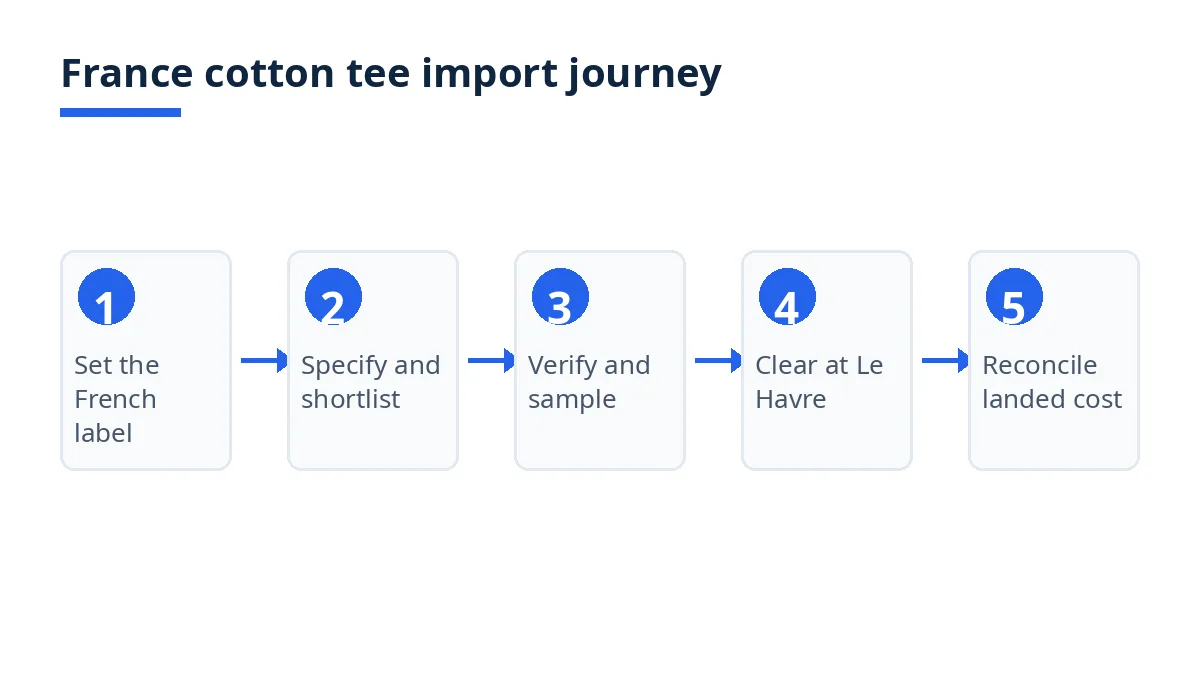
Define the selling market first: France, with French label artwork, and any further EU market as a separate language version.
Write the full specification: fiber, weight, measurements, construction, colors, print, packaging, and tests.
Shortlist three to five suppliers through the directory and record the same facts for each.
Verify documents and legal-entity consistency before paying for samples or deposits.
Send every shortlisted supplier the same request for quotation and compare replies on one Incoterm basis.
Approve the development sample, then the pre-production sample in production fabric with the approved French label artwork.
Confirm classification at 61091000, the Everything But Arms preference, and the origin proof with your broker.
Confirm French EORI registration and the French VAT number that will appear on the customs entry for autoliquidation.
Agree the AQL inspection plan, defect classes, and rejection procedure in the purchase order.
Book freight on the agreed Incoterm, confirm the Le Havre release route with your forwarder, and insure the shipment at the agreed cover level.
Send the broker the complete document set before sailing and check the draft declaration for classification, value, origin, and the VAT liable person.
Clear at Le Havre, deliver to the warehouse, inspect on arrival against the approved sample, check the pre-filled import VAT on the VAT return, and reconcile the landed cost, the declaration, and the VAT return.
How Exportain helps
Exportain helps a French buyer run this sequence without starting from a blank page. Search the directory for cotton t-shirt suppliers and post a single request for quotation that every shortlisted supplier answers against the same brief. Post a free RFQ on Exportain here: Post a Free RFQ.
FAQs
What is the typical MOQ for cotton t-shirts from Bangladesh?
There is no single typical MOQ, and no figure in this guide should be read as one. Minimums vary by supplier, by fabric, and by whether the minimum counts per order, per style, per color, or per size. Ask which unit each minimum applies to and compare minimums only on that same unit.
How long does shipping take?
Shipping time is order-specific. The sailing schedule, the transshipment port, the Le Havre terminal position, clearance, and inland delivery to your warehouse all move the date. Ask your forwarder for a dated quotation for your route, volume, and sailing week, and plan backwards from that quotation plus clearance and delivery time.
What import duty applies?
For cotton t-shirts at 61091000 that meet the Everything But Arms origin rules and carry the required proof of origin, duty is 0 percent under the preference.1 7 France applies the EU common customs tariff, so there is no separate French duty rate. If the preference is not proved, the broker's TARIC third-country figure for 6109.10 on the entry date applies instead, and this guide states no third-country figure of its own.6
How do I verify a supplier?
Check the legal company name and registered address across the quotation, invoice, bank account, and shipping documents, and ask for the trade license, taxpayer identification number, VAT registration where applicable, Export Registration Certificate, and relevant chamber or trade association documents. Add a factory visit, an independent audit, reference buyers, or a trial order for larger programs, and read what any trust badge actually covers before relying on it.
Next steps on Exportain
Start with the pillar process, then work the cost method, then build your shortlist: How to Import from Bangladesh, Landed Cost for Imports from Bangladesh, and Bangladeshi Manufacturers and Exporters. When the specification and French label plan are ready, post the brief once and let suppliers quote against it: Post a Free RFQ.
Sources
- EU trade relations with Bangladesh. European Commission, (accessed )
- AQL Calculator | Sample Size and ISO 2859-1 Tool. AQMBD (accessed )
- Regulation (EU) No 1007/2011 on textile fibre names and related labelling and marking of the fibre composition of textile products. European Union, (accessed )
- Incoterms 2020: A Practical Guide for Exporters. Reidel Law Firm (accessed )
- Who we are? | HAROPA PORT. HAROPA PORT (accessed )
- HS Code 61091000 - T-shirts, singlets and other vests of cotton, knitted or crocheted. tariffnumber.com (accessed )
- Trade arrangements. European Commission, Access2Markets (accessed )
- VAT in France (TVA): 2026 Rates, Refunds and Business Thresholds. Selectra (accessed )
- Postponed VAT Accounting in France. SimplyVAT (accessed )
- Using the EORI number. German Customs (Zoll) (accessed )
About the author
Sourcing from Bangladesh?
Post a request for quotation and suppliers on Exportain can send you their quotes directly.
Post an RFQ


