

Cotton T-Shirts From Bangladesh to Canada: A Buyer's Import Checklist
A Canada-specific cotton t-shirt import guide: Montreal routing, bilingual labeling, Form B255 LDCT proof, GST on the duty-paid value, and a CAD landed-cost example for 6,400 shirts to Toronto.
Short answer
To import cotton t-shirts from Bangladesh to Canada, specify the tee in full, verify the supplier documents and knit production, and approve a pre-production sample with bilingual label artwork. Classify each style at 6109.10.00, check the LDCT claim with Form B255, confirm the broker tariff figure and GST base, choose FOB or FCA to Montreal, and build the landed cost before bulk production.
On this page
Key takeaways
Cotton t-shirts, knitted or crocheted, of cotton sit at Canadian tariff item 6109.10.00 in the archived CBSA Chapter 61 schedule; the archived line lists LDCT as Free and MFN at 18 percent, and the broker must confirm the current line on the entry date.
For textile and apparel goods of HS Chapters 50 to 63, the LDCT proof is Form B255, with Criteria C for t-shirts sewn or otherwise assembled in the least developed country, plus direct shipment to Canada.
Canadian textile labels must show fiber content in English and French, except where only one official language is used in consumer transactions; Quebec has additional French-language requirements to confirm separately.
The Canada verification case is a 420-shirt trial lot at General Inspection Level II: code letter H, a sample of 50 shirts, acceptance at 3 or fewer major defectives at AQL 2.5 and at 5 or fewer minor defectives at AQL 4.0.
Example figures only: 6,400 shirts through Montreal to Toronto give a landed cost of CAD 4.71 per shirt excluding GST, with conditional GST of CAD 1,232.00 at 5 percent if the broker confirms that tax base.
The first Canadian order changes the checklist at two points that do not appear in a European order, and both have to be settled before bulk production. The first is the tariff claim: Bangladesh-origin goods may qualify for the Least Developed Country Tariff, which the Canada Border Services Agency describes as a preferential treatment under which qualifying goods enter Canada duty-free if they meet specific origin rules1. The second is the label: required fiber content information, and any information directly relating to fiber content, must be bilingual except in areas where only one official language is used in consumer transactions2. A Toronto buyer who gets those two points right, and who routes the container through Montreal with an inland leg to Toronto, has a clear path through the rest of the order.
This guide follows one Canadian journey: a knitted cotton t-shirt, Chattogram to Montreal, then inland to a Toronto warehouse. CN describes the Port of Montreal as the largest container port in Eastern Canada, with a rail network directly dockside3. No figure here is presented as a typical price, minimum, or transit time. Figures that appear are either supplier quotations to be obtained, or figures labeled as examples for one stated order.
Why source cotton t-shirts from Bangladesh
Bangladesh offers a knitwear base in which spinning, knitting, dyeing, cutting, sewing, printing, and packing capacity sit close together. For a Canadian buyer, that closeness matters most when a sample needs correction, because a supplier that controls more of the chain can usually answer with a revised sample.
The commercial case for Canada rests on fit with the Canadian market rather than on price alone. A tee built for sale across Canada needs a bilingual fiber label, a size curve that matches the buyer assortment, and a fabric weight that suits the selling season.
The sequence used here matches the Exportain pillar guide on importing from Bangladesh: specify first, shortlist second, verify before relying on any supplier, compare quotations on the same basis, approve samples in writing, and give the broker complete documents early4.
Find and verify suppliers
Start with a shortlist of three to five suppliers that actually knit or source cotton tees, rather than with the first reply to a broadcast inquiry. Use the supplier directory to compare profiles on the same fields for every candidate: legal company name, location, main products, and the checks shown on the profile.
Verification means documents, not assurances. Ask every shortlisted supplier for its trade license, tax registration, Export Registration Certificate, and chamber or association membership documents where relevant, and check that the legal name matches across the quotation, proforma invoice, bank account, and shipping documents. Any mismatch needs a written explanation before money moves. A trust badge records which document and photo checks have been reviewed; it is not a factory audit, not an inspection of the goods, and not a guarantee of capacity or delivery.
For a larger program, add a factory visit, an independent audit, named reference buyers, and a trial order, and agree in writing who pays for audits and visits.
The Canada verification case is a trial lot, not a first bulk order. A Toronto buyer places a 420-shirt trial lot with the preferred candidate, inspects it under the sampling plan in the quality section, and only then confirms the 6,400-shirt program in the landed-cost example.
MOQ, pricing and samples
No single minimum order quantity applies to cotton t-shirts from Bangladesh, and this guide states none. Each supplier sets its own minimum, and the minimum may apply per order, per style, per color, or per size. The only minimum that matters is the one written in the supplier quotation for the exact breakdown ordered, so ask in those terms: minimum per style, per color, and per size, and whether a surcharge applies below it.
Prices are likewise order-specific. A quotation is comparable only when every supplier quotes against the same specification, quantity breakdown, Incoterm with a named place, and packaging and labeling requirements. Compare quotations line by line: unit price and currency, what the price includes, sample terms, payment terms, lead time counted from a named event such as sample approval, and the date the price expires.
Samples are part of the contract, not a courtesy. Work through three stages: a development sample, a pre-production sample made with the actual fabric, trims, labels, and packaging intended for bulk, and a shipment sample drawn from finished production. Approve the pre-production sample in writing, keep one sealed piece, and do not allow bulk production to start before that approval.
Payment terms deserve the same written treatment. State when each payment falls due and against which document or milestone, and keep the agreed terms in the sales contract.
Quality control and certifications needed
Quality control starts with a written specification that an inspector can check: fabric composition and weight, measurements with tolerances, stitching and construction details, color standards, print or embroidery artwork, packaging, and labeling. A specification that says "good quality" cannot be inspected.
Labeling for Canada follows the Competition Bureau guide to the Textile Labelling and Advertising Regulations. The disclosure label must bear fiber content information in percentages by mass, and dealer identity information2. Except in areas where only one official language is used in consumer transactions, the required fiber content information, and any information directly relating to fiber content, must be bilingual2. For a cotton tee, the result is a label reading "100% cotton / coton" for a single-fiber shirt, with any section or descriptive term relating to fiber content also in both languages. Dealer identity, and country of origin when required, need only be in one official language2. For permanent labels, separate English and French labels must be adjoining or contiguous2.
Quebec needs a separate check. The same guide notes that Quebec has additional requirements concerning the use of the French language on products marketed within its jurisdiction, and points readers to l'Office quebecois de langue francaise2. Confirm those requirements with a Quebec adviser before approving the label, and check the artwork against the pre-production sample.
Certifications work the same way as labels: name them specifically. If retail customers require a particular fiber, chemical, or social-compliance certificate, write the exact certificate name, issuing body, and scope into the request for quotation, and ask to see the certificate document with its scope and expiry date. Where laboratory testing is required, name the tests, the method, and who pays, and agree whether testing happens on the pre-production sample, during production, or both.
For finished-goods inspection, use an acceptance sampling plan agreed before production. The ISO 2859-1 tables show how a lot size and inspection level give a code letter, and how that code letter gives a sample size with accept and reject numbers5. In the Canada trial case, a lot of 420 shirts at General Inspection Level II gives code letter H and a sample of 50 shirts5. At AQL 2.5 for major defects, accept at 3 or fewer and reject at 4 or more; at AQL 4.0 for minor defects, accept at 5 or fewer and reject at 6 or more5. Critical defects are handled separately.
Incoterms, shipping and transit time
Choose the Incoterm with the named place before comparing freight figures, because the rule decides who arranges carriage, who bears risk at each point, and which cost lines already sit inside the price. Under FOB Chattogram, the buyer arranges and pays main freight and insurance, and risk passes when the goods are loaded on board. Under CIF Montreal, the seller pays freight and minimum insurance to Montreal, but risk still passes at loading. Under FCA, which suits containerized shipments, risk passes when the goods are handed to the buyer's carrier at the named place.
This guide uses no single transit time as a fact, because transit time depends on the sailing schedule, routing, transshipment, and port conditions on the dates shipped. Ask the forwarder for a dated estimate for the actual sailing, and treat that estimate as the planning figure.
The route in this guide runs from Chattogram to Montreal. The Port of Montreal sits on the Saint Lawrence River and offers a dockside rail network for the inland leg3. From Montreal, the inland leg to a Toronto warehouse is a domestic movement quoted for the actual delivery address. Confirm which destination charges the freight already covers, and who bears storage and demurrage if collection is late.
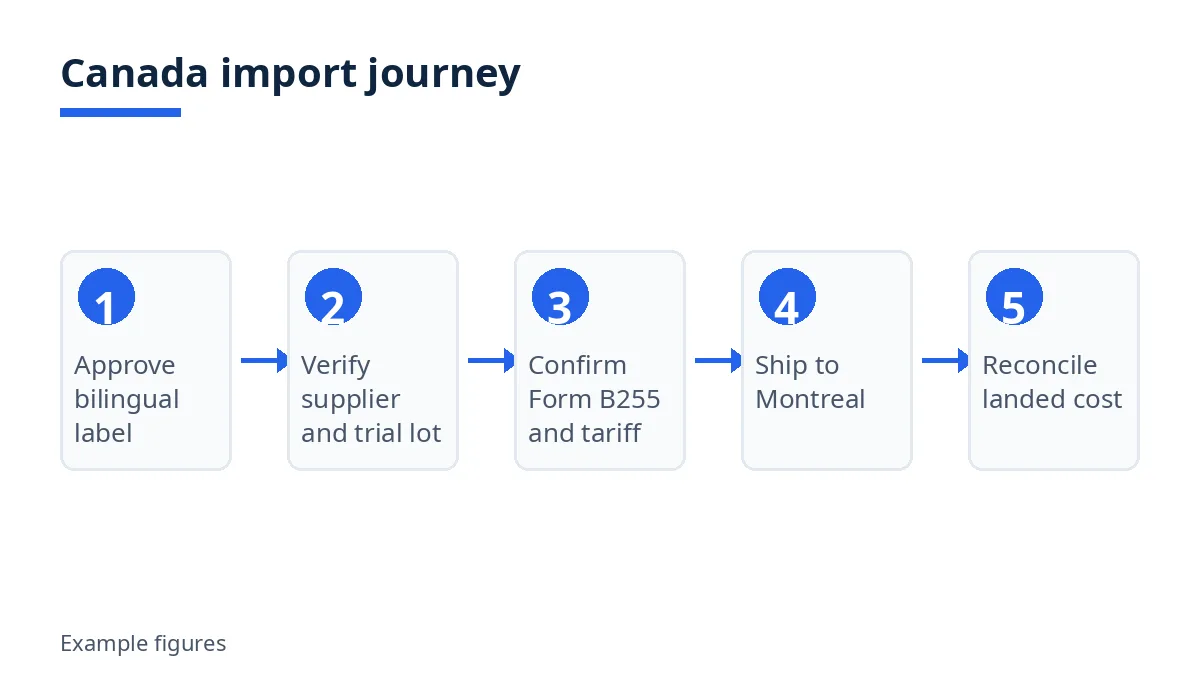
The diagram below traces the Canada journey from bilingual label approval to landed-cost reconciliation.
Import duty, taxes and documents
Classification comes first. The archived CBSA Chapter 61 schedule lists tariff item 6109.10.00 as t-shirts, singlets and other vests, knitted or crocheted, of cotton6. That page is archived and has not been altered or updated since it was archived, so the description is used here while the rate on the entry date must come from the current schedule and the broker. Confirm the full Canadian tariff item, including any statistical suffix for the exact style, with the broker before pricing.
On duty, the Least Developed Country Tariff is the claim to check first. The CBSA states that qualifying goods enter Canada duty-free if they meet specific origin rules, and that to qualify, goods must satisfy the rules of origin, meet proof of origin requirements, and be shipped directly to Canada from an LDCT beneficiary country1. The archived Chapter 61 line for 6109.10.00 lists LDCT as Free and the Most-Favoured-Nation rate as 18 percent6. Those are the archived line, not a promise about the entry date: the broker must confirm the current figures for 6109.10.00 on the entry date, and if the current line differs, the current line governs.
The origin proof for this product is specific, and it is not Form A alone. For textile and apparel goods of Harmonized System Chapters 50 to 63, the Certificate of Origin for Textile and Apparel Goods Originating in a Least Developed Country, Form B255, must be submitted as proof of origin7. The same memorandum places t-shirts in Part A3, and states that to be entitled to the LDCT, such goods must be sewn or otherwise assembled in that least developed country, with Criteria C in Field 6 of Form B2557. The importer declares possession of the proof on the commercial accounting declaration, using code 08 for LDCT, and must present it on request; failure to do so results in the MFN treatment or another appropriate treatment7. Goods qualify only if shipped directly to Canada from a beneficiary country, which may include transshipment if the direct-shipment conditions are met7.
If the LDCT claim is not proved, the fallback is the broker-confirmed MFN figure for 6109.10.00 on the entry date. Do not price from the archived 18 percent figure without that confirmation, and do not price from a duty-free assumption without the Form B255 and direct-shipment evidence in hand. The landed-cost example below therefore shows duty at zero only as a conditional example, on the stated condition that the broker confirms LDCT for that line and that the Form B255 is accepted.
On tax, the importer must pay GST or HST directly to the CBSA when the goods are imported or taken out of bond for use, and the tax on imported goods is payable on the duty-paid value determined under the Customs Act8. The Canada Revenue Agency states that a person liable to pay duty on imported goods, or who would be so liable if the goods were subject to duty, must also pay tax at 5 percent on the excise and duty-paid value9. Whether the provincial part of HST or a provincial sales tax applies, and whether GST paid is recoverable in the buyer position, are questions for the broker and tax adviser. This guide states no provincial tax figure and no recoverability conclusion.
Documents and registration come before shipment. Importers, exporters, or customs brokers acting for a client need a nine-digit business number before registering for an import-export program account with the CBSA, and the business names on file must match the names on customs release documents, or goods may be delayed10. All importers and licensed customs brokers must maintain a customs account with the CBSA, and eligibility requires a registered business number with the Canada Revenue Agency11. The broker needs the commercial invoice, packing list, bill of lading, Form B255, and business number details, with values and quantities consistent across every document, sent early enough for a pre-arrival check.
Landed cost example (table)
Example figures only: every figure in this table is illustrative for a single order, not a quoted price, freight rate, or charge for any supplier, route, or shipment. The example covers 6,400 unisex cotton t-shirts shipped FOB Chattogram, cleared at Montreal, and delivered to a Toronto warehouse. All figures are in Canadian dollars (CAD). Duty is shown at zero only on the conditional LDCT basis stated in the previous section, and GST is shown separately because its recoverability depends on the buyer position and the broker-confirmed tax base12.
Line | Example figures (CAD) |
|---|---|
Product cost: 6,400 shirts at 3.85, FOB Chattogram | 24,640.00 |
Ocean freight, Chattogram to Montreal | 2,750.00 |
Cargo insurance | 190.00 |
Import duty at 0 percent, conditional LDCT basis only | 0.00 |
Port and broker charges at Montreal | 920.00 |
Inland delivery, Montreal to Toronto | 780.00 |
Pre-shipment inspection | 610.00 |
Bank and currency costs | 240.00 |
Total landed cost excluding GST | 30,130.00 |
Landed cost per shirt excluding GST | 4.71 |
Conditional GST at 5 percent of 24,640.00, if the broker confirms that base | 1,232.00 |
The arithmetic is 24,640.00 plus 2,750.00 plus 190.00 plus 920.00 plus 780.00 plus 610.00 plus 240.00 equals 30,130.00. Divided by 6,400 shirts, the landed cost is 4.71 CAD per shirt excluding GST. The conditional GST figure is 5 percent of 24,640.00, which equals 1,232.00 CAD, and it is conditional because the broker must confirm the duty-paid value that forms the tax base for the actual entry.
Step-by-step import checklist
Write the full specification: fabric, weight, measurements, construction, colors, print or embroidery, packaging, and bilingual label.
Shortlist three to five suppliers that knit or source cotton tees, and compare them on identical fields.
Request trade licenses, tax registration, Export Registration Certificates, and association documents, and reconcile the legal name across all documents.
Run the 420-shirt trial lot through the agreed sampling plan before confirming the bulk program.
Agree the quotation in writing: unit price, currency, Incoterm with named place, minimum per style, color, and size, sample and payment terms, lead time from a named event, and price validity.
Approve the pre-production sample and bilingual label artwork in writing, keep a sealed piece, and hold bulk production until approval.
Confirm classification at 6109.10.00 for each style, the Form B255 proof and Criteria C, the direct-shipment evidence, and the broker-confirmed LDCT and MFN figures for the entry date.
Confirm the tax position: the 5 percent federal rate on the duty-paid value, whether HST or provincial tax applies, and whether GST paid is recoverable.
Confirm the nine-digit business number, the import-export program account, and the customs account details before shipment.
Book freight on the agreed Incoterm, take a dated forwarder estimate, and confirm which destination charges are already covered.
Send the broker the invoice, packing list, bill of lading, Form B255, and business number details early enough for a pre-arrival check.
Inspect finished goods against the specification and sampling plan, and hold shipment on a failed inspection until the remedy is agreed.
Reconcile the landed cost after delivery: actual quantities, charges, duty paid, and GST treatment, and file it with the order record.
How Exportain helps
Exportain connects Canadian buyers with Bangladeshi suppliers, and the platform is built around the same sequence this guide follows: search suppliers, compare quotations on identical terms, and settle terms in writing before production. A buyer can post a free RFQ stating quantity and breakdown, target price, destination, Incoterm, required certifications, and deadline, so suppliers in the category quote against the same brief. The how-to-buy guide walks through the eight platform steps from search to freight and inspection, and the supplier directory lets a buyer filter by the checks shown on each profile.
Exportain is not a party to the goods contract, and it does not inspect goods, book freight, or clear customs. Supplier verification on the platform records document and photo checks, and the buyer sampling, inspection, broker, and forwarder steps in this guide remain the buyer responsibility. The pillar guide on how to import from Bangladesh sets out the same sequence in full for buyers who want the general process before the Canada detail in this guide.
FAQs
What is the typical MOQ for cotton t-shirts from Bangladesh?
There is no single figure to quote, and any guide that prints one as a fact is guessing. Each supplier sets its own minimum, which may apply per order, per style, per color, or per size. Ask for the minimum in those exact terms in the quotation, and confirm whether a surcharge applies below it before comparing prices.
How long does shipping take?
This guide states no transit time as a fact, because the time depends on the sailing schedule, routing, transshipment, and port conditions on the shipped dates. Ask the forwarder for a dated estimate for the actual sailing, naming the vessel schedule and any transshipment port, and plan inland delivery from Montreal to Toronto on the haulier quotation for the delivery address.
What import duty applies?
Cotton t-shirts, knitted or crocheted, of cotton sit at tariff item 6109.10.00 in the archived CBSA Chapter 61 schedule6. Under the LDCT, qualifying goods enter Canada duty-free if they meet origin rules, satisfy proof of origin requirements, and are shipped directly to Canada from an LDCT beneficiary country1. For goods of Chapters 50 to 63, that proof is Form B255, with Criteria C for t-shirts sewn or otherwise assembled in the least developed country7. If the LDCT claim is not proved, the broker-confirmed MFN figure for 6109.10.00 on the entry date applies; the archived MFN figure on that line is 18 percent6.
How do I verify a supplier?
Ask for the trade license, tax registration, Export Registration Certificate, and association documents where relevant, and reconcile the legal name across the quotation, proforma invoice, bank account, and shipping documents. Add a factory visit, an independent audit, named reference buyers, and a trial lot proportionate to the risk. In this guide, the trial lot is 420 shirts at General Inspection Level II, code letter H, sample 50, accepted at 3 or fewer major defectives at AQL 2.5 and at 5 or fewer minor defectives at AQL 4.05.
Next steps on Exportain
Start with the specification and the label, then run the comparison on identical terms. Post a free RFQ with the quantity breakdown, bilingual label requirement, Form B255 expectation, and Montreal delivery point, so suppliers quote against the same brief.
Sources
- Claim the least developed countries preferential tariff rate. Canada Border Services Agency (accessed )
- Guide to the Textile Labelling and Advertising Regulations. Competition Bureau Canada (accessed )
- The Port of Montreal: A Key North American Trade Gateway. CN (accessed )
- How to Import from Bangladesh. Exportain (accessed )
- AQL Calculator | Sample Size and ISO 2859-1 Tool. AQMBD (accessed )
- Chapter 61 - T2021-3. Canada Border Services Agency (accessed )
- Memorandum D11-4-4: Rules of Origin Respecting the General Preferential Tariff and Least Developed Country Tariff. Canada Border Services Agency (accessed )
- Taxes and duties. Public Services and Procurement Canada (accessed )
- GST/HST and QST Annual Information Return for Selected Listed Financial Institutions. Canada Revenue Agency (accessed )
- Getting or making changes to a nine-digit business number for importing and exporting. Canada Revenue Agency (accessed )
- Payment of duties and taxes on imported commercial goods - Memorandum D17-5-1. Canada Border Services Agency (accessed )
- Landed Cost for Imports from Bangladesh. Exportain (accessed )
About the author
Sourcing from Bangladesh?
Post a request for quotation and suppliers on Exportain can send you their quotes directly.
Post an RFQ


