Cotton T-Shirts From Bangladesh to Australia: Step-by-Step Import Guide
Australia-specific cotton t-shirt import guide: Sydney routing, DFQF duty at 6109.10, GST on the taxable importation, care labelling, and an AUD landed-cost example for 7,200 shirts.
Short answer
To import cotton t-shirts from Bangladesh to Australia, specify the tee in full, verify the supplier documents and knit production, and approve a pre-production sample with Australian care-label artwork. Classify each style at 6109.10, confirm the LDC duty-free claim and origin evidence with your broker, confirm the GST base, choose FOB or CIF to Sydney, and build the landed cost before bulk production.
On this page
Key takeaways
Cotton t-shirts at Australian tariff line 6109.10 enter duty-free and quota-free as Least Developed Country goods under DFAT's statement, but the broker must confirm the current line and the preference claim on the entry date.
The ABF preferential rules guide confirms LDC duty-free and quota-free access since 1 July 2003, subject to stricter origin rules, a 25 percent cap on non-LDC materials counting as local content, and the last process of manufacture in Bangladesh.
A commercial order over AUD 1,000 requires an N10 Import Declaration, and GST is 10 percent of the value of the taxable importation, which is the customs value plus any duty plus transport and insurance to the place of consignment in Australia.
All clothing and most textile items sold in Australia must carry care instructions, and a Made in claim generally requires the last substantial step in making the product to have happened in that country.
Example figures only: a 360-shirt trial lot at General Inspection Level II gives code J, a sample of 80, accept 5 at AQL 2.5 and accept 7 at AQL 4.0; a 7,200-shirt Sydney example lands at AUD 4.81 per shirt excluding GST, with conditional GST of AUD 3,261.00.
An Australian buyer importing cotton t-shirts from Bangladesh faces three decisions before any other detail matters: whether the shirts qualify for duty-free entry, how GST will be charged at the border, and what the care label must say when the shirts go on sale. Get those three right, and the rest of the order becomes specification, sampling, and timing.
The central fact for this route is favorable. As a Least Developed Country, products from Bangladesh enter Australia duty-free and quota-free, and DFAT states that this treatment will continue when Bangladesh graduates from Least Developed Country status.1 Duty-free entry still depends on meeting the Australian rules of origin, on correct classification at 6109.10, and on the broker confirming the current tariff line on the entry date.
Why source cotton t-shirts from Bangladesh
Bangladesh suits a cotton t-shirt program because knitwear is a core garment-sector strength. Factories in and around Dhaka, Gazipur, Narayanganj, and Chattogram cut, sew, print, embroider, dye, and finish knit garments at volume, with supporting trades for yarn, fabric, trims, and packaging close by. That depth means several factories can quote the same tee, so price, lead time, and quality comparisons are real.
The Australia angle differs from the European and North American guides because the commercial case rests on a different set of numbers. Textiles make up the large majority of Bangladesh exports to Australia, with readymade garments forming the bulk of that flow.2 For a Sydney or Melbourne buyer, the question is therefore less whether Bangladesh can make the product and more whether the buyer can run a repeatable order through an Australian border process with its own declaration, GST base, and care-label standard.
Find and verify suppliers
Start with a specification before contacting suppliers. A usable cotton t-shirt specification states the fabric composition and weight in grams per square meter, the knit structure, the fit and size range with a measurement chart, the stitching and seam type, the neck construction, the print or embroidery method, the color standards, the packaging per carton, and the label artwork. It also states quantity per style, color, and size. A factory that receives that document can quote a real price.
Shortlist three to five suppliers who make knit t-shirts themselves or who can show a direct production relationship with the factory that will make them. Ask each candidate for the same documents: the legal company name and registered address, the trade license, the taxpayer identification number, the VAT registration where applicable, and the Export Registration Certificate. Check that the same legal name appears on the quotation, proforma invoice, bank details, and shipping documents. The Exportain pillar guide to importing from Bangladesh sets out the same sequence and is a useful cross-check.3
Deeper checks are proportionate to order size. For a first order, ask for reference buyers the supplier is willing to name and for a clear statement of who will make the goods, where, and under what arrangement. For a larger program, add a factory visit or an independent audit. When comparing quotations, convert every offer to the same basis first: a lower unit price on one Incoterm can be more expensive once freight, insurance, duty, GST, broker fees, and inland delivery are added. Ask each supplier to state the price, currency, Incoterm with named place and edition, validity date, payment terms, sample terms, and lead time counted from sample approval.
MOQ, pricing and samples
No single MOQ figure applies to every cotton t-shirt factory in Bangladesh, so this guide states no figure as a market fact. MOQ depends on the fabric, the color count, the size range, the print method, and whether the factory must dye fabric to order or can cut from stock fabric. Treat any MOQ a supplier states as that supplier's figure for that specification, and ask whether it applies per order, per style, per color, or per size, because the answer changes the total quantity the buyer must commit to.
Pricing follows the same logic. The unit price moves with fabric weight, cotton quality, stitch density, print coverage, label and packaging complexity, and quantity, and it moves again with the Incoterm. A price quoted FOB Chattogram excludes main freight and insurance. A price quoted CIF Sydney includes them to the named destination port, subject to the insurance level in the contract. Compare the two only after converting both to an estimated landed cost.
Samples are the contract in physical form. The development sample confirms that the factory understood the specification. The pre-production sample, made with the actual fabric, trims, labels, and packaging for the bulk order, is the piece to approve in writing. Keep one sealed or signed pre-production sample with the buyer and one matching piece at the factory, and do not authorize bulk production before that approval. State sample costs and timing in writing.
Quality control and certifications needed
Quality control starts with the fabric and ends with the carton. Before production, confirm fabric weight, shrinkage allowance, color fastness, and measurement tolerances in the specification. During production, check cutting, sewing, print placement, label attachment, and measurement against the approved sample. At final inspection, check the finished shirts, packaging, carton marks, and label artwork.
For the final inspection, agree a sampling plan in advance and record it in the purchase order. The AQL system under ISO 2859-1 sets the sample size from the lot size and inspection level, and sets the accept and reject numbers for each defect class.4 The Australia verification case in this guide is a 360-shirt trial lot at General Inspection Level II: code letter J, a sample of 80 shirts, accept 5 and reject 6 for major defects at AQL 2.5, and accept 7 and reject 8 for minor defects at AQL 4.0.4 Treat critical defects, such as a safety hazard or a wrong label, separately, with no acceptance number agreed in advance.
Request certifications by name, not by general claim. If a retailer or customer requires a particular standard, name it in the purchase order, state which test report or certificate must accompany the shipment, and state who pays for testing. Common requests include fabric composition, color fastness, and restricted-substance testing, plus a certificate for organic cotton where that claim will appear on the label. Ask for the certificate before production and keep it with the shipment file.
Labeling brings Australian consumer law into the factory specification. All clothing and most textile items sold in Australia must carry a label giving care instructions, covering washing, drying, ironing, and dry cleaning, along with prohibited treatments and warnings where they apply.5 Approve the care-label artwork before production, using the international care symbols or English wording the current Australian standard allows, and check it against the actual fabric, not a generic label from a previous product. For origin claims, a Made in claim generally means the last substantial step in making the product happened in that country and changed the ingredients or components into something fundamentally different.6 A shirt cut and sewn in Bangladesh can support a Made in Bangladesh claim on that test, but keep the production evidence.6
Incoterms, shipping and transit time
The Incoterm decides who arranges the main carriage, who bears transit risk at each stage, and which costs are already inside the price. For a first Sydney order, FOB Chattogram and CIF Sydney are the two rules most buyers compare. Under FOB, the seller delivers the goods on board the vessel nominated by the buyer at Chattogram, and the buyer arranges and pays for main freight and insurance from that point. Under CIF, the seller contracts for carriage and at least minimum insurance to Sydney, while the buyer still handles import clearance, duty, GST, and onward delivery. DAP Sydney moves delivery to a named place in Sydney but does not move import clearance to the seller.
No transit time is stated here as a standard figure, because the time from Chattogram to Sydney depends on the sailing schedule, the transhipment port, the carrier, the season, and congestion at both ports. Ask the forwarder for a dated estimate naming the vessel, any transhipment point, and the expected Sydney arrival date. For bulk orders, sea freight to Sydney is the normal route, with inland delivery as a separate priced leg. Air freight should be used only for samples or urgent replenishment.
Import duty, taxes and documents
Classification comes first. Cotton t-shirts, knitted or crocheted, fall under HS heading 6109, and the Australian tariff line used in this guide is 6109.10 for t-shirts, singlets, and other vests of cotton. The broker must confirm the full Australian tariff item for the exact shirt on the entry date, because a different construction, fibre mix, or knit structure can fall under a different line.
The duty treatment is set by the Australian System of Tariff Preferences. DFAT states that products from Bangladesh, as a Least Developed Country, enter Australia duty-free and quota-free, and that this treatment will continue after graduation.1 The ABF preferential rules guide confirms duty-free and quota-free access for Least Developed Countries, in place since 1 July 2003, subject to more stringent rules of origin than those for earlier developing-country preference.7 The guide also states that materials from non-LDC sources counting as local content are limited to 25 percent of total factory cost, one test the broker must apply.7
Origin proof is therefore a factory-cost question, not a formality. The ABF guide requires that the last process of manufacture be performed in the preference country for partly manufactured goods, and states that minor operations such as pressing, labeling, ticketing, packaging, preparation for sale, and inspection are not processes of manufacture in their own right.7 The buyer should be able to show, through factory records, that the cutting and sewing took place in Bangladesh, and should keep the commercial documentation, bill of materials, factory cost information, and bill of lading on file. Australian Trusted Trader importers may benefit from a waiver of the requirement to obtain or present origin certification documents for goods manufactured in lesser developed countries under Schedule 1 of the Customs Tariff Act 1995, but the waiver does not waive the rules of origin, and evidence must generally be kept for at least five years.8 A buyer who is not an Australian Trusted Trader should ask the broker, before shipment, which origin document is wanted on file. If the claim cannot be proved, the broker must confirm the current general rate for the confirmed line on the entry date, and that figure governs. The example below uses the duty-free figure only on that condition.
The import declaration is the second document set. An Import Declaration, known as N10, must be completed when imported goods have a combined value over AUD 1,000 and are being cleared into home consumption, and all applicable duties, taxes, and charges must be paid before release.9 The declaration states the goods, importer details, transport details, and tariff classification and customs value, and it may be lodged in the Integrated Cargo System.9 The importer remains responsible for the declaration even when a broker lodges it.9
GST is charged on the value of the taxable importation, not on the supplier price alone. The ATO states that GST on a taxable importation is 10 percent of that value, being the customs value, any customs duty payable, the amount paid or payable to transport the goods to their place of consignment in Australia, the insurance cost for that transport, and any wine tax payable.10 A GST-registered business importing goods as part of its activities may be able to claim a GST credit for GST paid, while an unregistered business or individual still pays GST on the importation.10 GST is generally payable before release, unless the importer is registered under the deferred GST scheme, which defers payment until the first activity statement lodged after importation.10 Confirm with the accountant whether GST is recoverable, because that decides whether it sits in the landed cost or in the cash-flow plan.
Assemble the broker documents before the vessel sails: commercial invoice, packing list, bill of lading, origin evidence, approved label artwork, and any test reports or certificates the purchase order required. The invoice should state both legal names, the product description, the quantity per style, color, and size, the unit and total price, the currency, the Incoterm with named place and edition, and the country of origin. A mismatch between invoice, packing list, and bill of lading is a common cause of a clearance query. An import processing charge also applies to a full import declaration, and the broker should state it for the specific entry, with the broker fee, any biosecurity-related charge, and the destination terminal charges listed separately.
Landed cost example (table)
The table below is an example only. Every figure is an example figure for a Sydney-bound order, not a quoted price, freight rate, or charge for any real shipment. The duty line is zero only if the LDC preference claim for 6109.10 is proved and the broker confirms the current line on the entry date. GST is shown as a conditional line because recoverability depends on the buyer's registration and activity.
Line | Example item | Example figure (AUD) |
|---|---|---|
Quantity | Cotton t-shirts, FOB Chattogram to Sydney | 7,200 shirts |
Product cost | 7,200 shirts at AUD 4.10 per shirt | 29,520.00 |
Ocean freight | Chattogram to Sydney, example forwarder figure | 2,850.00 |
Cargo insurance | Example insurance figure for the voyage | 240.00 |
Customs value and transport for GST | Product cost plus freight plus insurance | 32,610.00 |
Import duty | Conditional LDC preference figure, broker to confirm | 0.00 |
Customs broker fee | Example broker fee for the entry | 420.00 |
Destination port and terminal charges | Example charges on arrival in Sydney | 580.00 |
Inland delivery | Sydney port to western Sydney warehouse, example | 390.00 |
Pre-shipment inspection | Example inspection fee | 460.00 |
Bank and currency costs | Example transfer and margin costs | 180.00 |
Total landed cost excluding GST | Sum of the lines above | 34,640.00 |
Landed cost per shirt excluding GST | Total divided by 7,200 shirts | 4.81 |
GST, conditional | 10 percent of AUD 32,610.00 under the ATO formula | 3,261.00 |
Total including conditional GST | Total excluding GST plus conditional GST | 37,901.00 |
Landed cost per shirt including conditional GST | Total including GST divided by 7,200 shirts | 5.26 |
The landed-cost method follows the Exportain landed-cost guide, which defines landed cost as the supplier price plus every charge it does not cover, divided by the good units received.11 At AUD 4.10 per shirt on an FOB basis, the shirts already cost AUD 4.81 per shirt before GST once freight, insurance, broker, port, inland, inspection, and bank costs are added. Recalculate the table for every order from current quotes and broker figures.
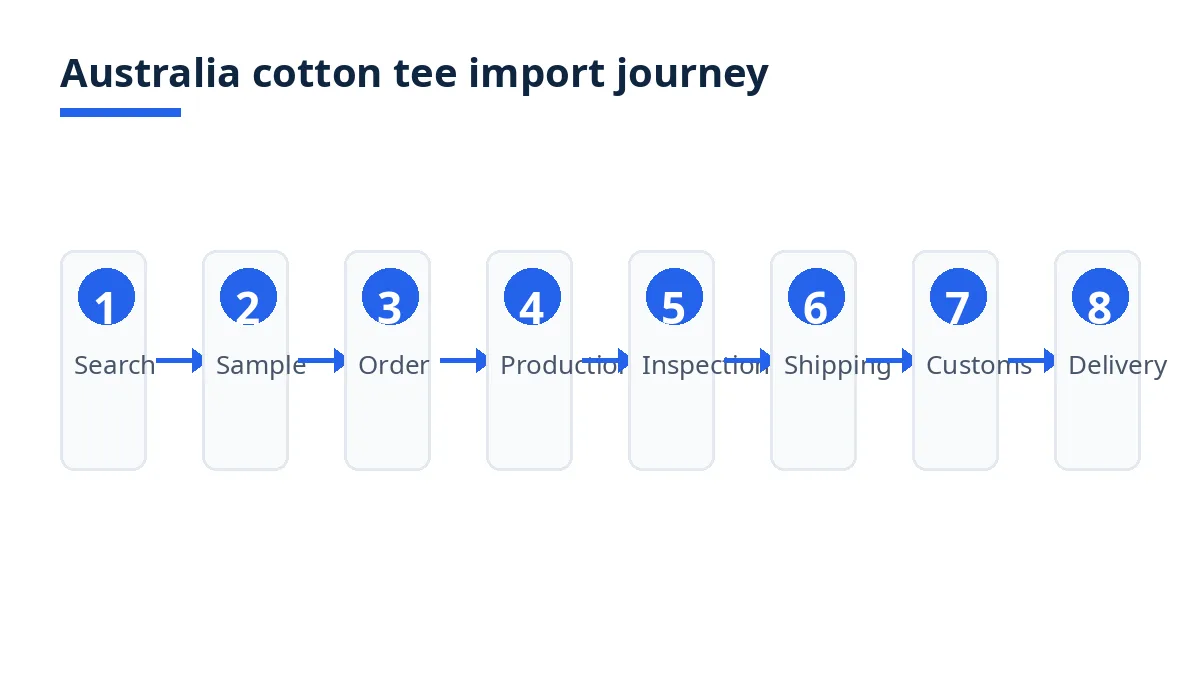
Step-by-step import checklist
Write the full specification, with quantity per style, color, and size.
Shortlist three to five suppliers, and request the same legal, tax, and export documents.
Compare quotations on the same Incoterm and currency basis, and convert each to an estimated landed cost.
Agree the sample sequence and written approval for the pre-production sample.
Name the certifications and test reports required, and state who pays for testing.
Agree the AQL sampling plan and accept and reject numbers in the purchase order.
Approve the care-label and origin-label artwork before bulk production.
Ask the broker to confirm the tariff line, LDC claim, origin evidence, and GST base.
Confirm the forwarder's dated sailing estimate and the destination charges included.
Check the invoice, packing list, bill of lading, and origin evidence before sailing.
Lodge the import declaration through the broker, and reconcile every charge.
On delivery, compare the shirts, cartons, and labels with the approved sample.
How Exportain helps
Exportain gives an Australian buyer a single place to post the specification as an RFQ, receive quotations against the same brief, compare suppliers in the category, and keep the commercial record in one thread. Posting the RFQ with the full specification, quantity breakdown, destination, Incoterm, required certifications, and deadline means each supplier quotes against the same document. The supplier directory lets the buyer review profiles and declared certifications before shortlisting.
Exportain does not replace the Australian broker, forwarder, inspection company, or accountant, who decide the tariff line, origin evidence, GST treatment, and care-label wording for the specific shipment.
FAQs
What is the typical MOQ for cotton t-shirts from Bangladesh?
There is no single figure that holds for every factory, fabric, and print method, so treat any MOQ as a supplier-specific figure. Ask whether the minimum applies per order, per style, per color, or per size, and what changes it, such as custom dyeing or a wider size range.
How long does shipping take?
Shipping time from Chattogram to Sydney is not a fixed figure, because it depends on the sailing schedule, any transhipment port, the carrier, and congestion at both ports. Ask the forwarder for a dated estimate naming the vessel, any transhipment point, and the expected Sydney arrival date.
What import duty applies?
For cotton t-shirts at 6109.10, the duty answer depends on whether the LDC preference claim is proved. DFAT states that products from Bangladesh enter Australia duty-free and quota-free as a Least Developed Country, and that this treatment will continue after graduation.1 The ABF guide confirms duty-free and quota-free access for LDC goods since 1 July 2003, subject to the more stringent LDC rules of origin.7 If the claim is not proved, the broker must confirm the current general rate for the confirmed line, and that figure governs.
How do I verify a supplier?
Verify a supplier in three layers: documents, production, and samples. First, request the legal company name, trade license, taxpayer identification number, VAT registration where applicable, and Export Registration Certificate, and check that the same legal name appears on every commercial document. Second, confirm who will actually make the goods and where, and use a factory visit or audit for a larger program. Third, run the sample sequence through to a written pre-production approval, and agree the AQL plan before bulk production.
Next steps on Exportain
Start with the specification, not with a price request. Write the fabric, fit, size chart, print method, packaging, and label artwork into one document, post it as an RFQ, and compare quotations on the same Incoterm and landed-cost basis. Use the general guide to importing from Bangladesh, the landed-cost guide, the supplier directory, and the buying guide.
Post a free RFQ on Exportain with the full specification, the quantity per style, color, and size, the Sydney destination, the Incoterm, the required certifications, and the deadline. Ask each quoting supplier to confirm the MOQ basis and sample terms, and send the shortlisted quotations to the broker and forwarder for tariff, GST, and freight figures before confirming the order.
Sources
- Bangladesh country brief. DFAT (accessed )
- A guide to exporting to Australia from Bangladesh. DHL (accessed )
- How to Import from Bangladesh. Exportain (accessed )
- AQL Calculator | Sample Size and ISO 2859-1 Tool. AQMBD (accessed )
- Clothing and textiles. NSW Government (accessed )
- Country of origin claims. ACCC (accessed )
- Preferential Rules of Origin. Australian Border Force (accessed )
- Australian Trusted Trader Origin Waiver Benefit. Australian Border Force (accessed )
- Import declarations. Australian Border Force (accessed )
- GST and imported goods. Australian Taxation Office (accessed )
- Landed Cost for Imports from Bangladesh. Exportain (accessed )
About the author
Sourcing from Bangladesh?
Post a request for quotation and suppliers on Exportain can send you their quotes directly.
Post an RFQ