

How to Import Bed Sheets From Bangladesh to USA: Step-by-Step Guide
Import bed sheets from Bangladesh to the USA: specification, supplier checks, samples, HTS 6302 duty rates, FTC labelling, CBP entry and landed cost, with a step-by-step checklist for US buyers.
Short answer
To import bed sheets from Bangladesh to USA, write a specification that fixes fiber, weave, finish, sizes, pocket depth, hems, trim, labels and packing for one sheet set. Shortlist mills that already make bed linen, verify documents and capability, and approve a pre-production sample. Classify each style under heading 6302, confirm the duty rate and label wording with your customs broker, file the Importer Security Filing before loading, and build the landed cost before bulk production.
On this page
Key takeaways
Bed sheets sit in heading 6302: 6302.10 for knitted or crocheted bed linen, 6302.21, 6302.22 and 6302.29 for printed bed linen, and 6302.31, 6302.32 and 6302.39 for other bed linen.
Trim changes the duty: in Revision 17 (2026) the general rate for printed cotton bed linen, other, not napped (6302.21.90) is 6.7 percent, and with embroidery, lace, braid, edging, trimming, piping or applique work (6302.21.50) it is 20.9 percent.
United States labels must disclose fiber content with generic names and percentages by weight, the manufacturer or marketer name, and the country where the product was processed or manufactured, plus care instructions under the Care Labeling Rule.
The United States suspended preferential GSP access for Bangladesh goods in June 2013 and the suspension remains in place, so price at the general rate and ask your broker to confirm any additional duty for the entry date.
The Importer Security Filing for ocean cargo must be submitted at least 24 hours before the cargo is loaded onto a vessel at the foreign port.
To import bed sheets from Bangladesh to USA, start with a written specification for one sheet set, classify it under heading 6302 of the United States tariff schedule, and confirm the duty rate and label wording with your customs broker before you approve bulk production. The specification decides the price, the tariff line and the label, so it comes first.
This guide is for buyers based in the United States bringing bed sheets from Bangladesh into the United States for sale. It covers the United States entry process only.
Why US buyers source bed sheets from Bangladesh
A bed sheet order from Bangladesh is a specification order, not a catalogue order. You set the fiber, the weave, the finish, the size set, the hem and the packing, and the mill quotes against that specification. A buyer who sends only a photograph and a target price will receive quotes for different products.
The range you can specify is wide: flat sheets, fitted sheets and pillowcases in cotton, cotton-rich blends or man-made fibers, in percale or sateen weaves, printed, dyed or bleached, with plain hems or with trims such as embroidery, lace, braid or piping. Each choice changes the work in the mill and the tariff line at the United States border: printed cotton sheets and plain cotton sheets sit on different lines in heading 6302, and a sheet with embroidery or applique work sits on a different line again.1 Decide the construction before you ask for prices.
Work backward from the date the sheets must be on your shelves, and hold a buffer for a second sample round.
Define the sheet set before you contact suppliers
What goes into a bed sheet specification?
Write the specification as one document, with one row per piece in the set, and send the same document to every supplier.
Start with the fiber and the fabric. Name the fiber composition in the words you want on the label, for example 100 percent cotton or a cotton and polyester blend with the percentages stated. Name the weave, percale or sateen, and the finished fabric weight or thread count only together with the counting method your retail program accepts. Name the finish: bleached, dyed in named colors, or printed with a named print.
Then fix the sizes: finished flat-sheet, fitted-sheet and pillowcase dimensions, all from your own size chart. Use the size names your retail program uses, but never rely on the name alone. State finished measurements after washing and the tolerance you will accept.
Then fix the construction details: hem widths, hem stitching, elastic type and coverage on a fitted sheet, and any trim. Trim matters twice: it adds operations in the mill, and it moves the sheet to a different tariff line in heading 6302, where the general rate can be much higher than the rate for a plain sheet of the same fiber.1 Close with labels and packing.
Find and verify suppliers for the US market
Where should you start the search?
Start with mills and exporters whose current range already includes bed linen. A factory that makes only apparel or only towels is not a close substitute, because sheet production uses wide fabric, long cutting tables, hemming at sheet length and packing of matched sets. Browse suppliers on Exportain and filter for home-textile exporters, then read each profile against your specification: does the range include bed linen in your fiber and construction, does it show sheet sets or only fabric, and does it state sample availability and the minimum order quantity? Shortlist three or four suppliers, and send each one the identical specification document.
How do you verify a supplier before you pay?
Verification has three layers. The first is company documents: trade licence, export registration and association membership where applicable, checked so that the company name, address and bank account name agree across every document. The second is capability: monthly sheet capacity, whether weaving is in-house or fabric is bought in, fabric width, dyeing and printing route, and which recent sheet sets the factory can show from current production.
The third layer is payment discipline. Keep payments to the company account named in the documents, never to a personal account, and verify any change of bank details through a separate channel before you act on it. On Exportain, supplier profiles carry document and photo review badges where the checks have been completed. A badge records a review of documents and photos. It is not a factory inspection, a certification or a guarantee, and Exportain is not a party to the goods contract.
MOQ, pricing and samples: what a US quote must show
What is the typical MOQ for bed sheets from Bangladesh?
There is no single typical minimum order quantity for bed sheets from Bangladesh. The minimum is set per design and usually per color or print, because fabric is woven, dyed or printed in batches and a cutting plan is set up per size set. Ask each supplier how its minimum splits by design, color, size set and piece composition, and get the answer in writing before you compare quotes.
How is the price built, and how should you compare quotes?
Fabric is a major cost element in a bed sheet, followed by cutting and sewing, dyeing or printing, finishing, testing, packing and the factory margin. Ask what each price is based on, in writing.
Compare quotes on the same delivery term: add freight, insurance, duty and delivery to a free-on-board price before comparing it with a delivered price.
Which samples do you need, and how do you approve them?
Work in stages. A development sample shows whether the factory can construct the sheet. A pre-production sample, made in the actual production fabric, color or print and finish, is the sample you approve for bulk. Test the samples as your customers will use them: measure each piece after washing to your care label, fit the fitted sheet, and check shade and print match. Approve in writing, name the approved sample by style and date, and keep one sealed counter-sample of each style.
US labeling rules: fiber content, origin and care
What must the label say?
Federal law requires that most textile and wool products carry a label listing the fiber content, the country of origin, and the identity of the manufacturer or another business responsible for the product.2 The FTC Textile Rules require labels disclosing the generic names and percentages by weight of the fibers, the manufacturer or marketer name, and the country where the product was processed or manufactured.3
For bed sheets made in Bangladesh, that means three label decisions before bulk label sewing begins. First, the fiber statement: use the generic fiber names, with percentages by weight, and make sure the percentages match the fabric you bought. Second, the country of origin: the label must state where the product was processed or manufactured, so a sheet set made in Bangladesh carries that origin statement.3 Third, the identity: the name of the manufacturer or marketer, or the Registered Identification Number where the rules permit one. Under the Care Labeling Rule, manufacturers and importers must provide instructions so consumers know how to clean the products they buy.2 Agree the care instructions at sampling stage, and wash-test the sample to the care label.
Quality control, testing and certifications for US retail
Which quality checks are specific to bed sheets?
Against the approved sample and size chart, check fiber composition, finished measurements within your agreed tolerances, and consistency across the size set. Then check construction piece by piece: hems, fitted pocket depth, elastic coverage, print registration, color match and any trim. Check dimensional change and colorfastness after washing, and agree the test methods and pass limits in the specification.
Agree the inspection method and defect limits before production. ISO 2859-1:2026 defines a system of acceptance sampling plans for inspection by attributes, and its summary states that AQL stands for acceptance quality limit, the maximum average percentage of defective items considered acceptable during random sampling, used to determine sample sizes and acceptance and rejection thresholds.4 Inspect in stages: an inline check during production, and a final random inspection on packed goods.
Classify bed sheets under HTS heading 6302 and confirm the duty rate
How are bed sheets classified for duty?
Duty follows the classification of each style in the United States tariff schedule, not the supplier's product name. Heading 6302 covers bed linen, table linen, toilet linen and kitchen linen.1 Within heading 6302, bed linen splits by construction and print: 6302.10 for knitted or crocheted bed linen, 6302.21, 6302.22 and 6302.29 for printed bed linen, and 6302.31, 6302.32 and 6302.39 for other bed linen.1 Each line then splits further by trim and by whether the sheet is napped or not napped.1
Keep each piece on its own entry line, with its own quantity and value, so the entry matches the packing list piece by piece. Classify every style before you price the order, and confirm the full 10-digit code for each style with your broker.
What import duty applies?
Your rate depends on each style's subheading, the origin and any preference in force on the entry date, so there is no single rate for a whole bed sheet order. In the United States schedule opened for this guide, Revision 17 (2026), the general rates for the bed linen lines most buyers use are shown in the table below.1 Confirm the current rate for each style before you commit to a selling price.
HTSUS line | Description | General rate, Revision 17 (2026) |
|---|---|---|
6302.10.00 | Bed linen, knitted or crocheted | 6% |
6302.21.70 | Other bed linen, printed, of cotton, other, napped | 2.5% |
6302.21.90 | Other bed linen, printed, of cotton, other, not napped | 6.7% |
6302.22.20 | Other bed linen, printed, of man-made fibers, other | 11.4% |
6302.29.00 | Other bed linen, printed, of other textile materials | 4.5% |
6302.31.70 | Other bed linen, of cotton, other, napped | 3.8% |
6302.31.90 | Other bed linen, of cotton, other, not napped | 6.7% |
6302.32.20 | Other bed linen, of man-made fibers, other | 11.4% |
6302.39.00 | Other bed linen, of other textile materials | 4.3% |
6302.21.50 | Other bed linen, printed, of cotton, containing embroidery, lace, braid, edging, trimming, piping or applique work, not napped | 20.9% |
The last line is the warning. The same printed cotton sheet carries a general rate of 6.7 percent without trim and 20.9 percent with embroidery, lace, braid, edging, trimming, piping or applique work, in the schedule opened for this guide.1
Do not assume a preference. The United States suspended preferential Generalized System of Preferences access for Bangladesh goods in June 2013, and the Bangladesh Customs page states that the suspension remains in place.5 Price at the general rate unless your broker confirms otherwise, and ask your broker to check the Chapter 99 notes for the entry date. Do not add a Section 301 rate by default to a Bangladesh-origin costing.
Incoterms, US ports and transit: Chattogram to the United States
Which delivery term should a first order use?
Under the Incoterms 2020 rules, risk passes from seller to buyer at the same point and time as delivery.6 Under FOB, CFR and CIF the seller must place the goods on board the vessel.6 In all rules but EXW the seller carries out export formalities, and in all rules but DDP the buyer carries out import formalities.6 The four sea rules, FAS, FOB, CFR and CIF, are only intended for port-to-port bulk or break-bulk shipments and are not suitable for container shipments in their current form.6
For a first container order, weigh FOB at the Bangladeshi port against FCA at the named terminal. Under FCA, delivery happens when the goods are handed to your carrier, which matches how containerised cargo moves.
There is no single typical transit time for bed sheets from Bangladesh to the United States. The route, the transshipment points, the season and the port of discharge all move the sailing time, and clearance and inland delivery sit on top of it. Ask your forwarder for the current sailing schedule, choose the gateway by your warehouse, and confirm free time and detention terms in writing.
CBP entry, duty, taxes and documents for the USA
Which documents do you need for clearance?
The entry documentation required to secure release consists of the entry on CBP Form 3461 or its electronic equivalent, evidence of the right to make entry, a commercial invoice, a packing list where appropriate, and other documents required by CBP or other agencies.7
The standard import set is the commercial invoice, the packing list, the bill of lading, and proof of origin where a preference is claimed. Keep quantities, weights and carton counts in agreement across the invoice, the packing list and the bill of lading. Name each piece plainly on its own invoice line, with fiber composition, quantities, unit prices, the delivery term and the HTSUS line.
For ocean cargo, add the Importer Security Filing. The Importer Security Filing, also known as 10+2, is a mandatory CBP requirement for ocean cargo imports into the United States, under which importers must electronically submit 10 specific data elements at least 24 hours before the cargo is loaded onto a vessel at the foreign port.8 The filing requires an ISF bond, and late or inaccurate filing can result in penalties of USD 5,000 or more per violation, cargo holds and increased scrutiny.8
Who is the importer of record, and what does the broker do?
The importer of record is responsible for the entry: classification, valuation, origin, duty payment and recordkeeping. A licensed customs broker can file the entry, the entry summary and the ISF on your behalf, but the responsibility for the accuracy of the entry stays with the importer of record. Ask the broker to confirm the classification, duty rate, bond and fees for your shipment before you place the order.
Landed cost example: Chattogram to a US warehouse
A landed cost is the full cost of one sheet set, ready to sell at your warehouse. Every number below is an example figure only, not a quote. Example figures: 4,000 printed cotton flat sheet sets, not napped, line 6302.21.90, shipped by sea from Chattogram to a United States East Coast gateway. Duty is calculated at the general rate of 6.7 percent in the schedule opened for this guide.1
Cost element | Example figures (per set) | How to obtain your figure |
|---|---|---|
Product price, FOB Chattogram | $7.80 | Confirmed pro forma invoice |
International freight | $0.95 | Forwarder quote divided by sets shipped |
Insurance | $0.07 | Policy or forwarder quote |
Duty at 6.7% of example customs value | $0.52 | Broker calculation from confirmed codes and rates |
Port, clearance and broker fees | $0.41 | Broker invoices divided by sets |
Delivery to warehouse | $0.58 | Local carrier quote divided by sets |
Total landed cost | $10.33 | Sum of all lines above |
Ask your broker to calculate duty line by line from the confirmed codes and the customs value. Work the calculation twice: at quote stage and again after shipment with the actual invoices. See landed cost for imports from Bangladesh for the full method, and read the HS code guide for bed sheets before you fix the codes in your costing.
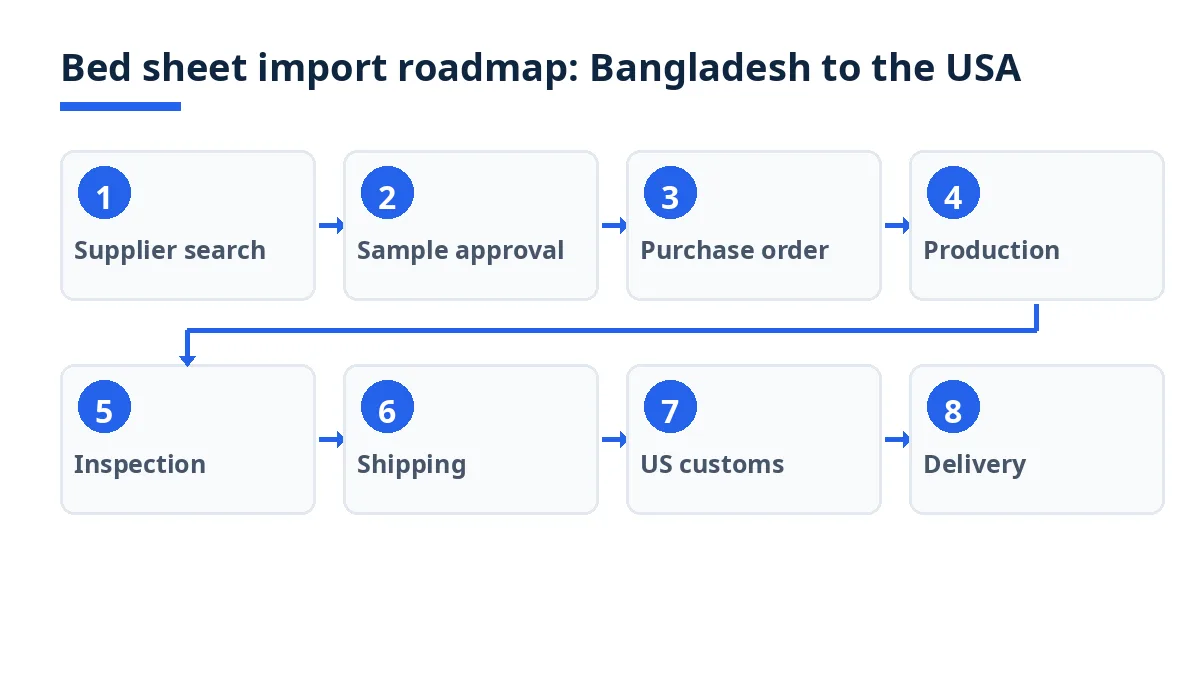
How to import bed sheets from Bangladesh to USA: the step-by-step checklist
Write the specification set by set: fiber, weave, finish, measurements, pocket depth, hems, trim, labels and packing.
Classify every style from heading 6302 and confirm each full 10-digit code and duty rate with your broker.1
Shortlist mills whose range includes bed linen, and request quotes on the identical specification and delivery term.
Verify the chosen supplier: documents, capacity, fabric source, dyeing and printing route, and a factory check for a first order.
Agree the label wording: fiber content, origin, manufacturer identity and care instructions.2 3
Order samples in stages, measure and wash-test them, and approve a pre-production sample of each style.
Confirm the order in writing: purchase order, pro forma invoice, delivery and payment terms, inspection plan, labelling, packing and shipment date.
Inspect during production and again on packed goods against the approved samples.
Give your broker the ISF details early enough to file at least 24 hours before loading.8
Ship, clear customs with the confirmed code for each style, and reconcile the actual landed cost.
How Exportain helps
Browse suppliers for Bangladeshi home-textile exporters, read how to buy, then post your specification and target quantity as an RFQ and compare replies on the same terms. Exportain is a B2B marketplace where buyers post RFQs, receive quotations and message suppliers. It does not inspect goods, book freight or clear customs, and it is not a party to the goods contract. Supplier profiles carry document and photo review badges where those checks have been completed.
FAQs
What is the typical MOQ for bed sheets from Bangladesh for a US buyer?
There is no single typical minimum. It is set per design and usually per color or print. Ask each supplier how its minimum splits, and confirm the split in writing.
How long does shipping take from Bangladesh to the USA?
Production time and transit time are separate, and neither has a single typical figure. Sea transit takes weeks rather than days and varies by route, transshipment, season and gateway. Ask your forwarder for the current sailing schedule, and confirm free time and detention terms in writing.
What import duty applies to bed sheets from Bangladesh to the USA?
Duty follows the confirmed classification of each style, the origin and any preference or additional duty in force on the entry date. Bed sheets sit in heading 6302: 6302.10 for knitted or crocheted bed linen, 6302.21, 6302.22 and 6302.29 for printed bed linen, and 6302.31, 6302.32 and 6302.39 for other bed linen.1 In Revision 17 (2026), the general rate for line 6302.21.90 is 6.7 percent, and for line 6302.31.90 it is also 6.7 percent.1 Price at the general rate and ask your broker to confirm any additional duty for the entry date.5
How do I verify a supplier in Bangladesh for a US order?
Check company documents first, then capability: sheet capacity, fabric source, dyeing and printing route, and recent sheet production. Keep payments to the company account named in the documents, approve a pre-production sample of each style, and confirm the label wording and HTSUS codes with your broker before the goods ship.
Next steps on Exportain
Read how to import from Bangladesh for the full process, then check the HS code guide for bed sheets against the codes in your costing. When your specification is written, post an RFQ on Exportain and compare quotes on the same terms.
Sources
- Harmonized Tariff Schedule of the United States, Chapter 63: Other made up textile articles; sets; worn clothing and worn textile articles; rags (Revision 17, 2026). United States International Trade Commission (accessed )
- Textile, Wool, Fur, Apparel and Leather Matters. Federal Trade Commission (accessed )
- FTC Seeks Public Input in Review of Textile Labeling Rules. Federal Trade Commission (accessed )
- ISO 2859-1:2026 - Sampling procedures for inspection by attributes — Part 1: Sampling schemes indexed by acceptance quality limit (AQL) for lot-by-lot inspection. International Organization for Standardization (accessed )
- Bangladesh Customs, National Board of Revenue (NBR). National Board of Revenue, Bangladesh Customs (accessed )
- Insider thoughts: Bob Ronai on Incoterms 2020 Rules; What are they about?. International Chamber of Commerce (accessed )
- 19 CFR 142.3 - Entry documentation required. Legal Information Institute, Cornell Law School (accessed )
- Importer Security Filing (ISF). DP World (accessed )
About the author
Sourcing from Bangladesh?
Post a request for quotation and suppliers on Exportain can send you their quotes directly.
Post an RFQ


