

Bed Sheets From Bangladesh to Canada: A Buyer's Import Checklist
Bed sheets from Bangladesh to Canada through Vancouver: LDCT duty-free entry with Form B255, bilingual labels, 5% GST on the duty-paid value, supplier checks, and a per-sheet-set landed cost example in Canadian dollars.
Short answer
To import bed sheets from Bangladesh to Canada, fix each sheet by size matrix, fitted depth, weave, thread count and fibre blend, classify it under the indicative heading 6302, and confirm the full tariff item and every duty line with your broker before ordering. Agree bilingual fibre labels, a Form B255 certificate of origin for the LDCT claim, direct shipment to Canada, and a Vancouver broker, then approve a washed pre-production sample before bulk production.
On this page
Key takeaways
Bed sheets are classified under the indicative heading 6302, split by printed or unprinted and by cotton, man-made fibres or other textile materials; the Canadian tariff schedule opened for this guide shows Most-Favoured-Nation rates of 17 percent for cotton and other textile material lines and 18 percent for man-made fibre lines, with LDCT listed for each line, and every duty line must .
The Least Developed Country Tariff gives duty-free entry for goods that meet the origin rules, the proof of origin requirements and direct shipment to Canada; for textile and apparel goods of HS Chapters 50 to 63, the proof of origin is the Form B255 certificate, which must be submitted as proof of origin.
Canadian textile labels must show the generic name and percentage of each fibre present at 5 percent or more of the total mass, and the dealer name and place of business or CA identification number, with fibre information in both English and French.
GST is calculated on the total value of the goods and applicable duties, so the duty treatment changes the GST as well as the duty; confirm the value for duty and the value for tax with your broker before pricing.
There is no single typical MOQ, price or transit time for bed sheets; set the size matrix, approve a washed sample, and confirm every tariff line with your broker before pricing or shipping.
A bed sheet order for Canada is decided twice: once on the sheet itself, and once on the tariff treatment. The same cotton sheet can enter duty-free under the Least Developed Country Tariff or at 17 percent under the Most-Favoured-Nation rate, depending on the origin rules, the proof of origin and the direct shipment requirement. Fix the sheet specification, the classification and the origin file together, before the first shipment leaves Chattogram.
Ask your forwarder and broker to quote Vancouver and Montreal before you fix the delivery term. The Vancouver Fraser Port Authority reports that the Port of Vancouver's four container terminals handled 3.47 million TEUs in 2024, up 11 percent on 2023, with laden inbound imports up 14 percent.1
Key points to take away
Bed sheets are classified under the indicative heading 6302, split by printed or unprinted and by cotton, man-made fibres or other textile materials; the Canadian tariff schedule opened for this guide shows Most-Favoured-Nation rates of 17 percent for cotton and other textile material lines and 18 percent for man-made fibre lines, with LDCT listed for each line.
The Least Developed Country Tariff gives duty-free entry for goods that meet the origin rules, the proof of origin requirements and direct shipment to Canada; for textile and apparel goods of HS Chapters 50 to 63, the proof is the Form B255 certificate.2
Canadian textile labels must show the generic name and percentage of each fibre present at 5 percent or more of the total mass, and the dealer name and place of business or CA identification number, with fibre information in both English and French.
GST is calculated on the value of the goods plus applicable duties, so the duty treatment changes the GST as well as the duty; confirm the value for duty and the value for tax with your broker.
There is no single typical MOQ, price or transit time for bed sheets; set the size matrix, approve a washed sample, and confirm every tariff line with your broker before pricing.
Why source bed sheets from Bangladesh
Bangladesh has a home-textile base built around cotton spinning, weaving, dyeing and finishing, and bed sheets sit in that chain rather than in garment production. A mill that weaves sheeting fabric, dyes or prints it, and cuts and hems the finished sheet under one roof can hold shade and size consistency across a colour range. Ask whether the mill already supplies bed sheets into Canada or another North American market. Do not source bed sheets from a garment factory that offers sheets as a side line, and do not buy a sheet programme from a trader who cannot name the weaving mill.
The Canadian question is fit plus labelling. A sheet that fits the mattress but carries an English-only fibre label, or a label with the wrong fibre percentages, is not ready for a Canadian shelf. Judge a sheet mill on washed finished size, seam strength, colourfastness and label accuracy together. A mill that holds size after washing and prints labels from the approved composition, in both official languages, is the mill that avoids the re-labelling cost at the Canadian end.
Which sheet sizes must the brief fix for Canada?
Europe has no single bedding size standard, and the size guide opened for this guide states that what is considered standard is usually an established market convention, while individual retailers and brands may use additional sizes of their own.3 The same guide lists fitted sheets from 90 by 200 cm for a single bed, through 140 by 200 cm for a French bed and 160 by 200 cm for a queen-size bed, to 180 by 200 cm for a king-size bed, with a 30 cm fitted depth for adult sizes.3 Canadian retail uses its own size names alongside centimetre dimensions, so the purchase order must carry both: the retail size name the customer uses, and the width, length and fitted depth in centimetres.
Put every size in the purchase order as width, length and fitted depth in centimetres, and state whether the measurement is before or after washing. Name the pillowcase size for each sheet set, and state the fitted depth for a mattress with a topper where the programme requires it. The Competition Bureau states that the Textile Labelling Act does not require manufactured garments to conform to specific size dimensions or size codes, but if a size dimension is provided it must be accurate and must not include false or misleading information.4 That means a wrong size on the label is a labelling fault, not a minor packing difference. Ask the mill to state its own size tolerance in writing, and measure the approved sample after washing.
Percale, sateen and thread count: what do they decide?
Percale and sateen describe how the fabric is woven, not which fibre it is made from. Percale sheets have a thread count of 200 to 400, a closely knit plain weave of one yarn over and one yarn under, a matte finish and a crisp feel.5 Sateen sheets have a thread count of 300 to 500, a weave of one yarn over and three or four under, a silky smooth finish and a more wrinkle-resistant drape, but are less suited to warm summer months.5 Thread count refers to the amount of horizontal and vertical threads within a single square inch, and a higher thread count does not always equate to the best sheets.5
Choose the weave for the end user, not for the catalogue. A hotel programme that launders sheets at high temperatures will usually take percale for its crisp hand and wash durability, while a retail programme sold on softness and drape will usually take sateen. Name the weave, the thread count range and the counting method in the brief, and ask the mill to state how it counts thread count.
Which fibre blends suit which sheet programme?
The fibre blend decides the hand, the wash behaviour and the classification. A 100 percent cotton sheet is the standard hotel and retail sheet, and cotton-polyester blends are common where easy care matters. State the blend as percentages by weight for every component, including the elastic and thread where they form part of the article. Do not let a supplier substitute a blend after sampling: the fibre content on the label, the classification and the price all follow the blend. Wash-test each colour separately, since dye uptake differs by fibre.
Find and verify suppliers
Where do Canadian buyers start the search for bed sheet suppliers in Bangladesh?
Start with a written sheet brief, not with supplier names. Fix the sheet before anyone quotes: flat or fitted construction, size matrix with fitted depth and the Canadian retail size name, weave and thread count, fibre blend, colour or print, hem and elastic specification, the bilingual label set, care symbols, and packing by set or by piece. Then shortlist suppliers whose current ranges include bed sheets in that construction. Browse suppliers on Exportain before you send an inquiry.
Send every candidate the identical brief and ask for the same reply format: weave and thread count assumed, size matrix and fitted depth, fibre blend, price inclusions, validity, and the minimum per size and per colour. Ask early about Canada: has the supplier shipped bed sheets to Canada, can it supply bilingual labels, and can it provide the Form B255 certificate of origin for textile goods?2
How do you verify a supplier before you pay?
Verification has three layers, each checked before payment. The first is company documents: trade licence, export registration and association membership, checked so that name, address and bank account name agree across every document. The second is capability: the weaving, dyeing and finishing route, the cutting and hemming line, capacity for the size matrix, and a finished sheet set from current production in your size, weave and colour.
The third layer is payment discipline. Keep payments to the company account named in the documents, never to a personal account, and verify any change of bank details through a separate channel. On Exportain, supplier profiles carry document and photo review badges. Exportain states that verification is a document and photo review, not a factory inspection, and that a badge is not a guarantee of capacity, quality or delivery.6 Exportain is not a party to the contract for goods, and it does not inspect goods, book freight or clear customs.6
MOQ, pricing and samples
What is the typical MOQ for bed sheets from Bangladesh?
There is no single typical minimum order quantity for bed sheets from Bangladesh. The minimum is set per size and usually per colour, because sheeting fabric is woven and dyed in batches and the cutting plan is set up per size matrix. A fitted sheet minimum is not the same as a flat sheet minimum, and a printed design carries its own minimum for the print run. Ask how each minimum splits by size, colour and print, and whether it is counted in sheets, sets, dozens or cartons. Record the minimum in the purchase order.
How is the price built, and how should you compare quotes?
Yarn and weaving usually form the main cost element in a cotton sheet, followed by dyeing or printing, cutting, hemming and elastic insertion, finishing, testing, labelling and packing, plus the mill margin. Thread count drives yarn use, so two sheets of the same size at different thread counts are different products. A fitted sheet costs more to make than a flat sheet of the same fabric, because of the elastic, the corner construction and the extra cutting. Print work, embroidery, a border and retail packing each add operations, and each should appear as a named line or be confirmed as included.
Compare quotes only on the same basis: same size matrix and fitted depth, weave and thread count, fibre blend, colour or print, hem and elastic, delivery term and packing, and the same currency. Ask what is excluded, including the bilingual label set and any testing. Convert every quote to the same delivery term, then to landed cost in Canadian dollars.
Which samples do you need, and how do you approve them?
A development sample shows whether the mill can weave or source the specified fabric, hold the size and finish the hem and corners cleanly. A pre-production sample, made in the actual production fabric, weave, thread count, colour or print and finish, is the sample you approve for bulk. For fitted sheets, try the pre-production sample on a mattress of the stated size, including a mattress with a topper where the programme requires it.
Test the samples the way a Canadian customer will use them. Measure before and after washing following the care label, check the elastic recovery on the fitted sheet, and wash a dark colour with a white sheet to check colour transfer. Check the bilingual label on the sample before approval, not after bulk production. Approve in writing and keep one sealed counter-sample of each sheet type and colour.
Quality control and certifications needed
What do size, seam and shrinkage checks cover?
Size is the first check on a bed sheet, and it is measured after washing, not only off the loom. Check width, length and fitted depth on sheets drawn from different cartons, and check the elastic length and corner depth on fitted sheets. Seam checks cover the hem, the corner joins and the elastic casing: stitches even and unbroken, and no raw edges that will fray in the wash. Shrinkage is agreed as a limit in the purchase order, measured by the agreed method after the agreed number of washes, and the approved sample is the reference for that limit.
Agree the inspection method and defect limits before production, and set your own limits rather than adopting another buyer's figure. ISO 2859-1:2026 defines a system of acceptance sampling plans for inspection by attributes, and its summary states that AQL stands for acceptance quality limit, the maximum average percentage of defective items considered acceptable during random sampling, used to determine sample sizes and acceptance and rejection thresholds.7 Set the AQL level and sample size in the purchase order and draw the sample across sizes, colours and cartons.
Which label rules apply to bed sheets sold in Canada?
Settle labelling at sampling stage, because the label wording is also the composition the classification is built on. Under the Textile Labelling Act, the label must show the fibre content, with the generic name of each fibre present in an amount of 5 percent or more of the total mass, the amount of fibre expressed as a percentage of total mass, and sectional disclosure when appropriate, plus the dealer name and place of business, or CA identification number.4 The information on the label must be factual, legible and accessible to the prospective consumer at the time of purchase.4
The fibre information must appear in both English and French. The Competition Bureau's labelling summary states that the generic name of the fibre and any information relating to the fibre content must appear on the label in both French and English, and gives the example of 65 percent cotton/coton with 35 percent polyester.4 Check the bilingual label artwork against the approved composition before printing, including the French fibre names, and confirm who holds the CA identification number shown on the label: the dealer identity on the label is the importer's responsibility to get right.
Care labelling in Canada is voluntary in form, but not in accuracy. The Competition Bureau states that care labelling, in the form of either written words or symbols, is a voluntary program in Canada, and that if care information is included it cannot be false or misleading and must accurately reflect an appropriate method of care for the article.4 ISO 3758:2023 establishes a system of graphic symbols for marking textile articles, with five main symbols for washing, bleaching, drying, ironing and pressing, and professional textile care.8 Use the symbols in that order and set each one from test results on the actual sheet. The same Competition Bureau page notes flammability standards for consumer textile products including bedding, so confirm the flammability position for the sheet programme with your broker or adviser before the first shipment.4
Which certifications do you actually need?
What you need follows your customer: a retailer, hotel group or brand may name a specific test or scheme in its supplier manual. Name any such requirement in the brief and check the matching certificate's scope, product, issuing body and date. For bed sheets, the tests buyers ask for most often are dimensional stability after washing, colourfastness, pilling and seam strength, each on the actual fabric and colour.
OEKO-TEX STANDARD 100 is the certification Canadian sheet buyers ask about most often. Hohenstein states that the test criteria depend above all on intended use, and that the more direct the skin contact, the stricter the requirements.9 Bed linen falls in Product Class II, for textiles whose surface comes into direct contact with the skin, a class the Hohenstein page lists as including bed linen.9 A STANDARD 100 certificate is valid for 12 months and can be renewed annually.9 Check the certificate number, class, articles covered and expiry date. Bed linen for babies and young children falls in Product Class I on the same page, so a baby sheet programme needs the stricter class checked separately.9
Incoterms, shipping and transit time
Which delivery term should a first Canadian order use?
Under Incoterms 2020, each rule tells you where delivery takes place, and the risk of loss or damage passes from seller to buyer at the same point and time as delivery.10 In only two rules, CIP and CIF, must the seller provide the buyer with insurance. In all rules but EXW the seller must carry out export formalities, while in all rules but DDP the buyer must carry out import formalities.10 That division is why the Canadian entry, including the CARM accounting declaration, stays with the Canadian buyer under most sheet terms.
For a container shipment from Chattogram to Vancouver, weigh FCA at the named terminal against FOB at Chattogram. The four sea rules, FAS, FOB, CFR and CIF, are only intended for port-to-port bulk or break-bulk shipments and are not suitable for container shipments in their current form, because a container is handed to the carrier before it is loaded on board.10 For a first sheet order, FCA at the container terminal gives a cleaner handover point for a containerised load than FOB, and the term must name the terminal and the edition, Incoterms 2020, in the contract.
How long does shipping take from Chattogram to Vancouver?
There is no single typical transit time for bed sheets from Bangladesh to Canada, and this guide states none. Sea freight is the standard route for bulk sheet orders and it takes weeks rather than days, varying by sailing schedule, routing, transshipment and season. Work backward from the date the sheets must be on sale, and confirm the shipment date only after sample approval. Sheets are bulky for their weight, so confirm the container load by volume and carton count, not only by weight, and agree the carton dimensions before production. Direct shipment also matters for the tariff treatment, as set out below, so confirm the routing with the forwarder before the goods sail.
Import duty, taxes and documents
How are bed sheets classified for Canadian duty?
Duty follows the classification of each sheet type in the Canadian Customs Tariff, not the supplier's product name. The Harmonised System is an international commodity classification of approximately 5,000 six-digit product categories, organized in a hierarchy of sections, chapters, headings and sub-headings, and countries subdivide the six-digit categories further for their own tariffs.11 The CBSA states that the first six digits of the tariff classification number are a common identifier across all countries using the Harmonised System, and the next four digits are unique to Canada.12
The indicative heading for bed sheets is 6302, which covers bed linen, table linen, toilet linen and kitchen linen. The Canadian tariff schedule opened for this guide lists other bed linen, printed, of cotton under 6302.21, of man-made fibres under 6302.22 and of other textile materials under 6302.29, and other bed linen of cotton under 6302.31, of man-made fibres under 6302.32 and of other textile materials under 6302.39, with bed sheet and pillow case sets shown as statistical breakouts under the cotton lines.13 Treat every heading here as indicative until your broker confirms it, and classify printed and unprinted sheets separately.
What import duty applies in Canada, and what must you confirm with your broker?
Confirm every duty line with your broker before you commit to a selling price. The Canadian tariff schedule opened for this guide shows Most-Favoured-Nation rates of 17 percent for 6302.21, 6302.29, 6302.31 and 6302.39, and 18 percent for 6302.22 and 6302.32, with LDCT listed among the applicable preferential tariffs for each of those lines.13 The schedule is dated 1 January 2021, so confirm the current rate for your exact tariff item and entry date with your broker. Confirm every duty line with your broker before you price at any rate.
The Least Developed Country Tariff is a preferential tariff treatment under which imported goods that qualify enter Canada duty-free, if they meet specific origin rules.14 Almost all goods imported into Canada that originate in a least developed country can enter duty-free under the LDCT, provided they meet specific requirements, and to qualify, goods must satisfy the rules of origin, meet proof of origin requirements, and be shipped directly to Canada from an LDCT or GPT beneficiary country.14 If the goods do not meet the LDCT requirements, they may still be eligible for a reduced duty rate through the General Preferential Tariff.14 Price without the preference until your broker confirms it in writing for the exact shipment.
How does the Form B255 certificate work for a sheet shipment?
Proof of origin for textiles is a specific form, not a general statement. To claim the LDCT benefits, importers must declare that they have the required proof of origin in their possession: a Form A certificate of origin, an exporter's statement of origin, or a Form B255 certificate of origin for textile and apparel goods originating in a least developed country, which is the form required for LDC-originating textile and apparel goods of HS Chapters 50 to 63.2 The proof of origin must be presented to the CBSA upon request, and failure to do so will result in the application of the MFN treatment or another appropriate tariff treatment.2
Account for the shipment in the commercial accounting declaration in the CARM Client Portal, using tariff treatment code 08 for the Least Developed Country Tariff, code 09 for the General Preferential Tariff, or code 02 for the Most-Favoured-Nation Tariff.14 2 Confirm the code, the form and the direct shipment documents with your broker before the goods sail, and keep the proof of origin file with the shipment records. A missing Form B255 turns a duty-free entry into an MFN entry, with the GST difference that follows.
What does a Vancouver customs entry need from a Canadian importer?
A Canadian importer needs the classification, the tariff treatment and the value for duty settled before accounting. The CBSA states that the tariff classification number, along with the country of origin, is used to find the tariff treatment, and that the duty rate and the value of the goods help determine how much is owed in duties and taxes.12 In most cases, the value for duty is based on the price paid to the seller under the first valuation method, with adjustments where applicable, and the value for duty must be declared in Canadian currency.12 Confirm with your broker which adjustments apply to the sheet shipment, including how international freight and insurance are treated in the value for duty, before you price.
GST is separate from duty, and its base follows the duty. The CBSA states that GST is a federal tax on most products and services imported into Canada, and that GST is calculated on the total value of the goods and applicable duties.12 The CBSA worked example applies 5 percent GST to the value for tax, which is the value for duty plus the customs duty.12 Plan on 5 percent GST on the duty-paid value for a Vancouver entry unless your tax adviser confirms a different treatment, including any provincial component that applies where the goods are delivered. The standard import set is the commercial invoice, packing list, bill of lading and proof of origin where a preference is claimed. Name each sheet type plainly on its own invoice line, with size, weave, fibre blend and quantity.
Landed cost example
A landed cost is the full cost of one sheet set, ready to sell from your Canadian warehouse, excluding any GST recovery treatment. Every number below is an example figure only, not a quote, and every tariff line must be confirmed with your broker.
Example figures: 2,500 cotton percale sheet sets, each set one flat sheet, one fitted sheet and two pillowcases, FCA Chattogram, sea freight to Vancouver. The value for duty in this example is the CAD 14.00 product price; confirm with your broker whether any adjustment applies. Duty is shown at the 17 percent Most-Favoured-Nation line for the cotton bed linen lines in the schedule opened for this guide.
Cost element | Example figures (per sheet set, CAD) | How to obtain your figure |
|---|---|---|
Product price, FCA Chattogram | $14.00 | Confirmed pro forma invoice |
International freight to Vancouver | $1.90 | Forwarder quote divided by sheet sets shipped |
Insurance | $0.18 | Policy or forwarder quote |
Value for duty in this example | $14.00 | Product price; confirm adjustments with your broker |
Duty at 17.00 percent | $2.38 | Broker calculation from confirmed codes and rates; confirm with broker |
Port, clearance and broker fees, Vancouver | $0.55 | Broker invoices divided by sheet sets |
Inland delivery to Canadian warehouse | $0.42 | Local carrier quote divided by sheet sets |
Total landed cost, excluding GST | $19.43 | Sum of product, freight, insurance, duty, fees and delivery |
GST is shown separately. For this worked example only, the value for tax is the value for duty plus duty, $16.38 per sheet set, and applying 5 percent gives $0.82 per sheet set as an example figure, for a total cash cost at import of $20.25 per sheet set in this example.12 Confirm the GST base with your broker or tax adviser before you use this example. If your broker confirms the LDCT preference with a Form B255, the duty line falls to zero, the GST in this example falls to $0.70 per sheet set, and the total excluding GST falls to $17.05 per sheet set. See landed cost for imports from Bangladesh for the full method.
Step-by-step import checklist for Vancouver entry
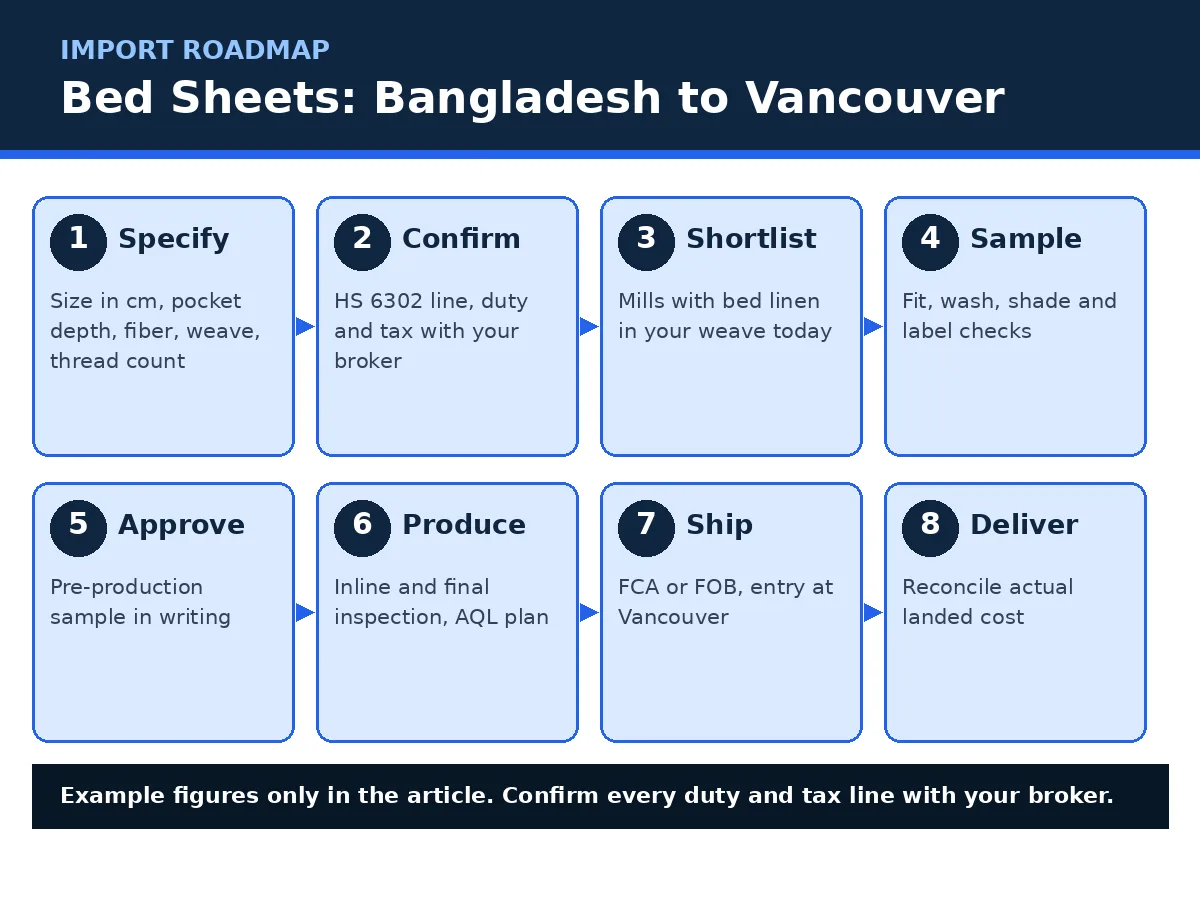
Write the sheet brief: construction, size matrix with fitted depth and Canadian retail size name, weave and thread count, fibre blend, colour or print, hem and elastic, bilingual label set, care symbols and packing.
Classify every sheet type from heading 6302 and the printed or unprinted subheadings, and confirm each tariff item and duty line with your broker.
Shortlist mills whose range includes bed sheets in your construction, and request quotes on the identical brief and delivery term.
Verify the supplier in three layers: company documents, sheet capacity and current production, and payment discipline.
Order samples in stages, wash and measure them, try the fitted sheet on a mattress, check the bilingual label set, and approve a pre-production sample of each type and colour.
Confirm the origin position: origin rule, Form B255 certificate, direct shipment routing and the CARM tariff treatment code.
Confirm the broker, the value for duty and the GST base, and confirm the classification and duty line in writing.
Confirm the order in writing: purchase order, pro forma invoice, delivery and payment terms, inspection plan, labelling, packing and shipment date.
Inspect during production and on packed goods against the approved samples, across sizes, colours and cartons.
Ship from Chattogram to Vancouver, clear customs with the confirmed tariff item and Form B255, and reconcile the actual landed cost.
How Exportain helps
Exportain lets you post one RFQ with the full sheet brief, so mills quote against the same size matrix, weave and delivery term. Supplier profiles show which document and photo checks have been reviewed. Read how to import from Bangladesh for the full process before you post the RFQ.
What is the typical MOQ for bed sheets from Bangladesh?
There is no single typical minimum. It is set per size and usually per colour or print, because sheeting fabric is woven and dyed in batches and a cutting plan is set up per size matrix. Ask how the minimum splits by size, colour and print, and whether it is counted in sheets, sets, dozens or cartons.
How long does shipping take?
Neither production time nor transit time has a single typical figure. Sea freight from Chattogram to Vancouver takes weeks rather than days and varies by sailing schedule, routing, transshipment and season, and clearance at Vancouver and inland delivery add further time.
What import duty applies?
Confirm every duty line with your broker before you price or ship. The indicative heading is 6302, and the Canadian tariff schedule opened for this guide shows 17 percent for the cotton bed linen lines and 18 percent for the man-made fibre lines, with LDCT listed for each line.13 An LDCT preference depends on the origin rules, the Form B255 proof of origin and direct shipment.14 2
How do I verify a supplier?
Check company documents first, then capability and payment discipline: a finished sheet set from current production, and payments only to the company account named in the documents. Treat any profile badge as a document and photo review, not a factory inspection or a guarantee.6
Next steps on Exportain
Read how to import from Bangladesh for the full process, then work through the landed cost method with your broker's confirmed duty line.
Post a free RFQ on Exportain and get quotes from Bangladeshi suppliers → https://exportain.com/rfqs
Sources
- Port of Vancouver moves record trade in 2024, supporting Canada and Canadians. Vancouver Fraser Port Authority (accessed )
- Memorandum D11-4-4: Rules of Origin Respecting the General Preferential Tariff and Least Developed Country Tariff. Canada Border Services Agency (accessed )
- Bed Linen Sizes Across Europe & Your Custom Size. VON SCHÜTZ (accessed )
- Textile labelling requirements. Competition Bureau Canada (accessed )
- What Is Percale? A Guide to Percale Weave Sheets. MasterClass (accessed )
- About Exportain. Exportain (accessed )
- ISO 2859-1:2026 - Sampling procedures for inspection by attributes — Part 1: Sampling schemes indexed by acceptance quality limit (AQL) for lot-by-lot inspection. International Organization for Standardization (accessed )
- ISO 3758:2023 — Textiles — Care labelling code using symbols. International Organization for Standardization (accessed )
- OEKO-TEX STANDARD 100 for textiles tested for harmful substances. Hohenstein (accessed )
- Insider thoughts: Bob Ronai on Incoterms 2020 Rules; What are they about?. International Chamber of Commerce (accessed )
- Harmonised System. European Commission (accessed )
- Select the duties and taxes that apply. Canada Border Services Agency (accessed )
- Customs Tariff - Schedule, Chapter 63: Other made up textile articles; sets; worn clothing and worn textile articles; rags. Canada Border Services Agency (accessed )
- Claim the least developed countries preferential tariff rate. Canada Border Services Agency (accessed )
- landed cost
- import duty
- quality control
- buyer guide
- Bangladesh sourcing
- Bed sheets
- OEKO-TEX Standard 100
- Canada
About the author
Sourcing from Bangladesh?
Post a request for quotation and suppliers on Exportain can send you their quotes directly.
Post an RFQ


