

Bed Sheets to Australia From Bangladesh: Step-by-Step Import Guide
Bed sheets from Bangladesh to Australia: Australian size chart, percale and sateen weaves, ABF tariff 6302 duty, 10% GST, care labelling, supplier checks and a per-sheet landed cost example.
Short answer
To import bed sheets from Bangladesh to Australia, specify each sheet by centimeter dimensions, pocket depth, fiber content, weave and thread count, classify it under the indicative heading 6302 at the 5 percent general rate shown on the Australian schedule, and confirm the full tariff line, duty and GST position with your broker before ordering. Arrange care labels under the 2023 standard, approve a pre-production sample, and appoint a licensed customs broker.
On this page
Key takeaways
Bed sheets fall under the indicative heading 6302, with printed cotton bed linen at 6302.21 and unprinted cotton bed linen at 6302.31; the Australian schedule shows a general rate of 5 percent for the six bed linen lines, and every duty line must be confirmed with a broker before pricing or shipping.
Australian linen sizes differ from mattress sizes on purpose: a Queen fitted sheet is designed for a 152 by 203 cm mattress with a 40 cm wall, so every fitted sheet must be specified by width, length and pocket depth in centimeters.
GST on import is 10 percent of the value of the taxable importation, which is the customs value plus duty plus transport and insurance to Australia; confirm deferral and credit with a broker and tax adviser.
Australian care labels must meet the Consumer Goods (Care Labelling) Information Standard 2023, using AS/NZS 1957:1998 or ISO 3758:2012; bed linen is OEKO-TEX STANDARD 100 Product Class II, with certificates valid for 12 months.
Percale uses a one-over, one-under weave at a thread count of 200 to 400 for a crisp finish, while sateen uses a one-over, three-or-four-under weave at 300 to 500 for a smooth finish; thread count alone does not show quality.
An Australian bed sheet order is decided at three points: at the mill in Bangladesh, where the sheet is woven, dyed and finished; at the Australian port, where the container is declared and cleared; and in the bedroom, where the sheet must fit the mattress it was sold for. This guide follows that order: specification, size chart, supplier, samples, delivery term, tariff and tax, and landed cost.
Choose the Australian size chart before you fix the delivery term. Australian mattress names do not match the names used in other markets, so a sheet ordered by name alone can arrive the wrong size. Order by centimeter dimensions and pocket depth, and confirm every duty line with your broker before you price.
Why source bed sheets from Bangladesh
Bangladesh has an established home textile base covering bed linen alongside towels and furnishing fabric. In 2024-25, Bangladesh Bank recorded home textile export receipts of USD 453.8 million, up 3.2 percent on the previous year, and terry towel receipts of USD 18.7 million, up 14.0 percent.1 Those figures describe banking-channel receipts.
The practical reason to source bed sheets from Bangladesh is weaving, dyeing, printing and finishing in one supply chain. A mill that controls the loom and the dye range can hold shade consistency across a color range. Shortlist mills whose current range already includes bed linen in the weave and fiber you need, and ask to see current production in that weave.
Find and verify suppliers
Where do Australian buyers start the search for bed sheet suppliers in Bangladesh?
Start with a sheet specification, not with supplier names: flat or fitted sheet, set composition, size in centimeters, pocket depth, fiber content, weave, thread count, color or print, hem and elastic detail, label set, and packing. Browse suppliers on Exportain, send every candidate the identical specification, and ask for the same reply format: fabric and weave assumed, finished dimensions, price inclusions, validity, and minimum per size and color. If one supplier quotes a shorter flat sheet, a shallower pocket or a different weave, it is quoting a different sheet, not a cheaper one.
How do you verify a supplier before you pay?
Verification has three layers, each checked before payment: company documents, so that name, address and bank account name agree across every document; capability, shown by a finished sheet set from current production in your weave, size and color; and payment discipline, keeping payments to the company account named in the documents. On Exportain, supplier profiles carry document and photo review badges. A badge is a review of documents and photos, not a factory inspection or a guarantee, and Exportain is not a party to the goods contract.
MOQ, pricing and samples
What is the typical MOQ for bed sheets from Bangladesh?
There is no single typical minimum order quantity for bed sheets from Bangladesh. The minimum is set per sheet size and usually per color or print, because sheeting fabric is woven and dyed in batches. A queen set, a king flat sheet and a single fitted sheet in one order can carry different minimums. Ask how each minimum splits by size, color, print and set composition, and whether it is counted in sheets, sets, dozens or cartons.
How is the price built, and how should you compare quotes?
Fabric is usually the main cost element in a cotton sheet, followed by dyeing or printing, cutting and hemming, finishing, testing, labeling and packing, plus the mill margin. Thread count and weave drive yarn use and loom time, so two sheets of the same finished size at different thread counts or in different weaves are different products. A percale weave uses a one-over, one-under pattern for a crisp, matte finish, while a sateen weave sends each yarn over three or four yarns before going under, for a smooth finish and more drape.2 Percale sheets commonly carry a thread count of 200 to 400, and sateen sheets commonly carry 300 to 500.2 Compare quotes only on the same basis: same dimensions, fiber, weave, thread count, color or print, set composition, delivery term and packing.
Which samples do you need, and how do you approve them?
Work in stages, and approve in writing at each stage. A development sample shows whether the mill can match your hand feel, hold the finished size and finish the hem and elastic cleanly. A pre-production sample, made in the actual production fabric, weave, thread count, color or print and finish, is the sample you approve for bulk. Test the samples as a customer will use them: fit the fitted sheet on a mattress of the stated size and pocket depth, measure the flat sheet before and after washing, check shrinkage, colorfastness and pilling, and check the label set. Approve in writing and keep one sealed counter-sample of each sheet type.
Quality control and certifications needed
What do Australian sheet sizes require you to specify?
Australian bed sizes are unique, so an international chart will not do.3 The most common mattress sizes are Single at 92 by 188 cm, Double at 138 by 188 cm, Queen at 153 by 203 cm and King at 183 by 203 cm, with King Single at 107 by 203 cm and Super King at 203 by 203 cm.3 Linen sizes differ from mattress sizes on purpose: a Queen fitted sheet is designed for a 152 by 203 cm mattress and usually has a 40 cm wall, while flat sheets are cut wider and longer so they can be tucked in.3 Specify three numbers for every fitted sheet: width, length and pocket depth including any topper. State the set composition in full: how many flat sheets, fitted sheets and pillowcases, and the pillowcase size.
Bed size | Fitted sheet (cm) | Flat sheet (cm) |
|---|---|---|
Single | 91 x 193 + 40 wall | 180 x 254 |
King Single | 107 x 203 + 40 wall | 200 x 270 |
Double | 137 x 193 + 40 wall | 228 x 254 |
Queen | 152 x 203 + 40 wall | 245 x 270 |
King | 182 x 203 + 40 wall | 275 x 270 |
Treat the table as a starting point for your own specification, and confirm every dimension against your customer's size chart before ordering.3
What do thread count, weave and fiber checks cover?
Thread count is the number of horizontal and vertical threads within one square inch of fabric.2 It describes density, not quality on its own, and a higher count does not always mean a better sheet.2 Set the thread count for each weave, and check it against the fabric you approved, because multi-ply yarns can inflate a count without adding quality. Agree the inspection method and defect limits before production. ISO 2859-1:2026 defines a system of acceptance sampling plans for inspection by attributes, indexed by acceptance quality limit (AQL), and its summary states that AQL is the maximum average percentage of defective items considered acceptable during random sampling.4 Inspect in stages: an inline check during cutting and sewing, and a final random inspection on packed goods, measuring finished size, pocket depth, shade and label accuracy across cartons.
Which label rules apply to bed sheets sold in Australia?
Agree the fiber wording, care instructions, size wording and label position in writing at sampling stage, and check the finished label before bulk label sewing begins.
Care instructions are the regulated label element to settle first. The Consumer Goods (Care Labelling) Information Standard 2023 requires textile products, including clothing, textiles and furnishing, to be provided with adequate written care instructions, to help consumers, drycleaners and cleaning professionals avoid damage such as shrinkage and running of colors.5 The standard requires compliance with either AS/NZS 1957:1998 on textiles care labelling, with variations, or ISO 3758:2012 on the care labelling code using symbols, in the relevant parts.5 Suppliers must meet the 2023 standard, using English words, international care symbols, or both, as the standard allows.5 Agree which route your labels use, and confirm the current position with your adviser before bulk production.
Which certifications do you actually need?
No single certificate covers every bed sheet order for Australia. What you need follows your customer: a retailer, hotel group or brand may name a specific test or scheme in its supplier manual. Name it in the specification, and check the certificate scope, product covered, issuing body and date.
OEKO-TEX STANDARD 100 is the certification Australian sheet buyers ask about most often. Hohenstein states that the criteria and limit values depend above all on intended use, and that the more direct the skin contact, the stricter the requirements.6 Bed linen falls in Product Class II, for textiles whose surface comes into direct contact with the skin.6 A STANDARD 100 certificate is valid for 12 months and can be renewed annually.6 Check the certificate number, class, articles covered and expiry date, and confirm the certified articles include the exact sheet construction and colors you ordered.
Incoterms, shipping and transit time
Which delivery term should a first Australian order use?
Under Incoterms 2020, the delivery term settles delivery, risk, cost and customs obligations. In all rules except DDP, the buyer carries out import formalities. Name the rule, the version and the named place in the contract, for example FCA Chattogram, Incoterms 2020.
For a container shipment from Chattogram to Sydney, Melbourne or Brisbane, weigh FCA at the named terminal against FOB at Chattogram. FCA is suitable for any mode of transport, including multimodal shipments, and the seller delivers the goods to the carrier the buyer names.7 FOB is to be used only for maritime or inland waterway transport, and the seller delivers once the goods are loaded on board at the named port.7 FCA matches how containerized sheet shipments move. If you accept FOB, agree in writing who bears the risk between terminal handover and loading.
How long does shipping take from Chattogram to an Australian port?
There is no single typical transit time for bed sheets from Bangladesh to Australia, and this guide states none. Sea freight takes weeks rather than days, varying by sailing schedule, routing, transshipment and season. Work backward from the shelf date, and confirm the shipment date only after sample approval. Confirm carton dimensions and weight before booking: sheet sets are bulky for their weight.
Import duty, taxes and documents
How are bed sheets classified for Australian duty?
Duty follows the classification of each sheet type in the Australian tariff, not the supplier name or the product name on the invoice. The Harmonized System groups bed linen under heading 6302, and the six-digit subheadings split bed linen by whether it is printed or not, and by fiber.8
Indicative six-digit line | Description | ABF general rate shown |
|---|---|---|
6302.21 | Other bed linen, printed, of cotton | 5% |
6302.22 | Other bed linen, printed, of man-made fibres | 5% |
6302.29 | Other bed linen, printed, of other textile materials | 5% |
6302.31 | Other bed linen, of cotton | 5% |
6302.32 | Other bed linen, of man-made fibres | 5% |
6302.39 | Other bed linen, of other textile materials | 5% |
The Australian Border Force schedule shows each of these lines at 5 percent, with statistical codes that split sheets from quilt covers, pillowcases and sets.9 Knitted or crocheted bed linen sits separately at 6302.10.00, shown as Free.9 Treat every heading here as indicative until your broker confirms it, and confirm the full tariff line and duty line for each sheet type before you price or ship. A printed cotton sheet and a plain cotton sheet sit on different lines.
What import duty applies in Australia, and what must you confirm with your broker?
Confirm every duty line with your broker before you commit to a selling price. The schedule lines for printed and unprinted bed linen in cotton, man-made fibers and other textile materials all show a general rate of 5 percent.9 That is the general rate shown on the schedule, not a promise about any single shipment. Confirm the current rate for the exact line and entry date with your broker, and confirm whether any preference, concession or additional duty applies to your entry. Price without any preference until the broker confirms it in writing, with the origin rules and the proof of origin the entry requires.
What GST applies on import, and how is it calculated?
GST is separate from duty. The Australian Border Force states that GST is payable on imported goods unless the goods are covered by an exemption, that the rate is 10 percent of the value of the taxable importation, and that the value is the sum of the customs value, any duty payable, and transport and insurance to Australia.10 GST is normally paid at clearance, unless the importer is approved for GST deferral.10 Under deferral, an importer with an Australian Business Number who is registered for GST quotes the ABN on entry, and the deferred GST is included in the next Business Activity Statement.10 Confirm with your broker and tax adviser whether deferral and input tax credit recovery apply to your business.
What does an Australian customs entry need, and what about biosecurity?
All goods imported into Australia must be declared. An import declaration is lodged for goods valued over AUD 1,000, while goods valued at AUD 1,000 or less may use a self-assessed clearance declaration.11 A commercial sheet order will usually exceed AUD 1,000, so plan on a full import declaration. Only the owner of the goods or a licensed customs broker can submit an import declaration, and most importers engage a broker because of the complexity of the laws governing importation.12 Appoint your broker before the first shipment, and keep all relevant documents for five years.11
Biosecurity is a separate border check from customs. Ask your broker whether a referral to the Department of Agriculture, Fisheries and Forestry applies to your goods, and keep cartons and packaging clean and new, free of soil, seed and other biosecurity risk material.
Which documents do you need for clearance in Australia?
The standard import set is the commercial invoice, packing list, bill of lading and proof of origin where a preference is claimed. Name each sheet type plainly on its own invoice line, with fiber content, weave, thread count, finished dimensions, quantities, unit prices and the delivery term. State printed or unprinted on the invoice, because that wording decides the classification line. Keep quantities, weights and carton counts in agreement across the documents.
Landed cost example
A landed cost is the full cost of one sheet, ready to sell from your Australian warehouse, excluding the GST recovery treatment. Every number below is an example figure only, not a quote. Example figures: 6,000 cotton percale flat sheets, 245 by 270 cm, FCA Chattogram, sea freight to Sydney (Port Botany), general rate only, with no preference assumed.
Cost element | Example figures (per sheet) |
|---|---|
Product price, FCA Chattogram | A$4.80 |
International freight to Sydney | A$0.55 |
Insurance | A$0.04 |
Duty at 5 percent of customs value | A$0.24 |
Port, clearance and broker fees, Sydney | A$0.31 |
Inland delivery to Sydney warehouse | A$0.22 |
Total landed cost, excluding GST | A$6.16 |
GST is shown separately. The Australian Border Force states that the value of the taxable importation is the customs value plus any duty payable plus transport and insurance to Australia, and that GST is 10 percent of that value.10 On the example figures, the value of the taxable importation is A$5.63 per sheet, giving GST of A$0.56 per sheet, as example figures. Confirm every duty and GST line with your broker. The total cash cost at import is A$6.72 per sheet. See the landed cost method for the full method.
Step-by-step import checklist
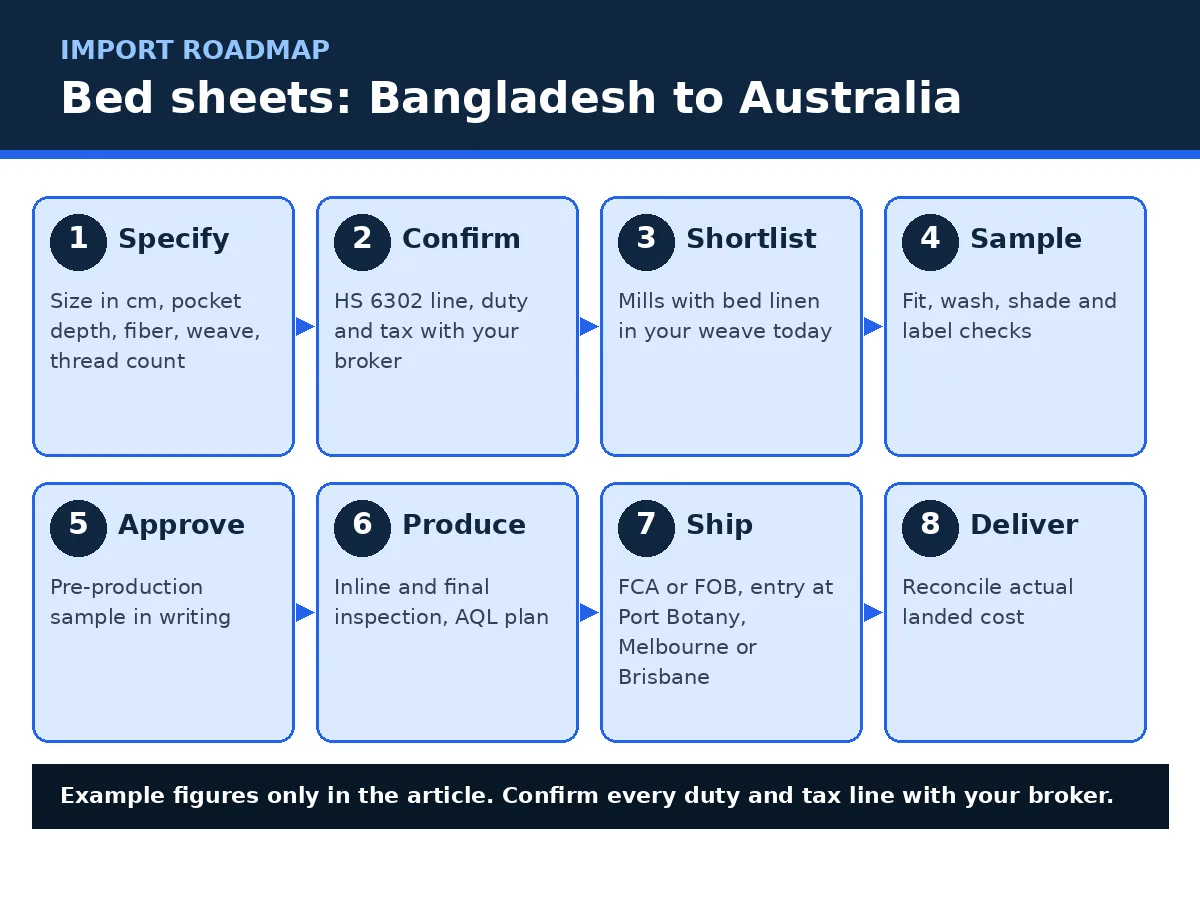
Write the sheet specification: flat or fitted, set composition, centimeter dimensions, pocket depth, fiber, weave, thread count, color or print, hem, care label route and packing.
Choose the Australian size chart and confirm it against your customer's mattress dimensions, including topper depth, before you order.
Classify every sheet type from the indicative heading 6302 and confirm each full tariff line and duty line with your broker.
Confirm the GST position with your broker and tax adviser, and price without any preference until the broker confirms it in writing.
Shortlist mills whose range includes bed linen in your weave, and request quotes on the identical specification.
Verify the supplier in three layers: documents, capacity and current production, and payment discipline.
Order samples in stages, fit and wash them, and approve a pre-production sample of each sheet type.
Appoint your licensed customs broker, confirm the biosecurity position, and confirm the port: Port Botany, Melbourne or Brisbane.
Confirm the order in writing: purchase order, pro forma invoice, delivery and payment terms, inspection plan, labeling and packing.
Ship from Chattogram, clear customs with the confirmed code, and reconcile the actual landed cost.
Next steps on Exportain
Read how to import from Bangladesh, then work through the landed cost method with your broker confirmed duty and GST lines. When your specification is ready, see how to buy on Exportain.
Post a free RFQ on Exportain and get quotes from Bangladeshi suppliers → https://exportain.com/rfqs
What is the typical MOQ for bed sheets from Bangladesh?
There is no single typical minimum. The minimum is set per sheet size and usually per color or print, because sheeting fabric is woven and dyed in batches. Ask how each minimum splits by size, color, print and set composition, and whether it is counted in sheets, sets, dozens or cartons.
How long does shipping take?
Production time and transit time are separate, and neither has a single typical figure. Sea freight from Chattogram to an Australian port takes weeks rather than days, varying by schedule, routing and season. Plan from the forwarder current schedule.
What import duty applies?
Confirm every duty line with your broker before you price or ship. The indicative heading is 6302, with printed cotton bed linen under 6302.21 and unprinted cotton bed linen under 6302.31, and the schedule lines for the six bed linen subheadings show a general rate of 5 percent.9 Confirm the current rate for the exact line and entry date, and price without any preference until the broker confirms it in writing.
How do I verify a supplier?
Check company documents first, so that the name, address and bank account agree across the trade licence, export registration and invoices. Then check capability: weaving and dyeing route, bed linen capacity, and a finished sheet set from current production in your weave and size. Keep payments to the company account named in the documents, and treat any profile badge as a document and photo review, not a factory inspection or a guarantee.
Sources
- Annual Export Receipts of Goods and Services 2024-25. Bangladesh Bank (accessed )
- What Is Percale? A Guide to Percale Weave Sheets. MasterClass (accessed )
- A Simple Bedding Size Chart for Australia: Get the Perfect Fit. Sienna Living (accessed )
- ISO 2859-1:2026 - Sampling procedures for inspection by attributes — Part 1: Sampling schemes indexed by acceptance quality limit (AQL) for lot-by-lot inspection. ISO (accessed )
- Consumer Goods (Care Labelling) Information Standard 2023 - Explanatory Statement. Federal Register of Legislation (accessed )
- OEKO-TEX STANDARD 100 for textiles tested for harmful substances. Hohenstein (accessed )
- FCA & FOB Incoterms 2020 explained: Key differences. ICC Academy (accessed )
- HS 2017 - Code 6302: Bed linen, table linen, toilet linen and kitchen linen. United Nations Statistics Division (accessed )
- Chapter 63: Other made up textile articles; sets; worn clothing and worn textile articles; rags. Australian Border Force (accessed )
- GST and other taxes when importing. Australian Border Force (accessed )
- Import declarations. Australian Border Force (accessed )
- About Customs Brokers. Australian Border Force (accessed )
- landed cost
- import duty
- quality control
- buyer guide
- Bangladesh sourcing
- Bed sheets
- OEKO-TEX Standard 100
- Australia
About the author
Sourcing from Bangladesh?
Post a request for quotation and suppliers on Exportain can send you their quotes directly.
Post an RFQ


