

How to Import Bath Towels From Bangladesh to USA: Step-by-Step Guide
How US buyers import bath towels from Bangladesh: supplier checks, samples, GSM and pile quality checks, FTC labels, HTS 6302.60 duty, ISF and CBP entry, and a landed-cost example.
Short answer
To import bath towels from Bangladesh to the USA, fix the towel specification first: size, cotton terry construction, GSM, pile, colours, and US labels. Verify the supplier and approve a pre-production sample, classify each towel type under heading 6302, agree the Incoterm, file the ISF before loading, clear the CBP entry, and build the landed cost before bulk production.
On this page
Key takeaways
Cotton terry bath towels sit at 6302.60.00, with a general rate of 9.1 percent in Revision 17 (2026) of the US tariff schedule, indicative until your broker confirms the full 10-digit code and checks any Chapter 99 additional-duty line.
There is no single typical MOQ, price, or transit time for bath towels: the minimum is set per towel type, per colour, and per size, and quotes should be compared only on the identical specification and delivery term.
US labels must state fibre content, country of origin, and business identity, with care instructions supported by a reasonable basis; OEKO-TEX Product Class II and GOTS label grades count only when the certificate matches the towel ordered.
Most ISF elements are due no later than 24 hours before cargo is laden at the foreign port, the ISF is not the CBP entry, and the manufacturer, origin, and HTSUS number must agree across both filings.
To import bath towels from Bangladesh to USA, start with the towel you will sell in the United States, not with a supplier list. A bath towel order for the US market is decided by its size, cotton terry construction, GSM and pile, colour range, and the labels it must carry for a US customer. When those points are fixed, the rest follows: supplier checks, samples, classification, the US entry, and the landed cost.
Bath towels from Bangladesh are most often cotton terry towels. In the United States tariff schedule, toilet linen and kitchen linen of terry towelling or similar terry fabrics, of cotton, sits at 6302.60.00, and the general rate shown in Revision 17 (2026) is 9.1 percent.1 That line is the starting point for duty, not the final answer. Treat every HS heading in this guide as indicative until your broker confirms the full 10-digit code for your exact towel.
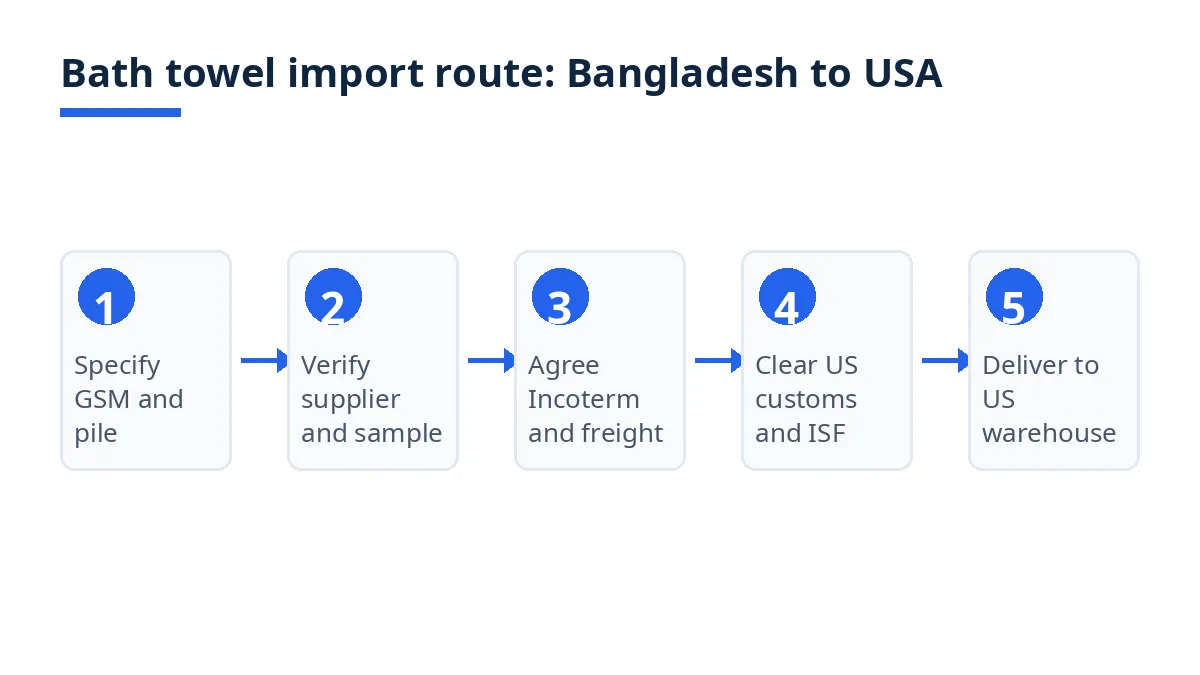
This guide is for US buyers: brands, retailers, hotels, wholesalers, and importers. It follows the order a US import actually follows, from specification and supplier checks to the Importer Security Filing, US Customs and Border Protection (CBP) entry, and delivery to a US warehouse. It states no typical price, minimum, or transit time, because none has a single figure across sizes, colours, and US destinations. Where numbers appear, they are labelled Example figures.
Why source bath towels from Bangladesh
A bath towel is a flat, open surface, and every fault shows on it. Its working part is the pile: loops of yarn that stand up from the ground fabric, take up water, and release lint in washing. A towel that measures correctly can still fail if the pile is uneven across its width, if loops are short and sparse at the edges, or if one dye lot dries a shade lighter than the next.
Source from a supplier whose current range already includes terry towels in the sizes you need. Terry weaving, dyeing, border work, and hemming use different equipment from apparel sewing, so a garment-only supplier is not a close substitute.
Fix the fibre mix first, because it drives the tariff line, the fibre-content label, and washing behaviour at once. Plan the range as a set: a bath towel, hand towel, and washcloth in the same colour may share a dye lot and border, but each size is still its own item for pricing, packing, and labelling.
Find and verify suppliers
Where do you start the search for bath towels suppliers in Bangladesh?
Start with a written specification, not with company names. Write down the size matrix, fibre composition, GSM and pile height, border design, hem type, colours, label wording, and packing format. State whether the towel is a single item or part of a set, and how many pieces make one retail unit. Then shortlist suppliers whose current range already includes terry towels in those sizes.
Send every candidate the identical specification and ask for the same reply format: construction assumed, GSM, size, colours, price inclusions, validity, and the minimum per towel type, per colour, and per size. Browse suppliers on Exportain and compare replies on the same terms. A reply that changes the GSM, size, or packing format is a different towel, not a cheaper version of the same one.
How do you verify a supplier before you pay?
Verification has three layers: company documents (trade licence, export registration, membership where applicable, with name, address, and bank account agreeing across documents); capability (terry weaving or fabric sourcing, dyeing and finishing route, current towel sizes, recent orders shown); and payment discipline (pay only the company account named in the documents, and verify any bank-detail change through a separate channel).
On Exportain, supplier profiles carry document and photo review badges. A badge is a review of documents and photos, not a factory inspection or a guarantee, and Exportain is not a party to the goods contract. Use a video or in-person factory check for a first bulk order where the value justifies it.
MOQ, pricing and samples
What is the typical MOQ for bath towels from Bangladesh?
There is no single typical minimum. The minimum is set per towel type, and usually per colour and per size, because yarn is bought in lots, dyeing runs in lots, and a loom and finishing plan is set up per construction and colour. A white towel, a dyed towel in six colours, and a matched set of three sizes will not carry the same minimum.
Ask how the minimum splits across the set, and ask for every minimum line in writing, with the binding lot named and set-up costs itemised apart from the unit price. If a colour or size blocks the order, reshape it: fewer colours, one dye lot shared across sizes, one border design, or bulk packing instead of retail sets.
How is the price built, and how should you compare quotes?
Yarn is usually the largest cost element in a cotton terry towel, followed by weaving, dyeing and finishing, cutting and sewing, borders, labels, packing, inspection, transport to the port, and margin. GSM is the main price lever you control: a heavier towel uses more yarn and costs more to dye and finish.
Compare quotes only on the identical specification and delivery term, and ask each supplier to state what is excluded, such as testing, special packing, or set assembly. Two quotes can differ because one assumes a lower GSM, a smaller size, or a simpler border. Ask what each price is based on, in writing, and re-confirm the price before bulk production if the validity period has passed.
Which samples do you need, and how do you approve them?
Work in stages: a development sample, then a pre-production sample in the actual production yarn, colour, border, and finish, which is the sample you approve for bulk. GSM, pile, and shade cannot be approved from a sample in substitute yarn or colour.
Test samples as customers will use them: measure flat and after washing, check pile evenness, border position, hems, shade match, lint, and absorbency. Approve the GSM, size, colour, border, and label, and keep one sealed counter-sample of each type.
Quality control and certifications needed
What do GSM, pile, and labelling checks cover?
GSM, pile height, and loop density are three separate buyer checks. GSM alone does not describe a towel: a heavy towel can still carry short, sparse loops, and pile thin at the edges will not dry evenly. State all three in the specification, then check them on more than one towel and across the full width of each towel.
Against the approved sample, check size before and after washing, border position, hems, shade match, lint, and absorbency against a written pass level and test method agreed with the supplier. Agree inspection method and defect limits before production, leaving acceptance numbers to the purchase order. Inspect in stages: inline during production, and a final random inspection on packed goods.
Which US label rules apply to bath towels?
Fibre content, country of origin, and manufacturer identity sit at the centre of US textile labelling. Federal law requires that most textile and wool products have a label that lists the fibre content, the country of origin, and the identity of the manufacturer or another business responsible for marketing or handling the product, and under the Care Labeling Rule, manufacturers and importers must provide instructions so consumers know how to clean the products they buy.2
State fibre composition by generic fibre name, in percentages by weight, in descending order, matching the yarn and fabric bought. Agree exact label wording at sampling stage and check the finished label before bulk sewing begins.
Care wording needs the same discipline. The Care Labeling Rule requires regular care instructions, and a manufacturer or importer must have a reasonable basis for the care information disclosed, such as reliable evidence that the product was not harmed when cleaned according to the instructions.3 Agree the washing, drying, bleaching, and ironing wording, test the towel using that wording, and keep the evidence with the order file.
Which certifications do you actually need?
No single certificate covers every US order. What you need follows your customer and channel: a retailer may name a scheme in its manual, and a packaging claim such as organic needs the matching certificate. Name any requirement in the specification, and check scope, product, issuing body, and expiry date.
OEKO-TEX STANDARD 100 tests textiles for harmful substances, and its product classes depend on intended use, with towels listed in Product Class II, for textiles whose surface comes into direct contact with the skin.4 A certificate and label are only awarded if all components meet the criteria, and a certificate is valid for 12 months and can be renewed annually.4 Ask for the product class, not just the scheme name.
For an organic claim, the Global Organic Textile Standard (GOTS) sets two label grades: organic (at least 95 percent organic fibres) and made with organic materials (at least 70 percent).5 The logo can only be applied if all stages comply, so all processors, manufacturers, and traders need certification.5
Incoterms, shipping and transit time
Which delivery term should a first US order use?
Incoterms 2020 rules define the place of delivery, transfer of risk, costs, who contracts for transport, and who completes export and import formalities.6 For containerised towels, the key choice is FCA versus FOB. Under FCA, the seller delivers and transfers risk when goods are delivered to the carrier or person designated by the buyer at the agreed place, and FCA suits any mode of transport, including multimodal container shipments.6 Under FOB, risk passes once goods are loaded onto the vessel at the named port, and FOB is only for maritime or inland waterway transport.6
Weigh FCA at a named terminal against FOB at the Bangladeshi port. Under FCA, delivery happens when the container is handed to your carrier. Under FOB, risk stays with the seller until the container is on board, even if stacked at the port before loading. State rule, edition, and named place in full, for example FCA Chattogram container terminal, Incoterms 2020. In all but one rule the buyer completes import formalities, so assume entry, duty, and ISF are buyer tasks. Under CIF the seller pays freight and minimum insurance to the destination port, but risk still passes on board at origin.
How long does shipping take?
There is no single typical transit time for bath towels from Bangladesh to the United States. Sea freight is the standard route for bulk orders, and transit varies by US port, routing, transshipment, and season. Air freight suits samples and urgent small lots, not bulk towels, which are bulky for their weight.
Plan from your forwarder current sailing schedule, keeping production time separate from transit time. Add clearance, delivery, and a buffer after approval and inspection. Confirm carton count, dimensions, and weight, because towels fill a container by volume before weight, and make sure quote, ISF, and entry name the same port and warehouse.
Import duty, taxes and documents
How are bath towels classified for US duty?
Duty follows the classification of each towel type, not the supplier product name. Heading 6302 covers bed, table, toilet, and kitchen linen, and cotton terry towels sit at 6302.60.00, described as toilet linen and kitchen linen, of terry towelling or similar terry fabrics, of cotton.1 Statistical suffixes split towels further, including dish towels and other towels, so the full 10-digit code depends on the towel type.1
Other constructions sit on other lines: other cotton towels at 6302.91.00 (9.2 percent in Revision 17), man-made fibre towels at 6302.93 (6.2 percent pile/tufted at 6302.93.10; 9.9 percent other at 6302.93.20).1 Read each as a schedule line, indicative for your entry date, and put each type on its own invoice line.
What import duty applies to bath towels from Bangladesh to the USA?
For cotton terry bath towels at 6302.60.00, the general rate in Revision 17 (2026) is 9.1 percent.1 That is the Column 1 general rate, shown alongside special-programme rates and a Column 2 rate of 40 percent.1 Do not read 9.1 percent as the total duty for your entry. Ask your broker to confirm the current rate for the full 10-digit code on your entry date, and to check whether any additional-duty line in Chapter 99 applies to Bangladesh-origin towels on that date.
Assume no preference: no free trade agreement with the United States can be assumed, unless your broker confirms a programme covering your towel, origin, and entry date. Agree proof of origin at order stage. Duty is separate from sales tax, which follows the sale.
What is the CBP entry and the ISF for an ocean shipment?
A commercial ocean shipment needs two filings buyers often confuse. The Importer Security Filing, or ISF (10+2), is advance cargo data for goods arriving by vessel. The ISF Importer, or an authorised agent, must submit the elements through a CBP-approved electronic interchange system, most of them no later than 24 hours before cargo is laden aboard the vessel at the foreign port.7 Those elements include seller, buyer, importer of record number, consignee numbers, manufacturer or supplier, ship-to party, country of origin, and commodity HTSUS number, while container stuffing location and consolidator are due as early as possible and no later than 24 hours before arrival at a US port.7
The ISF is not the entry. The entry presents the goods to CBP for release, with classification, value, and duty per line, usually handled by a licensed customs broker. The two filings must agree, and if ISF information changes before the goods enter a US port, the filing must be updated.7 Give your broker the manufacturer, country of origin, and confirmed HTSUS number before the container is stuffed: the 24-hour clock runs from loading at the foreign port, not from arrival.
Which documents do you need for clearance?
The standard set is the commercial invoice, packing list, bill of lading, and proof of origin where a claim is made. Name each towel type plainly on its own invoice line, with fibre, size, GSM, colours, quantities, prices, and delivery term, and keep quantities, weights, and carton counts agreeing across all documents.
Landed cost example
A landed cost is the full cost of one towel, ready to sell from your US warehouse. Every number below is an Example figure only, not a quote, and the duty line uses the 9.1 percent schedule rate for 6302.60.00 as an example rate, to be confirmed by your broker.
Example figures: 10,000 cotton terry bath towels, FCA Chattogram, sea freight to a US port, duty at the example schedule rate only.
Cost element | Example figures (per towel) | How to obtain your figure |
|---|---|---|
Product price, FCA | $1.85 | Confirmed pro forma invoice |
International freight | $0.24 | Forwarder quote divided by towels shipped |
Insurance | $0.01 | Policy or forwarder quote |
Duty at 9.1 percent example rate | $0.17 | Broker calculation from confirmed codes and rates |
Port, clearance and broker fees | $0.09 | Broker invoices divided by towels |
Local delivery to warehouse | $0.06 | Local carrier quote divided by towels |
Total landed cost | $2.42 | Sum of all lines above |
The table excludes the merchandise processing fee, any harbour maintenance fee, and sales tax. Ask your broker to add every CBP fee, and work the calculation twice: at quote stage and again after shipment with actual invoices. See how to import from Bangladesh and the landed cost guide.
Step-by-step checklist to import bath towels from Bangladesh to USA
Write the specification: towel type and set composition, size matrix, fibre, GSM, pile, border, hem, colours, label wording, and packing.
Classify every towel type from heading 6302 and 6302.60, and confirm each full 10-digit code and rate with your broker, treating each heading as indicative until verified.
Shortlist suppliers whose range includes terry towels in your sizes, and request quotes on the identical specification and delivery term.
Verify the supplier: documents, terry capacity, dyeing route, and a finished towel from current production; pay only the company account named in the documents.
Order samples in stages, test GSM, pile, size after washing, shade, lint, and absorbency, agree label wording, and approve a pre-production sample of each type in production yarn and colour.
Confirm the order in writing: purchase order, pro forma invoice, delivery and payment terms, inspection plan, labelling, packing, and shipment date.
Give your broker ISF data before loading: manufacturer, origin, and HTSUS number, with stuffing location and consolidator by the deadlines in 19 CFR 149.2.7
Inspect during production and again on packed goods against approved samples, checking pile, border, shade, hems, labels, and carton contents.
Ship, clear CBP entry with the confirmed code for each type, reconcile the actual landed cost, and file the invoice, packing list, bill of lading, ISF confirmation, and label artwork together.
How Exportain helps
Browse suppliers for Bangladeshi suppliers and compare towel ranges against your specification before shortlisting anyone for sampling. Then post your specification and target quantity as an RFQ and compare replies on the same GSM, size, colour, delivery term, and packing. Read how to buy on Exportain for the buying steps, from RFQ to order.
Exportain is a B2B marketplace where buyers post RFQs, receive quotations, and message suppliers. It does not inspect goods, book freight, or clear customs; the US entry, ISF, and duty remain with you and your broker.
FAQs
What is the typical MOQ for bath towels from Bangladesh?
There is no single typical minimum. The minimum is set per towel type, usually per colour and per size, because yarn lots, dye lots, and loom plans each carry their own floor. Ask for every minimum line in writing and name the binding lot.
How long does shipping take?
There is no single typical shipping time: sea transit varies by port, routing, and season, and production time is separate. Plan from your forwarder sailing schedule, add clearance and delivery, and keep a buffer after approval and inspection.
What import duty applies?
For cotton terry towels at 6302.60.00, the general rate in Revision 17 (2026) is 9.1 percent.1 Confirm the full code and current rate for each type with your broker, and ask whether any additional-duty line applies. Treat every rate as indicative until verified.
How do I verify a supplier?
Check documents first, then capability: terry capacity, fabric source, dyeing route, and recent production in your sizes. Keep payments to the company account named in the documents, and approve a pre-production sample of each type before bulk production.
Next steps on Exportain
Read how to import from Bangladesh, then check how to buy and browse suppliers to shortlist suppliers on Exportain. When your specification is written, post it as an RFQ and compare replies on the same GSM, size, colour, and delivery term before you order samples.
Sources
- Harmonized Tariff Schedule of the United States, Chapter 63: Other made up textile articles; sets; worn clothing and worn textile articles; rags (Revision 17, 2026). United States International Trade Commission (accessed )
- Textile, Wool, Fur, Apparel and Leather Matters. Federal Trade Commission (accessed )
- Care Labeling of Textile Wearing Apparel and Certain Piece Goods. Federal Trade Commission (accessed )
- OEKO-TEX STANDARD 100 for textiles tested for harmful substances. Hohenstein (accessed )
- Global Organic Textile Standard (GOTS). IDFL, (accessed )
- FCA & FOB Incoterms 2020 explained: Key differences. ICC Academy (accessed )
- 19 CFR 149.2 - Importer security filing, requirement, time of transmission. Cornell Law Institute (accessed )
About the author
Sourcing from Bangladesh?
Post a request for quotation and suppliers on Exportain can send you their quotes directly.
Post an RFQ


