Importing Baby Clothes From Bangladesh to UAE: Costs, Duties and Suppliers
UAE guide to importing baby clothes from Bangladesh: Jebel Ali entry, mainland versus designated zone, 5% duty, VAT, Arabic and English labels, and a worked landed cost per garment.
Short answer
To import baby clothes from Bangladesh to the UAE, decide first whether goods enter the mainland or a designated zone such as JAFZA, because that decides when duty and VAT are paid. Classify each style under heading 6111 for knitted garments or 6209 for woven garments, confirm the 5 percent schedule rate with your broker, approve samples and Arabic and English labels, ship to Jebel Ali, and clear customs with the confirmed code and documents.
On this page
Key takeaways
In the GCC Tariff Book opened for this guide, babies' garments carry 5 percent: knitted cotton 6111.20, knitted synthetic fibres 6111.30, knitted other textile materials 6111.90, woven cotton 6209.20, woven synthetic fibres 6209.30 and woven other textile materials 6209.90.
Entry route decides tax timing in the UAE: goods in a designated zone are not charged import VAT while they stay under customs control, while goods entering the mainland market attract VAT at 5 percent.
Plan for Arabic and English labels from the start, and do not present a G-Mark as a clothing certificate: the G-Mark is mandatory for children's toys and low voltage equipment, while GSO EN 14682:2021 covers cords and drawstrings on children's clothing.
A lane listing opened for this guide shows Chattogram to Jebel Ali full-container-load transit of 10 days and 9 hours on the schedules visible on that page; confirm the sailing and free days at Jebel Ali with your forwarder for your shipment date.
There is no single typical MOQ for baby clothes from Bangladesh: the minimum is set per style and usually per colour, because fabric is knitted, dyed or printed in batches and a cutting plan is set up per size range.
A UAE-based buyer importing baby clothes from Bangladesh should start at the UAE border and work backward to the factory. The first decision is where the goods will enter and where they will be sold: mainland UAE, a designated zone such as Jebel Ali Free Zone (JAFZA), or a designated zone with later movement to the mainland. That decision changes when duty and value added tax (VAT) are paid. Settle the entry route, the classification and the label before production begins. This guide is for UAE retailers, brands, distributors and online sellers buying baby clothes from Bangladesh. Every duty figure comes from the schedule opened for it, and every illustrative figure is labelled as an example figure.
Why source baby clothes from Bangladesh
Bangladesh supplies baby clothes in cotton, synthetic fibres and blends, in knitted and woven constructions, across rompers, sleepsuits, sets, dresses, tops and bottoms. For a UAE buyer, the practical question is whether a particular supplier makes your exact construction well: knitted rompers with snap closures are a different production task from woven dresses with lined bodices. Shortlist by construction.
The UAE market also shapes the specification. Put warm-weather expectations into it directly: fabric composition, fabric weight as your choice, closure type and pull strength as your test, seam finish, and wash and care instructions.
Find and verify suppliers
Where should you start the search?
Start with a written specification for each style, then search for suppliers whose current range already includes that construction. For each style, record the construction (knitted or woven), fibre composition, size range, closure type, print method, label content and packing. Send every candidate the identical specification and ask for the same reply format: fabric assumed, price inclusions, validity period, and minimum quantity per style and per colour. Browse suppliers on Exportain and read finding suppliers in Bangladesh before you shortlist.
How do you verify a supplier before you pay?
Verification has three layers. The first is company documents: trade licence, export registration and association membership where applicable, checked so that name, address and bank account name agree across every document. The second is capability: current baby-clothes production, fabric source, dyeing and printing route, and closure and trim sourcing. A finished garment from current production shows more than a catalogue photograph: snap setting, seam finish and size consistency.
The third layer is payment discipline. Keep payments to the company account named in the documents, never to a personal account, and verify any change of bank details separately. On Exportain, supplier profiles carry document and photo review badges: a review of documents and photos, not a factory inspection or a guarantee, and Exportain is not a party to the goods contract.
MOQ, pricing and samples
What is the typical MOQ for baby clothes from Bangladesh?
There is no single typical MOQ for baby clothes from Bangladesh. The minimum is set per style and usually per colour, because fabric is knitted, dyed or printed in batches, closures and trims are bought per style, and a cutting plan is set up per size range. A plain cotton romper in three colours will not carry the same minimum as an embroidered set in eight sizes and four colours. Ask how the minimum splits by style, colour, size range and print, in writing, before you compare prices.
How is the price built, and how should you compare quotes?
Fabric is usually the largest cost element in a baby garment, followed by cutting and sewing, dyeing or printing, closures and trims, testing, labelling and packing, and the factory margin. Small sizes do not automatically mean low cost: closures, snaps and bindings cost similar effort whatever the garment size, and a romper with a full snap placket costs more to finish than a simple pull-on top. Two quotes can differ because one assumes a lighter fabric, a simpler closure, fewer sizes or no testing. Ask what each price is based on, in writing.
Compare quotes on the same basis: same style, sizes, fabric, closure, print method, delivery term and packing. Ask each supplier to state what is excluded, for example testing or special packing, and whether the quoted price includes Arabic and English labels or whether labelling is an extra step.
Which samples do you need, and how do you approve them?
Work in stages. A development sample shows whether the factory can construct the style, set snaps evenly and hold the size chart. A pre-production sample, made in the actual production fabric, colour, print and trims, is the sample you approve for bulk. Size, colour and closure performance cannot be approved from a sample in substitute fabric, because dyeing, finishing and washing change dimensions and shade.
Test the samples as your customers will use them: wash the garment following your care label, check that snaps still close firmly after washing, measure each size against your chart, and check that no loose trim, button or snap part detaches under a firm pull. Approve in writing and keep one sealed counter-sample of each style. For a first UAE order, approve the label at the same stage as the garment, so the Arabic and English wording is settled before bulk label printing begins.
Quality control and certifications needed
Which quality checks are specific to baby clothes?
Against the approved sample and chart, check fabric composition, finished weight, measurements for every size, and consistency across colours. Then check construction garment by garment: seam finish, snap setting and alignment, binding and edge finish, and trim attachment. Check that no sharp edge or detached part remains on a garment intended for an infant. A style can pass garment by garment and still fail as a range if one size drifts from the chart.
Agree the inspection method and defect limits before production. ISO 2859-1:2026 defines a system of acceptance sampling plans for inspection by attributes, and its summary states that AQL stands for acceptance quality limit, the maximum average percentage of defective items considered acceptable during random sampling, used to determine sample sizes and acceptance and rejection thresholds.1 Inspect in stages: an inline check during sewing catches a drift while correction is still possible, and a final random inspection on packed goods checks quantity, workmanship, measurements, labels and packing.
Which label rules apply in the UAE?
Plan for Arabic and English labels from the start. Arabic labelling is generally mandatory for consumer products sold in the UAE, and additional languages are permitted provided they do not contradict or obscure the Arabic text, with labels legible, durable and affixed so they remain visible throughout the product's life.2 Labels must clearly display essential information such as product name, description, country of origin, manufacturer or importer details, ingredients or materials, usage instructions, and safety warnings where applicable.2 For baby clothes, that means fibre composition, size, care instructions and country of origin in Arabic and English, agreed at sampling stage. Do not leave the Arabic translation to the packing stage: an error found after packing means relabelling the whole shipment.
Which certifications and conformity checks do you actually need?
No single certificate covers every baby-clothes order. The Emirates Conformity Assessment Scheme (ECAS) is mandatory for regulated products, is administered by the Ministry of Industry and Advanced Technology (MoIAT), and its certificates are valid for one year.3 Whether your baby-clothes line falls in a regulated category is a question for your broker and for MoIAT, not an assumption to make in the purchase order. Ask early, and if a scheme applies, match the certificate scope to your exact styles and materials.
Two distinctions matter for baby products. The Gulf Conformity Mark (G-Mark) is mandatory across all six Gulf Cooperation Council (GCC) states for low voltage electrical equipment and children's toys, issued by a Gulf Standardization Organization (GSO)-approved Notified Body.3 Plain baby clothing is not a toy, so do not present a G-Mark as a clothing certificate; if a set includes a toy element, check that element's conformity separately. Separately, GSO EN 14682:2021 specifies requirements for cords and drawstrings on children's clothing, including disguise costumes and ski apparel, up to the age of 14 years.4 Apply that lens to every style with a cord, drawstring, hood tie or waist tie, and record the decision style by style in the specification.
A test report for a different fabric or closure does not cover your printed style. Name any test or scheme your retailer requires in the specification, ask for the matching report, and check its scope, issuing body and date before bulk production.
Incoterms, shipping and transit time
Which delivery term should a first UAE order use?
The Incoterms 2020 rules set out, for each rule, where delivery takes place, and risk passes from seller to buyer at the same point and time as delivery.5 Under FOB, CFR and CIF the seller must place the goods on board the vessel.5 On customs, in all rules but EXW the seller must carry out export formalities, and in all rules but DDP the buyer must carry out import formalities.5 The same summary notes that the four sea rules, FAS, FOB, CFR and CIF, are only intended for port-to-port bulk or break-bulk shipments and are not suitable for container shipments, because a container is handed to the carrier before it is on board.5
For a first container order to Jebel Ali, weigh FOB at the Bangladeshi port against FCA at the named terminal, and avoid DDP unless your seller already clears goods in the UAE regularly.5
How long does shipping take?
Production time and transit time are separate, and neither has a single typical figure. A lane listing opened for this guide shows Chattogram to Jebel Ali full-container-load transit of 10 days and 9 hours on the schedules visible on that page, with the final vessel rotation depending on the selected schedule and carrier allocation.6 Treat that as a schedule snapshot, not a promise: confirm the sailing and free days at Jebel Ali with your forwarder, and add clearance and onward delivery. An order is ready only when every size has finished sewing, labelling, inspection and packing. Baby clothes are light for their volume, so confirm pieces per carton, carton dimensions and weight, because carton volume can limit a shipment before weight does.
Mainland, designated zone or re-export: which entry route?
This is the UAE decision that most changes the tax timing. Goods brought directly into a designated zone are not charged import VAT as long as they stay inside the zone or move to another designated zone under customs supervision, while goods leaving a designated zone and entering the UAE market attract VAT at 5 percent.7 JAFZA is listed among the designated zones in that account, alongside Dubai Airport Free Zone and Dubai Textile City.7 Sales to customers outside the UAE are zero-rated when you can provide export documentation.7
Do not assume that every free zone gives the same treatment. Only certain free zones are designated zones, and the relief applies only to goods that remain under customs control with complete paperwork.7 Before you choose the route, tell your broker and your tax adviser exactly where the goods will be stored, where they will be sold, and whether any stock will move to the mainland later: the second declaration is where the deferred duty and VAT fall due.
Import duty, taxes and documents
How are baby clothes classified for duty in the UAE?
Duty follows the classification of each style in the GCC tariff, not the supplier's product name. The central split is construction: babies' garments and clothing accessories, knitted or crocheted, sit in heading 6111, and babies' garments and clothing accessories, not knitted or crocheted, sit in heading 6209.8 In the schedule opened for this guide, the GCC Tariff Book published by Abu Dhabi Customs, knitted babies' garments carry 5 percent on cotton under 6111.20, on synthetic fibres under 6111.30, and on other textile materials under 6111.90.8 Woven babies' garments carry 5 percent on cotton under 6209.20, on synthetic fibres under 6209.30, and on other textile materials under 6209.90.8
Keep knitted, woven, cotton and synthetic styles on separate invoice lines matching their classifications, and classify any separate accessory on its own line. The schedule opened here is the 2022 GCC Tariff Book, so confirm the current full national code and rate with your broker before you price or ship.
What import duty and VAT apply?
For mainland entry, duty is 5 percent of the customs value for baby clothes on the 6111 and 6209 lines above.8 A Dubai customs account of the same lane states the same mainland position: customs duty of 5 percent of the cost, insurance and freight (CIF) value, and 5 percent VAT on most items.9
VAT is charged at 5 percent, and for a consignment above AED 1,000 in declared value the calculation shown on the VAT page opened for this guide is the CIF value plus excise tax, customs duty and customs fees, multiplied by 5 percent.10 For baby clothes, which carry no excise tax, the practical formula is 5 percent of CIF value plus customs duty. A VAT-registered importer generally accounts for import VAT through its VAT return, while a non-registered importer pays at entry. For goods held in a designated zone, VAT falls due when the goods enter the UAE market.7
Which documents do you need for clearance?
To import in Dubai, a company registers with Dubai Customs and takes a Customs Client Code through the Dubai Trade Portal, with its trade licence, passport copy of the authorised individual, Emirates ID, tenancy contract and contact details among the documents listed for that registration.9 The shipment document set listed for Dubai clearance is the commercial invoice with currency and product description, packing list, bill of lading or air waybill, certificate of origin, delivery order, importer code certificate, import permits for restricted goods, and a trade licence copy.9
The invoice should name each style plainly, for example knitted cotton baby romper with snap closure, with composition, sizes, quantities, unit prices and the delivery term, on its own line. Quantities, weights and carton counts must agree across every document. If your goods move from a free zone to the mainland, expect a second declaration, with duty and VAT assessed at that point.9
Landed cost example (table)
A landed cost is the full cost of one baby garment, ready to sell. Every number below is an example figure, not a quote.
Example figures: 5,000 knitted cotton rompers, FOB Chattogram, sea freight to Jebel Ali, mainland entry.
Cost element | Example figures (per garment) | How to obtain your figure |
|---|---|---|
Product price, FOB | $4.80 | Confirmed pro forma invoice |
International freight | $0.55 | Forwarder quote per garment |
Insurance | $0.05 | Policy or forwarder quote |
CIF value | $5.40 | Sum of the three lines above |
Duty at 5 percent | $0.27 | Broker calculation |
Port, clearance and broker fees | $0.22 | Broker invoices per garment |
Local delivery to warehouse | $0.18 | Carrier quote per garment |
Total landed cost, excluding VAT | $6.07 | Sum of all lines above |
VAT at 5 percent on CIF plus duty, cash cost if not recoverable | $0.28 | Broker calculation |
VAT is shown separately because its cash effect depends on your registration position. See landed cost for imports from Bangladesh for the full method, and work the calculation twice: at quote stage and again after shipment with the actual invoices.
Step-by-step import checklist
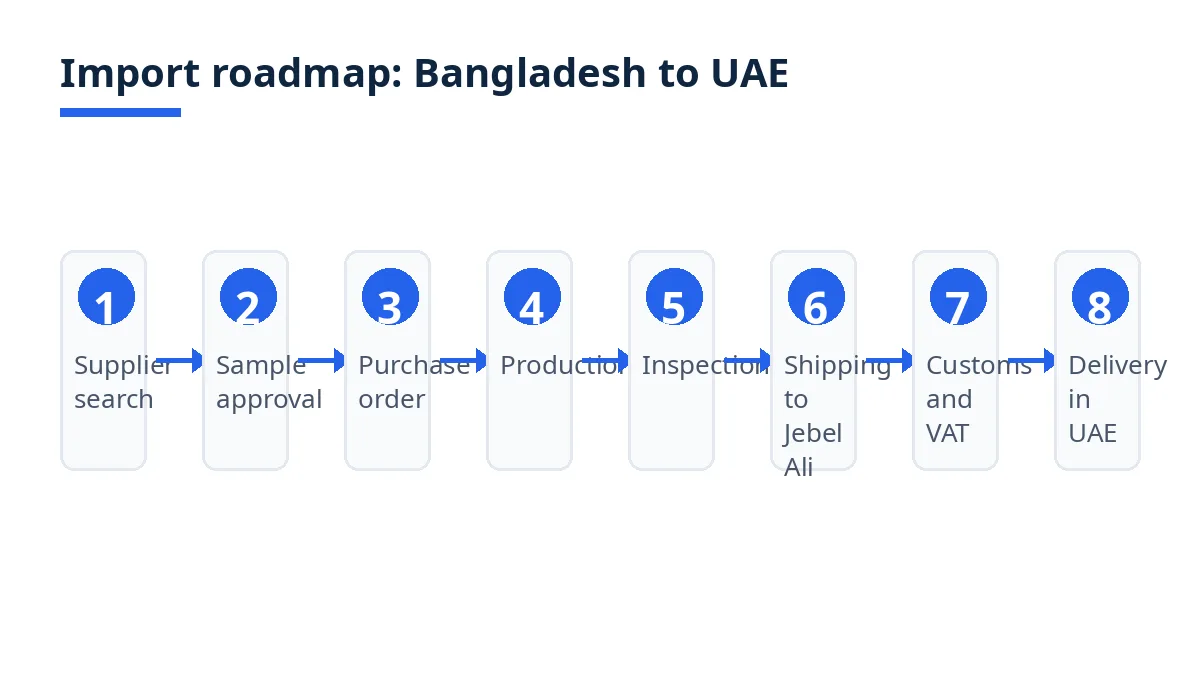
Decide the entry route: mainland, designated zone, or designated zone with later mainland movement, and confirm the tax timing with your broker.
Write the specification style by style: construction, fibre, sizes, closure, print method, label content, and packing.
Classify every style from heading 6111 (knitted) and heading 6209 (woven), then the fibre line, and confirm each code and rate with your broker.
Shortlist suppliers whose current range includes your construction, and request comparable quotes on the identical specification and delivery term.
Verify the chosen supplier: documents, capacity, fabric and trim routes, and a factory check for a first order.
Order samples in stages, wash and measure them, test closures, approve the label, then approve a pre-production sample of each style.
Confirm the order in writing: purchase order, pro forma invoice, delivery and payment terms, inspection plan, labelling, packing and shipment date.
Confirm your Dubai Customs Client Code and VAT position before shipment, and the declaration type for your entry route.
Inspect during production and again on packed goods against the approved samples.
Ship to Jebel Ali, clear customs with the confirmed code for each style, pay or account for duty and VAT, and reconcile the actual landed cost.
How Exportain helps
Browse suppliers for Bangladeshi baby-clothes exporters and compare their ranges against your style list. Then post your specification and target quantity as an RFQ and compare replies on the same terms before you choose a factory for sampling. Exportain is a B2B marketplace where buyers post RFQs, receive quotations and message suppliers. It does not inspect goods, book freight or clear customs.
FAQs
What is the typical MOQ for baby clothes from Bangladesh?
There is no single typical minimum. It is set per style and usually per colour, because fabric is knitted, dyed or printed in batches and a cutting plan is set up per size range. Ask each supplier how its minimum splits by style, colour and size range.
How long does shipping take?
Production time and transit time are separate, and neither has a single typical figure. A lane listing opened for this guide shows Chattogram to Jebel Ali full-container-load transit of 10 days and 9 hours on the schedules visible on that page.6 Confirm the sailing and free days at Jebel Ali with your forwarder, and add clearance and onward delivery.
What import duty applies?
In the schedule opened for this guide, babies' garments in headings 6111 and 6209 carry 5 percent: knitted cotton 6111.20, synthetic fibres 6111.30 and other textile materials 6111.90, and woven cotton 6209.20, synthetic fibres 6209.30 and other textile materials 6209.90.8 Confirm the current full national code with your broker before you price or ship. VAT at 5 percent applies on CIF value plus duty for a mainland import, subject to your registration position and to the designated-zone rule.10 7
How do I verify a supplier?
Check company documents first, so that name, address and bank account agree across the trade licence, export registration and invoices. Then check capability: capacity, fabric and trim routes, and recent production in your construction. Keep payments to the company account named in the documents, and approve a pre-production sample of each style, including its label, before bulk production.
Next steps on Exportain
Read how to import from Bangladesh for the full process, then use how to buy to set out your buying route. When ready, browse suppliers and compare quotes on the same specification and delivery term.
Sources
- ISO 2859-1:2026 - Sampling procedures for inspection by attributes — Part 1: Sampling schemes indexed by acceptance quality limit (AQL) for lot-by-lot inspection. International Organization for Standardization (accessed )
- Product Safety & Labeling Regulations. Al Kabban & Associates (accessed )
- Product Certification UAE | ECAS EQM G-Mark SABER. ITMAD (accessed )
- GSO EN 14682:2021 - Safety of children's clothing, cords and drawstrings. Ministry of Industry & Commerce, Kingdom of Bahrain (accessed )
- Insider thoughts: Bob Ronai on Incoterms 2020 Rules; What are they about?. International Chamber of Commerce (accessed )
- Chittagong to Jebel Ali FCL Shipping Rates | Schedules & Transit Time. Cogoport (accessed )
- Designated Zones vs Free Zones: VAT Implications for SMEs in the UAE. TaxReady (accessed )
- GCC Tariff Book 2022. Abu Dhabi Customs (accessed )
- Dubai Customs Clearance Made Easy: Everything Importers Need to Know. Forward Air Cargo (accessed )
- How is VAT calculated for imported goods. Zoho Books (accessed )
About the author
Sourcing from Bangladesh?
Post a request for quotation and suppliers on Exportain can send you their quotes directly.
Post an RFQ