Importing Baby Clothes From Bangladesh to Italy: Step-by-Step Guide
How to import baby clothes from Bangladesh to Italy: Genoa and Naples routing, EBA duty-free treatment, Italian VAT and fiscal representation, Italian-language labels, baby safety rules and landed cost.
Short answer
To import baby clothes from Bangladesh to Italy, classify each style under heading 6111 for knitted garments or 6209 for woven garments, confirm Everything But Arms duty-free treatment with proof of origin, and ship through Genoa or Naples. Verify the supplier, approve a pre-production sample with its Italian label, agree the delivery term and inspection plan, and build the landed cost before bulk production.
On this page
Key takeaways
Baby clothes are classified in heading 6111 for knitted or crocheted garments, with 6111.20 for cotton, 6111.30 for synthetic fibres and 6111.90 for other textile materials, and in heading 6209 for woven garments, with 620920 for cotton, 620930 for synthetic fibres and 620990 for other materials.
Bangladesh benefits from Everything But Arms duty-free, quota-free access to the European Union for all products except arms and ammunition, subject to origin rules and proof of origin agreed at order stage.
Italy applies a standard VAT rate of 22 percent, and businesses from outside the European Union must appoint a local fiscal representative for non-resident VAT registration, with the representative jointly liable for VAT compliance.
Fibre labels for goods sold in Italy must be in Italian, the official language of the member state, with fibre names and percentages in descending order, and the importer ensures label accuracy where the manufacturer is outside the Union.
Under EN 14682, garments for young children must not carry drawstrings or functional cords in the head, neck or upper chest area, and decorative cords there are tightly limited, so design cords out of babywear wherever possible.
An Italy-based buyer importing baby clothes from Bangladesh starts with the Italian entry, not with the factory floor. Classify each style under heading 6111 for knitted garments or heading 6209 for woven garments, confirm duty-free treatment under Everything But Arms with proof of origin, and route the shipment through Genoa for the north or Naples for the south, as your forwarder advises for your warehouse. Italian import VAT, Italian-language labels and EU baby safety rules are settled before production, not after the container arrives.
This guide follows that Italian route from supplier search to delivery: Genoa and Naples port entry, Italian VAT at import, fiscal representation where the importing entity sits outside the European Union, Italian-language fibre labels, and onward delivery to Italian warehouses and stores.
Why source baby clothes from Bangladesh
Bangladesh is a least developed country, and the European Union's Everything But Arms arrangement grants duty-free, quota-free access for all exports except arms and ammunition.1 The European Commission states that Bangladesh benefits from the most favourable regime available under the Generalised Scheme of Preferences, namely Everything But Arms.1 For an Italian buyer, that preference is the reason to shortlist Bangladesh before comparing individual factories, provided the goods meet the origin rules and the proof of origin is agreed at order stage.
The second reason is fit with the Italian market. Baby clothes are small, light and size-sensitive, and Bangladesh has a deep garment base that works in knitted and woven babywear. That fit does not remove the product work: start by fixing the product range in writing, each style separately, with construction, fibre mix, size range by height, closure type, print or embroidery, and packing unit.
A third reason is the route. Italy offers two natural sea entries for this trade, Genoa in the north and Naples in the south. Ask your forwarder to quote both entries for a first order, with clearance and onward delivery shown as separate lines.
Find and verify suppliers
Where should an Italy-based buyer start the search?
Start with a specification, not with factory names. Send every candidate the same document: style list, construction, fibre mix, size curve by height, colourways, closure and trim detail, label wording in Italian, packing method and target delivery term. Ask each supplier to reply in the same format, stating fabric assumed, price inclusions, validity and minimum per style and per colour.
Shortlist suppliers whose current range already includes baby clothes. A factory that sews adult knitwear can cut a romper, but baby production adds small-size handling, snap safety work and small-parts control. Ask what share of current production is babywear, whether testing runs in-house or at an external lab, and which recent baby styles the factory can show from current production.
How do you verify a supplier before you pay?
Verification has three layers. The first is company documents: trade licence, export registration and association membership where applicable, checked so that name, address and bank account name agree across every document. The second is capability: monthly babywear capacity, fabric source, dyeing route, snap fixing, and recent baby styles from current production. The third layer is payment discipline: keep payments to the company account named in the documents, never to a personal account, and verify any change of bank details through a separate channel before paying.
MOQ, pricing and samples
What is the typical MOQ for baby clothes from Bangladesh?
There is no single typical minimum order quantity for baby clothes from Bangladesh. The minimum is set per style and usually per colour, because fabric is knitted, dyed or printed in batches and a cutting plan is set up per size curve. A plain cotton romper and a printed sleepsuit set with applique will not carry the same minimum.
The size curve is the part buyers most often under-specify. Baby sizes run in narrow height steps, each needing its own pattern and snap placement. For classification purposes, the expression for babies garments means articles for young children of a body height not exceeding 86 cm.2 Confirm how many pieces per size the minimum assumes, and whether slow sizes can be dropped from a first order.
How is the price built, and how should you compare quotes?
Fabric is usually the largest cost element in a baby garment, followed by cutting and sewing, dyeing or printing, trims such as snaps and ribbing, testing, packing and the factory margin. Small sizes do not automatically mean low cost: handling, snap fixing and quality checks per piece stay close to adult levels while fabric use falls. Compare quotes on the same basis: same style list, fibre mix, size curve, print method, delivery term and packing. Ask what is excluded, for example testing fees or special packing.
Which samples do you need, and how do you approve them?
Work in stages. A development sample shows whether the factory can construct the style, fix snaps cleanly and match the size chart. A pre-production sample, made in the actual production fabric, colour, print and trims, is the sample you approve for bulk. Colour and snap performance cannot be approved from a sample in substitute fabric, because dyeing, washing and finishing change shade, shrinkage and snap grip.
Quality control and certifications needed
Which quality checks are specific to baby clothes?
Against the approved sample and size chart, check fabric composition, measurements at every size step, and consistency across the size curve. Then check construction garment by garment: seam finish, snap fixing, ribbing recovery, print adhesion, shade match, and loose threads or sharp points at closures.
Agree the inspection method and defect limits before production. ISO 2859-1:2026 defines a system of acceptance sampling plans for inspection by attributes, and its summary states that AQL stands for acceptance quality limit, the maximum average percentage of defective items considered acceptable during random sampling, used to determine sample sizes and acceptance and rejection thresholds.3 Inspect in stages: an inline check during sewing catches a drift while correction is still possible, and a final random inspection on packed goods checks quantity, workmanship, measurements, labels and packing.
Which label rules apply in Italy?
Fibre labelling applies to every textile garment in the range. Article 9 of Regulation (EU) No 1007/2011 states that a textile product shall be labelled or marked with the name and percentage by weight of all constituent fibres in descending order.4 Agree the wording at sampling stage and check that the percentages match the fabric you bought.
Italy adds a language rule that an English-only label cannot satisfy. The labelling or marking shall be provided in the official language or languages of the Member State on the territory of which the textile products are made available to the consumer, unless the Member State concerned provides otherwise.4 For goods sold in Italy, that means Italian wording on the fibre composition label. If the manufacturer is not established in the Union, the importer shall ensure the supply of the label or marking and the accuracy of the information contained therein.4 That places the Italian label squarely on the Italian buyer, so approve the Italian text yourself rather than accepting a supplier translation unchecked.
Beyond fibre composition, ask your broker and your Italian retail customers what else the finished label and packaging must carry for the Italian market, and settle those items at sampling stage.
Which safety rules apply to baby clothes in Italy?
Cords and drawstrings need a design decision before sampling, not a correction after production. In accordance with the standard EN 14682, garments intended for young children shall not be designed, manufactured, or supplied with drawstrings or functional cords in the head, neck or upper chest area.5 In addition, decorative cords shall not be permitted anywhere on the hood or at the back of the neck, and in other parts of the neck and upper chest areas, decorative cords shall have free ends no longer than 7.5 cm, shall have no knots, toggles or three-dimensional embellishments and shall not be positioned so they can tie across the throat.5
For babywear, the practical answer is usually to design cords out of the garment altogether: no hood cords, no neck drawstrings, no decorative neck cords on the smallest sizes. Where a style genuinely needs a cord elsewhere on the garment, name the standard in the specification and ask for the matching test report for your exact style.
Small parts need the same discipline. Snaps, buttons and applique must stay fixed through washing and repeated use, and any detachable decoration on a garment for a baby must be treated as a safety item in the specification and in inspection. Name the tests your Italian customers require, including any restricted-substance testing, in the specification and ask for reports that match your exact styles.
Incoterms, shipping and transit time
Which delivery term should a first order use?
The Incoterms 2020 rules set out, for each rule, where delivery takes place, and risk passes from seller to buyer at the same point and time as delivery.6 Under FOB, CFR and CIF the seller must place the goods on board the vessel.6 On customs, in all rules but EXW the seller must carry out export formalities, and in all rules but DDP the buyer must carry out import formalities.6 The same ICC Academy summary notes that the four sea rules, FAS, FOB, CFR and CIF, are only intended for port-to-port bulk or break-bulk shipments and are not suitable for container shipments, because a container is handed to the carrier before it is on board.6
For a first order shipped in containers, weigh FOB at the Bangladeshi port against FCA at the named terminal. Under FOB, the factory delivers the goods on board and your forwarder handles the sea leg. Under FCA, delivery happens when the goods are handed to your carrier, which matches how containerised cargo moves. Write the named place and the port, Genoa or Naples, into the purchase order, and confirm who books the onward delivery from that port to your warehouse.
How long does shipping take?
There is no single typical transit time for baby clothes from Bangladesh to Italy. Sea freight is the standard route for bulk orders and it takes weeks rather than days, varying by sailing schedule, routing, transshipment and season. Plan from your forwarder's current schedule to Genoa or Naples, and add clearance and onward delivery. Keep production time separate from transit time.
Ask your forwarder to quote the sea leg, the Genoa or Naples clearance and the onward delivery as separate lines, and confirm carton counts, dimensions and weights in the specification. Baby clothes are light for their volume, so carton volume can limit a shipment before weight does.
Import duty, taxes and documents
How are baby clothes classified for duty?
Duty follows the classification of each style in the destination tariff, not the supplier's product name. Knitted or crocheted babies garments sit in heading 6111, which covers babies garments and clothing accessories knitted or crocheted, with 6111.20 for cotton, 6111.30 for synthetic fibres and 6111.90 for other textile materials.2 Woven babies garments sit in heading 6209, which covers garments and clothing accessories for babies, not knitted or crocheted, with 620920 for cotton, 620930 for synthetic fibres and 620990 for other textile materials.7
Treat every heading in this guide as indicative and verify it before you price or ship. Confirm the full Italian national code for each style with your broker in the EU TARIC schedule, and classify any separate accessory in a set on its own line where the schedule requires it. A knitted romper, a woven dress and a bib in one order can sit on different lines, and a wrong line changes the duty and the documents.
What import duty applies?
Your rate depends on each style's code, the origin and any preference in force on the entry date, so there is no single rate for a whole baby clothes order. In the European Union, Bangladesh benefits from Everything But Arms duty-free access, subject to origin rules.1 Apply that treatment only where the goods meet the origin rules and the proof of origin is agreed at order stage, and ask your broker to confirm the preference on the entry before you commit to a selling price.
What import VAT applies in Italy, and what is fiscal representation?
Import VAT is separate from duty. In Italy the standard VAT rate is 22 percent, and reduced rates are provided for several supplies of goods and services.8 The Agenzia delle Entrate states that VAT applies on importations carried out by anyone.8 Whether import VAT is recoverable in your position, and on what customs value it is charged, are questions for your accountant and your broker.
Fiscal representation matters where the importing entity is established outside the European Union. Italy requires businesses from outside the European Union to appoint a local fiscal representative for both non-resident VAT registrations and VAT refund applications, and the fiscal representative must register with the Italian tax authorities and is jointly and severally liable for the non-EU business's VAT compliance and liabilities.9 If your importing entity sits outside the EU, appoint the representative and agree the guarantee and fee structure before the first shipment.
Which documents do you need for clearance?
The standard import set is the commercial invoice, packing list, bill of lading or air waybill, and proof of origin where a preference is claimed. The invoice should name each style plainly, for example knitted cotton baby romper with snap closure, with composition, size curve, quantities, unit prices and the delivery term, on its own line. Quantities, weights and carton counts must agree across every document.
Landed cost example
A landed cost is the full cost of one baby garment, ready to sell. Every number below is an example figure only, not a quote.
Example figures: 3,000 knitted cotton baby sleepsuit sets, FOB Chattogram, sea freight to Genoa, duty at an example rate only, with EBA duty-free treatment applied in the example.
Cost element | Example figures (per set) | How to obtain your figure |
|---|---|---|
Product price, FOB | 3.80 EUR | Confirmed pro forma invoice |
International freight | 0.42 EUR | Forwarder quote divided by sets shipped |
Insurance | 0.04 EUR | Policy or forwarder quote |
Duty | 0.00 EUR | Broker calculation from confirmed codes and rates, example rate only |
Port, clearance and broker fees at Genoa | 0.31 EUR | Broker invoices divided by sets |
Local delivery from Genoa to warehouse | 0.18 EUR | Local carrier quote divided by sets |
Inspection and testing | 0.12 EUR | Inspection and lab quotes divided by sets |
Total landed cost | 4.87 EUR | Sum of all lines above |
Example figures throughout this table are illustrative only. Import VAT is not included, because its treatment depends on your market and tax position: in Italy the standard VAT rate is 22 percent.8 Work the calculation twice: at quote stage, style by style, and again after shipment with the actual invoices. See landed cost for imports from Bangladesh for the full method.
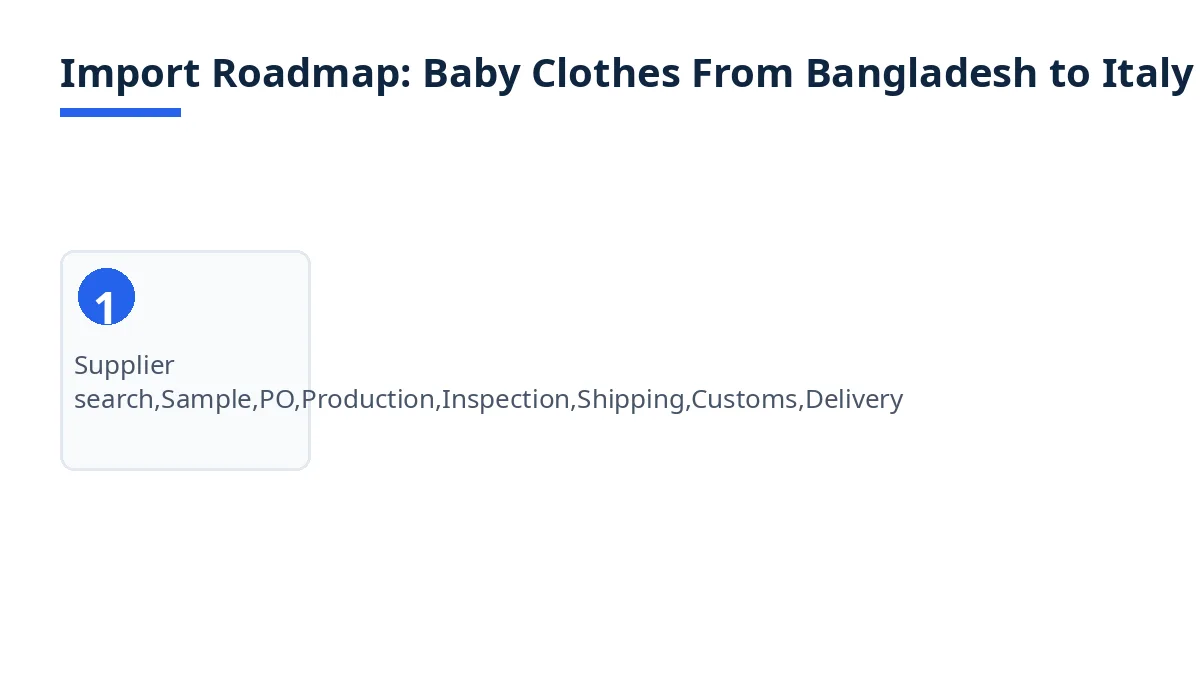
Step-by-step import checklist: how to import baby clothes from Bangladesh to Italy
Write the specification style by style: construction, fibre mix, size curve by height, colourways, closures, trims, Italian label wording, packing and delivery term.
Classify every style, starting from heading 6111 for knitted garments and heading 6209 for woven garments, and confirm each full code and duty with your broker in the EU TARIC schedule.
Shortlist suppliers whose range includes baby clothes, and request comparable quotes on the identical specification and delivery term.
Verify the chosen supplier: company documents, babywear capacity, fabric source, dyeing route, snap fixing route, and a video or in-person factory check for a first order.
Order samples in stages, wash and re-measure them, work every snap repeatedly, approve the Italian label on the pre-production sample, then approve a pre-production sample of each style in production fabric and trims.
Confirm the order in writing: purchase order, pro forma invoice, delivery and payment terms, inspection plan with AQL and defect limits, cord and small-parts rules, labelling, packing and shipment date.
Inspect during production and again on packed goods against the approved samples, checking snap fixing, shade consistency, measurements at every size and Italian label accuracy.
Ship to Genoa or Naples, clear customs with the confirmed code for each style and the agreed proof of origin, and reconcile the actual landed cost.
How Exportain helps
Browse suppliers for Bangladeshi babywear exporters and compare their ranges against your style list. Then post your specification and target quantity as an RFQ and compare replies on the same terms before you choose a factory for sampling. Read how to buy from Bangladesh for the steps from search to shipment on the platform. Exportain is a B2B marketplace where buyers post RFQs, receive quotations and message suppliers. It does not inspect goods, book freight or clear customs. Supplier badges on Exportain are document and photo reviews, not inspections or guarantees, and Exportain is not a party to the goods contract.
FAQs
What is the typical MOQ for baby clothes from Bangladesh?
There is no single typical minimum. It is set per style and usually per colour, because fabric is knitted, dyed or printed in batches and a cutting plan is set up per size curve. Confirm how many pieces per size the minimum assumes before you accept a quote.
How long does shipping take?
Production time and transit time are separate, and neither has a single typical figure. Sea transit from Bangladesh to Genoa or Naples takes weeks rather than days and varies by sailing schedule, routing, transshipment and season. Plan from your forwarder's current schedule to your chosen Italian port, and add clearance and onward delivery.
What import duty applies?
Duty follows the confirmed classification of each style, the destination and the origin. Knitted babies garments sit in heading 6111 and woven babies garments sit in heading 6209, with the fibre splits set out above.2 7 In the European Union, Bangladesh benefits from Everything But Arms duty-free access, subject to origin rules.1 Confirm the preference and the full national code for each style with your broker before you price.
How do I verify a supplier?
Check company documents first, so that name, address and bank account agree across the trade licence, export registration and invoices. Then check capability: babywear capacity, fabric source, dyeing route, snap fixing and recent baby styles from current production. Keep payments to the company account named in the documents, and approve a pre-production sample of each style, including its Italian label, before bulk production.
Next steps on Exportain
Read how to import from Bangladesh for the full process, then work through landed cost for imports from Bangladesh with your own quotes. When ready, browse suppliers and post your baby clothes specification as an RFQ to compare quotes on the same terms.
Sources
- EU trade relations with Bangladesh. European Commission, (accessed )
- Bangladesh Customs Tariff, Chapter 61: Articles of apparel and clothing accessories, knitted or crocheted. National Board of Revenue (accessed )
- ISO 2859-1:2026 - Sampling procedures for inspection by attributes — Part 1: Sampling schemes indexed by acceptance quality limit (AQL) for lot-by-lot inspection. International Organization for Standardization (accessed )
- Regulation (EU) No 1007/2011 on textile fibre names and related labelling and marking of the fibre composition of textile products. European Union, (accessed )
- PRISM: Narrative style risk assessment - non-compliant cords and drawstrings identified in clothing intended for children. GOV.UK (accessed )
- Insider thoughts: Bob Ronai on Incoterms 2020 Rules; What are they about?. International Chamber of Commerce (accessed )
- HS 2012 Classification Detail: Code 6209, babies' garments and clothing accessories, not knitted or crocheted. United Nations Statistics Division (accessed )
- VAT in Italy. Agenzia delle Entrate (accessed )
- Fiscal representative in Italy. Avalara (accessed )
About the author
Sourcing from Bangladesh?
Post a request for quotation and suppliers on Exportain can send you their quotes directly.
Post an RFQ