Baby Clothes From Bangladesh to Germany: A Buyer's Import Checklist
Germany import checklist for baby clothes from Bangladesh: German labels, EBA duty, 19% import VAT, EU cord and chemical safety, samples, MOQ structure and landed cost.
Short answer
To import baby clothes from Bangladesh to Germany, fix a written specification with German-language fibre labels, shortlist suppliers with a current baby-garment range, approve a pre-production sample in bulk fabric, classify knitted garments under heading 6111 or woven garments under 6209, confirm the duty-free Everything But Arms origin claim with a German broker, and budget 19 percent German import VAT on the customs value plus any duty.
On this page
Key takeaways
Germany is the entry point for this guide: a German EORI number, German-language fibre labels, and a German broker confirmation for classification and origin come before bulk production.
Knitted or crocheted babies' garments fall under heading 6111, defined for young children up to 86 cm body height, while woven babies' garments fall under heading 6209.
Under Everything But Arms, qualifying Bangladeshi-origin goods enter the EU duty-free; without a preference, the schedule opened for this guide shows 12.00 percent on non-glove lines of heading 6111, so confirm the claim with a broker.
German import VAT is 19 percent on the customs value plus any duty, and it applies even when duty is zero under EBA.
EN 14682 cord and drawstring safety, REACH chemical restrictions and EU textile labelling are design gates: settle them in the specification and the pre-production sample, not after production.
This guide is written for a buyer in Germany who is placing a first or early order for baby clothes from Bangladesh and wants the German side of the order settled before money moves. It covers the order in German-market order: what must be true about the garment, the supplier and the paperwork before production, then how duty, import VAT and delivery are handled at the German border.
Start with the decision that shapes everything else. A baby garment sold in Germany must carry a German-language fibre label, pass the chemical and cord-safety checks for children's clothing in the EU, and arrive with a customs classification and origin statement your broker can defend. If any of those three is missing, the order is not ready to ship, however good the sample looks.
Why source baby clothes from Bangladesh
Bangladesh supplies knit baby garments at scale, and the practical reason to look there is the combination of knitting capacity and a duty preference into the EU. The EU's Everything But Arms (EBA) scheme is a special arrangement for least developed countries (LDCs) that grants full duty-free and quota-free access to the EU Single Market for all products except arms and ammunition.1 The European Commission's country page confirms that Bangladesh, as a least developed country, benefits from the EBA arrangement, which grants duty-free, quota-free access for all exports except arms and ammunition.2
That preference is the reason this guide treats origin as a buying step, not as paperwork after shipment. Duty-free entry depends on the goods genuinely originating in Bangladesh under the scheme's origin rules, and on proof of that origin being available when customs asks for it. German customs notes that where a tariff concession takes the form of an exemption from customs duty, only the import VAT and any applicable excise duty must be paid, and that preferential treatment for commercial goods is subject to presenting written proof of preferential status.3
Find and verify suppliers
Where should a Germany-based buyer start?
Start with a written specification, then search. The specification should fix the garment type, the fibre composition, the size range, the trim list, the label wording in German, the packing method, and the test reports you require. Send the same specification to every candidate so the quotes you compare describe the same garment.
Verification for a German order has four layers:
Identity and legal standing. Ask for the company registration, the export registration, and the factory address, and check that the name on the quotation matches the name on the documents. Mismatched names are a reason to pause, not a detail to fix later.
Baby-garment capability. Ask for recent baby-garment styles the supplier has made, the size range covered, and the trims used. Ask how snaps, buttons and appliques are attached and tested, because loose trims are a children's safety issue, not a cosmetic one.
Chemical and labelling competence. Ask which lab tests the supplier already runs for EU-bound children's clothing, and whether the supplier can produce German-language fibre labels from your artwork. A supplier that cannot explain its testing route is not ready for a German order.
Export track record. Ask which EU destinations the supplier has shipped to, and whether it has supplied the origin documents a German broker needs. Experience with EU shipments matters because the origin statement and the packing list must match the physical shipment exactly.
Exportain's role here is limited and should be understood plainly. Exportain is a marketplace where buyers find Bangladeshi suppliers, post requests for quotation, receive quotations and message suppliers. It is not a party to the contract for the goods, and it does not inspect goods, book freight or clear customs. Use it to find and compare suppliers, and keep the verification steps above as your own checks.
MOQ, pricing and samples
What should the quotation state?
There is no single typical minimum order quantity, price or lead time that holds across baby-garment styles, fabrics and size ranges, so this guide states none as fact. Instead, require every quotation to state its own figures in writing: minimum quantity per style, per colour and per size; the price basis; the sample cost and whether it is credited against the bulk order; the production time after sample approval; and the payment terms.
Structure the price discussion in four parts:
Fabric and trims. The fibre mix, the fabric weight you choose, and the trim list drive the unit price more than any other factor. Changing a snap type or adding an applique after quotation changes the price, so freeze the trim list before you compare quotes.
Size curve. A baby range is sold as a curve of sizes, not as one size. Ask for the quantity split across the curve, because a supplier's minimum may apply per size rather than per style.
Labelling and packing. German-language labels, hang tags, polybags and carton marking are costs. List them in the quotation so they are not added later as extras.
Testing. Lab testing for EU children's clothing rules is a line item. Ask which tests are included, which lab will run them, and who pays for a retest if a result fails.
Example figures, for structure only, appear in the landed-cost table later in this guide. They are illustrations of how the parts add up, not market prices.
Quality control and certifications needed
Which EU rules decide whether a baby garment can be sold in Germany?
Three sets of rules do most of the work, and each one needs a different check.
First, textile labelling. Textile products must be labelled or marked to give an indication of their fibre composition whenever they are made available on the market, and the labelling must be durable, easily legible, visible and accessible, with the label securely attached.4 The Finnish Safety and Chemicals Agency's textile guidance adds that fibre composition must be indicated in descending order by percentage weight, that linings, fillings and other distinct components must be stated separately, that full fibre names must be used rather than abbreviations, and that mandatory information is generally required in the official language of the relevant market, which for Germany means German.5
Second, chemical safety. Textiles must fulfil the general safety requirements of the EU General Product Safety Regulation, and the chemicals in textiles are regulated by the REACH and CLP Regulations.5 The same guidance notes that azo dyes that may release certain aromatic amines are restricted in textile and leather products in prolonged contact with the skin or the mouth, that nickel release from coated buttons and press studs is restricted, and that certain phthalates are restricted in toys and childcare products.5 For a baby order, ask the lab report to cover the restricted substances that apply to your exact garment and trims, and keep the report with the shipment file.
Third, cords, drawstrings and small parts. The most typical safety issues in textiles include chemicals, cords and drawstrings in children's clothing, small parts that may come off and pose a choking hazard, and insufficient labelling.5 The relevant standard listed for children's clothing cords and drawstrings is EN 14682.5 Treat this as a design rule, not as a test to pass at the end: avoid cords and drawstrings on garments for young children wherever the design allows it, keep any functional cord short and fixed as the standard requires, and check every decorative attachment for pull strength before bulk production.
What should inspection cover?
Agree the inspection plan in the purchase order, not after production. A workable plan for baby clothes includes an inline check during production, a final random inspection before packing, and a lab-test report for the bulk fabric and trims. The inspection checklist should cover measurements against the approved size chart, stitching and seam strength, snap and button attachment, colour and print match against the approved sample, label accuracy in German, and carton contents against the packing list. Record the result per style and per size, and hold shipment if a failure affects safety, labelling or size, even if the rest of the lot looks clean.
Incoterms, shipping and transit time
Which delivery term fits a first German order?
Incoterms 2020 terms allocate cost, risk and customs responsibility between buyer and seller, and the choice matters more than the freight quote alone. The summary used for this guide lists the terms from maximum buyer responsibility to maximum seller responsibility: under EXW the buyer handles everything from the seller's premises, under FCA the seller delivers to the buyer's nominated carrier and clears export, under FOB the seller loads the goods on board and clears export while the buyer pays main carriage, under CIF the seller pays freight and minimum-cover insurance to the destination port while risk still passes at loading, under DAP the seller delivers to the destination ready for unloading while the buyer pays import duty and clearance, and under DDP the seller delivers cleared for import with all duties and taxes paid.6
For a first order into Germany, FCA or FOB through a forwarder you appoint usually gives the best control, because you choose the carrier and see freight and insurance separately. Under CIF the freight is inside the unit price, but risk still passes at loading, so check the insurance cover and destination charges before accepting it.6 DAP suits a buyer who wants the seller to carry transport risk to Germany while handling German customs directly; DDP suits a buyer who wants one delivered price, but only if the seller can genuinely act as importer in Germany.
How should transit be agreed?
Do not accept a single transit figure as a promise. Agree the route, the port of loading, the EU port of entry and the buffer for a missed sailing, and state who pays destination charges and who books onward transport. A shipment that arrives without its origin statement or packing list will wait, and waiting costs more than a slower sailing that arrives complete.
Import duty, taxes and documents
How is a baby garment classified for German customs?
Knitted or crocheted babies' garments and clothing accessories fall under heading 6111, and woven babies' garments fall under heading 6209. The tariff schedule opened for this guide defines babies' garments for heading 6111 as articles for young children of a body height not exceeding 86 cm, and states that articles classifiable both in heading 6111 and in other headings of the chapter are classified in heading 6111.7 Heading 6209 covers babies' garments and clothing accessories that are not knitted or crocheted.8 Classify by construction first, then by fibre: cotton, synthetic fibres, or other textile materials, because the duty line follows that split.
At schedule level, the tariff schedule opened for this guide shows a third-country duty of 12.00 percent on the non-glove lines of heading 6111, and 8.90 percent on glove, mitten and mitt lines.7 That is the rate that would apply without a preference. Under EBA, the rate for qualifying Bangladeshi-origin goods is duty-free, as described above.1 2 Confirm the exact line and the preference claim with your German customs broker before shipment, because a wrong heading or a failed origin claim changes the duty bill, and the broker's confirmation is the document you rely on, not this guide.
What does German import VAT add?
German customs states that the import VAT rate is currently set at 19 percent, with a reduced rate of 7 percent for selected goods such as food products and books, and that the basis for assessment of import VAT is the goods' customs value plus customs duty, plus any applicable excise duties.3 Baby clothes fall under the standard 19 percent rate. For commercial shipments, the full amount of postage up to the domestic place of destination is taken into account when assessing the customs value.3 Where a tariff concession exempts the goods from customs duty, only the import VAT and any applicable excise duty must be paid.3
Work through the sequence in order: customs value first, duty second, import VAT on the sum. A broker who quotes duty and VAT as a single percentage has skipped a step. Ask for the three lines separately.
Which documents must travel with the shipment?
Commercial invoice, with the price basis, the classification per line, and the origin statement.
Packing list, matching the cartons exactly, with quantities per style, colour and size.
Bill of lading or air waybill, matching the invoice and packing list.
Certificate or statement of origin supporting the EBA preference claim, in the form your broker confirms.
Lab test reports for the bulk fabric and trims, kept in the shipment file.
German-language label artwork approval, signed before production.
What is an EORI number, and who needs one?
An EORI (Economic Operators Registration and Identification) number is a unique number issued by the competent authorities in the European Union that allows customs to identify economic operators.9 An operator established in the European Union applies for the EORI number in the member state where it is resident, and there is an obligation for economic operators to quote an EORI number on customs declarations.9 A Germany-based buyer therefore applies in Germany and quotes the number on the import declaration. If you use a customs broker, give the broker your EORI number before the shipment sails, and check that the declaration carries it.
Landed cost example (table)
Example figures only. The table below shows how the parts of a German import add up. It is not a price list, and every figure must be replaced with your own quotation, freight quote and broker confirmation before you order.
Cost line | Example figure (EUR) | Note |
|---|---|---|
Goods, FOB Chittagong | 10,000 | Example figures |
International freight and insurance to the EU port | 1,200 | Example figures |
Customs value | 11,200 | Goods plus freight and insurance |
Import duty under EBA, if origin is proven | 0 | |
Import VAT at 19 percent on customs value plus duty | 2,128 | 19 percent rate per German customs3 |
Example pre-shipment inspection | 400 | Example figures |
Example inland transport to a German warehouse | 300 | Example figures |
Example landed total, including import VAT | 14,028 | Example figures; VAT treatment in your accounts is a matter for your tax adviser |
Read the table as a checklist, not as a budget. If the EBA claim fails, duty is charged at the schedule rate and the import VAT base rises by that duty amount. If the freight quote excludes destination charges, those appear after arrival.
Step-by-step import checklist
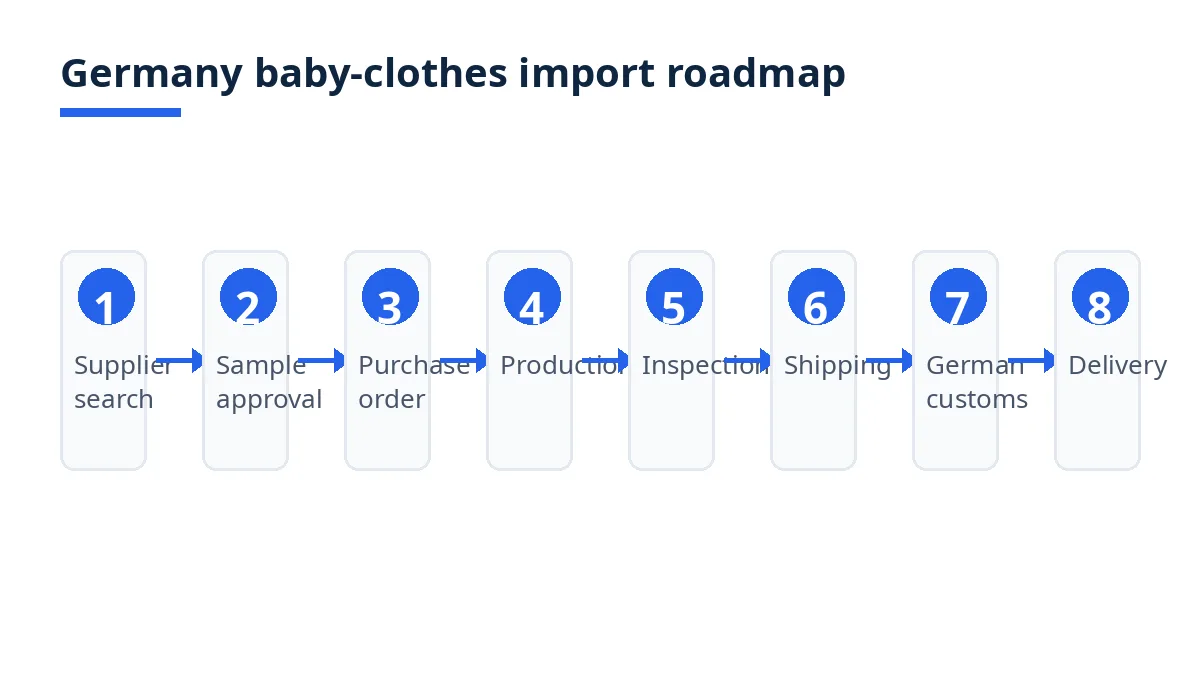
Write the specification: garment, fibre, sizes to 86 cm, trims, German label wording, packing and tests.
Shortlist suppliers with a current baby-garment range, and send the same specification to each one.
Compare quotations on the same basis: MOQ per style, colour and size; price basis; sample terms; testing included.
Approve a proto sample, then a pre-production sample in bulk fabric with final trims and the German label.
Confirm the classification: heading 6111 for knitted or crocheted garments, heading 6209 for woven garments, with the fibre split.7 8
Confirm the EBA origin claim and the exact origin document with your German broker.1 2
Agree the Incoterms 2020 term, the route, the port of entry and who pays destination charges.6
Agree the inspection plan and the lab tests, and put both in the purchase order.
Confirm your EORI number is on the import declaration.9
Check the invoice, packing list and transport document against each other before the shipment sails.
On arrival, pay the duty, if any, and the 19 percent import VAT on the customs value plus duty.3
Check the delivered cartons against the packing list and the approved sample before accepting the goods.
How Exportain helps
Exportain helps a Germany-based buyer at the start of the order, not at the border. Use the marketplace to find Bangladeshi suppliers with a baby-garment range, post a request for quotation with your written specification, compare quotations on the same basis, and message suppliers about samples, testing and origin documents. The buying journey on the site is described on the how-to-buy page, and the supplier search starts from the supplier directory. Keep the checks in this guide as your own responsibility: classification, origin, labelling, testing, inspection and German customs clearance are decisions for you and your broker, because Exportain is not a party to the goods contract and does not inspect goods, book freight or clear customs.
For background on the wider import process, see the guide on how to import from Bangladesh, the landed cost guide, the HS code guide for baby clothes, and the quality control checklist for baby clothes.
FAQs
What is the typical MOQ for baby clothes from Bangladesh?
There is no single typical MOQ that holds across styles, fabrics and size ranges. Require each supplier to state its minimum per style, per colour and per size in writing, and compare those three figures together. A low headline minimum that applies per size is a larger order than a higher minimum that applies per style.
How long does shipping take?
This guide states no transit time as fact, because the time depends on the route, the sailing schedule, the EU port of entry and the onward transport to your warehouse. Ask your forwarder for the sailing schedule, the expected arrival window and the buffer for a missed sailing, and put the route and the delivery term in the purchase order. A shipment that arrives without its origin document or packing list will wait regardless of how fast the vessel was.
What import duty applies?
For qualifying Bangladeshi-origin baby clothes, the EBA scheme grants duty-free access to the EU Single Market.1 2 Without a preference, the tariff schedule opened for this guide shows 12.00 percent on the non-glove lines of heading 6111.7 Confirm the line and the preference claim with your German customs broker before shipment. Import VAT at 19 percent applies on the customs value plus duty, even when duty is zero.3
How do I verify a supplier?
Verify identity, baby-garment capability, chemical and labelling competence, and EU export experience, in that order. Ask for matching registration documents, recent baby-garment styles, lab test reports for EU-bound children's clothing, German-language label samples, and the origin documents used for earlier EU shipments. Visit the factory or appoint an inspector if the order value justifies it, and never treat a marketplace listing alone as verification.
Next steps on Exportain
Start with a written specification and a shortlist, not with a price negotiation. Browse suppliers for baby-garment ranges, read how to buy for the buying steps, and post your specification as a request for quotation so suppliers quote the same garment. Then run the checklist in this guide, from sample approval to the German customs declaration, before bulk production begins.
Sources
- Trade arrangements. European Commission, Access2Markets (accessed )
- EU trade relations with Bangladesh. European Commission, (accessed )
- Assessment of taxes and duties. German Customs (Zoll) (accessed )
- Regulation (EU) No 1007/2011 on textile fibre names and related labelling and marking, Article 14: Labels and markings. legislation.gov.uk (accessed )
- Textiles. Finnish Safety and Chemicals Agency (Tukes) (accessed )
- Incoterms 2020 Guide for Importers. Importivity (accessed )
- Babies' garments and clothing accessories, knitted or crocheted - Northern Ireland Online Tariff, heading 6111. UK Government (accessed )
- HS 6209 Guide: Classify Baby Suits & Duties Tips. FreightAmigo (accessed )
- Using the EORI number. German Customs (Zoll) (accessed )
About the author
Sourcing from Bangladesh?
Post a request for quotation and suppliers on Exportain can send you their quotes directly.
Post an RFQ