

Baby Clothes From Bangladesh to France: A Buyer's Import Checklist
France buyer's guide to importing baby clothes from Bangladesh: French EORI and VAT autoliquidation, EBA duty-free entry, French-language labels, Triman sorting, Le Havre and Fos routes, and a worked landed-cost example.
Short answer
To import baby clothes from Bangladesh to France, fix a style-by-style specification with French labels, verify a supplier that already makes baby garments in your construction, approve a pre-production sample, classify each style under heading 6111 or 6209, claim duty-free entry under Everything But Arms where the origin rules are met, and clear through Le Havre or Fos-sur-Mer with your French EORI and VAT numbers on the declaration.
On this page
Key takeaways
Under Everything But Arms, qualifying Bangladeshi-origin baby clothes enter the EU duty-free, but the preference depends on origin rules and proof of origin agreed at order stage.
Knitted or crocheted babies garments fall under heading 6111 and other babies garments under heading 6209, so classify by construction first, then by fibre, and confirm each full code with a French broker.
Since 1 January 2022, French import VAT is self-assessed on the VAT return rather than paid in cash at the border, and the standard French VAT rate is 20 percent.
French labels must carry fibre composition in French, plus Triman sorting information, and baby garments must avoid cords and drawstrings in the head, neck and upper chest area under EN 14682.
There is no single typical MOQ, price or transit time for baby clothes, so confirm each figure in writing for your exact style, size curve, route and shipment date.
A France-based buyer importing baby clothes from Bangladesh faces a different set of border questions than a buyer in any other market, and those questions should be settled before bulk production starts. The goods enter the European Union through a French port such as Le Havre or Fos-sur-Mer, the import VAT is handled on the French VAT return rather than paid in cash at the border, the fibre label must read in French, and the garment carries French sorting information for the consumer.
This guide follows one order from specification to delivery in France. It covers how to find and check a supplier, what to agree on quantity, price and samples, which safety and labelling rules apply to baby garments sold in France, how duty and French VAT work, and how to build a landed cost. Every figure in the landed-cost table is an example figure, not a quote, and every duty statement should be confirmed with a French customs broker for the exact garment and entry date.
Why source baby clothes from Bangladesh
Bangladesh makes baby garments in both constructions a French buyer will order: knitted or crocheted pieces such as bodysuits, sleepsuits and rompers, and woven pieces such as dresses, shirts and dungarees. That split matters from the first day, because the two constructions sit in different tariff headings and follow different production routes.
The duty position is the other reason France-based buyers look at Bangladesh. The Everything But Arms scheme is a special arrangement for least developed countries, granting full duty-free and quota-free access to the EU Single Market for all products except arms and ammunition.1 Duty-free entry is not automatic: the goods must genuinely originate in Bangladesh under the scheme's origin rules, and the proof of origin must be available when French customs asks for it.
Find and verify suppliers
Where should a France-based buyer start?
Start with a written specification, then search. The specification should fix the garment type, the construction, the fibre composition, the size curve in the month bands you sell, the trim list, the French label wording, the packing method, and the test reports you require. Send the same specification to every candidate so the quotes you compare describe the same garment.
How do you verify a supplier before you pay?
Verification has four layers. The first is identity and legal standing: company registration, export registration and factory address, checked so that the name on the quotation matches the name on the documents and on the bank account. The second is baby-garment capability: recent baby styles the supplier has made, the size range covered, and how snaps, buttons and appliques are attached and tested, because loose trims on a baby garment are a safety issue, not a cosmetic one. The third is labelling and testing competence: whether the supplier can produce French-language fibre labels from your artwork and which lab tests it already runs for EU-bound children's clothing. The fourth is export track record: whether it has shipped to the EU and can supply the origin documents a French broker needs. On Exportain, supplier profiles carry document and photo review badges: a badge is a review of documents and photos, not a factory inspection or a guarantee, and Exportain is not a party to the goods contract.
MOQ, pricing and samples
What is the typical MOQ for baby clothes from Bangladesh?
There is no single typical minimum order quantity for baby clothes from Bangladesh. The minimum is set per style and usually per colour and per size, because fabric is knitted, dyed or printed in batches and a cutting plan is set up per size curve. A plain cotton bodysuit and a printed woven dress with several trims will not carry the same minimum. Ask each supplier how its minimum splits by style, colour and size, and read typical MOQ for baby clothes in Bangladesh for how minimums are structured.
How is the price built, and how should you compare quotes?
Fabric and trims drive the unit price more than any other factor, followed by cutting and sewing, dyeing or printing, testing, labelling and packing. A baby range is sold as a curve of sizes, so ask for the quantity split across the curve: a supplier's minimum may apply per size rather than per style. Freeze the trim list before you compare quotes, because changing a snap type or adding an applique after quotation changes the price. Compare quotes only on the same basis: same garment, same size curve, same delivery term, same packing and same testing inclusions.
Which samples do you need, and how do you approve them?
Work in stages. A development sample shows whether the factory understood the specification and can construct the garment. A pre-production sample, made in the actual production fabric, colour, trims and labels, is the sample you approve for bulk. Check it the way a parent will use the garment: measure every size against your chart, test every snap and button for attachment, check that prints and colours match across sizes, and confirm the French label wording and the sorting information before bulk label sewing begins. Approve in writing and keep one sealed counter-sample of each style.
Quality control and certifications needed
Which French and EU rules decide whether a baby garment can be sold in France?
Four sets of rules do most of the work, and each one needs a different check.
First, product safety. Under the EU General Product Safety Regulation, importers must ensure the product complies with the general safety requirement before placing it on the market, must indicate their name, registered trade name or trade mark and postal and electronic address on the product, its packaging or an accompanying document, and must ensure the product is accompanied by clear instructions and safety information in a language easily understood by consumers in the member state where it is made available.2 For France, that language is French. In France, the DGCCRF is the department of the Ministry of Economy responsible for ensuring respect for consumer law by companies, including the safety and conformity of consumer products and services.3
Second, cords, drawstrings and small parts. Garments intended for young children must not be designed, manufactured or supplied with drawstrings or functional cords in the head, neck or upper chest area, and decorative cords are not permitted on the hood or at the back of the neck, under the European standard EN 14682.4 Treat this as a design rule, not as a test to pass at the end: avoid cords on garments for young children wherever the design allows it, and check every button, snap and applique for pull strength before bulk production.
Third, textile labelling. Fibre composition descriptions must be indicated in catalogues and trade literature, on packaging, labels and markings in a manner that is easily legible, visible and clear, and clearly visible to the consumer before purchase, including where the purchase is made by electronic means.5 The labelling or marking must be provided in the official language or languages of the member state where the textile products are made available to the consumer, unless that member state provides otherwise.5 For a French order, that means French fibre names on the label, for example 100% coton for a cotton garment, with percentages in descending order by weight.
Fourth, French sorting information. The AGEC law No. 2020-105 of 10 February 2020 seeks to reduce waste and promote the circular economy in France, and its sorting information and Triman logo were approved on 1 February 2022 and became compulsory on all clothing, household linen and footwear placed on the market in France on 1 February 2023.6 A baby garment sold in France therefore carries the Triman sorting information alongside the fibre label.
Which certifications do you actually need?
No single certificate covers every baby-clothes order. What you need follows your customer and your market: a retailer may name specific lab tests in its own supplier manual, and the lab report must cover your exact garment and trims, not a different fabric or an untrimmed version. Ask which tests are included in the quotation, which lab will run them, and who pays for a retest if a result fails. Keep every report with the shipment file, with its scope, product covered, issuing body and date.
Incoterms, shipping and transit time
Which delivery term should a first French order use?
The Incoterms 2020 rules allocate cost, risk and customs responsibility between seller and buyer. Under EXW the buyer takes on everything from the seller's premises, under FCA the seller delivers to the buyer's nominated carrier and clears export, under FOB the seller loads the goods on board and clears export while the buyer pays main carriage, under CIF the seller pays freight and minimum-cover insurance to the destination port while risk still passes at loading, under DAP the seller delivers to the destination ready for unloading while the buyer pays import duty and clearance, and under DDP the seller delivers cleared for import with all duties and taxes paid.7
For a first order shipped in containers, weigh FCA at the named terminal against FOB at Chattogram. A container is handed to the carrier before it is on board, so a term that matches container movement avoids a gap in risk transfer. DAP suits a buyer who wants the seller to carry transport risk to France while handling French customs directly. DDP suits a buyer who wants one delivered price, but only if the seller can genuinely act as importer in France: under DDP the foreign seller must register for VAT in France, and a non-EU seller acting as importer of record in France generally needs an accredited fiscal representative.8
There is no single typical transit time for baby clothes from Bangladesh to France: sea freight takes weeks rather than days, varying by port, routing, transshipment and season. Choose the entry port with your forwarder and your warehouse in mind, Le Havre for northern France and Paris or Fos-sur-Mer for the Mediterranean south, and name the port of loading, the EU port of entry and the buffer for a missed sailing in the order.
Import duty, taxes and documents
How is a baby garment classified for French customs?
Classify by construction first, then by fibre. For the purposes of heading 6111, the expression babies garments and clothing accessories means articles for young children of a body height not exceeding 86 cm, and articles classifiable both in heading 6111 and in other headings of the chapter are classified in heading 6111.9 Heading 6209 covers babies garments and clothing accessories that are not knitted or crocheted: 620920 for cotton, 620930 for synthetic fibres and 620990 for other textile materials.10 A knitted cotton bodysuit, a woven cotton dress and a synthetic sleepsuit in one order can therefore sit on three different lines.
What import duty applies?
Duty follows the confirmed classification of each style, the origin and any preference in force on the entry date, so there is no single rate for a whole baby-clothes order. Under Everything But Arms, qualifying Bangladeshi-origin goods enter the EU duty-free and quota-free, except arms and ammunition.1 Without a preference, the rate is the standard third-country rate for the exact line in the EU tariff, which your broker must confirm: do not copy a rate from another product or another country.
What does French import VAT add?
The standard VAT rate in France is 20%, and VAT is due on goods sold and services rendered in France.11 Since 1 January 2022, the use of the import VAT reverse charge has been compulsory in France for businesses registered for VAT, with the declaration and payment of import VAT made directly in the French VAT return instead of the customs declaration, as a reverse charge self-assessed by the taxpayer.12 The reverse charge procedure allows businesses to self-assess and deduct import VAT simultaneously in the VAT return without physically paying cash at the border, and for most businesses this produces a nil net effect with no physical payment required.12 The VAT return is pre-filled automatically with the amount of import VAT due, based on the information previously declared to customs, and businesses are responsible for verifying the pre-filled amounts.12
Work through the sequence in order: customs value first, duty second, import VAT on the sum. Give your French intra-community VAT number to your customs representative before importation so that it is added to the customs declaration.12 Where an importer does not have a French intra-community VAT number, it should contact the tax authority to obtain one, and for businesses based outside the EU, a fiscal representative may be required.12
What is a French EORI number, and who needs one?
Without an EORI number, a company does not exist in the eyes of European customs for import purposes: for a French company the number is FR plus the SIRET, and a foreign company must apply for a specific EORI if it imports in its own name.8 In France, the EORI community identifier number can now be based on the SIREN as of 5 April 2023, and operators without an EORI SIREN number can request one through the online service.13 A France-based buyer therefore applies in France, quotes the number on the import declaration, and gives it to the broker before the shipment sails.
Which documents must travel with the shipment?
The standard import set is the commercial invoice, packing list, bill of lading or air waybill, and proof of origin where a preference is claimed. The invoice should name each style plainly, for example knitted cotton baby bodysuit, with composition, size curve, quantities, unit prices and the delivery term, on its own line. Keep knitted, woven, cotton and synthetic styles on separate lines matching their classifications, and keep quantities, weights and carton counts in agreement across every document.
Landed cost example
A landed cost is the full cost of one garment, ready to sell. Every number below is an example figure only, not a quote.
Example figures: 5,000 knitted cotton baby bodysuits, FOB Chattogram, sea freight to Le Havre, duty at zero under Everything But Arms for qualifying goods.
Cost element | Example figures (per garment) | How to obtain your figure |
|---|---|---|
Product price, FOB | $2.85 | Confirmed pro forma invoice |
International freight | $0.42 | Forwarder quote divided by garments shipped |
Insurance | $0.03 | Policy or forwarder quote |
Duty | $0.00 | Broker calculation from confirmed codes and EBA claim |
Port, clearance and broker fees | $0.31 | Broker invoices divided by garments |
Local delivery to warehouse | $0.18 | Local carrier quote divided by garments |
Inspection and testing | $0.12 | Inspection company and lab quotes divided by garments |
Total landed cost | $3.91 | Sum of all lines above |
Import VAT, example figures | $0.66 | Example figures: 20% applied to the customs value plus duty in this example, declared on the VAT return and deducted, not added to the total |
Import VAT is not included in the total, because a VAT-registered buyer declares and deducts it on the return. Work the calculation twice: at quote stage, style by style, and again after shipment with the actual invoices.
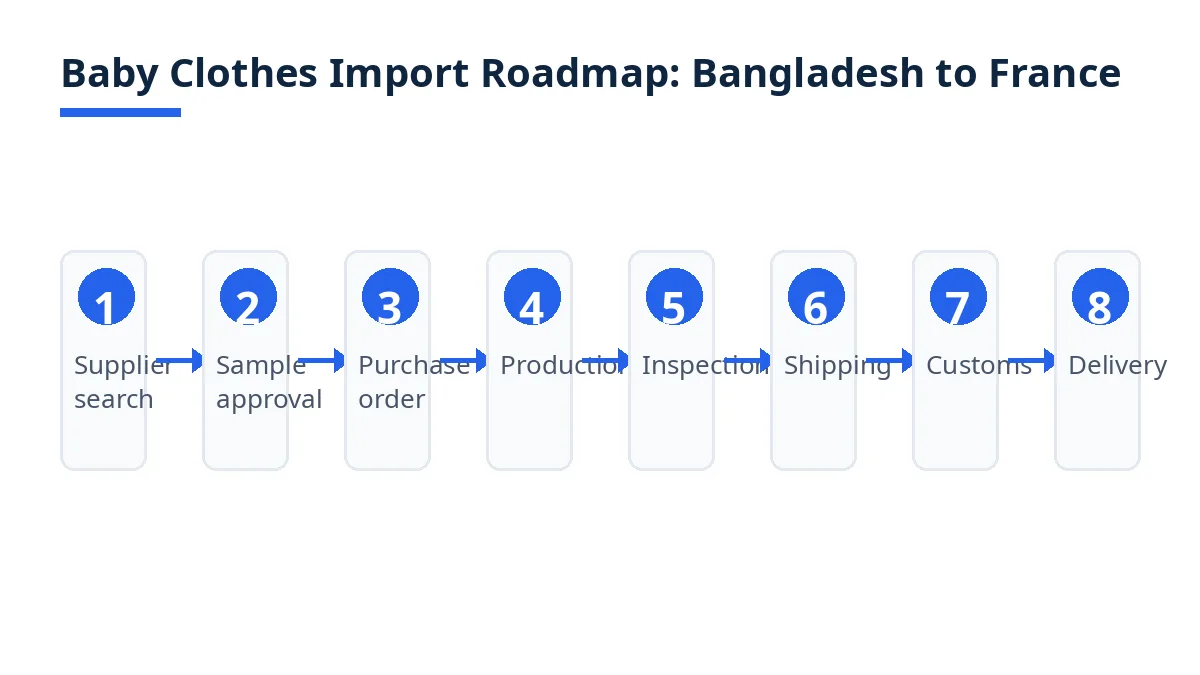
Step-by-step import checklist: how to import baby clothes from Bangladesh to France
Write the specification style by style: construction, fibre, size curve, trims, French label wording, sorting information, labels and packing.
Classify every style, starting from headings 6111 for knitted or crocheted babies garments and 6209 for other babies garments, and confirm each full code and duty with your French broker.
Shortlist suppliers whose range already includes baby garments in your construction, and request comparable quotes on the identical specification and delivery term.
Verify the chosen supplier: company documents, baby-garment capacity, trim attachment and testing route, French label capability, and EU shipment track record.
Order samples in stages, measure every size, test every trim, check the French label and sorting information, then approve a pre-production sample of each style in production fabric and trims.
Confirm the order in writing: purchase order, pro forma invoice, delivery and payment terms, inspection plan and shipment date.
Agree the origin statement and the proof of origin at order stage, and give your French EORI and VAT numbers to the broker before the shipment sails.
Inspect during production and again on packed goods against the approved samples, checking measurements, trim attachment, label accuracy in French and carton contents.
Ship through Le Havre or Fos-sur-Mer as agreed, clear customs with the confirmed code for each style, and reconcile the actual landed cost.
How Exportain helps
Browse suppliers for Bangladeshi baby-clothes exporters and compare their ranges against your style list. Then post your specification and target quantity as an RFQ and compare replies on the same terms before you choose a factory for sampling. Read how to buy from Bangladesh for the buying steps on the platform. Exportain is a B2B marketplace where buyers post RFQs, receive quotations and message suppliers. It does not inspect goods, book freight or clear customs.
FAQs
What is the typical MOQ for baby clothes from Bangladesh?
There is no single typical minimum. It is set per style and usually per colour and per size, because fabric is knitted, dyed or printed in batches and a cutting plan is set up per size curve. Ask each supplier how its minimum splits by style, colour and size, and confirm the split in writing before you compare quotes.
How long does shipping take?
Production time and transit time are separate, and neither has a single typical figure. Sea transit takes weeks rather than days and varies by port, routing, transshipment and season, so plan from your forwarder's current sailing schedule.
What import duty applies?
Duty follows the confirmed classification of each style, the origin and any preference in force on the entry date. Knitted or crocheted babies garments fall under heading 6111, and other babies garments fall under heading 6209.10 Under Everything But Arms, qualifying Bangladeshi-origin goods enter the EU duty-free and quota-free, except arms and ammunition.1 Without a preference, confirm the standard rate for the exact line in the EU tariff with your French broker before you price.
How do I verify a supplier?
Check company documents first, so that name, address and bank account agree across the registration, export documents and invoices. Then check capability: baby-garment production in your construction, size range, trim attachment and testing, French label capability, and EU shipment track record. Keep payments to the company account named in the documents, and approve a pre-production sample of each style before bulk production.
Next steps on Exportain
Read how to import from Bangladesh for the full process, then work through landed cost for imports from Bangladesh with your own quotes. When ready, browse suppliers and post your baby-clothes specification as an RFQ to compare suppliers on the same terms.
Sources
- Trade arrangements. European Commission, Access2Markets (accessed )
- Regulation (EU) 2023/988 on general product safety. European Union (accessed )
- In which cases should the Commission refer the matter to the DGCCRF?. Service-Public.fr (accessed )
- PRISM: Narrative style risk assessment - non-compliant cords and drawstrings identified in clothing intended for children. GOV.UK (accessed )
- Regulation (EU) No 1007/2011 on textile fibre names and related labelling and marking of the fibre composition of textile products, Article 16. European Union, (accessed )
- Understanding the AGEC Law. Refashion (accessed )
- Incoterms 2020 Guide for Importers. Importivity (accessed )
- Importing into France: EORI, VAT & Reverse Charge Guide. Eurofiscalis (accessed )
- Babies' garments and clothing accessories, knitted or crocheted - Heading 6111. UK Government (UK Integrated Online Tariff) (accessed )
- HS 2012 Classification Detail: Code 6209, babies' garments and clothing accessories, not knitted or crocheted. United Nations Statistics Division (accessed )
- France - Corporate - Other taxes. PwC (accessed )
- Changes to import VAT in France come into effect January 1, 2022. Avalara (accessed )
- Towards a single EORI SIREN number for your customs formalities. Service-Public.fr (accessed )
About the author
Sourcing from Bangladesh?
Post a request for quotation and suppliers on Exportain can send you their quotes directly.
Post an RFQ


