HS Code for Women's Blouses: Classification Guide for Importers
Women's woven blouses sit in heading 6206: cotton at 6206.30 and man-made fibers at 6206.40. This guide covers the deciding factors and the US, EU and UK national codes.
Short answer
Women's or girls' woven blouses, shirts and shirt-blouses sit in heading 6206 of the Harmonized System. The six-digit line follows the fiber: 6206.10 for silk, 6206.20 for wool or fine animal hair, 6206.30 for cotton, 6206.40 for man-made fibers and 6206.90 for other textile materials. Knitted blouses sit in heading 6106 instead. Countries extend the six digits to eight or ten for national tariffs.
On this page
Key takeaways
Women's or girls' woven blouses, shirts and shirt-blouses sit in heading 6206, with the six-digit line set by fiber.
Cotton blouses sit at 6206.30 and man-made fiber blouses at 6206.40; silk is 6206.10, wool is 6206.20 and other materials are 6206.90.
A knitted or crocheted blouse leaves heading 6206 for heading 6106, because Chapter 62 excludes knitted or crocheted articles.
Garments with pockets below the waist or tightening at the bottom of the garment are not covered by heading 6206.
In the UK tariff the residual blouse line runs to ten digits as 6206909000, with a third country duty line of 12.00%.
If you import women's blouses, the hs code for women's blouses is the line your customs entry, duty calculation and origin claim depend on. The Harmonised System is an international classification system developed by the World Customs Organization (WCO), with approximately 5,000 six-digit product categories organised by sections, chapters at two digits, headings at four digits and sub-headings at six digits.1 A woven blouse for women or girls sits in heading 6206, and the fabric decides the six-digit line.
Quick answer: indicative heading 6206
Women's or girls' woven blouses, shirts and shirt-blouses sit under heading 6206. The United Nations Statistics Division lists chapter 62 as apparel and clothing accessories, not knitted or crocheted, and heading 6206 as "Blouses, shirts and shirt-blouses; women's or girls' (not knitted or crocheted)".2
Inside heading 6206, the six-digit split is by textile material: 6206.10 covers silk or silk waste, 6206.20 covers wool or fine animal hair, 6206.30 covers cotton, 6206.40 covers man-made fibres, and 6206.90 covers other textile materials.2 Treat the fibre line as the indicative six-digit answer, then verify the full national code before you file an entry.
How HS codes are structured
The HS organises approximately 5,000 six-digit product categories by sections, chapters at two digits, headings at four digits and sub-headings at six digits, supported by general rules for interpretation and explanatory notes.1
Level | Digits | For women's blouses |
|---|---|---|
Chapter | 2 digits (62) | Articles of apparel and clothing accessories, not knitted or crocheted |
Heading | 4 digits (6206) | Blouses, shirts and shirt-blouses, women's or girls' |
Subheading | 6 digits (6206.30, for example) | Blouses, shirts and shirt-blouses, of cotton |
National extension | 8 to 10 digits | Set by the importing country, where fibre and garment splits appear |
The diagram below summarises the four levels.
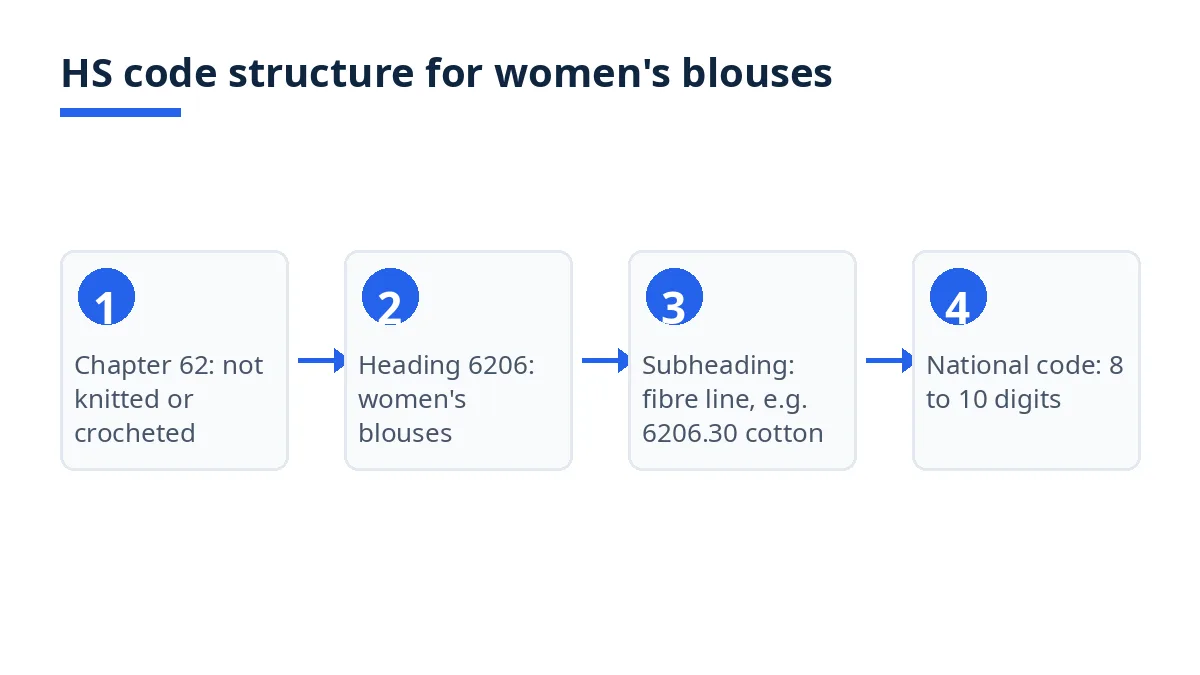
Countries use the HS as the basis for customs tariffs and statistical data, and they subdivide the six-digit categories into national subheadings; the Combined Nomenclature of the European Union uses eight-digit codes.1 The current version is HS 2022.1 New to the system? Read the 6-digit HS code guide and the harmonized system tariff code explainer.
Factors that decide the code for women's blouses
Classification follows the headings and chapter notes, not a retail listing or the word blouse on an invoice.
Woven construction, not knitted. Chapter 62 of the US Harmonized Tariff Schedule applies only to made up articles of any textile fabric other than wadding, excluding knitted or crocheted articles.3 A woven blouse therefore belongs in Chapter 62. A knitted or crocheted blouse is outside it: the European Commission's textile guidance places shirts and shirt blouses under heading codes 6106, if knitted or crocheted, or 6206.4 Check the fabric construction first, because a knitted style in a blouse cut takes the Chapter 61 heading.
The blouse test. Shirts and shirt-blouses are garments designed to cover the upper part of the body, having long or short sleeves and a full or partial opening starting at the neckline, while blouses are loose-fitting garments also designed to cover the upper part of the body but may be sleeveless and with or without an opening at the neckline, and all three may have a collar.3 The Commission's guidance adds that blouses of heading 6206 do not have to have an opening at the neckline.4
Pockets and tightening can move the garment out of 6206. Headings 6205 and 6206 do not cover garments with pockets below the waist, with a ribbed waistband or other means of tightening at the bottom of the garment.3 The Commission's guidance points the same way: pockets below the waist can move a garment to jackets of heading 6204, and a ribbed waistband or other tightening at the bottom can move it to wind jackets of heading 6202.4
Fibre composition and blends. The six-digit split inside heading 6206 is by textile material: silk or silk waste at 6206.10, wool or fine animal hair at 6206.20, cotton at 6206.30, man-made fibres at 6206.40 and other textile materials at 6206.90.2 For a blend, the textile section notes classify a mixture as the single textile material that predominates by weight over any other single material.5 A cotton blouse with a small elastane share stays on the cotton line when cotton predominates by weight; a polyester-predominant blouse moves to 6206.40. Record the exact fibre percentages by weight for every style.
Wearer group and closure. Heading 6206 covers women's or girls' garments only.2 Chapter 62 note 9 in the US schedule adds the closure rule: a right over left front closure marks a women's or girls' garment and a left over right closure a men's or boys' garment, and a garment that cannot be identified as either goes to the women's or girls' headings.3
National codes: US HTS, EU CN and TARIC, UK commodity code
United States: HTS, ten digits. The US schedule splits the six-digit lines further at eight digits. Silk takes a single line, 6206.10.00, while wool splits into certified hand-loomed and folklore products at 6206.20.10, blouses containing 30 percent or more by weight of silk or silk waste at 6206.20.20, and other blouses at 6206.20.30.3 Cotton splits into hand-loomed products at 6206.30.10, blouses containing 36 percent or more by weight of flax fibers at 6206.30.20, and other blouses at 6206.30.30, and man-made fibers split on the same pattern at 6206.40.10, 6206.40.20, 6206.40.25 and 6206.40.30.3 Other textile materials take the single line 6206.90.00.3 The statistical suffix then separates women's from girls' garments.3 Read the full ten-digit line for your garment rather than copying a code from a similar style.
European Union: CN at eight digits, TARIC for measures. The Combined Nomenclature integrates the HS and adds EU subdivisions, producing eight-digit codes.1 The six-digit fibre split carries through, so a cotton blouse reads 6206 30 00 at eight digits and a man-made fiber blouse reads 6206 40 00, with the residual line at 6206 90 90. For origin Bangladesh, read the line in TARIC for the entry date, because preferential treatment depends on origin rules and proof of origin rather than on the code alone.
United Kingdom: commodity code. The UK builds its commodity code on the same first six digits and sets its own extension after them, in the same way other countries subdivide the six-digit categories into national subheadings.1 In the UK Integrated Online Tariff, the residual blouse line runs to ten digits as commodity code 6206909000, "Of other textile materials", with 6206 9090 as the code for exporting and Intrastat reporting.5 Take the full code from the UK Trade Tariff for your garment and entry date, and never reuse a US code for a UK entry.
How to confirm the code officially
Use this sequence for each style, and keep the evidence in the shipment file.
Write a precise description: woven or knitted construction, fibre percentages by weight, garment type (blouse, shirt or shirt-blouse), wearer group, pockets below the waist or tightening at the bottom, and the front closure direction.
Start from the official tariff for the destination: the USITC HTS, TARIC or the UK Trade Tariff. Read the heading text and chapter notes, not only the search result line.
Check published rulings for similar garments. For the United States, the USITC advises traders to use the Customs Rulings Online Search Service (CROSS), because the correct classification of many items can be found there.6
For a borderline garment, such as a knitted blouse-look style or a blend near an even fibre split, apply for a binding decision before you ship. In the EU, a Binding Tariff Information (BTI) application needs a separate application for each type of product and a detailed description of the goods.7 In the United Kingdom, a legally binding decision is generally valid for 3 years, through an Advance Tariff Ruling.8 In the United States, if the merchandise is not described in any ruling on CROSS, you may submit a request for a binding ruling to U.S. Customs and Border Protection.6
Give your broker the description and the confirmed code, and use the same code on the invoice, packing list and declaration.
Common classification mistakes
Filing a knitted blouse under 6206. Chapter 62 excludes knitted or crocheted articles,3 and shirts and shirt blouses fall under heading 6106 when they are knitted or crocheted.4 A knitted blouse in a woven-look print is not a Chapter 62 blouse.
Ignoring pockets and hems. Headings 6205 and 6206 do not cover garments with pockets below the waist or with a ribbed waistband or other means of tightening at the bottom.3 A top with pockets below the waist or a tightened hem needs a fresh heading check.
Filing a blend on the minority fibre. A mixture is classified as the material that predominates by weight.5 If polyester outweighs cotton, the line is 6206.40,2 not the cotton line at 6206.30.
Using the men's shirt heading for a women's style. Heading 6206 covers women's or girls' blouses, shirts and shirt-blouses,2 and a right over left front closure marks a women's or girls' garment under the US chapter notes.3 A women's woven shirt filed under heading 6205, the men's or boys' shirt heading, starts the entry on the wrong heading.
Copying a code from another country. A six-digit match does not mean the national code matches. The EU extends the six digits to eight in the Combined Nomenclature,1 and the UK tariff runs the residual blouse line to ten digits as 6206909000.5 Check the import line in the destination tariff before shipping.
Related duties and documents
The code decides which duty line and measures customs applies, but this guide states no general duty rate. On the UK tariff page for commodity code 6206909000, the schedule lines show a third country duty of 12.00% and a Developing Countries Trading Scheme Comprehensive Preferences line of 0.00%.5 Those lines are indicative only for that code on that tariff: read the rate beside your confirmed code for your origin and entry date, and check what proof of origin a preference claim requires.
FAQs
What is the HS code for women's blouses?
Women's or girls' woven blouses, shirts and shirt-blouses sit under heading 6206, "Blouses, shirts and shirt-blouses; women's or girls' (not knitted or crocheted)".2 The six-digit line follows the fibre: 6206.10 for silk or silk waste, 6206.20 for wool or fine animal hair, 6206.30 for cotton, 6206.40 for man-made fibres and 6206.90 for other textile materials.2 Verify the full national code before use.
Is the HS code the same in every country?
Only the first six digits are harmonized. Beyond six digits, each country sets its own lines: eight digits in the EU Combined Nomenclature,1 and ten digits in the United States, where the eight-digit lines separate hand-loomed products and weight-based fibre thresholds,3 and in the United Kingdom, where the residual blouse line is 6206909000.5
How do I confirm the correct code?
Describe the garment precisely, look the code up in the destination tariff, and read the heading text and chapter notes. Check published rulings, such as CROSS for the United States.6 For a borderline garment, apply for a binding decision before shipping: a BTI in the EU,7 an Advance Tariff Ruling in the United Kingdom,8 or a binding ruling from U.S. Customs and Border Protection.6
What happens if I use the wrong code?
Duty, licensing and quota treatment are worked out from the code on the declaration, so a wrong code means those treatments come from the wrong line. GOV.UK notes that a binding decision helps calculate customs duties, licensing requirements, quotas and other restrictions in advance,8 which is why confirming the code before the first shipment is cheaper than correcting entries later.
Next steps on Exportain
Read how to import women's blouses from Bangladesh for the ordering and shipping steps, and work through the women's blouses quality control checklist before approving a bulk order. Browse Bangladeshi suppliers and post the confirmed code in your requirement.
Sources
- Harmonised System. European Commission (accessed )
- UNSD Classification Detail: HS Code 6206. United Nations Statistics Division (accessed )
- Harmonized Tariff Schedule of the United States, Chapter 62: Articles of apparel and clothing accessories, not knitted or crocheted (Revision 17, 2026). United States International Trade Commission (accessed )
- Classifying textiles. European Commission, Access2Markets (accessed )
- Commodity code 6206909000: Of other textile materials - UK Integrated Online Tariff. GOV.UK, HM Revenue and Customs (accessed )
- MTB 2019: Get Out Ahead of the Pack with a Binding Ruling from CBP. U.S. International Trade Commission (accessed )
- European Binding Tariff Information (EBTI). European Commission, Taxation and Customs Union, (accessed )
- Check what you'll need to get a legally binding decision on a commodity code. GOV.UK, HM Revenue and Customs (accessed )
About the author
Sourcing from Bangladesh?
Post a request for quotation and suppliers on Exportain can send you their quotes directly.
Post an RFQ