

HS Code for Terracotta Crafts: Classification Guide for Importers
Ornamental terracotta crafts sit under indicative heading 6913, at subheading 6913.90 for pieces other than porcelain or china, while usable tableware stays at 6912 and national codes run to 8-10 digits in the US, EU and UK.
Short answer
Terracotta crafts made only for display, such as figurines, wall plaques and ornamental vases, fall under indicative heading 6913, statuettes and other ornamental ceramic articles, at subheading 6913.90 for pieces other than porcelain or china. Glazed or unglazed finish does not change the heading on its own. Usable tableware stays at 6912. Confirm the full 8-10 digit national code in the destination tariff before filing.
On this page
Key takeaways
Ornamental terracotta pieces fall under indicative heading 6913, statuettes and other ornamental ceramic articles, at subheading 6913.90 for pieces other than porcelain or china, while porcelain pieces take 6913.10.
Usable terracotta tableware stays at heading 6912, building and architectural pieces take heading 6905, and pieces with no ornamental purpose that fit no earlier heading are tested under heading 6914.
In the United States, the 6913.90 lines split into sculptor-produced pieces at 6913.90.10, ceramic tile pieces at 6913.90.20, a narrow reddish-body lustrous-glaze earthenware line at 6913.90.30, and the residual line at 6913.90.50.
In the United Kingdom, the 6913.90 lines split by material into common pottery, earthenware or fine pottery, and other materials, each divided into hand-made and other at ten digits.
Only the first six digits are shared worldwide, so confirm the full eight-digit European Union code or ten-digit United States or United Kingdom code, and seek a binding decision for borderline pieces before shipping.
If you import terracotta figurines, wall plaques or ornamental vases from Bangladesh, the hs code for terracotta crafts is the line your customs entry, duty calculation and origin claim depend on. The Harmonized System is a multipurpose international product nomenclature developed by the World Customs Organization (WCO), comprising more than 5,000 commodity groups, each identified by a six-digit code, and used by more than 200 countries and economies as a basis for their customs tariffs.1 For terracotta, the code turns on what the piece is for: a display-only figurine and a usable dinner plate are both fired clay, but they do not share a heading.
Quick answer: indicative HS heading (with verify note)
The indicative heading for ornamental terracotta crafts is 6913, statuettes and other ornamental ceramic articles, at subheading 6913.90, other, for pieces other than porcelain or china.2 The Chapter 69 table lists 6913.10 for porcelain or china and 6913.90 for other materials, so ordinary terracotta sits on the 6913.90 side.2 Treat every code here as indicative and verify the full national code before filing.
Piece | Indicative code territory | Why |
|---|---|---|
Terracotta figurine, statuette, bust or wall plaque made only for display | Heading 6913, subheading 6913.90 | Ornamental ceramic, not porcelain |
Terracotta vase sold as a display ornament | Heading 6913, subheading 6913.90 | Display purpose, not tableware |
Terracotta plate, bowl or cup made for serving food | Heading 6912, ceramic tableware and kitchenware | Usable tableware takes the tableware heading |
Terracotta tile, roofing piece or architectural ornament for a building | Heading 6905, ceramic constructional goods | Building pieces sit outside the ornamental heading |
Terracotta piece with no ornamental purpose and no earlier heading that fits | Heading 6914, other ceramic articles | Tested last, after 6912 and 6913 |
In the United States schedule, the 6913.90 lines split further: sculptor-produced pieces take 6913.90.10, ceramic tile pieces take 6913.90.20, a narrow reddish-body lustrous-glaze earthenware line takes 6913.90.30, and the residual line 6913.90.50 covers other pieces.3 Most terracotta ornaments land on the residual line, but a glazed reddish piece with that mottled finish must be tested against 6913.90.30.
How HS codes are structured (2-4-6 digits)
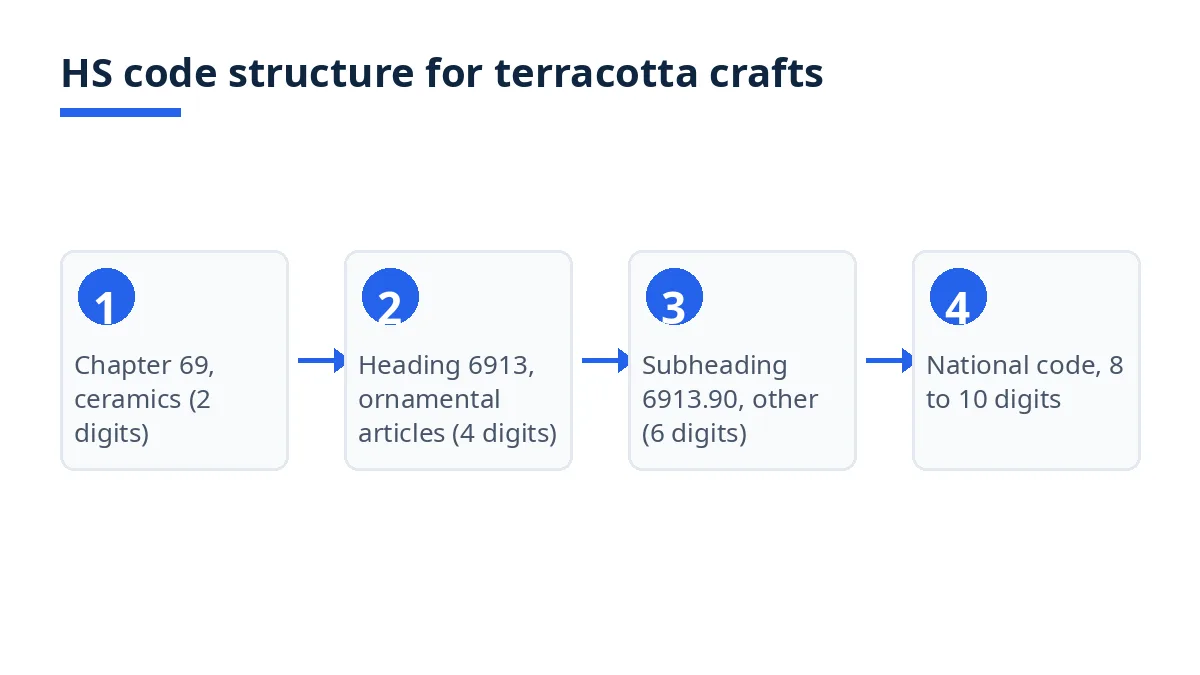
The Harmonized System organizes its approximately 5,000 six-digit product categories in a hierarchy of sections, chapters at 2 digits, headings at 4 digits and subheadings at 6 digits.4 Each pair of digits narrows the category: chapter 69 for ceramic products, heading 6913 for statuettes and other ornamental ceramic articles, then subheading 6913.90 for other materials.2 Countries then subdivide the six-digit categories into national subheadings, and the European Union uses eight-digit codes.4 The current version is HS 2022.4
Factors that decide the code for terracotta crafts
Ornamental purpose comes first. Heading 6913 covers statuettes and other ornamental ceramic articles, while heading 6912 covers ceramic tableware, kitchenware, other household articles and toilet articles, other than of porcelain or china.2 A figurine that only stands on a shelf is ornamental, while a plate that serves food is tableware even when painted by hand. A decorated plate that still serves food as well as a plain plate stays in tableware; only a piece whose usefulness is clearly subordinate to its ornament moves toward 6913.
Material: terracotta is earthenware, not porcelain. Terracotta is generally applied to unglazed objects made of iron-bearing clays, a type of earthenware with a porous fired body.5 That places ordinary terracotta on the "other" side of every porcelain split: 6913.90 rather than 6913.10, and 6912 rather than 6911 for tableware.2 A porcelain figurine takes the 6913.10 side, so never file a porcelain piece on a terracotta line.
Glazed or unglazed does not decide the heading on its own. Terracotta is often left unglazed, but a glaze coat alone does not move an ornamental piece out of 6913 or a plate out of 6912.5 What a glaze can change is the national line: in the United States, a reddish-bodied earthenware piece with a lustrous glaze mottled or streaked brown to black with metallic oxide or salt has its own line at 6913.90.30, separate from the residual 6913.90.50 line.3
Hand-made status matters at national level. The United Kingdom tariff splits the 6913 lines by material and then by hand-made status: under 6913.90, common pottery takes 6913 9010, earthenware or fine pottery takes 6913 9093, and other materials take 6913 9098, each with a hand-made and an other suffix at ten digits.6 A hand-thrown piece and a slip-cast copy can therefore take different ten-digit codes in the United Kingdom, though both share 6913.90 at six digits. State the making method on the invoice.
Form: statuette, vessel or building piece. A free-standing figure, bust or relief plaque fits the statuette wording of 6913.2 A vessel is tested by use: an ornamental vase with no usable function fits 6913, while a jug meant for pouring fits household articles. Roofing tiles, chimney pots and architectural ornaments belong with ceramic constructional goods at 6905.2 A garden pot needs its own test: a pot sold as a display ornament is tested under 6913, but a pot sold to hold a growing plant is tested by its own function.
Sets and mixed pieces. When a shipment combines a terracotta figurine with a base, a stand or a second material, classify by the piece that gives the set its character. A terracotta lamp is tested as a lamp first, not as an ornament, and a festive piece made for a single celebration is tested as a festive article first. Where two headings both seem to fit, get a ruling.
National codes: US HTS, EU CN/TARIC, UK commodity code
United States: HTS, ten digits. The United States schedule subdivides the six-digit categories into eight-digit rate lines and ten-digit statistical lines.3 For terracotta ornaments, read the full ten-digit line inside 6913.90: 6913.90.10 for sculptor-produced pieces, 6913.90.20 for ceramic tile pieces, 6913.90.30 for the narrow reddish-body lustrous-glaze earthenware line, and 6913.90.50 for other pieces.3
European Union: CN at eight digits, TARIC for measures. The Combined Nomenclature uses eight-digit codes, comprising the HS codes with further EU subdivisions.4 At eight digits, the 6913.90 branch splits by material into common pottery at 6913 9010, earthenware or fine pottery at 6913 9093, and other materials at 6913 9098.7 Read the confirmed line in TARIC for the entry date and for origin Bangladesh.
United Kingdom: commodity code. The United Kingdom builds its commodity code on the same first six digits, with its own extension after them.4 The United Kingdom tariff page for heading 6913 lists the full ten-digit codes, including the common pottery, earthenware or fine pottery, and other lines at 6913 9010, 6913 9093 and 6913 9098, each split into hand-made and other at ten digits.6 Do not copy a European Union eight-digit code into a United Kingdom entry.
How to confirm the code officially
Write a precise description: material and body color, glazed or unglazed, making method, dimensions, intended use, and any usable function.
Start from the official tariff for the destination: the United States International Trade Commission schedule, TARIC or the United Kingdom Trade Tariff, and read the heading text and chapter notes.
Check published rulings for similar pieces. For the United States, the United States International Trade Commission advises traders to use the Customs Rulings Online Search Service (CROSS), because the correct classification of many items can be found there.8
For a borderline piece, such as a usable vase that is also highly decorated, apply for a binding decision before you ship. A legally binding decision is generally valid for 3 years and helps calculate duties, licensing requirements, quotas or other restrictions in advance.9 In the European Union and Northern Ireland, a Binding Tariff Information decision needs a separate application for each type of goods.10 In Great Britain, apply for an Advance Tariff Ruling, which requires an EORI number starting with GB.9
Give your broker the description and the confirmed code for each design, and use the same codes throughout the entry and the invoice.
Common classification mistakes
Filing every terracotta piece under 6913. Usable plates and cups take 6912, roofing and architectural pieces take 6905, and pieces with no ornamental purpose that fit no earlier heading are tested under 6914.2 The word terracotta describes the material, not the heading.
Filing a usable plate as an ornament because it is painted. Heading 6912 covers ceramic tableware and kitchenware other than porcelain or china, and a painted plate that still serves food stays there.2 Decoration alone does not make a plate ornamental.
Filing a porcelain figurine on the terracotta line. Porcelain or china takes 6913.10, while other materials take 6913.90.2 Material decides the subheading, so a mixed shipment needs separate lines by material.
Skipping the narrow United States earthenware line. A reddish-bodied earthenware piece with a lustrous glaze mottled or streaked brown to black with metallic oxide or salt has its own line at 6913.90.30, separate from the residual 6913.90.50 line.3
Copying a code from another country. The European Union extends the six digits to eight,4 and the United States and the United Kingdom use ten digits with their own splits inside 6913.90.3 6
Treating hand-made status as irrelevant. In the United Kingdom, the 6913.90 lines split into hand-made and other at ten digits.6 Leaving the making method off the invoice removes the fact the code turns on.
Related duties and documents
This guide states no duty rates: the code decides which duty line customs applies, and a rate on one 6913.90 line does not carry to another line or another country. Read the rate beside your confirmed code for your origin and entry date, and check what proof of origin a preference claim requires. A legally binding decision helps calculate duties and restrictions in advance, and alerts you to licensing requirements or quotas.9 Keep the piece description, confirmed codes, any binding decision and the origin evidence together in the shipment file.
FAQs
What is the HS code for terracotta crafts?
There is no single code for every terracotta craft. Ornamental pieces, such as figurines and display vases, fall under indicative heading 6913, at subheading 6913.90 for pieces other than porcelain or china.2 Usable tableware takes 6912, building pieces take 6905, and national codes run to eight digits in the European Union and ten digits in the United States and the United Kingdom.4 3 6
Is the HS code the same in every country?
Only the first six digits are shared worldwide: chapter 69, heading 6913 and subheading 6913.90 are the same starting point in every HS country.1 Beyond six digits, each country adds its own lines: eight digits in the European Union,4 and ten digits in the United States and the United Kingdom.3 6
How do I confirm the correct code?
Describe each piece precisely, read the heading text and chapter notes in the destination tariff, and check published rulings, such as CROSS for the United States.8 For a borderline piece, apply for a binding decision before shipping: a Binding Tariff Information decision for the European Union or Northern Ireland,10 an Advance Tariff Ruling for Great Britain,9 or a CBP binding ruling for the United States.8
What happens if I use the wrong code?
Duty, licensing and quota treatment are worked out from the code on the declaration, so a wrong code brings the wrong treatment. A legally binding decision in advance helps you calculate the duties and restrictions that will apply, and alerts you to licensing requirements or quotas.9
Next steps on Exportain
Browse Bangladeshi suppliers on Exportain and post a free RFQ with the confirmed codes stated per design. The hs code harmonized system guide is the background read, and the hs codes classification guide covers the steps for your next product. Exportain is not a party to the goods contract and does not inspect goods, book freight or clear customs, so keep your broker and your binding decision at the center of the entry.
Sources
- What is the Harmonized System (HS)?. World Customs Organization (accessed )
- Table Chapter 69 Ceramic products. Statistics Canada (accessed )
- Harmonized Tariff Schedule of the United States, Chapter 69 (2026 Revision 17). U.S. International Trade Commission (accessed )
- Harmonised System. European Commission (accessed )
- Pottery Glossary. Ashbrook Ceramics (accessed )
- Statuettes and other ornamental ceramic articles - UK Integrated Online Tariff, heading 6913. GOV.UK, HM Revenue and Customs (accessed )
- HS Code 69139010 - Statuettes and other ornamental articles of common pottery. TariffNumber (accessed )
- MTB 2019: Get Out Ahead of the Pack with a Binding Ruling from CBP. U.S. International Trade Commission (accessed )
- Check what you'll need to get a legally binding decision on a commodity code. GOV.UK, HM Revenue and Customs (accessed )
- Apply for a Binding Tariff Information decision. GOV.UK (accessed )
About the author
Sourcing from Bangladesh?
Post a request for quotation and suppliers on Exportain can send you their quotes directly.
Post an RFQ


