HS Code for Surgical Gloves: Classification Guide for Importers
Surgical gloves classification: the indicative heading 4015 and subheading 4015.12 for vulcanized-rubber gloves of a kind used for medical or surgical purposes, the material-first fork, the principal-use test, and US, EU, and UK national codes to confirm.
Short answer
For a glove of vulcanized rubber other than hard rubber that is of a kind used for medical, surgical, dental, or veterinary purposes, the indicative starting point is heading 4015, subheading 4015.12, to be verified in the destination tariff. The settled code turns on material first, then on the kind of use shown by the goods as presented, and finally on the full national line on the entry date.
On this page
Quick answer: indicative HS heading (with verify note)
For a glove of vulcanized rubber other than hard rubber that is of a kind used for medical, surgical, dental, or veterinary purposes, the indicative starting point is heading 4015, subheading 4015.12, to be verified in the destination tariff for the exact goods as presented on the entry date.1 2 Heading 4015 covers articles of apparel and clothing accessories, including gloves, mittens, and mitts, for all purposes, of vulcanized rubber other than hard rubber; subheading 4015.12 covers gloves, mittens, and mitts of a kind used for medical, surgical, dental, or veterinary purposes.1 2
Note that 4015.12 is not a surgical-gloves-only line: it groups medical, surgical, dental, and veterinary kinds together, so the current schedule has no separate six-digit surgical-gloves line. The settled code depends on the material, the kind of use shown, and the national line confirmed on the entry date. Classification only: no statement about effect, safety, or market authorization, and no duty rate.
How HS codes are structured (2-4-6 digits)
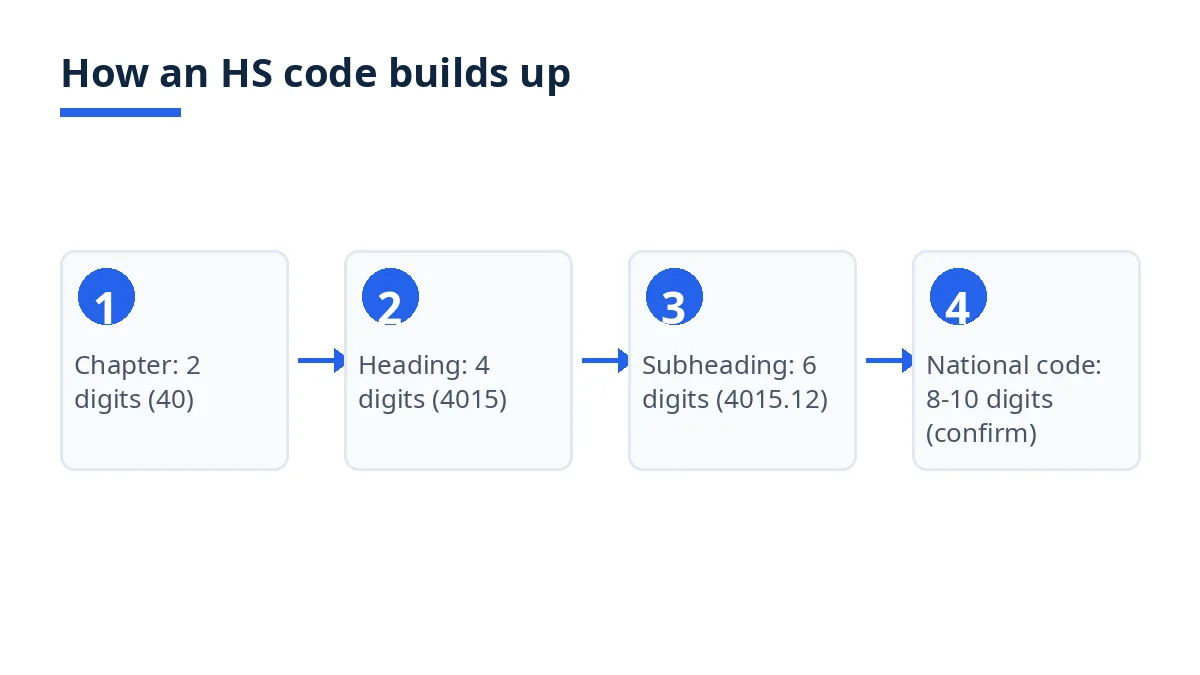
The Harmonized System is international only to six digits: the first two digits give the chapter, the first four the heading, and all six the subheading. National systems add digits after the sixth.3 Here, chapter 40 is rubber and articles thereof, heading 4015 is the four-digit level, and 4015.12 is a six-digit subheading.2
Rule 1 states that classification follows the terms of the headings and any relevant section or chapter notes, and Rule 6 adds that only subheadings at the same level are comparable.4 Read the heading text and notes first, compare lines at the same dash level, then extend the six digits.
Factors that decide the code for surgical gloves
Work through the questions in this order: material first, then kind of use, then the presentation questions, then the neighbouring headings. A later question cannot rescue a failure at an earlier one.
1. Material first: vulcanized rubber other than hard rubber
Heading 4015 admits only one material family: vulcanized rubber other than hard rubber.1 A glove of any other material cannot sit in 4015 however closely it resembles a surgical glove; it needs its own heading check. Hard rubber likewise falls outside 4015, with its own heading 4017 question.2
Ask the supplier for the material as specified, not as marketed: a trade name, a colour, or a carton claim does not establish vulcanized rubber within the chapter's scope. Record it identically on the specification, invoice, and packing list.
2. The use test: "of a kind used for"
Subheading 4015.12 turns on a use phrase: "of a kind used for medical, surgical, dental or veterinary purposes."1 That is a question about the class or kind of goods, not one shipment's destination or one buyer's intention. In United States practice, the class or kind turns on the physical characteristics, the purchasers' expectation, the channels of trade, the sale environment, the usage, the economic practicality of that use, and trade recognition.5
That test has a sharp consequence. United States rulings once treated industrial-use and medical-use latex gloves as the same class because they shared machines and materials, and later rulings corrected that view: shared machines and materials do not make two gloves the same class or kind.5 Packing, marking, labelling, and channels are evidence of the class.
3. Surgical, examination, and household: three use questions
A glove presented as of a kind used for surgical purposes raises the 4015.12 question, to be verified. An examination glove presented for medical purposes raises the same 4015.12 question, since the text covers medical kinds with surgical kinds and there is no separate examination line at six digits. A glove presented for household cleaning, industrial handling, or another non-medical purpose raises the 4015.19 question instead, since 4015.19 covers gloves other than those of a kind used for medical, surgical, dental, or veterinary purposes.2
Do not move a glove between 4015.12 and 4015.19 by renaming the carton alone. If the characteristics, channels, labelling, and trade recognition point to a household or industrial class, a medical-sounding name does not change it; if they point to a medical or surgical class, a plain carton does not remove it.5
4. Sterile, powdered, and powder-free: questions, not heading splits
The text of subheading 4015.12 splits on kind of use, not on sterile presentation or powdered or powder-free finish.1 Sterile and non-sterile gloves therefore start from the same use question, as do powdered and powder-free gloves. Record both features exactly as shipped. Neither feature alone settles the heading: the use test decides that.
5. The stale 4015.11 trap and neighbouring headings
Older schedules carried a separate surgical line, 4015.11, and lists compiled from them still circulate it. The current schedule carries 4015.12 for medical, surgical, dental, and veterinary kinds, not 4015.11.1 If a quotation, database entry, or shipment file quotes 4015.11, treat it as stale and re-check in the current schedule before declaring.
Neighbouring check: a product that is not a glove at all, such as a hygienic or pharmaceutical article of vulcanized rubber, raises a heading 4014 question.2
Worked example: the same glove, two classes
Shipment A is a vulcanized-rubber glove packed, marked, and sold for surgical purposes. Its indicative starting point is 4015.12, to be verified.1 5 Shipment B is the same physical glove, made on the same machines and of the same material, but packed, marked, and sold for household cleaning. Its indicative starting point is 4015.19, to be verified.2 5 The class of goods changed, so the starting point did.
Goods as presented | Indicative starting point (verify) | Confirm before declaring |
|---|---|---|
Vulcanized-rubber glove for surgical use | 4015.12 (verify) | Surgical class evidence, then national line |
Vulcanized-rubber glove for medical purposes, including examination use | 4015.12 (verify) | Medical class evidence, then national line |
Vulcanized-rubber glove for household, cleaning, or industrial purposes | 4015.19 (verify) | No medical or surgical class evidence, then national line |
Glove of another material, or of hard rubber | Outside 4015 (verify) | Heading for the actual material, then national line |
Old quotation citing 4015.11 | Stale line, re-check (verify) | Current schedule: 4015.12 covers the medical and surgical kinds |
No line in this table is a settled code for any shipment.
National codes: US HTS, EU CN/TARIC, UK commodity code
The first six digits are shared. Everything after them is national. Confirm the full code in the destination system on the entry date.
The United States uses the Harmonized Tariff Schedule, running to ten digits.3 Extend 4015.12 to the full ten-digit line: the current schedule carries a 4015.12.10 line for goods of a kind used for medical or surgical purposes, to be confirmed on the entry date.1
The European Union builds on the six digits with the Combined Nomenclature, an eight-digit extension, extended further in TARIC with EU measures.3 Find the six-digit subheading first, then read the eight-digit line and any TARIC detail.
The United Kingdom uses a ten-digit commodity code in the UK Trade Tariff.3 The first six digits should agree with the international subheading, while the later digits are United Kingdom decisions for the entry date. The UK tariff carries the 4015.12 line, shown as 4015 12 00 00, to be confirmed on the entry date before declaring.6
For goods leaving Bangladesh, compare the exporter's declared code with the destination code. Agreement on the first six digits is reassuring; disagreement after the sixth digit is expected.
How to confirm the code officially
Write the description as shipped: the material, the kind of use shown by packing, marking, channels, and labelling, and the sterile and powdered or powder-free finish as shipped, matching across the specification, invoice, and packing list. Read the heading texts and notes for headings 4014, 4015, and 4017 together.1 2 Apply the General Rules in order, compare subheadings only at the same level, extend the six digits in the destination tariff, and cross-check published rulings: CROSS rulings in the United States, Binding Tariff Information in the European Union, and an Advance Tariff Ruling in the United Kingdom.7 Another trader's ruling is not a decision about your goods.5 Where headings remain in contention, or the class evidence is mixed, ask a broker or apply for a binding ruling before shipping.7
Common classification mistakes
Quoting 4015.11 from an old schedule or database entry. The current subheading is 4015.12.1
Classifying from a trade name, brand name, or photograph. Customs classifies goods as presented.5
Treating the same machines and material as proof of the same class.5
Renaming a household or industrial glove to move it into 4015.12, or the reverse, without class evidence.
Treating sterile presentation or a powder-free finish, on its own, as settling the heading. The text splits on kind of use.1
Copying a supplier's full national code into a different destination. Only the first six digits travel.
Skipping the chapter notes, or comparing subheadings at different levels.4
Declaring a code once and never re-checking it after a change in material, use, packing, or destination.
Related duties and documents
This guide states no duty rate for any glove. Duty treatment is national, changes over time, and depends on the full national line, origin, and any measure attached to that line on the entry date. Read the current treatment for the confirmed line, through the broker.
The supporting documents are those that let a broker test the description: the supplier specification sheet stating the material and kind of use, the invoice and packing list in the same terms, the supplier's classification note with its reasoning and class evidence, and, where obtained, the broker's confirmation or binding ruling. For a repeating product, keep a classification file with the description, reasoning, rulings checked, the 4015.11 warning, and the national code and confirmation date.7
FAQs
What is the HS code for surgical gloves?
There is no single settled HS code for surgical gloves as a group. The indicative starting point for a vulcanized-rubber glove of a kind used for surgical purposes is heading 4015, subheading 4015.12, to be verified.1 The settled code depends on the material, the class evidence, and the national line on the entry date. A glove of another material starts outside heading 4015, and a household or industrial glove from 4015.19, to be verified.2
Is the HS code the same in every country?
The first six digits should be the same internationally for the same product, because they come from the shared Harmonized System.3 The full code is not the same everywhere: each country adds its own digits after the sixth digit, with ten digits in the United States, an eight-digit Combined Nomenclature code extended in TARIC in the European Union, and a ten-digit commodity code in the United Kingdom.3
How do I confirm the correct code?
Write the description as shipped, apply the General Rules in order, compare subheadings only at the same level, extend the six digits, and cross-check published rulings.4 7 Where headings remain in contention, or the class evidence is mixed, ask a broker or apply for a binding ruling before shipping.7
What happens if I use the wrong code?
Customs can reclassify the goods, reassess duty and tax treatment, delay clearance, and impose penalties. If an error is found, tell the broker promptly and update the file.
Next steps on Exportain
Work through HS Code (Harmonized System Code) first for the digit structure and national extensions, then use HS codes: how to classify your product to run the checks in order. Once the code is confirmed for the entry date, compare suppliers on the same written specification through Exportain suppliers.
Sources
- Harmonized Tariff Schedule of the United States, Chapter 40: Rubber and Articles Thereof (Revision 17, 2026). United States International Trade Commission (accessed )
- Chapter 40: Rubber and articles thereof. Statistics Canada (accessed )
- HS Code (Harmonized System Code). Exportain (accessed )
- General Rules for the Interpretation of the Harmonized System (archived). Canada Border Services Agency (accessed )
- HQ 964836: HQ 957522 revoked; non-medical use latex gloves. CustomsMobile (reproduction of a U.S. Customs and Border Protection ruling) (accessed )
- Articles of apparel and clothing accessories (including gloves, mittens and mitts), for all purposes, of vulcanised rubber other than hard rubber. GOV.UK (UK Trade Tariff) (accessed )
- How to Find an HS Code: Step-by-Step. Exportain (accessed )
About the author
Sourcing from Bangladesh?
Post a request for quotation and suppliers on Exportain can send you their quotes directly.
Post an RFQ