HS Code for Steel Products: Classification Guide for Importers
Steel spans Chapter 72 for material and Chapter 73 for finished articles. This guide maps the indicative headings by alloy class, form, width, coating and tube method, plus US, EU and UK national codes to confirm.
Short answer
Steel has no single HS code. Chapter 72 covers iron and steel as material, from primary forms to flat-rolled products, bars, rods and wire, while Chapter 73 covers finished articles such as tubes, fittings, structures and fasteners. The heading follows the alloy class, flat or long form, width, rolling stage, coating and tube production method. Confirm the full national code in the destination tariff before filing.
On this page
Key takeaways
Steel has no single code: Chapter 72 covers iron and steel as material, from primary forms to flat-rolled products, bars, rods and wire, while Chapter 73 covers finished articles such as tubes, fittings, structures and fasteners.
The alloy class decides the heading block: a non-alloy hot-rolled sheet sits in heading 7208, the same sheet in stainless steel sits in heading 7219, and the same sheet in another alloy steel sits in heading 7225.
Flat-rolled products split at 600 mm in every alloy class, and a coating moves a flat product from heading 7208 or 7209 into heading 7210, with the six-digit lines inside heading 7210 split by coating metal.
Tubes split by production method first: cast iron tubes sit in heading 7303, tubes made in one piece without a welded joint sit in heading 7304, and welded tubes split between headings 7305 and 7306.
Only the first six digits are shared worldwide: the EU extends to eight digits in the Combined Nomenclature and the United States and United Kingdom to ten digits, so confirm the full national code per line.
If you import steel, the phrase hs code for steel products does not point to one line in the tariff. Steel runs from pig iron and slabs to coated sheet, bars, wire, tubes, fittings and finished structures. The first decision is the chapter: Chapter 72 covers iron and steel as material, and Chapter 73 covers articles made of iron or steel. Every heading below is indicative only.
Quick answer: indicative HS heading (with verify note)
There is no single HS code for steel products: the code follows the product form, the alloy class and the processing stage.
Product | Indicative heading territory |
|---|---|
Pig iron, ferro-alloys, ingots, semi-finished slabs, blooms and billets | Headings 7201 to 7207 |
Flat-rolled non-alloy steel, width 600 mm or more: hot-rolled uncoated, cold-rolled uncoated, clad, plated or coated | Headings 7208, 7209 and 72101 |
Flat-rolled non-alloy steel, width under 600 mm, uncoated or coated | Headings 7211 and 72121 |
Bars and rods in coils; other bars, rods, angles, shapes and sections; wire, non-alloy | Headings 7213, 7214 to 7216, and 72171 |
Stainless steel flat-rolled, bars and wire | Headings 7219 to 72231 |
Other alloy steel flat-rolled, bars and wire | Headings 7225 to 72291 |
Sheet piling and railway track material | Headings 7301 and 73022 |
Tubes, pipes and hollow profiles: cast iron; one-piece without a welded joint; welded over 406.4 mm diameter; other welded and closed tubes | Headings 7303, 7304, 7305 and 73062 |
Tube and pipe fittings, structures, screws and bolts, other finished articles | Headings 7307, 7308, 7318 and 73262 |
Verify before filing. A hot-rolled coil and a galvanized sheet can look alike in a photo and sit in different headings, and a structure made from the same coil sits in Chapter 73.
How HS codes are structured (2-4-6 digits)
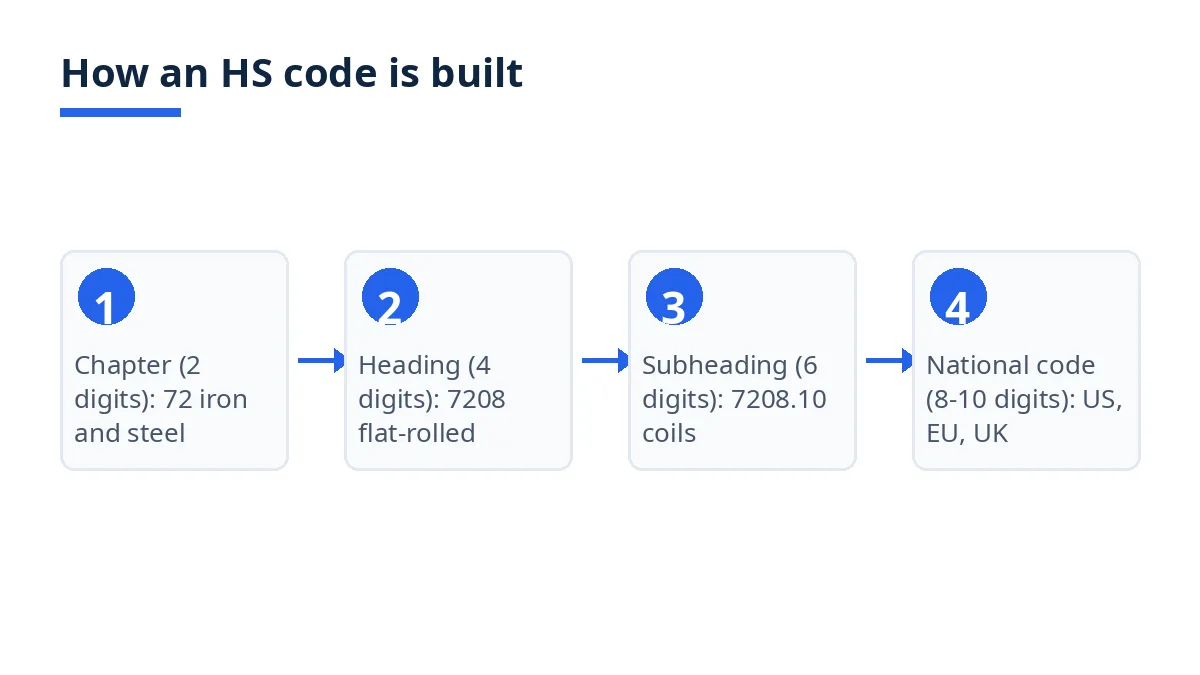
The Harmonized System is an international product nomenclature developed by the World Customs Organization, comprising about 5,000 commodity groups, each identified by a six-digit code, and used by more than 200 countries and economies as a basis for their customs tariffs.3 The European Commission adds that the Combined Nomenclature of the EU integrates the HS and adds eight-digit subdivisions.3 The first six digits are shared worldwide.
Take a hot-rolled flat product as the worked example. Chapter 72 is iron and steel. Heading 7208 is flat-rolled products of iron or non-alloy steel, of a width of 600 mm or more, hot-rolled, not clad, plated or coated.1 Inside that heading, the six-digit subheading adds the next distinction, such as coils versus straight lengths. Beyond six digits, each country adds its own extension.
Factors that decide the code for steel products
Chapter 72 material versus Chapter 73 article. Chapter 72 covers iron and steel in primary, semi-finished and rolled forms: ingots, slabs, billets, flat-rolled products, bars, rods, angles, shapes, sections and wire.1 Chapter 73 covers articles of iron or steel: sheet piling, track material, tubes and pipes, fittings, structures, containers, stranded wire, chain, screws and bolts.2 A steel plate stays in Chapter 72, but a plate cut, punched and bolted into a bridge section becomes a structure in heading 7308.
Alloy class: non-alloy, stainless or other alloy. Stainless steel is defined as alloy steel containing, by weight, 1.2 percent or less of carbon and 10.5 percent or more of chromium.4 Other alloy steel does not meet the stainless definition but contains a listed alloying element at or above a stated threshold, such as 0.3 percent or more of chromium or nickel, or 1.65 percent or more of manganese.4 If none of those criteria apply, the steel is non-alloy steel.4 A non-alloy hot-rolled sheet sits in heading 7208, the same sheet in stainless steel sits in heading 7219, and the same sheet in another alloy steel sits in heading 7225.1
Flat versus long products, split at 600 mm. Non-alloy flat products of 600 mm or more sit in headings 7208 to 7210, and the same products under 600 mm sit in headings 7211 and 7212.1 Stainless flat products split the same way, at headings 7219 and 7220, and other alloy flat products at headings 7225 and 7226.1 Bars and rods in coils sit in heading 7213 for non-alloy steel and heading 7227 for other alloy steel, while other bars, rods, angles, shapes and sections sit in headings 7214 to 7216 and heading 7228.1
Processing stage. Heading 7208 covers flat products hot-rolled and not clad, plated or coated, while heading 7210 covers the same width of product clad, plated or coated.1 A zinc, tin, chromium or aluminum-zinc coating therefore moves a flat product from heading 7208 or 7209 into heading 7210, and the six-digit lines inside heading 7210 split by coating metal.1 Heading 7209 covers cold-rolled flat products.4 Further working after rolling, such as drilling, bending or assembling, can move a product out of Chapter 72 and into a Chapter 73 article heading.
How a tube was made. Tubes and pipes split by production method before they split by size or grade. Cast iron tubes sit in heading 7303. Tubes made in one piece, without a welded joint, sit in heading 7304.2 Welded tubes with a circular cross section and an external diameter over 406.4 mm sit in heading 7305, and the remaining tubes, pipes and hollow profiles sit in heading 7306.2
Dimensions and end use. Headings inside Chapter 72 and Chapter 73 turn on measurable facts: width, thickness, diameter, cross-sectional shape and coils versus straight lengths. End use helps only where the heading text says so: line pipe of a kind used for oil or gas pipelines is named inside headings 7304, 7305 and 7306.2
National codes: US HTS, EU CN/TARIC, UK commodity code
United States: HTS, ten digits. The United States builds on the same first six digits and extends them to ten digits in the Harmonized Tariff Schedule. Chapter 72 runs from pig iron at heading 7201 through wire of other alloy steel at heading 7229, and Chapter 73 runs from sheet piling at heading 7301 through other articles of iron or steel at heading 7326.1 2
European Union: CN at eight digits, TARIC for measures. The Combined Nomenclature integrates the HS and adds EU subdivisions, producing eight-digit codes.3 The CN code is the code declared on the customs declaration, and TARIC layers the measures that apply to that code for the origin and entry date.
United Kingdom: commodity code. The United Kingdom builds its commodity code on the same first six digits, with its own extension after them, and the full code is looked up in the Online Trade Tariff.4
How to confirm the code officially
Write a precise description: alloy class with carbon and chromium percentages from the mill certificate, product form, width, thickness, diameter, cross section, coil or straight length, rolling stage, coating and production method for tubes.
Start from the official tariff for the destination: the USITC Harmonized Tariff Schedule, TARIC or the UK Trade Tariff, and read the heading text and chapter notes, not only the heading title.1
Check published rulings for similar products. For the United States, the Customs Rulings Online Search Service (CROSS) holds published CBP rulings, and the USITC notes that the correct classification of many items can be found there.5
For a borderline product, such as a coated flat product near the 600 mm width line or a tube whose production method is disputed, apply for a binding decision before you ship. In the EU, a Binding Tariff Information decision requires a separate application for each type of product.6 In the United Kingdom, a legally binding decision is generally valid for 3 years.7 In the United States, if no ruling on CROSS covers your product, request a binding ruling from U.S. Customs and Border Protection.5
Give your broker the description and the confirmed code for each line, and use the same codes on the commercial invoice, the packing list and the entry.
Common classification mistakes
Filing a finished article in Chapter 72. A structure, a fitting, a screw or a tank is an article of iron or steel in Chapter 73 even when it is made from Chapter 72 material.2
Filing a coated product as uncoated. A zinc-coated sheet is not heading 7208 or 7209. Clad, plated or coated flat products of 600 mm or more sit in heading 7210.1
Ignoring the 600 mm width line. Flat-rolled products split at 600 mm in every alloy class: headings 7208 to 7210 against 7211 and 7212 for non-alloy steel, heading 7219 against 7220 for stainless steel, and heading 7225 against 7226 for other alloy steel.1
Filing stainless steel as other alloy steel, or the reverse. Stainless steel requires 1.2 percent or less of carbon and 10.5 percent or more of chromium.4
Filing tube made in one piece as welded tube. Heading 7304 covers tubes, pipes and hollow profiles made without a welded joint, while headings 7305 and 7306 cover welded and other closed tubes.2
Copying a code from another country, or using one code for a mixed shipment. The first six digits are shared, but the United States extends to ten digits, the EU to eight digits in the CN, and the United Kingdom to its own commodity code.3 4 Plates, tubes, fittings and fasteners in one container take separate codes.1 2
Related duties and documents
This guide states no duty rates: the code decides which duty line customs applies, and a rate on a non-alloy flat-rolled line does not carry to a stainless line or to a finished article line. Read the rate beside your confirmed code for your origin and entry date.
Keep the classification file per line: the mill certificate with chemistry and coating, the dimensional record, the production method for tubes, the confirmed national code, any binding decision and the origin evidence.
FAQs
What is the HS code for steel products?
There is no single code. Steel spans Chapter 72 for iron and steel as material, from headings 7201 to 7229, and Chapter 73 for articles of iron or steel, from headings 7301 to 7326.1 2 A hot-rolled non-alloy sheet of 600 mm or more is tested against heading 7208, a coated sheet against heading 7210, a stainless flat product against heading 7219, and a finished tube, fitting or structure against headings 7304 to 7308.1 2
Is the HS code the same in every country?
Only the first six digits are shared worldwide. The HS comprises about 5,000 commodity groups, each identified by a six-digit code, used by more than 200 countries and economies.3 Beyond six digits, each country adds its own lines: eight digits in the EU Combined Nomenclature,3 and ten digits in the United States and the United Kingdom.1 4
How do I confirm the correct code?
Describe the product precisely, including alloy chemistry, form, dimensions, rolling stage, coating and production method, then read the heading text and chapter notes in the destination tariff.1 Check published rulings, such as CROSS for the United States.5 For a borderline product, apply for a binding decision before shipping: a BTI in the EU,6 an Advance Tariff Ruling in the United Kingdom,7 or a CBP binding ruling in the United States.5
What happens if I use the wrong code?
Duty, licensing and quota treatment are worked out from the code on the declaration, so a wrong code brings the wrong treatment. A binding decision taken in advance helps you calculate the duties and restrictions that will apply, and in the United Kingdom such a decision is generally valid for 3 years.7
Next steps on Exportain
Browse Bangladeshi suppliers on Exportain and post a free RFQ with the confirmed codes stated per line, so suppliers quote the exact form, alloy class and coating you tested. The harmonized system guide is the background read, and how to classify your product walks through the general method.
Sources
- Harmonized Tariff Schedule of the United States, Chapter 72 (2026 Revision 17). U.S. International Trade Commission (accessed )
- Harmonized Tariff Schedule of the United States, Chapter 73 (2026 Revision 17). U.S. International Trade Commission (accessed )
- Harmonized System. European Commission, (accessed )
- Classifying iron and steel for import and export. GOV.UK, HM Revenue and Customs (accessed )
- Customs Rulings Online Search System (CROSS). U.S. Customs and Border Protection (accessed )
- European Binding Tariff Information (EBTI). European Commission, Taxation and Customs Union, (accessed )
- Check what you'll need to get a legally binding decision on a commodity code. GOV.UK, HM Revenue and Customs (accessed )
About the author
Sourcing from Bangladesh?
Post a request for quotation and suppliers on Exportain can send you their quotes directly.
Post an RFQ