HS Code for Seagrass Baskets: Classification Guide for Importers
Seagrass baskets sit in heading 4602 at 4602.19, the other vegetable materials line, because seagrass has no named bamboo or rattan line — confirm the full national code, including the US wickerwork and other split, before filing.
Short answer
A seagrass basket is classified in heading 4602, basketwork and wickerwork, at subheading 4602.19, of other vegetable materials, because seagrass has no named bamboo or rattan line. That six-digit code is indicative only: the United States splits it further by article kind, including baskets and bags, luggage and handbags, and other articles, with willow and palm-leaf carve-outs. Confirm the full national code for your exact basket before filing.
On this page
Key takeaways
Seagrass baskets sit in heading 4602, basketwork and wickerwork, at subheading 4602.19, of other vegetable materials; bamboo is 4602.11 and rattan is 4602.12.
Seagrass reaches 4602.19 by elimination, not by a named line, so a written supplier statement proving the material is not bamboo, rattan, willow, palm leaf or plastic strip is the key document.
A flat seagrass mat is not a basket: mats of other vegetable materials sit in heading 4601, at 4601.29, while only a finished basket shape, or an article made up from heading 4601 material, belongs in heading 4602.
At six digits, baskets, bags and handbags share 4602.19; the split by article kind and wickerwork happens in the national digits, so a mixed shipment needs a line per article kind.
Only the first six digits are shared worldwide: the EU extends to eight digits and the United States and the United Kingdom add their own national detail, so confirm the full national code per article kind.
If your supplier lists a shipment as "natural baskets" and the cartons hold seagrass laundry baskets, seagrass planters and a seagrass tote, one code will not cover all of it. The hs code for seagrass baskets turns on a point the bamboo guide never has to face: seagrass has no line of its own. It falls into a residual line shared with every other vegetable plaiting material that is neither bamboo nor rattan, so the proof you carry matters more than the label on the carton. For the general meaning of an HS code, read the HS code hub; for the step-by-step method, read how to classify your product. The bamboo baskets guide is the contrast case.
Quick answer: indicative HS heading (with verify note)
Indicative only — verify before filing: confirm the full national code in the destination tariff for your exact basket, entry date and origin before you declare it.
Article | Indicative code | Why |
|---|---|---|
Seagrass basket, made directly to shape or made up from seagrass plaiting material | 4602.19 | Heading 4602 covers basketwork; seagrass sits in the other vegetable materials line 1 2 |
Bamboo basket, for contrast | 4602.11 | Bamboo has its own subheading 2 |
Rattan basket, for contrast | 4602.12 | Rattan has its own subheading 2 |
Seagrass-look basket woven from plastic strip, for contrast | 4602.90 | |
Flat seagrass mat, matting or screen, not a basket | 4601.29 | Heading 4601 covers sheet-form plaiting products 1 |
Seagrass basket that functions as furniture, for contrast | Chapter 94 test | Chapter 94 articles are excluded from Chapter 46 1 |
How HS codes are structured (2-4-6 digits)
The Harmonized System is a multipurpose international product nomenclature developed by the World Customs Organization (WCO), comprising more than 5,000 commodity groups, each identified by a six-digit code, and used by more than 200 countries and economies as a basis for their customs tariffs.3 The European Commission describes the same hierarchy: chapters at two digits, headings at four and subheadings at six, and the current version is HS 2022.4
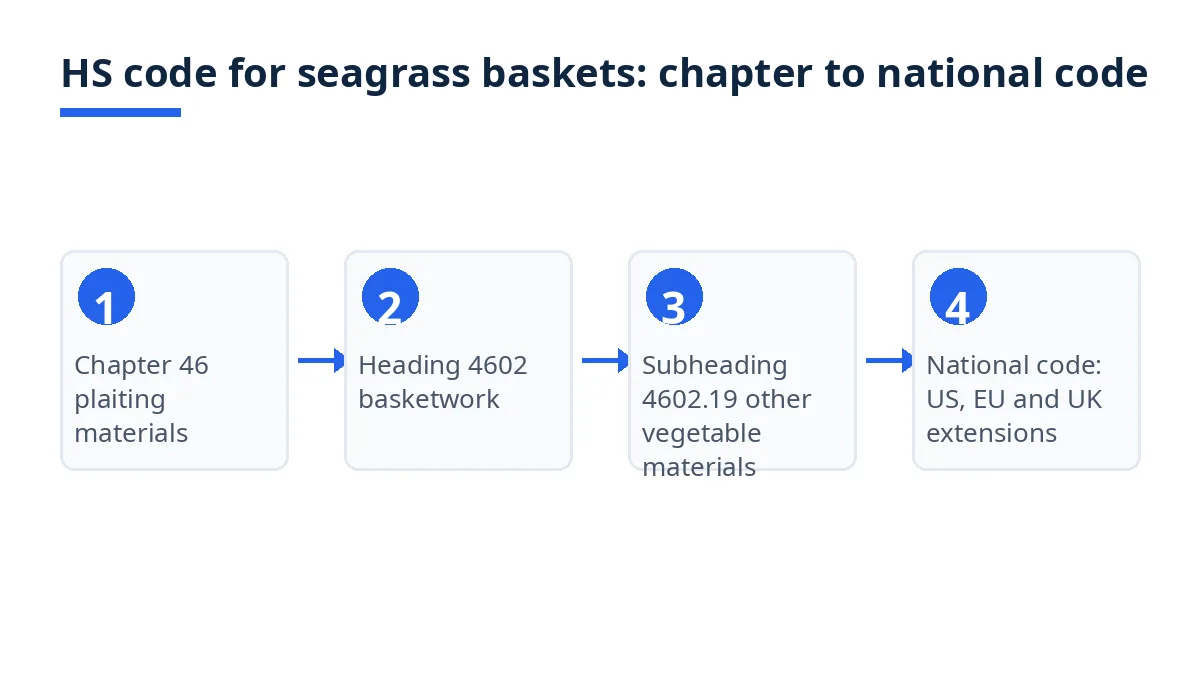
Read a seagrass basket code from left to right. 46 is the chapter, covering manufactures of straw, esparto or other plaiting materials, basketware and wickerwork.1 4602 is the heading: basketwork, wickerwork and other articles, made directly to shape from plaiting materials or made up from articles of heading 4601, plus articles of loofah.1 4602.19 is the six-digit subheading: of vegetable materials other than bamboo and rattan.2 National digits follow: eight digits in the EU Combined Nomenclature,4 and further national digits in the United States and the United Kingdom.
Factors that decide the code for seagrass baskets
A residual line, so prove the material instead of naming it. The United Nations list for heading 4602 names only two vegetable materials at six digits: bamboo at 4602.11 and rattan at 4602.12. Everything else vegetable sits at 4602.19.2 Seagrass therefore reaches 4602.19 by elimination, not by a line that says seagrass. Get a written material statement for every item confirming plant material that is not bamboo, rattan, willow or palm leaf. A photograph cannot carry that proof: seagrass, water hyacinth and palm-leaf baskets can look alike and share 4602.19 at six digits while splitting nationally.
Vegetable plaiting material, proved from the specification. Chapter 46 note 1 defines plaiting materials as materials in a state or form suitable for plaiting, interlacing or similar processes, and the list expressly includes strips of other vegetable material, for example strips of bark, narrow leaves and raffia or other strips obtained from broad leaves.1 Seagrass enters Chapter 46 on that vegetable-material basis. If the weave is a synthetic strip made to look like seagrass, the basket falls to the non-vegetable line 4602.90.2
Made directly to shape, or made up from heading 4601. Heading 4602 has two routes into it: an article made directly to shape from plaiting materials, or an article made up from articles of heading 4601.1 A basket woven straight into its shape takes the first route; a basket assembled from seagrass plaits or sheet material takes the second. A flat sheet that stays a sheet takes neither route: mats of other vegetable materials sit in heading 4601, at 4601.29, and other seagrass plaits and sheet products at 4601.94.1 A seagrass placemat sold flat is a heading 4601 question; the same weave finished as a basket is a heading 4602 question.
Article kind: basket, bag, planter, tote or furniture. At six digits, a seagrass storage basket, a seagrass tote and a seagrass handbag all sit at 4602.19.2 The split by article kind happens in the national digits: fishing baskets, other baskets and bags, luggage and handbags, and other articles each take their own lines inside 4602.19.1 A planter basket is still tested as a basket first, but describe the pot and liner honestly. Where a basket is sold as a seat or storage bench, run the Chapter 94 test first, because articles of Chapter 94 are excluded from Chapter 46.1
Trim, liner and frame: describe them, do not hide them. A cotton liner inside a seagrass laundry basket does not by itself move the basket out of basketwork: the United States lines for other baskets and bags expressly say whether or not lined.1 Record what a metal frame or wooden base does, and whether the seagrass still gives the article its shape and use.
Shared-line trap: seagrass, water hyacinth, willow and palm leaf. All four share 4602.19 at six digits, but the United States schedule carves willow and palm leaf out into their own national lines inside 4602.19.1 File a willow basket or a palm-leaf bag on a seagrass line and the national code is wrong even though the six digits match.
National codes: US HTS, EU CN/TARIC, UK commodity code
United States: HTS, full national level. Start from 4602.19 in the 2026 Revision 18 schedule, then read the lines for your article kind.1 Fishing baskets or creels sit at 4602.19.05. Other baskets and bags, whether or not lined, split into willow at 4602.19.12, palm-leaf wickerwork at 4602.19.14 and palm-leaf other at 4602.19.16, then other wickerwork at 4602.19.17 and other at 4602.19.18: a seagrass storage or laundry basket lands in that last pair, once the willow and palm-leaf lines are ruled out, and the wickerwork or other split turns on how your weave is described. Luggage, handbags and flatgoods, whether or not lined, split into willow at 4602.19.22, palm-leaf pocket and handbag articles at 4602.19.23, palm-leaf other at 4602.19.25, and other at 4602.19.29: a seagrass tote or handbag lands in that block. Other articles split into willow or wood wickerwork at 4602.19.35 and other at 4602.19.45, and other wickerwork at 4602.19.60 and other at 4602.19.80.1
European Union: CN at eight digits, TARIC for measures. The Combined Nomenclature uses eight-digit codes, comprising the HS codes with further EU subdivisions.4 The EU code for a seagrass basket begins with the same six digits, 460219, and the digits after it are EU detail. Read the confirmed CN and TARIC lines for your member state, entry date and origin.
United Kingdom: commodity code. The UK commodity code starts from the same first six digits, 460219, with its own national extension after them. Take the full code from the UK Trade Tariff for your article and entry date, rather than copying a United States or EU line.
How to confirm the code officially
Write a precise description: plaiting material and how you know it is seagrass rather than bamboo, rattan, willow, palm leaf or plastic strip, construction and weave, article kind, lining and frame, and whether it is made directly to shape or made up from heading 4601 material.
Start from the destination tariff — USITC HTS, TARIC or the UK Trade Tariff — and read the heading and chapter notes.
Check published rulings for similar baskets. For the United States, the USITC advises traders to use the Customs Rulings Online Search Service (CROSS).5
For a borderline basket, apply for a binding decision before you ship. In the EU, a Binding Tariff Information application needs a separate application for each type of product and a detailed description, including images or samples where possible.6 In the United Kingdom, a legally binding decision is generally valid for 3 years, through an Advance Tariff Ruling.7 In the United States, if the merchandise is not described in any ruling on CROSS, you may request a binding ruling from U.S. Customs and Border Protection.5
Give your broker the description and confirmed code for each article kind, and use the same codes on the entry, invoice and packing list.
Common classification mistakes
Filing seagrass as bamboo or rattan. Bamboo sits at 4602.11 and rattan at 4602.12; seagrass sits at 4602.19.2
Filing a synthetic seagrass-look basket as vegetable material. Basketwork of non-vegetable materials sits at 4602.90, not 4602.19.2
Filing flat seagrass mats as baskets. Mats of other vegetable materials sit in heading 4601, at 4601.29, not heading 4602.1
Filing every seagrass article on one national line. At six digits everything is 4602.19, but the United States schedule separates fishing baskets, baskets and bags, luggage and handbags, and other articles, with willow and palm-leaf carve-outs inside each block.1
Filing a planter or furniture article without testing it. A rigid pot or a furniture function changes the test: articles of Chapter 94 are excluded from Chapter 46.1
Copying a full code from another country. The EU extends six digits to eight,4 and the United States and the United Kingdom add their own national detail.
Related duties and documents
This guide states no duty rates: the code decides which duty line customs applies, and a rate on a willow line does not carry to a seagrass line, or a rate on a basket line to a handbag line. Read the rate beside your confirmed code for your origin and entry date.
Keep the shipment file together: the article-by-article specification, the material statement, the weave description, confirmed codes with tariff edition and entry date, any binding decision, and an invoice listing baskets, bags and luggage pieces on separate lines. Photographs do not replace the specification.
FAQs
What is the HS code for seagrass baskets?
The indicative six-digit code is 4602.19, of other vegetable materials, inside heading 4602, basketwork and wickerwork.1 2 Confirm the full national code: the United States splits 4602.19 by article kind and by wickerwork and other, after carving willow and palm leaf out into their own lines.1
Is the HS code the same in every country?
Only the first six digits are shared worldwide. Beyond six digits, each country adds its own lines: eight digits in the EU Combined Nomenclature,4 and further national digits elsewhere.
How do I confirm the correct code?
Describe each basket precisely and check rulings such as CROSS for the United States.5 For a borderline basket, seek a binding decision before shipping: Binding Tariff Information in the EU,6 an Advance Tariff Ruling in the United Kingdom,7 or a CBP binding ruling.5
What happens if I use the wrong code?
Duty, licensing and quota treatment follow the code on the declaration, so a wrong code brings the wrong treatment. A binding decision in advance helps you calculate the duties and restrictions that will apply.7
Next steps on Exportain
Browse Bangladeshi suppliers on Exportain, asking each supplier for a written specification stating plaiting material, construction and article kind per item. Read the HS code hub and how to classify your product before sending it to your broker. Exportain does not clear customs.
Sources
- Harmonized Tariff Schedule of the United States, Chapter 46 (2026 Revision 18). U.S. International Trade Commission (accessed )
- HS, 2017 - Code 4602. United Nations Statistics Division (accessed )
- What is the Harmonized System (HS)?. World Customs Organization (accessed )
- Harmonised System. European Commission (accessed )
- MTB 2019: Get Out Ahead of the Pack with a Binding Ruling from CBP. U.S. International Trade Commission (accessed )
- European Binding Tariff Information (EBTI). European Commission, Taxation and Customs Union, (accessed )
- Check what you'll need to get a legally binding decision on a commodity code. GOV.UK, HM Revenue and Customs (accessed )
About the author
Sourcing from Bangladesh?
Post a request for quotation and suppliers on Exportain can send you their quotes directly.
Post an RFQ