

HS Code for Printed Labels and Tags: Classification Guide for Importers
Printed paper labels take 4821.10 and unprinted labels 4821.90, while textile labels sit in 5807 and plastic stickers test under 3919. This guide works through the material, print and form tests that decide the code.
Short answer
Printed paper labels take 4821.10 and unprinted paper labels take 4821.90, while woven textile labels sit in 5807.10 and other textile labels in 5807.90. A self-adhesive plastic sticker is tested under 3919, not 4821. Only the first six digits are shared worldwide, so confirm the full national code for the exact material, print state and form before filing.
On this page
Key takeaways
Printed paper labels take 4821.10 and unprinted paper labels take 4821.90, and heading 4821 is expressly excepted from the chapter 49 rule for printed paper, so print alone does not move a paper label to chapter 49.
Textile labels not embroidered sit in heading 5807, at 5807.10 for woven labels and 5807.90 for other textile labels, while an embroidered badge or motif leaves 5807 and is tested under heading 5810.
Form matters as much as material: self-adhesive paper in strips or rolls is tested as material at 4811.41, and a self-adhesive plastic sticker is tested under heading 3919, not under the paper heading.
Only the first six digits are shared worldwide: the United States splits 4821.10 by print process at ten digits, the EU extends the six digits through the Combined Nomenclature to TARIC, and the United Kingdom uses its own ten-digit commodity code, so confirm the full national code and seek a binding decision for a borderline label.
A shipment of labels rarely contains one kind of label. One carton holds woven care labels, the next holds printed paper hang tags, and a third holds self-adhesive plastic stickers. Filing all three under one code is where the entry goes wrong. Each carton is tested on its base material, its printed or unprinted state, and its form on arrival.
Quick answer: indicative HS heading for printed labels and tags
There is no single code for every label and tag. The indicative six-digit code follows the base material first, and print second. Paper labels sit in heading 4821 whether or not they are printed, textile labels sit in heading 5807 when they are not embroidered, and other materials are tested under their own headings. Treat every code below as indicative and confirm the full national code before filing.
Goods as presented | Indicative code | Why |
|---|---|---|
Printed paper label, including a printed hang tag | 4821.10 | Heading 4821 covers paper labels of all kinds, whether or not printed; 4821.10 is the printed line1 |
Unprinted paper label | 4821.90 | The same heading, with 4821.90 as the other line1 |
Woven textile label, not embroidered | 5807.10 | Heading 5807 covers textile labels, in the piece, in strips or cut to shape or size, not embroidered; 5807.10 is the woven line2 |
Other textile label, not embroidered | 5807.90 | The same heading, with 5807.90 as the other line3 |
Embroidered badge or motif | Tested under heading 5810 | Heading 5807 covers only articles that are not embroidered2 |
Self-adhesive plastic label or sticker | Tested under heading 3919 | Heading 3919 covers self-adhesive flat shapes of plastics, whether or not in rolls4 |
Self-adhesive paper in rolls or sheets, not yet cut into labels | Tested under heading 4811 | The United States schedule places self-adhesive paper at 4811.41, in strips or rolls, which is material form, not a finished label1 |
Verify the label, not the trade name. A listing that says "printed label" does not settle whether the base is paper, textile or plastic, and a hang tag, a care label and a barcode sticker can sit in three different headings.
How HS codes are structured (2-4-6 digits)
The Harmonized System is a multipurpose international product nomenclature developed by the World Customs Organization, comprising more than 5,000 commodity groups, each identified by a six-digit code, and used by more than 200 countries and economies as a basis for their customs tariffs.5 The first two digits give the chapter, the first four give the heading, and all six give the subheading: chapter 48, heading 4821, subheading 4821.10 for a printed paper label, and chapter 58, heading 5807, subheading 5807.10 for a woven textile label.
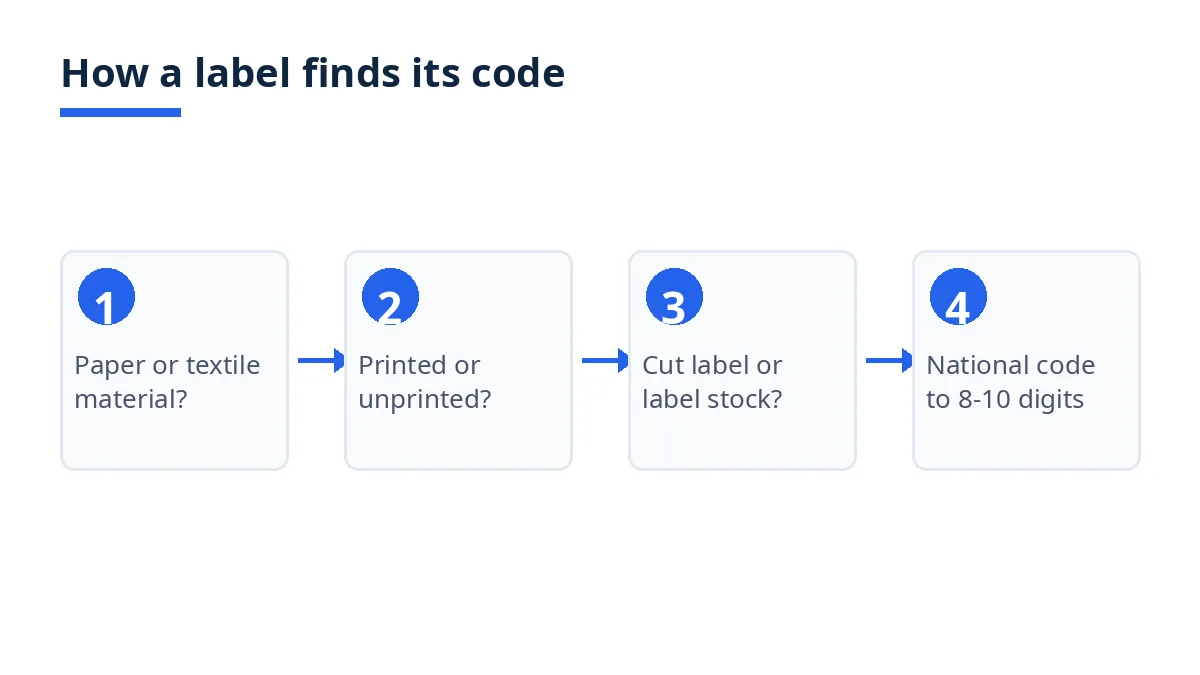
Only the first six digits are shared worldwide. Each destination country then adds its own digits, so a six-digit answer is a starting point, never the finished entry.
Factors that decide the code for printed labels and tags
Base material first, print second. A paper label stays in heading 4821 when it is printed, and a textile label stays in heading 5807 when it carries printed care instructions. Do not start from the word printed and look for a printed-matter heading. For paper labels, that route is closed by a chapter note: except for the goods of heading 4814 or 4821, paper printed with motifs, characters or pictorial representations, where the print is not merely subsidiary to the primary use, fall in chapter 49.1 Heading 4821 is expressly excepted, so print alone does not move a paper label to chapter 49.
Printed or unprinted decides the paper subheading, not the heading. Inside heading 4821, printed labels take 4821.10 and other labels take 4821.90.1 Record whether print is present on the exact goods in the shipment, not on the sample, because printed and unprinted versions of the same label take different subheadings.
Cut label or label stock. Material that has not yet become a label is not a label. Self-adhesive paper supplied in strips or rolls, to be printed and cut later, is tested as paper at heading 4811, where the schedule lists self-adhesive paper at 4811.41.1 Likewise, a roll of self-adhesive film is tested as flat plastic material, while a finished sticker cut to shape is tested as a finished article. State the form on the invoice: rolls, sheets, strips, or individual labels.
Textile labels: woven, other, or embroidered. Heading 5807 covers labels, badges and similar articles of textile materials, in the piece, in strips or cut to shape or size, not embroidered.2 Inside the heading, woven labels take 5807.10 and other textile labels take 5807.90.3 An embroidered badge or motif is outside 5807 altogether, because the heading text excludes embroidered articles, and embroidery is tested under heading 5810, which covers embroidery in the piece, in strips or in motifs.6
Plastic labels need their own test. A self-adhesive plastic sticker is not a paper label with a different surface. Heading 3919 covers self-adhesive plates, sheets, film, foil, tape, strip and other flat shapes of plastics, whether or not in rolls, and 3919.10 covers those flat shapes in rolls of a width not exceeding 20 cm.4 A finished plastic sticker therefore starts from 3919, not 4821.
Label, container, or printed card. A printed paper bag is a packing container, not a label, even when it carries the same brand print, and that container test is worked through separately in the HS code for paper bags. A greeting card or postcard is likewise tested on its own heading. When the piece is a hang tag, test it as a label first: its heading follows its function and its base material.
Labels shipped separately are classified as labels. Labels in their own cartons are entered as labels, under the heading for their material, not under the garment, bottle or box they will later mark. Keep separate invoice lines for each material and each printed or unprinted variant.
National codes: US HTS, EU CN/TARIC, UK commodity code
United States: HTS, ten digits. Under printed labels, 4821.10.20 covers labels printed in whole or in part by a lithographic process, and 4821.10.40 covers other printed labels. Under other labels, 4821.90.20 covers self-adhesive labels and 4821.90.40 covers other labels.1 Read the full ten-digit line for the exact label, including its print process and adhesive state, rather than stopping at 4821.10.
European Union: CN at eight digits, TARIC for measures. The Combined Nomenclature is applied in the EU at the eight-digit level, and TARIC adds the ninth and tenth digits for tariff and non-tariff measures such as suspensions, quotas and anti-dumping duty.7 Start from 4821.10, 4821.90, 5807.10 or 5807.90, and read the confirmed eight-digit CN line and any TARIC measures for the entry date.
United Kingdom: commodity code. The United Kingdom builds its commodity code on the same first six digits, with its own extension after them. Take the full ten-digit code from the UK Trade Tariff for the label and the entry date. Do not copy a United States ten-digit suffix into a United Kingdom entry, or the reverse.
How to confirm the code officially
Write a precise description: base material, printed or unprinted, print process where it matters, adhesive state, woven or other textile construction, embroidered or not, and the form on arrival.
Start from the official tariff for the destination: the USITC HTS, TARIC or the UK Trade Tariff, and read the heading text and the chapter notes, including the chapter 48 note that excepts heading 4821 from the chapter 49 printed-matter rule.1
Test every competing heading before settling: paper against textile against plastic, finished label against label stock, and label against container or printed card.
For a borderline label, apply for a binding decision before you ship. In the EU, Binding Tariff Information decisions refer to a nomenclature based on the Harmonized System, such as the Combined Nomenclature or TARIC.7 In the United Kingdom, a legally binding decision on a commodity code is generally valid for 3 years.8
Give your broker the description and the confirmed code for each variant, and use the same codes on the invoice, the packing list and the entry, with one invoice line per heading.
Common classification mistakes
Filing every label under 4821. Heading 4821 covers paper and paperboard labels only.1 A textile label belongs in 5807, and a self-adhesive plastic sticker is tested under 3919.4
Filing a printed paper label under chapter 49. Heading 4821 is expressly excepted from the chapter 49 rule for printed paper, so a printed paper label stays in 4821.1
Filing label stock as finished labels. Self-adhesive paper in strips or rolls sits at 4811.41 as material, not as a finished label at 4821.1
Filing a woven care label as part of the garment. Labels shipped separately are classified as labels. A woven care label takes 5807.10 on its own line, not the garment heading, and a printed satin label takes 5807.90.2 3
Filing an embroidered patch as a textile label. Heading 5807 covers articles that are not embroidered, so an embroidered badge or motif leaves 5807 and is tested under heading 5810.2 6
Copying a code from another country. Only the first six digits are shared. The United States splits 4821.10 by print process,1 the EU extends the six digits through the Combined Nomenclature to TARIC,7 and the United Kingdom uses its own extension, so a full code from one destination does not transfer to another.
Related duties and documents
This guide states no duty rates: the code decides which duty line customs applies, and a rate beside a printed paper line does not carry to an unprinted line, a textile line or a plastic line. Read the rate beside your confirmed code for your origin and entry date, and check what proof of origin a preference claim needs.
Keep the shipment file by variant: the supplier specification, the confirmed national code for each variant, any binding decision, and the origin evidence. Separate invoice lines per heading make the entry checkable.
FAQs
What is the HS code for printed labels and tags?
For printed paper labels, including printed hang tags, the indicative code is 4821.10, while unprinted paper labels take 4821.90.1 Woven textile labels not embroidered take 5807.10 and other textile labels not embroidered take 5807.90.2 3 Confirm the full national code before filing.
Is the HS code the same in every country?
Only the first six digits are shared. The Harmonized System is used by more than 200 countries and economies as a basis for customs tariffs,5 but each country extends the six digits in its own tariff: eight digits in the EU Combined Nomenclature, extended in TARIC,7 and ten digits in the United States and the United Kingdom.
How do I confirm the correct code?
Describe each label variant precisely, read the heading text and chapter notes in the destination tariff, and test the competing headings for material, print state and form.1 For a borderline label, apply for a binding decision before shipping: Binding Tariff Information in the EU7 or a legally binding decision in the United Kingdom, generally valid for 3 years.8
What happens if I use the wrong code?
Duty, licensing and quota treatment are worked out from the code on the declaration, so a wrong code brings the wrong treatment. A legally binding decision helps calculate those consequences in advance.8
Next steps on Exportain
Browse Bangladeshi suppliers on Exportain and state the confirmed code per label variant in your enquiry, so a supplier quotes on the exact material, print state and form you will declare. Read the Harmonized System hub for the structure behind the six digits, and the step-by-step classification guide for the method to test competing headings. Exportain is not a party to the goods contract and does not inspect goods, book freight or clear customs.
Sources
- Harmonized Tariff Schedule of the United States, Chapter 48 (2026 Revision 17). U.S. International Trade Commission (accessed )
- Classification Detail: HS 580710, woven labels, badges and similar articles, not embroidered. United Nations Statistics Division (accessed )
- Classification Detail: HS 580790, other labels, badges and similar articles, not embroidered. United Nations Statistics Division (accessed )
- Classification Detail: HS 391910, self-adhesive plates, sheets, film, foil, tape, strip and other flat shapes of plastics, in rolls of a width not exceeding 20 cm. United Nations Statistics Division (accessed )
- What is the Harmonized System (HS)?. World Customs Organization (accessed )
- Classification Detail: HS 581010, embroidery without visible ground, in the piece, in strips or in motifs. United Nations Statistics Division (accessed )
- Application for Binding Tariff Information (BTI): General Information. European Commission, Taxation and Customs Union (accessed )
- Check what you'll need to get a legally binding decision on a commodity code. GOV.UK, HM Revenue and Customs (accessed )
About the author
Sourcing from Bangladesh?
Post a request for quotation and suppliers on Exportain can send you their quotes directly.
Post an RFQ


