

HS Code for Porcelain Dinner Sets: Classification Guide for Importers
Porcelain dinner sets point indicatively to 6911.10, but the set pattern, piece list and household or hotel use decide the full national line, with US specified-set rules for patterns sold as sets.
Short answer
Porcelain dinner sets point indicatively to heading 6911, at subheading 6911.10 for tableware and kitchenware, but a set is not classified on material alone. The pattern, the pieces in it, and whether the ware is household or hotel use decide the full national line, and in the United States a pattern sold as a specified set follows its own lines. Confirm the full 8-10 digit code in the destination tariff before filing.
On this page
Key takeaways
Porcelain dinner sets point indicatively to heading 6911, at subheading 6911.10 for tableware and kitchenware, but the pattern, piece list and household or hotel use decide the full national line.
In the United States, a pattern sold as a specified set follows its own lines: the test looks at the articles sold or offered for sale in the pattern, whether or not they travel in the same shipment.
A vegetable dish and its cover, or a beverage pot and its lid, imported together constitute one article, so count covered pieces as one article on the invoice.
Hotel or restaurant ware sits on its own United States line at 6911.10.10, so a hotel set and a household set in the same pattern need separate entries.
Only the first six digits are shared worldwide: the European Union extends to eight digits and the United States and United Kingdom to ten, so confirm the full national code per piece.
You order a 16-piece porcelain dinner set for four people: dinner plates, side plates, bowls and mugs, all in one pattern. When the shipment reaches customs, the questions go further than the material. Officers ask which pattern the pieces belong to, which pieces that pattern includes, and whether the ware is for a household or for a hotel. This guide works from the set outward: the indicative heading first, then the set tests, then the national lines for the United States, the European Union and the United Kingdom. For the general method, read HS codes: how to classify your product.
Quick answer: indicative HS heading (with verify note)
Porcelain dinner sets point indicatively to heading 6911, tableware, kitchenware, other household articles and toilet articles, of porcelain or china, at subheading 6911.10 for tableware and kitchenware.1 A set is not classified on material alone: pattern, piece list and intended use decide the national line.
Shipment | Indicative line |
|---|---|
Porcelain dinner set for household use | 6911.10 (indicative, verify) |
Porcelain dinner set for hotel or restaurant use, United States | 6911.10.10, hotel or restaurant ware (United States national line) |
Porcelain set in a pattern sold as a specified set, United States | Specified-set lines 6911.10.35, 6911.10.37 or 6911.10.38 (United States national lines) |
Decorative porcelain plate whose ornament dominates its use | Heading 6913 (indicative, verify) |
Dinner set of stoneware or earthenware, not porcelain | Heading 6912 (indicative, verify) |
Treat this table as a starting point: the body test decides porcelain status, the set tests decide the line, and the destination tariff supplies the later digits.
How HS codes are structured (2-4-6 digits)
The Harmonized System is a multipurpose international product nomenclature developed by the World Customs Organization (WCO), comprising more than 5,000 commodity groups, each identified by a six-digit code, and used by more than 200 countries and economies as a basis for their customs tariffs.2 The European Commission describes the same hierarchy: chapters at two digits, headings at four digits and subheadings at six digits.3
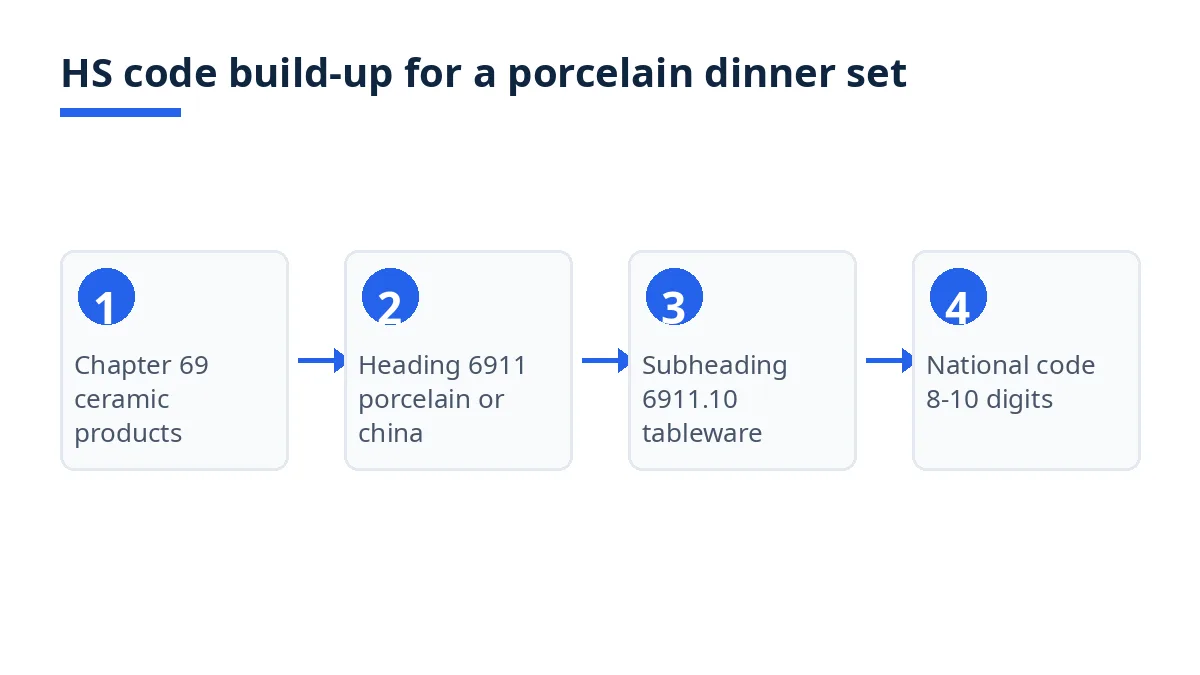
For a porcelain dinner set the build-up is: Chapter 69 for ceramic products; heading 6911 for tableware, kitchenware, other household articles and toilet articles, of porcelain or china; then subheading 6911.10 for tableware and kitchenware. Everything after the sixth digit is national detail: countries subdivide the six-digit categories into national subheadings,3 and the current version is HS 2022.3
Factors that decide the code for porcelain dinner sets
The fired-body test comes first, briefly. Chapter 69 applies only to ceramic products fired after shaping; articles heated below 800 °C merely to cure resins or remove water are not considered fired and are excluded.1 For headings 6909 through 6914, porcelain, china and chinaware embrace ceramic ware other than stoneware, whether glazed or decorated, having a fired white body, unless artificially coloured, absorbing not more than 0.5% of its weight of water and translucent in thicknesses of several millimetres.1 Bone chinaware, whose body contains 25% or more of calcined bone or tricalcium phosphate, stays at 6911, and water absorption is measured by ASTM C373.1 A body that fails the porcelain test points to heading 6912 instead, so ask the supplier to state the body and the test result in writing.
The pattern test is what makes a dinner set different from loose plates. In the United States, "available in specified sets" embraces plates, cups, saucers and other articles principally used for preparing, serving or storing food or beverages, or food or beverage ingredients, sold or offered for sale in the same pattern.1 No article counts as available in specified sets unless the pattern includes at least the listed articles.1 Those articles are 12 dinner plates, 12 side plates, 12 tea cups and their saucers, 12 soups, 12 fruits, one platter or chop dish, one open vegetable dish or bowl, one sugar and one creamer, each of a stated size or capacity; where soups or fruits are not offered, 12 cereals are substituted.1
The pattern test follows the pattern, not your shipment. Where each listed article is sold or offered for sale in the same pattern, the classification of all articles of that pattern is governed by the aggregate value of the listed articles in the stated quantities, whether or not those articles are imported in the same shipment.1 Buying only four dinner plates of a pattern that is sold as a specified set does not escape the pattern test. Before you order, find out whether the pattern is sold as a full specified set, and get the pattern name and piece list in writing.
One article can be several pieces. For headings 6911, 6912 and 6913, an article is a single tariff entity which may consist of more than one piece: a vegetable dish and its cover, or a beverage pot and its lid, imported in the same shipment, constitute one article.1 Count a covered dish or lidded sugar bowl as one article on the invoice, not two.
Household ware and hotel ware take different lines. In the United States schedule, hotel or restaurant ware and other ware not household ware sits on its own line at 6911.10.10.1 A porcelain set made for hotel service and a matching household set need separate entries, even in the same pattern. State the intended use on every order and invoice.
Tableware or ornamental: use decides. Heading 6913 covers statuettes and other ornamental ceramic articles. A fine bone china plate was classified at 6911 10 00 because it was designed essentially to serve useful purposes, its decoration was secondary, and it worked no less efficiently than a plain plate.4 A plate sold as wall decoration, with a hanger and no food-contact use, belongs on the 6913 side. Do not file display plates as tableware, or tableware as ornaments.
Mixed sets need a piece-by-piece list. A boxed set can mix bodies, for example porcelain plates with stoneware bowls, or mix tableware with a decorative piece. Retail sets that cannot be classified by the most specific description are classified by the component which gives them their essential character.5 Do not assume one code covers every piece in a mixed box: list each piece, its body and its use, and let your broker test whether the set rule or a per-piece reading applies.
Open stock is not automatically outside the set rules. A pattern sold piece by piece, but also offered as a full set, can still meet the specified-set test, because the test looks at what is sold or offered for sale in the pattern.1
National codes: US HTS, EU CN/TARIC, UK commodity code
United States: HTS, ten digits. Under 6911.10, hotel or restaurant ware sits at 6911.10.10, bone chinaware lines follow, and the specified-set lines at 6911.10.35, 6911.10.37 and 6911.10.38 split by aggregate value band.1 Other porcelain articles that are not tableware or kitchenware sit at 6911.90.1 Read the full ten-digit line for each piece.
European Union: CN at eight digits, TARIC for measures. The Combined Nomenclature integrates the HS and adds EU subdivisions, producing eight-digit codes.3 Tableware and kitchenware of porcelain or china sits at 6911 10 00, the line confirmed for a fine bone china plate in the United Kingdom tariff notice.4 In the Northern Ireland tariff, other tableware and kitchenware sits at 6911 1000 90 and other articles at 6911 9000 00.5 Read the confirmed line in TARIC for the entry date.
United Kingdom: commodity code, ten digits. The United Kingdom builds its commodity code on the same first six digits, with its own extension after them.3 Take the full code from the UK Trade Tariff for your ware and entry date.
United Arab Emirates and other destinations. The first six digits are shared by the more than 200 economies using the HS.2 For the United Arab Emirates, read the full national code in its tariff: the six digits are shared, the extension is national.
How to confirm the code officially
Write a precise description for the set: body type and water absorption result, pattern name, piece list with sizes, household or hotel use, and whether the pattern is sold as a specified set.
Start from the official tariff for the destination: the USITC HTS, TARIC or the UK Trade Tariff, and read the heading text and chapter notes.
Check published rulings for similar ware, including the fine bone china plate ruling at 6911 10 00.4
For a borderline set, apply for a binding decision before you ship. In the European Union, a Binding Tariff Information application needs a separate application for each type of product and a detailed description.6 In the United Kingdom, a legally binding decision is generally valid for 3 years, through an Advance Tariff Ruling.7
Give your broker the pattern name, piece list, body test evidence and confirmed code for each piece.
Common classification mistakes
Filing a boxed set under one code without checking the pieces. The pattern test, article rule and household or hotel split can each move a piece to a different line.1
Assuming open stock escapes the pattern test. The test looks at articles sold or offered for sale in the pattern, whether or not they travel in your shipment.1
Filing hotel ware as household ware. Hotel or restaurant ware sits on its own United States line at 6911.10.10.1 State the use.
Counting a dish and its cover as two articles. A dish and its cover imported together constitute one article.1
Filing bone china at 6912, or stoneware at 6911. Bone chinaware stays at 6911,1 while stoneware points to 6912.
Filing display plates as tableware. A plate whose use is clearly subordinate to ornament belongs with ornamental articles, not tableware.4
Copying a code from another country. The European Union extends the six digits to eight,3 and the United States and United Kingdom split the 6911 lines further.1 5
Related duties and documents
This guide states no duty rates: the code decides which duty line customs applies, and a rate on one specified-set line does not carry to another line or country. Read the rate beside your confirmed code for your origin and entry date.3 Keep the set file together: pattern name, piece list with sizes, body test result, household or hotel use, confirmed codes per piece, any binding decision and origin evidence.
FAQs
What is the HS code for porcelain dinner sets?
Porcelain dinner sets point indicatively to heading 6911, at subheading 6911.10 for tableware and kitchenware.1 The full national code depends on the pattern, piece list and household or hotel use, and in the United States a pattern sold as a specified set follows the specified-set lines.1
Is the HS code the same in every country?
Only the first six digits are shared worldwide. The system is used by more than 200 countries and economies as a basis for their customs tariffs,2 and each country further subdivides the six-digit categories into national subheadings.3 The European Union uses eight-digit codes, and the United States and United Kingdom use ten-digit codes.3
How do I confirm the correct code?
Describe the set precisely, read the heading text and chapter notes in the destination tariff, and check published rulings for similar ware.4 For a borderline set, apply for a binding decision before shipping: Binding Tariff Information in the European Union,6 or an Advance Tariff Ruling in the United Kingdom, generally valid for 3 years.7
What happens if I use the wrong code?
Duty, licensing and quota treatment are worked out from the code on the declaration, so a wrong code brings the wrong treatment. The Harmonized System nomenclature determines which tariffs and requirements apply,3 and a binding decision helps you calculate the duties and restrictions that will apply in advance.7
Next steps on Exportain
Browse Bangladeshi suppliers on Exportain, where supplier profiles carry document and photo review badges, and read the HS code explainer for the structure behind the digits.
Sources
- Harmonized Tariff Schedule of the United States, Chapter 69 (2026 Revision 18). U.S. International Trade Commission (accessed )
- What is the Harmonized System (HS)?. World Customs Organization (accessed )
- Harmonised System. European Commission (accessed )
- Plate made of fine bone china (Tariff notice 11). GOV.UK (accessed )
- Tableware, kitchenware, other household articles and toilet articles, of porcelain or china - Northern Ireland Online Tariff, heading 6911. GOV.UK, HM Revenue and Customs (accessed )
- European Binding Tariff Information (EBTI). European Commission, Taxation and Customs Union, (accessed )
- Check what you'll need to get a legally binding decision on a commodity code. GOV.UK, HM Revenue and Customs (accessed )
About the author
Sourcing from Bangladesh?
Post a request for quotation and suppliers on Exportain can send you their quotes directly.
Post an RFQ


