HS Code for Plastic Toys: Classification Guide for Importers
Plastic toys point indicatively to heading 9503, split by toy type rather than by polymer, with US, EU and UK national codes and toy-safety checks that run beside classification.
Short answer
Plastic toys point indicatively to heading 9503, but the line inside the heading depends on the toy type, not the polymer: a doll, a construction set and a motor toy take different lines, and an article that fails the play test, or falls under a Chapter 95 exclusion, leaves 9503 entirely. Confirm the full national code, and the matching toy-safety file, before filing.
On this page
Key takeaways
A toy for classification is an article designed and used for amusement, diversion or play rather than practicality; packaging, advertising and retail channel help decide the class or kind.
Inside heading 9503 the split runs by toy type first, and plastic is a split only inside some national lines, such as construction sets, motor toys and other toys of plastics in the UK tariff.
In the United States schedule, classification inside heading 9503 is based on the youngest age for which the product is intended, and the 2026 schedule carries the heading as a single line, 9503.00.00, with statistical suffixes.
A set takes the code of the component that gives it its essential character, so a furniture-and-toy set can be furniture rather than a toy, while a non-set combination with the essential character of toys stays in 9503.
Toy safety is a separate gate beside classification: the United States requires a children's product certificate based on CPSC-accepted third-party testing, and the EU requires technical documentation with a safety assessment and age suitability, with the EN 71 series among the referenced standards.
A plastic doll, a plastic building set and a plastic ride-on car can sit on the same shelf and still be tested under different lines of the same heading. For plastic toys, the first question is never the material. It is whether the article is a toy at all, and then what kind of toy it is. A toy is treated, for classification, as an article designed and used for amusement, diversion or play rather than for a practical purpose.1 Every heading here is indicative: confirm the full national code with your broker before filing.
Quick answer: indicative HS heading (with verify note)
Plastic toys point indicatively to heading 9503, which covers wheeled toys, dolls' carriages, dolls, other toys, scale models and puzzles.2 Inside it, the split runs by toy type first, and plastic matters only inside some national lines.
Toy | Indicative territory | Why |
|---|---|---|
Plastic ride-on tricycle, scooter or pedal car | 9503, wheeled-toy line | Heading names wheeled toys2 |
Plastic doll or doll's carriage | 9503, doll line | Heading names dolls2 |
Plastic construction set or building blocks | 9503, construction-toy line | UK tariff separates construction sets of plastics2 |
Plastic toy with a motor, or other plastic toy | 9503, motor-toy or other-plastic line | UK tariff separates motor toys and other toys of plastics2 |
Plastic toy put up in a set or outfit | 9503, sets line | UK tariff carries a separate sets line2 |
Spare plastic part for a toy | 9503, parts line, with the toy it fits | Parts for Chapter 95 articles follow those articles3 |
How HS codes are structured (2-4-6 digits)
The Harmonized System is a multipurpose international product nomenclature developed by the World Customs Organization (WCO), comprising more than 5,000 commodity groups, each identified by a six-digit code, and used by more than 200 countries and economies as a basis for their customs tariffs.4 The Commission describes the same hierarchy: chapters at two digits, headings at four digits and subheadings at six digits.5
For plastic toys the build-up reads as follows.
Chapter 95 covers toys, games and sports requisites. Heading 9503 narrows it to wheeled toys, dolls, other toys, scale models and puzzles. The six-digit level is where the shared code ends: in the current United States schedule, heading 9503 appears as a single line, 9503.00.00, with statistical suffixes that vary by product type.3 The current version is HS 2022.5
Factors that decide the code for plastic toys
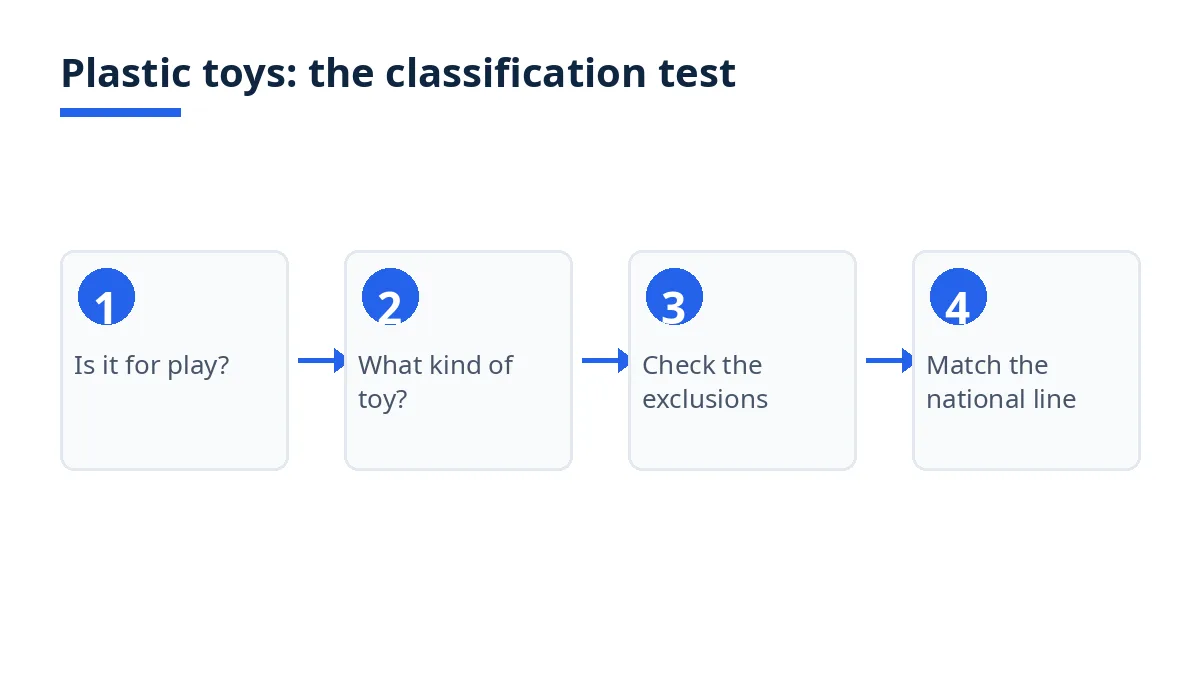
Work through these tests in order. Most errors come from starting with the polymer, or from assuming that anything sold in a toy shop is a 9503 toy.
1. The play test comes first. A good is a toy for classification only if it is designed and used for amusement, diversion or play, rather than practicality.1 Customs weighs the class or kind by physical characteristics, purchaser expectation, channels of trade, environment of sale, comparable use, economic practicality, and trade recognition.1 A figure marketed to adult collectors is tested differently from the same shape marketed as a child's plaything.
2. The toy type comes second, not the plastic. Inside heading 9503, the UK tariff separates wheeled toys, dolls, trains and scale-model kits, construction sets, animal toys, musical toys, puzzles, sets, motor toys, toy weapons, die-cast models, electronic education devices and other toys.2 Plastic is a split only inside some lines: construction sets, motor toys and other toys of plastics.2
3. Age grading changes the national detail, and the safety file too. In the United States schedule, classification inside heading 9503 is based on the youngest age for which the product is intended: an item labelled for ages 2 to 5 is classified in the under-3 category.3 Parts without their own age label take the age designation of the finished retail product.3 Record the intended age as labelled, and use the same age in the safety file.
4. The Chapter 95 exclusions can remove an article from 9503. Chapter 95 does not cover, among other things, fancy dress and sports clothing of textiles, sports footwear, children's bicycles, unmanned aircraft, sports craft, arms, lighting strings and utilitarian articles classified by their constituent material.3 A ride-on that is a children's bicycle sits at heading 8712, and a flying toy drone sits with unmanned aircraft at heading 8806. An article identifiable as intended exclusively for animals, such as a pet toy, is also outside heading 9503.3
5. Sets and combinations are tested by essential character. Articles put up together for retail sale to meet a particular need or carry out a specific activity form a set, which takes the code of the component that gives it its essential character.6 A convertible baby activity centre with an infant seat, plastic toys and a tabletop was classified as furniture of plastics, not as a toy, because the tabletop gave the set its essential character.6 By contrast, Chapter 95 note 4 keeps a non-set combination in 9503 where it has the essential character of toys:3 an action figure with replica elbow pads, and a stuffed animal with a replica cape, both stayed in 9503 because they were used for amusement, diversion and play, with no practical value.1
6. Toy safety is a separate gate beside classification. Classification decides the code; safety rules decide whether the toy may be sold at all. In the United States, a children's product certificate must be issued by the importer for products made overseas, based on testing by a CPSC-accepted third-party laboratory, and must accompany the shipment and be furnished to distributors and retailers and, on request, to the CPSC and to Customs.7 The certificate lists the applicable safety rules, including ASTM F963.7 In the European Union, the toy safety framework requires technical documentation that includes a safety assessment, the intended and foreseeable use, and the age suitability of the toy, with the harmonised EN 71 series among the standards referenced for conformity.8 A correct 9503 code never cures a failed safety test.
National codes: US HTS, EU CN/TARIC, UK commodity code
Only the first six digits are shared worldwide.5
United States: HTS, ten digits. The 2026 United States schedule carries heading 9503 as 9503.00.00, with statistical suffixes that vary by product type and by the youngest age for which the product is intended.3 Older rulings cite subheadings such as 9503.70 for sets, because the schedule has since been restructured: do not copy an old subheading without checking the current schedule.
European Union: CN at eight digits, TARIC for measures. The Combined Nomenclature uses eight-digit codes built on the six-digit subheading.5 Take the eight-digit CN line for the toy type, then check TARIC for the measures on your entry date.
United Kingdom: commodity code, ten digits. The United Kingdom builds its commodity code on the same first six digits.5 The UK tariff lists wheeled toys at 9503 0010 00, dolls at 9503 0021, construction sets of plastics at 9503 0035 00, puzzles other than wood at 9503 0069 00, sets at 9503 0070 00, motor toys of plastics at 9503 0075, and other toys of plastics at 9503 0095.2
How to confirm the code officially
Write a precise description for each toy: play purpose, toy type, construction, motor or no motor, set or single article, intended age exactly as labelled, and any practical function.
Start from the official tariff for the destination, and read the heading text and the Chapter 95 notes, including the exclusions and note 4.2 3
Check published rulings for similar toys: the action-figure and stuffed-animal combinations show the play test and note 4,1 and the activity-centre ruling shows how essential character can move a set out of 9503.6
For a borderline toy, apply for a binding decision before you ship: a Binding Tariff Information decision in the European Union, with a separate application for each product type and a detailed description,9 an Advance Tariff Ruling in the United Kingdom, generally valid for 3 years,10 or a binding ruling from US Customs and Border Protection.6
Give your broker the description, intended age and confirmed code for each toy, and use the same codes and age grading throughout the entry and the safety file.
Common classification mistakes
Filing every plastic toy on one line. Heading 9503 splits by toy type, and plastic is a split only inside some lines.2
Filing a practical article as a toy because it is plastic and colourful. The play test asks whether the article is designed and used for amusement, diversion or play rather than practicality.1 A pet chew falls under the animal exclusion.3
Filing a children's bicycle or a drone as a toy. Children's bicycles sit at heading 8712 and unmanned aircraft at heading 8806, both excluded from Chapter 95.3
Filing a furniture-and-toy set as a toy, or a note 4 combination as two codes. A set takes the code of its essential-character component.6 A non-set combination with the essential character of toys stays in 9503 as one combination.1 3
Copying an old United States subheading, or a full national code across destinations. Older rulings cite lines that the restructured 2026 schedule no longer carries for 9503.3 Only the first six digits are shared.5
Treating the safety certificate as the classification. A children's product certificate proves safety compliance; it does not prove the code.7
Related duties and documents
This guide states no duty rates: the code decides which duty line customs applies, and a rate on a doll line does not carry to a construction-set line. Read the rate beside your confirmed code for your origin and entry date, and check what proof of origin a preference claim requires.
Keep the classification file with the shipment documents: toy description, toy type, intended age as labelled, confirmed code, any binding decision, safety test reports, the children's product certificate or EU declaration of conformity, and origin evidence. Put each toy type on its own invoice line, with sets described as sets and their essential-character component named. If the specification or labelled age changes, re-check both files before the next shipment.
FAQs
What is the HS code for plastic toys?
Plastic toys point indicatively to heading 9503, which covers wheeled toys, dolls, other toys, scale models and puzzles.2 Inside the heading, the line depends on toy type: the UK tariff separates wheeled toys, dolls, construction sets, motor toys and other toys of plastics.2 Confirm the full national code before filing.
Is the HS code the same in every country?
Only the first six digits are harmonised: eight digits in the EU Combined Nomenclature,5 ten in the United Kingdom,2 and a single 9503.00.00 line with statistical suffixes in the current United States schedule.3
How do I confirm the correct code?
Describe each toy precisely, read the heading text and Chapter 95 notes, and check published rulings for similar toys.1 6 For a borderline toy, apply for a binding decision before shipping: an Advance Tariff Ruling in the United Kingdom,10 a Binding Tariff Information decision in the European Union,9 or a binding ruling from US Customs and Border Protection.6
What happens if I use the wrong code?
Duty, licensing and quota treatment are worked out from the code on the declaration, so a wrong code brings the wrong treatment. A binding decision in advance helps you calculate the duties and restrictions that will apply, and in the United Kingdom it is generally valid for 3 years.10 If the labelled age does not match the safety file, correct both.
Next steps on Exportain
Browse Bangladeshi suppliers on Exportain, where supplier profiles carry document and photo review badges, and compare plastic toy ranges with the confirmed codes and intended ages per toy. The HS code explainer covers the 2-4-6 structure, and the classification method guide walks through the heading and notes reading. Exportain is not a party to the goods contract and does not inspect goods, book freight or clear customs.
Sources
- Customs Ruling HQ H069897 - Classification of an action figure packaged with elbow pads and a stuffed animal packaged with a cape. U.S. Customs and Border Protection (accessed )
- Tricycles, scooters, pedal cars and similar wheeled toys; dolls' carriages; dolls; other toys; reduced-size ('scale') models and similar recreational models, working or not; puzzles of all kinds - UK Integrated Online Tariff, heading 9503. GOV.UK, HM Revenue and Customs (accessed )
- Harmonized Tariff Schedule of the United States, Chapter 95 (2026 Revision 18). U.S. International Trade Commission (accessed )
- What is the Harmonized System (HS)?. World Customs Organization (accessed )
- Harmonised System. European Commission (accessed )
- Customs Ruling NY N300852 - The tariff classification of a convertible baby activity table from China. U.S. Customs and Border Protection (accessed )
- FAQs - Certification and Third Party Testing. U.S. Consumer Product Safety Commission (accessed )
- Toy Safety Directive 2009/48/EC: Guidance Document on the Application of Directive 2009/48/EC on the Safety of Toys: Technical Documentation. European Commission (accessed )
- European Binding Tariff Information (EBTI). European Commission, Taxation and Customs Union, (accessed )
- Check what you'll need to get a legally binding decision on a commodity code. GOV.UK, HM Revenue and Customs (accessed )
About the author
Sourcing from Bangladesh?
Post a request for quotation and suppliers on Exportain can send you their quotes directly.
Post an RFQ