HS Code for Plastic Furniture: Classification Guide for Importers
Plastic furniture splits by function: seats point to heading 9401, decided by frame material, while other plastic furniture points to 9403.70, with national codes running to 8-10 digits.
Short answer
Plastic furniture has no single HS code. A seat points indicatively to heading 9401, with the frame material deciding the line: wood-frame, metal-frame, or 9401.80 for other seats. Other plastic furniture points indicatively to 9403.70, furniture of plastics. Confirm the full national code in the destination tariff before filing.
On this page
Key takeaways
A plastic seat points to heading 9401, not 9403.70: the frame decides the line, so a plastic shell on a steel frame takes the metal-frame line 9401.79, while a one-piece moulded chair points to 9401.80.
Other plastic furniture points to 9403.70, furniture of plastics, after the seat test has put the piece in heading 9403 rather than 9401.
In the United States, reinforced or laminated plastics split from other plastics inside both 9401.80 and 9403.70, so the construction must be confirmed, not assumed.
Only the first six digits are shared worldwide: the EU extends to eight digits and the United States and United Kingdom to ten, so confirm the full national code per piece.
A plastic chair and a plastic table can arrive in the same shipment, from the same supplier, in the same polymer, and still take different customs headings. For plastic furniture, the deciding question is not what the piece is made of, but what it is for: a seat is classified as a seat, and everything else that counts as furniture is classified as other furniture. All headings below are indicative: confirm the full national code in the destination tariff before filing. For the general method, read HS codes: how to classify your product.
Quick answer: indicative HS heading (with verify note)
There is no single heading for all plastic furniture. The furniture-function test splits the range in two:
Piece | Indicative heading | Why |
|---|---|---|
Plastic chair, stool, bench seat, or other seat | 9401, seats | Heading 9401 covers seats other than those of heading 94021 |
Plastic table, cabinet, shelf unit, or other non-seat furniture | 9403, other furniture, at 9403.70 for furniture of plastics | 9403.70 is furniture of plastics in the United States schedule1 and the UK tariff2 |
Vehicle seat, aircraft seat, or medical chair | 9401.20, 9401.10, or 9402 | The special-use lines come before the general seat lines in heading 94011 |
Toy furniture, or a cushion or mattress sold separately | 9503 or 9404 | Chapter 94 note 1 excludes toy furniture (9503) and Chapter 39, 40 or 63 mattresses, pillows or cushions1 2 |
A moulded plastic garden chair therefore starts at 9401, and a moulded plastic garden table at 9403.70. Treat both as starting points: the tests below can move a seat from one line to another.
How HS codes are structured (2-4-6 digits)
The Harmonized System is a multipurpose international product nomenclature developed by the World Customs Organization (WCO), comprising more than 5,000 commodity groups, each identified by a six-digit code, and used by more than 200 countries and economies as a basis for their customs tariffs.3 The European Commission describes the same hierarchy: chapters at two digits, headings at four digits and subheadings at six digits, with countries subdividing the six-digit categories further.4
For plastic furniture the build-up reads as follows.
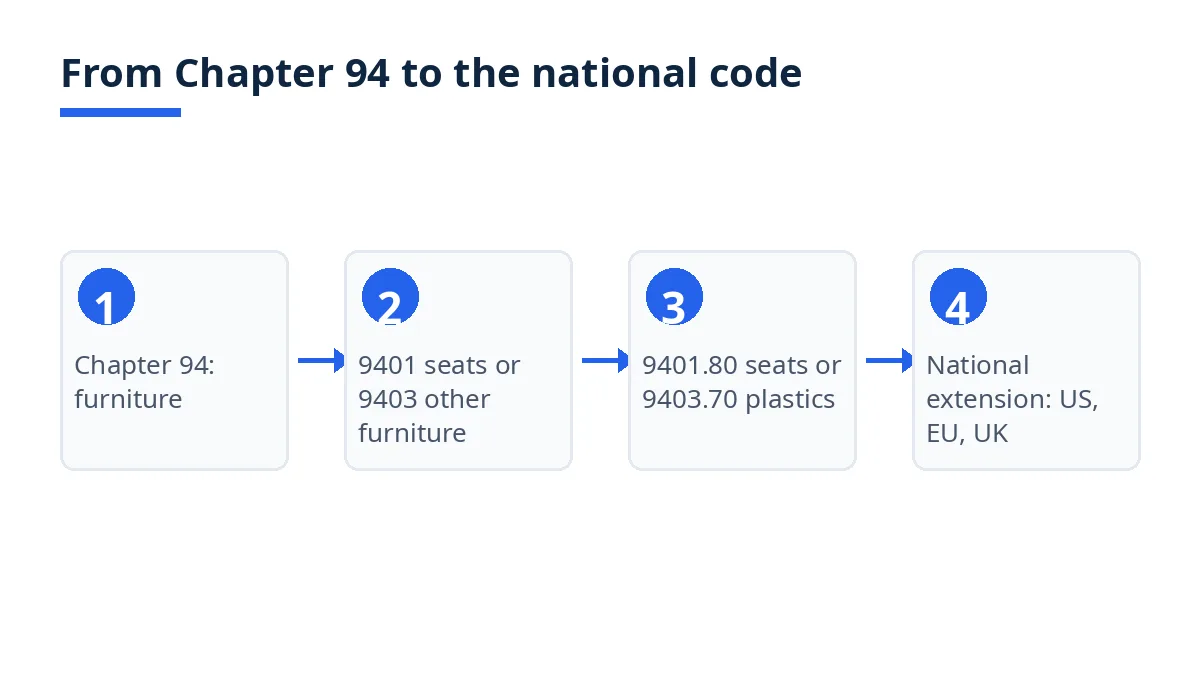
Chapter 94 covers furniture and related articles. Heading 9401 narrows it to seats, and heading 9403 to other furniture. At six digits, 9401.80 covers other seats and 9403.70 covers furniture of plastics. Everything after the sixth digit is national detail that does not travel to another territory. The current version is HS 2022, although some countries stay with a previous version for a time.4 Read the HS code explainer for the full structure.
Factors that decide the code for plastic furniture
Work through these tests in order. Most errors come from starting with the polymer instead of the function.
1. The seat test comes first. Ask whether the article is made to sit on. If it is, heading 9401 applies, whatever polymer the shell is moulded from. If it is not a seat, and it is not a special case such as medical furniture in heading 9402, heading 9403 applies. A plastic stool is a seat even with no backrest.
2. For seats, the frame decides the line, not the shell. Heading 9401 splits seats by special use, then by frame material: wooden frames at 9401.61 and 9401.69, metal frames at 9401.71 and 9401.79, and other seats at 9401.80.1 A plastic shell on a steel frame is therefore a metal-frame seat. A United States ruling on a plastic stacking chair with a powder-coated steel frame put it at 9401.79, not 9401.80, even though the seat and backrest were plastic.5 A one-piece moulded plastic chair with no wood or metal frame points to 9401.80.1
3. For non-seat furniture, the material split sits inside 9403. Heading 9403 splits other furniture by material and use, with furniture of plastics at 9403.70.1 A plastic table therefore points to 9403.70.
4. Reinforced or laminated plastic is a separate United States split. Inside both 9401.80 and 9403.70, the United States schedule separates reinforced or laminated plastics from other plastics: 9401.80.20 against 9401.80.40, and 9403.70.40 against 9403.70.80.1 A United States ruling on plastic picnic and folding tables with steel frames found their essential character in the plastic tabletop and classified them at 9403.70, on the reinforced or laminated line where that construction applied.5
5. The floor-or-ground rule, with named exceptions. Chapter 94 note 2 limits headings 9401 to 9403 to articles designed for placing on the floor or ground, except cupboards, bookcases, other shelved furniture (including single shelves presented with supports for fixing them to the wall) and unit furniture, and seats and beds.1 2 A freestanding cabinet qualifies directly; a wall-fixed shelf unit qualifies under the shelved-furniture exception.
6. Sets and composites are tested piece by piece, except where one article does the work. A table-and-chairs set is not one code: the table points to 9403.70 and each chair to its 9401 line by frame. The picnic-table ruling shows the other side: where benches are affixed to the table frame as one article, its essential character decides, and the tabletop gave it that character.5
7. Parts follow their own lines. Seat parts sit at 9401.91 for wood and 9401.99 for other materials, including a line for parts of rubber or plastics.1 Other-furniture parts sit in the parts lines of heading 9403. A loose plastic chair shell, table leg or hinge is not the finished piece. Chapter 94 note 3 also excludes sheets and slabs of glass, marble, stone or Chapter 68 or 69 material from the parts references, and bars heading 9404 goods, presented separately, from classification as furniture parts.1 2
National codes: US HTS, EU CN/TARIC, UK commodity code
Only the first six digits are shared worldwide. Beyond six digits, each country adds its own lines.4
United States: HTS, ten digits. The United States schedule extends 9401.80 to ten-digit lines separating children's highchairs, booster seats, bath seats, infant walkers, bouncers, swings and stationary activity centres from other seats, and splitting reinforced or laminated plastics from other plastics.1 For 9403.70 it separates reinforced or laminated plastics (9403.70.40) from other plastics (9403.70.80), each with household and office suffixes.1 Read the full ten-digit line for each piece.
European Union: CN at eight digits, TARIC for measures. The Combined Nomenclature uses eight-digit codes built on the six-digit subheading.4 Furniture of plastics sits at 9403.70.00 in the EU system, as shown by the UK tariff page for that commodity.2 Other seats sit at 9401.80.00, with no further plastic split at eight digits.6 Take the eight-digit CN line, then check TARIC for the measures on your entry date.
United Kingdom: commodity code, ten digits. The United Kingdom builds its commodity code on the same first six digits.4 The UK tariff lists other seats at 9401 8000 00, after the wood-frame lines at 9401 6100 00 and 9401 6900 00 and the metal-frame lines at 9401 7100 00 and 9401 7900 00.6 For furniture of plastics, the UK tariff page for commodity 9403 7000 00 carries the Chapter 94 notes alongside the code.2 Take the full ten-digit code from the UK Trade Tariff for the piece and entry date.
How to confirm the code officially
Write a precise description for each piece: seat or non-seat furniture, frame material and construction, whether the plastic is reinforced or laminated, dimensions, intended use, and floor-standing, wall-fixed or set status.
Start from the official tariff for the destination, and read the heading text and the Chapter 94 notes.1 2
Check published rulings for similar pieces: the stacking-chair ruling shows how a plastic shell on a steel frame takes the metal-frame line,5 and the picnic-table ruling shows how essential character is tested for a composite article.5
For a borderline piece, apply for a binding decision before you ship. In the European Union, a Binding Tariff Information decision needs a separate application for each type of product and a detailed description.7 In the United Kingdom, a legally binding decision is generally valid for 3 years, through an Advance Tariff Ruling.8 In the United States, binding rulings are issued by US Customs and Border Protection.5
Give your broker the description and confirmed code for each piece, and use the same codes throughout the entry.
Common classification mistakes
Filing every plastic furniture piece at 9403.70. Chairs, stools and other seats belong in heading 9401, not 9403.1
Filing a plastic-shell metal-frame chair as a plastic seat. The frame decides the seat line. The stacking chair with a steel frame took 9401.79, other seats with metal frames, not 9401.80.5
Filing a toy chair as furniture. Chapter 94 note 1 excludes toy furniture, which sits in heading 9503.1 2
Filing cushions, mattresses or bedding as furniture. Goods described in heading 9404, presented separately, are not furniture parts, and pneumatic or water mattresses, pillows or cushions of Chapter 39, 40 or 63 are excluded from Chapter 94.1 2
Filing vehicle, aircraft or medical seats on the general seat lines. Aircraft seats sit at 9401.10, motor-vehicle seats at 9401.20, and medical, surgical, dental or veterinary furniture at 9402.1
Filing parts as finished furniture. A chair shell, a tabletop or a leg takes a parts line, not the finished-piece line, and a loose sheet or slab is not a part at all under Chapter 94 note 3.1
Copying a full national code across destinations. Only the first six digits are shared.4
Related duties and documents
This guide states no duty rates: the code decides which duty line customs applies. Read the rate beside your confirmed code for your origin and entry date, and check what proof of origin a preference claim requires.
Keep the classification file with the shipment documents: piece description, frame and construction details, confirmed code for each piece, any binding decision, and origin evidence. Put each piece type on its own invoice line, with seats and tables separate even when they ship as a set. If the specification changes, for example from a one-piece moulded chair to a plastic shell on a steel frame, re-check the code before the next shipment.
FAQs
What is the HS code for plastic furniture?
There is no single code. A plastic seat points indicatively to heading 9401, at 9401.80 where no wood or metal frame line applies, and other plastic furniture points indicatively to 9403.70, furniture of plastics.1 2 Confirm the full national code for the destination and piece before filing.
Is the HS code the same in every country?
Only the first six digits are harmonised. Beyond six digits, each country adds its own lines: eight digits in the EU Combined Nomenclature,4 ten in the United States and the United Kingdom.1 6
How do I confirm the correct code?
Describe each piece precisely, read the heading text and Chapter 94 notes in the destination tariff, and check published rulings for similar pieces.5 For a borderline piece, apply for a binding decision before shipping: Binding Tariff Information in the European Union,7 an Advance Tariff Ruling in the United Kingdom,8 or a binding ruling from US Customs and Border Protection.5
What happens if I use the wrong code?
Duty, licensing and quota treatment are worked out from the code on the declaration, so a wrong code brings the wrong treatment. A binding decision in advance helps you calculate the duties and restrictions that will apply, and in the United Kingdom it is generally valid for 3 years.8
Next steps on Exportain
Browse Bangladeshi suppliers on Exportain, where supplier profiles carry document and photo review badges, and compare plastic furniture ranges with the confirmed codes stated per piece. The HS code explainer covers the 2-4-6 structure, and the classification method guide walks through the heading and notes reading. Exportain is not a party to the goods contract and does not inspect goods, book freight or clear customs.
Sources
- Harmonized Tariff Schedule of the United States, Chapter 94 (2026 Revision 18). U.S. International Trade Commission (accessed )
- Commodity code 9403700000: Furniture of plastics - Northern Ireland Online Tariff. GOV.UK, HM Revenue and Customs (accessed )
- What is the Harmonized System (HS)?. World Customs Organization (accessed )
- Harmonised System. European Commission (accessed )
- Customs Ruling NY N302413 - The tariff classification of tables and a chair from China. U.S. Customs and Border Protection (accessed )
- Seats (other than those of heading 9402), whether or not convertible into beds, and parts thereof - UK Integrated Online Tariff. GOV.UK, HM Revenue and Customs (accessed )
- European Binding Tariff Information (EBTI). European Commission, Taxation and Customs Union, (accessed )
- Check what you'll need to get a legally binding decision on a commodity code. GOV.UK, HM Revenue and Customs (accessed )
About the author
Sourcing from Bangladesh?
Post a request for quotation and suppliers on Exportain can send you their quotes directly.
Post an RFQ