

HS Code for Nakshi Kantha: Classification Guide for Importers
A nakshi kantha has no single HS code: a layered quilt takes 9404.40 and an unfilled embroidered bedspread takes 6304.19. Confirm the full national code for your exact piece before filing.
Short answer
A nakshi kantha has no single HS code. A layered kantha sold as a bedding quilt is tested against 9404.40, while an unfilled embroidered kantha sold as a bedspread is tested against 6304.19. The fork turns on whether the piece is bedding stuffed or internally fitted with layered cloth, not on the word kantha. Confirm the full national code in the destination tariff before filing.
On this page
Key takeaways
A layered kantha sold as a bedding quilt is tested against 9404.40, while an unfilled embroidered kantha sold as a bedspread is tested against 6304.19; both codes are indicative until confirmed.
Heading 6304 expressly excludes articles of heading 9404, so a layered bedding kantha must not be filed on the bedspread line.
Embroidery does not change the six-digit heading: an embroidered bedspread and a plain bedspread share 6304.19, with embroidery detail mattering at national level.
Fiber follows predominance by weight, and a synthetic-fiber-predominant cover moves away from the cotton line.
Only the first six digits are shared worldwide: the EU extends to eight digits and the United States and United Kingdom to ten, so confirm the full national code per piece.
If you import embroidered quilts from Bangladesh, the hs code for nakshi kantha is the line your customs entry, duty treatment and origin claim turn on, and no single code covers every kantha. A nakshi kantha is an embroidered quilt said to be indigenous to Bangladesh, made from old cloth, discarded saris, dhotis and lungis, ranging from utilitarian quilts to exquisitely embroidered heirlooms.1 Depending on the thickness required, three to seven saris are layered and quilted with a simple running stitch, and kanthas serve primarily as bed pallets and as light wraps.1 Customs tests the article you actually ship, not the word on the listing. For the general meaning of an HS code, read the HS code hub; for the step-by-step method, read how to classify your product.
Quick answer: indicative HS heading (with verify note)
Indicative only — verify before filing. Every heading here is indicative. Confirm the full national code in the destination tariff for your exact piece, entry date and origin before you declare it.
Piece as shipped | Indicative code | Why |
|---|---|---|
Layered kantha sold and used as a bedding quilt or quilted bedspread | 9404.40 | Heading 9404 covers bedding, including quilts, fitted with springs or stuffed or internally fitted with any material, and the UK tariff lists quilts, bedspreads, eiderdowns and duvets at 9404 402 |
Unfilled embroidered kantha sold as a bedspread, with no stuffed or internally fitted bedding character | 6304.19 | Heading 6304 covers other furnishing articles excluding those of heading 9404; its bedspread lines are 6304.11 for knitted or crocheted pieces and 6304.19 for other bedspreads3 |
Kantha sold as a wall hanging or decorative furnishing, not as bedding | 6304.92 for cotton, not knitted or crocheted | The other-furnishing lines of heading 6304 run by construction and fiber, and the US schedule lists 6304.92 as not knitted or crocheted, of cotton4 |
Small kantha article, such as a sitting spread or wrapper | Test by function and material, never by default | Kanthas range from lep kanthas (winter quilts) and sujni kanthas (spreads and coverlets) to the asan, a spread for sitting, and the bastani, a wrapper for clothes1 |
Ask first whether the piece is bedding. If it is a layered quilt for the bed, start in heading 9404; if it is a decorative cover without that bedding character, start in heading 6304. Only then ask about fiber, construction and national detail.
How HS codes are structured (2-4-6 digits)
The Harmonized System is a multipurpose international product nomenclature developed by the World Customs Organization (WCO), comprising more than 5,000 commodity groups, each identified by a six-digit code, and used by more than 200 countries and economies as a basis for their customs tariffs.5 The European Commission describes the same hierarchy: chapters at two digits, headings at four and subheadings at six, supported by general rules and explanatory notes.6 The current version is HS 2022.6
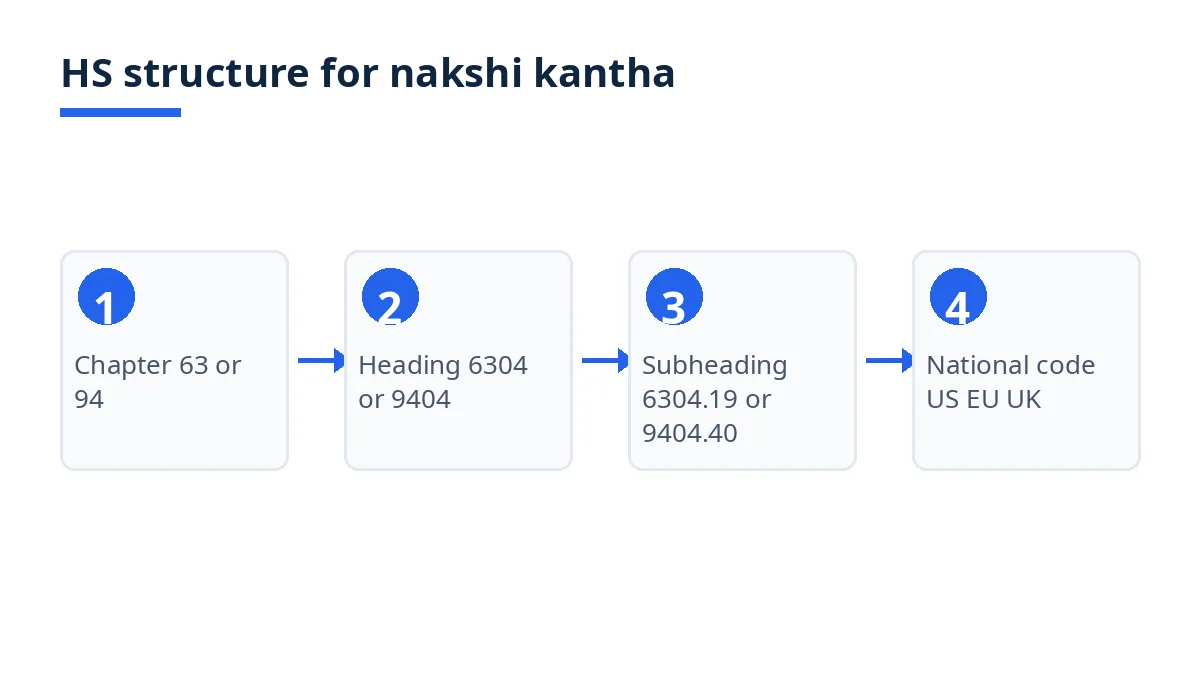
Read a kantha code from left to right. 63 is the chapter for other made up textile articles; 6304 is the heading for other furnishing articles, excluding those of heading 9404; 6304.19 is the six-digit subheading for bedspreads, not knitted or crocheted.3 On the bedding side, 94 is the furniture and bedding chapter; 9404 is the heading for mattress supports and articles of bedding; 9404.40 is the six-digit subheading for quilts, bedspreads, eiderdowns and duvets.2 National digits follow: eight in the EU Combined Nomenclature,6 and ten in the United States and the United Kingdom.
Factors that decide the code for nakshi kantha
Bedding or bedspread: the decisive fork. Heading 9404 turns on whether the article is bedding fitted with springs or stuffed or internally fitted with any material.2 A kantha whose layers are quilted together as a warm bed covering is tested there first, because the layered cloth gives the article its bedding character. A single decorative cover with no such character stays in heading 6304, whose heading text expressly excludes articles of heading 9404.3 When both descriptions seem to fit, the layering and stated bed use settle the fork.
Fiber, and blends by weight. Most traditional kanthas are cotton, because they are made from old cotton saris.1 Inside heading 6304, the other-furnishing lines run by fiber: 6304.92 is of cotton, 6304.93 is of synthetic fibers and 6304.99 is of other textile materials, all not knitted or crocheted.3 For a blend, the textile section notes classify a mixture as the single textile material that predominates by weight.7 Record the fiber percentages by weight for every style.
Embroidery does not change the six-digit heading. The running stitch and embroidered motifs are what make a kantha a nakshi kantha, but embroidery alone does not move a quilt to a different heading or a bedspread to a different subheading. At six digits, an embroidered bedspread and a plain bedspread share 6304.19.3 Embroidery matters at national level: the US schedule has carried a separate cotton bedspread line for pieces containing embroidery, lace, braid, edging, trimming, piping or applique work, beside an "other" cotton line.4 Read the current national line for your piece.
Use as presented, not the sales word. Kanthas range by size and use, from winter quilts to spreads and coverlets, and small kanthas serve as swaddling clothes, sitting spreads, wrappers, mirror wraps, dining spreads, Quran covers and prayer rugs.1 A piece sold as a wall hanging is tested as a furnishing article, a piece sold as a baby wrap is tested as that article, and a piece sold as bedding is tested as bedding. Size alone decides nothing. State the intended use on the specification.
National codes: US HTS, EU CN/TARIC, UK commodity code
United States: HTS, ten digits at full national level. Start from 9404.40 for a quilt-form kantha or 6304.19 for a bedspread-form kantha, then read the full national line for fiber, filling and embroidery detail. In the US schedule, the cotton bedspread line has distinguished pieces containing embroidery from other cotton bedspreads,4 so an embroidered cotton kantha needs its national line read, not just its six digits. Do not carry a UK or EU extension into a US entry.
European Union: CN at eight digits, TARIC for measures. The Combined Nomenclature integrates the HS and adds EU subdivisions, producing eight-digit codes.6 Read the confirmed CN line and the TARIC measures for your member state, entry date and origin, starting from 6304.19 or 9404.40 as the shared six digits.
United Kingdom: commodity code, ten digits. The UK tariff lists bedspreads (other) of cotton at 6304 1910, split into a hand-printed batik line at 6304 1910 10 and an other line at 6304 1910 90, with flax or ramie at 6304 1930 and other textile materials at 6304 1990.8 For bedding, the UK tariff lists quilts, bedspreads, eiderdowns and duvets at 9404 40, split into filled with feathers or down at 9404 4010 00 and other at 9404 4090 00.2 A cotton kantha quilt without feather or down filling therefore points to 9404 4090 00 territory, and a cotton kantha bedspread to 6304 1910 90 territory, each confirmed for your piece and entry date. That UK split is national detail: do not carry it into a US or EU declaration.
How to confirm the code officially
Write a precise description: bed use or furnishing use, layers and any filling, construction, fiber percentages by weight, dimensions, embroidery, and whether the piece is a quilt, a bedspread, a wall piece or another article.
Start from the destination tariff — USITC HTS, TARIC or UK Trade Tariff — and read the heading, subheading and chapter notes, not just the number.
Check published rulings for similar articles. For the United States, the USITC advises traders to use the Customs Rulings Online Search Service (CROSS), because the correct classification of many items can be found there.9
For a borderline piece, such as a lightly layered kantha that could be read as either a quilt or a bedspread, apply for a binding decision before you ship. In the EU, a Binding Tariff Information application needs a separate application for each type of product and a detailed description.10 In the United Kingdom, a legally binding decision is generally valid for 3 years, through an Advance Tariff Ruling.11 In the United States, if the merchandise is not described in any ruling on CROSS, you may request a binding ruling from US Customs and Border Protection.9
Give your broker the description and the confirmed code for each article, and use the same codes on the entry, invoice and packing list.
Common classification mistakes
Filing every kantha under one code. A winter quilt, a bedspread and a wall hanging are different articles even when one maker stitched them all.1 The quilt form points to 9404.40 and the bedspread form to 6304.19.3 2
Filing a quilt as a bedspread, or a bedspread as a quilt. Heading 6304 expressly excludes articles of heading 9404.3 If the piece is layered bedding, the 6304 bedspread line is the wrong starting point.
Filing a blend as cotton without the weight test. A mixture is classified as the material that predominates by weight.7 If synthetic fiber outweighs cotton, the cotton line is wrong.
Filing a set under one code. A kantha shipped with cushion covers or a throw does not give the whole set the kantha's code. Classify each article separately.
Copying a full code from another country. The EU extends the six digits to eight,6 and the US and UK use ten-digit codes with their own splits, such as the UK cotton bedspread and feather-or-down splits.8 2
Related duties and documents
This guide states no duty rates: the code decides which duty line customs applies, and a rate on a bedspread line does not carry to a quilt line or a cotton line. Read the rate beside your confirmed code for your origin and entry date, and check what proof of origin a preference claim requires. A binding decision helps you calculate the duties and restrictions in advance.11
Keep the shipment file together: the piece-by-piece specification (layers and filling, construction, fiber percentages by weight, dimensions, stated use), confirmed codes, any binding decision, origin evidence, and an invoice listing quilts, bedspreads, wall pieces and small articles on separate lines. Photographs do not replace the specification.
FAQs
What is the HS code for nakshi kantha?
There is no single six-digit code for nakshi kantha. A layered kantha sold as a bedding quilt is tested against 9404.40, and an unfilled embroidered kantha sold as a bedspread is tested against 6304.19.3 2 Both are indicative: confirm the full national code per piece.
Is the HS code the same in every country?
Only the first six digits are shared worldwide. Beyond them, the EU uses eight digits,6 and the US and UK use ten digits, including the UK splits for cotton bedspreads and feather-or-down bedding.8 2
How do I confirm the correct code?
Describe each piece precisely, read the heading text and chapter notes, and check rulings such as CROSS for the US.9 For a borderline piece, seek a binding decision before shipping: Binding Tariff Information in the EU,10 an Advance Tariff Ruling in the UK,11 or a CBP binding ruling in the US.9
What happens if I use the wrong code?
Duty, licensing and quota treatment follow the code on the declaration, so a wrong code brings the wrong treatment. A binding decision in advance helps you calculate the duties and restrictions that will apply.11
Next steps on Exportain
Browse Bangladeshi suppliers on Exportain, asking each supplier for a written specification stating layers and filling, construction, fiber percentages by weight and stated use per item. Read the HS code hub and how to classify your product before sending a specification to your broker. Exportain does not clear customs, so keep your broker and any binding decision at the center of the entry.
Sources
- Nakshi Kantha. Banglapedia, Asiatic Society of Bangladesh (accessed )
- Mattress supports; articles of bedding and similar furnishing: heading 9404. GOV.UK, HM Revenue and Customs (accessed )
- Classification Detail — HS Code 6304. United Nations Statistics Division (accessed )
- Harmonized Tariff Schedule of the United States, Chapter 63. United States International Trade Commission (accessed )
- What is the Harmonized System (HS)?. World Customs Organization (accessed )
- Harmonised System. European Commission (accessed )
- Harmonized Tariff Schedule of the United States, Section XI Notes (2025 Revision 11). U.S. International Trade Commission (accessed )
- Other furnishing articles, excluding those of heading 9404 — UK Integrated Online Tariff, heading 6304. GOV.UK, HM Revenue and Customs (accessed )
- MTB 2019: Get Out Ahead of the Pack with a Binding Ruling from CBP. U.S. International Trade Commission (accessed )
- European Binding Tariff Information (EBTI). European Commission, Taxation and Customs Union, (accessed )
- Check what you'll need to get a legally binding decision on a commodity code. GOV.UK, HM Revenue and Customs (accessed )
About the author
Sourcing from Bangladesh?
Post a request for quotation and suppliers on Exportain can send you their quotes directly.
Post an RFQ


