

HS Code for Medical Gowns: Classification Guide for Importers
Disposable nonwoven surgical gowns sit in heading 6210 at 6210.10, reusable coated woven gowns in 6210.40 or 6210.50, and plain untreated woven gowns are tested against heading 6211, with national codes to 8-12 digits.
Short answer
Medical gowns have no single HS code. A disposable felt or nonwoven surgical or isolation gown is tested against heading 6210 at subheading 6210.10, a reusable woven gown with a plastic coating, lamination, or rubberised fabric against 6210.40 or 6210.50 by wearer group, and a plain untreated woven gown against heading 6211 instead. Every heading here is indicative and must be confirmed in the destination tariff before filing.
On this page
Key takeaways
A disposable gown of felt or nonwoven fabric is tested against heading 6210 at subheading 6210.10, while a reusable woven gown with a plastic coating, lamination, or rubberised fabric is tested against 6210.40 or 6210.50 by wearer group.
Heading 6210 requires a fabric of heading 5602, 5603, 5903, 5906, or 5907, so a plain untreated woven gown fails the 6210 test and is tested against heading 6211 instead.
Chapter 62 note 6 gives heading 6210 priority over other headings in the chapter, which is why the fabric test comes before any garment-shape test.
National lines differ: the United States uses the ten-digit line 6210.10.5010 for disposable nonwoven surgical or isolation gowns, the EU and UK use 6210 10 92 and 6210 1092 00 for single-use surgical gowns, and the UAE runs to twelve digits.
Only the first six digits are shared internationally, so confirm the full national code in the destination tariff, or apply for a binding decision, before filing.
A shipment described only as medical gowns can hide three different classifications. Disposable nonwoven isolation gowns, reusable coated surgical gowns, and plain patient gowns do not take one code because they share the word gown. Customs classifies the fabric and the treatment, not the trade name on the carton. For background on the system, read the HS code hub, and for the step method, read how to classify your product.
Quick answer: indicative HS heading (with verify note)
There is no single HS code for medical gowns. The indicative heading depends on the fabric family first, and every heading below is indicative only. Confirm the full national code in the destination tariff before filing.
Gown type | Indicative territory |
|---|---|
Disposable surgical or isolation gown of felt or nonwoven fabric | Heading 6210, subheading 6210.101 |
Reusable woven surgical gown, impregnated, coated, covered, or laminated with plastics, or of rubberised textile fabric | Heading 6210, subheading 6210.40 for men or 6210.50 for women or unisex1 |
Single-use gown of nonwoven fabric, of a kind used by patients or surgeons during surgical procedures | Heading 6210, UK and EU line 6210 10 922 |
Plain woven gown with no felt, nonwoven, coating, lamination, or rubberised fabric | Test against heading 6211, other garments, not 62103 |
Gown made of plastic sheeting, or of paper or cellulose | Headings 3926 or 4818, outside Chapter 621 |
How HS codes are structured (2-4-6 digits)
The Harmonized System is a multipurpose international product nomenclature developed by the World Customs Organization (WCO), comprising more than 5,000 commodity groups, each identified by a six-digit code, and used by more than 200 countries and economies as a basis for their customs tariffs.4 The first two digits are the chapter, the first four are the heading, and all six are the subheading. Chapter 62 covers articles of apparel and clothing accessories, not knitted or crocheted. Heading 6210 covers garments made up of fabrics of heading 5602, 5603, 5903, 5906, or 5907.3 Subheading 6210.10 narrows that heading to garments of fabrics of heading 5602 or 5603, where felt and nonwoven gowns sit.
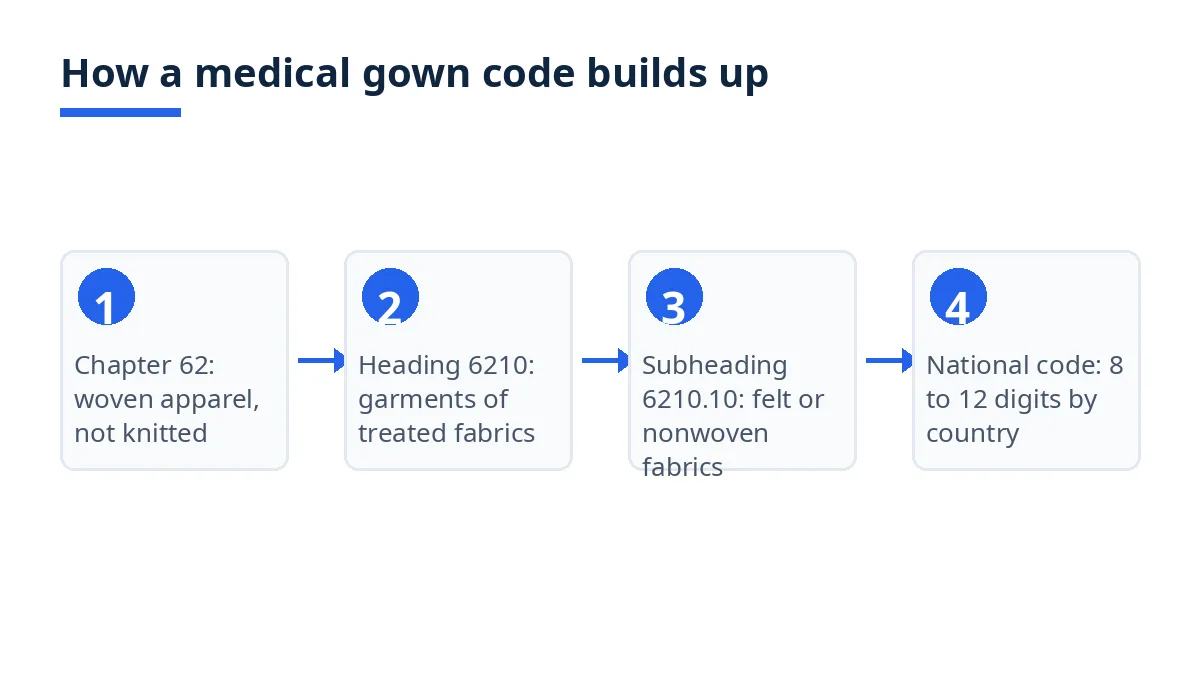
Beyond six digits, each country adds its own detail: eight digits in the EU, ten in the United States and the United Kingdom, and twelve in the UAE. Only the first six digits are shared internationally.
Factors that decide the code for medical gowns
Fabric family comes first. Heading 6210 is defined by its fabric list: felt and nonwovens of headings 5602 and 5603, and impregnated, coated, covered, or laminated fabrics and rubberised fabrics of headings 5903, 5906, and 5907.3 Ask the supplier for the fabric heading, not just the fibre name. A spunbond-meltblown-spunbond (SMS) nonwoven gown and a woven polyester-cotton gown with a plastic lamination both pass the fabric test through different subheadings. A plain woven gown with no treatment does not pass it at all.
The 6210 priority rule. Chapter 62 note 6 provides that garments classifiable both in heading 6210 and in other headings of the chapter are classified in heading 6210.3 The fabric test therefore comes before any garment-shape test. The European guidance states the same point in practical terms: garments made from felt or other nonwovens are classified under heading 6210, and a woven fabric with a visible non-cellular coating on one surface is classified under heading 6210.5
Single-use or reusable, and who wears it. The United States line covers nonwoven disposable apparel designed for use in hospitals, clinics, laboratories, or contaminated areas, with surgical or isolation gowns as a statistical line inside it.3 The UK and EU line covers single-use gowns of a kind used by patients or surgeons during surgical procedures.2 A reusable gown is not a single-use gown, and an examination gown is not automatically a surgical gown.
Wearer group for woven treated gowns. Inside heading 6210, the split runs by garment type and wearer group, including other men's or boys' garments at 6210.40 and other women's or girls' garments at 6210.50.2 Left over right front closure marks a men's or boys' garment, right over left marks a women's or girls' garment, and a garment that cannot be identified as either is classified in the women's or girls' headings.3 Many surgical gowns are unisex tie-back styles with no front closure, so the wearer group on the order settles the line.
Knitted construction leaves Chapter 62, and reinforcements do not decide the code alone. Chapter 62 applies only to made-up articles of textile fabric other than wadding, excluding knitted or crocheted articles.3 The UK guidance states the split directly: garments are classified under Chapter 61 if made from knitted or crocheted fabric, and Chapter 62 covers clothing made from woven or non-woven fabrics.6 A spunlace surgical gown combined with cellulose fibres by spunlacing likewise remains in the single-use gown line, and the EU note for subheading 6210 10 92 adds that the inner side may also have polyester fabric reinforcements.7 Sterilisation and wrapping describe presentation, not fabric, and do not move a gown between 6210.10, 6210.40, and 6210.50.
National codes: US HTS, EU CN/TARIC, UK commodity code
United States: HTS, ten digits. In the 2026 HTS, subheading 6210.10.50 covers nonwoven disposable apparel designed for use in hospitals, clinics, laboratories, or contaminated areas, with surgical or isolation gowns as statistical suffix 10, giving the indicative ten-digit line 6210.10.5010.3
European Union: CN at eight digits, TARIC for measures. The Combined Nomenclature extends the six-digit subheading to eight digits, and TARIC adds the measures that apply on import. For single-use surgical gowns, the eight-digit CN line is 6210 10 92, for single-use gowns of a kind used by patients or surgeons during surgical procedures.7 Check the line in TARIC for the entry date.
United Kingdom: commodity code, ten digits. The UK Trade Tariff lists heading 6210 with nine commodities, including single-use gowns of a kind used by patients or surgeons during surgical procedures at 6210 1092 00 and other women's or girls' garments at 6210 5000 00.2 Take the full ten-digit code from the UK tariff for your garment and entry date.
United Arab Emirates: twelve digits. The UAE uses a twelve-digit integrated customs tariff built on the six-digit HS, with GCC regional digits and UAE national digits added after them.8 The full twelve-digit line must be read in the UAE tariff for the shipment.
How to confirm the code officially
Write a precise description: construction, fabric heading where known, fibre content, any impregnation, coating, covering, lamination, or rubberising, single-use or reusable, wearer group, and whether the gown is for surgical procedures, isolation, examination, or patient use.
Start from the official tariff for the destination, and read the heading text and chapter notes, including the 6210 priority rule in Chapter 62 note 6.3
Check published rulings for similar garments. For the United States, the USITC advises traders to use the Customs Rulings Online Search Service (CROSS), and if the merchandise is not described in any ruling, a binding ruling may be requested from U.S. Customs and Border Protection.9
For a borderline gown, apply for a binding decision before you ship. In the EU, a Binding Tariff Information application needs a separate application for each type of product and a detailed description.10 In the United Kingdom, a legally binding decision is generally valid for 3 years, through an Advance Tariff Ruling.11
Give your broker the description and the confirmed code for each gown type, and use the same codes across the invoice, the packing list, and the entry.
Common classification mistakes
Filing every medical gown under 6210. Heading 6210 requires a fabric of heading 5602, 5603, 5903, 5906, or 5907.3 A plain woven gown with no treatment does not meet that test, and a plastic-sheeting gown belongs outside Chapter 62.1
Filing a surgical gown as scrubs, or scrubs as a gown. Scrubs are workwear garments tested against heading 6211, while a treated surgical gown is tested against heading 6210 first, under the Chapter 62 note 6 priority rule.3
Copying a code from another country. The EU line stops at eight digits in the Combined Nomenclature, the United States and the United Kingdom run to ten, and the UAE runs to twelve.2 8 Only the first six digits transfer.
Treating single-use and reusable as the same line. The UK and EU single-use surgical gown line describes gowns of a kind used by patients or surgeons during surgical procedures,2 and the United States hospital-apparel line describes nonwoven disposable apparel designed for hospital, clinic, laboratory, or contaminated-area use.3 A reusable gown does not fit either description.
Classifying from a photo or a trade name. A photograph cannot show whether a fabric is a nonwoven of heading 5603, a woven fabric with a coating of heading 5903, or an untreated woven fabric. The European guidance warns that a small feature can mean a different classification code.5 Get the fabric specification in writing, and re-check the code when the specification changes.
Related duties and documents
This guide states no duty rates: the code decides which duty line customs applies, and a rate on one gown line does not carry to another gown line. Read the rate beside your confirmed code for your origin and entry date, and check what proof of origin a preference claim requires. Keep the regulatory boundary separate from classification: a gown can be a medical device, personal protective equipment, or both, depending on its purpose and the destination rules.
Keep the style description, fabric specification, treatment details, confirmed codes, any binding decision, and the origin evidence together in the shipment file, with each gown type as a separate invoice line. Example figures: a mixed order might list 5,000 disposable nonwoven isolation gowns, 2,000 reusable coated surgical gowns, and 1,000 patient gowns as three lines, each with its own code. Those quantities are example figures only.
FAQs
What is the HS code for medical gowns?
There is no single code. A disposable gown of felt or nonwoven fabric is tested against heading 6210 at subheading 6210.10,1 a reusable woven gown with a plastic coating, lamination, or rubberised fabric is tested against 6210.40 or 6210.50 by wearer group,1 and a plain woven gown with no treatment is tested against heading 6211 instead, because it fails the 6210 fabric test.3 Every heading here is indicative and must be confirmed in the destination tariff.
Is the HS code the same in every country?
Only the first six digits are shared internationally. Beyond six digits, each country adds its own lines: eight digits in the EU, ten in the United States and the United Kingdom, and twelve in the UAE.2 8 Confirm the full national code for each destination before filing.
How do I confirm the correct code?
Describe each gown precisely, read the heading text and chapter notes in the destination tariff, and check published rulings, such as CROSS for the United States.9 For a borderline gown, apply for a binding decision before shipping: a Binding Tariff Information decision in the EU,10 an Advance Tariff Ruling in the United Kingdom,11 or a binding ruling from U.S. Customs and Border Protection.9
What happens if I use the wrong code?
Duty, licensing, and quota treatment are worked out from the code on the declaration, so a wrong code brings the wrong treatment. A binding decision taken in advance helps you calculate the duties and restrictions that will apply.11
Next steps on Exportain
Browse Bangladeshi suppliers on Exportain and post a free RFQ at Exportain RFQs with the confirmed code stated per gown type, not per shipment. The HS code hub is the background read, and how to classify your product is the step method. Exportain is not a party to the goods contract and does not inspect goods, book freight or clear customs, so keep your broker and your binding decision at the centre of the entry.
Sources
- HS classification reference for Covid-19 medical supplies (HS 2022). World Customs Organization (accessed )
- Garments, made up of fabrics of heading 5602, 5603, 5903, 5906 or 5907: UK Integrated Online Tariff, heading 6210. GOV.UK, HM Revenue and Customs (accessed )
- Harmonized Tariff Schedule of the United States, Chapter 62: Articles of apparel and clothing accessories, not knitted or crocheted (Revision 17, 2026). United States International Trade Commission (accessed )
- What is the Harmonized System (HS)?. World Customs Organization (accessed )
- Classifying textiles. European Commission, Access2Markets (accessed )
- Classifying textile apparel. HM Revenue & Customs (GOV.UK), (accessed )
- Surgical gowns with reinforcements (Tariff notice 8). GOV.UK, HM Revenue and Customs (accessed )
- All you need to know about the UAE 12-digit Integrated Customs Tariff. Kuehne+Nagel (accessed )
- MTB 2019: Get Out Ahead of the Pack with a Binding Ruling from CBP. U.S. International Trade Commission (accessed )
- European Binding Tariff Information (EBTI). European Commission, Taxation and Customs Union, (accessed )
- Check what you'll need to get a legally binding decision on a commodity code. GOV.UK, HM Revenue and Customs (accessed )
About the author
Sourcing from Bangladesh?
Post a request for quotation and suppliers on Exportain can send you their quotes directly.
Post an RFQ


