HS Code for Instant Noodles: Classification Guide for Importers
Instant noodles point indicatively to heading 1902, but egg content, stuffing, cooking method, and the seasoning sachet can each move the line, and the United Kingdom even lists a national instant noodle line. This guide works through the deciding factors and how to confirm the full national code.
Short answer
The indicative heading for instant noodles is 1902, pasta whether or not cooked or stuffed or otherwise prepared, with the subheading turning on egg content, stuffing, cooking or other preparation, and presentation. A plain dried wheat block, an egg noodle, and a cup pack with a seasoning sachet can point to different lines, so confirm the full national code in the destination tariff on the entry date before filing.
On this page
An instant noodle pack looks simple, but for customs it is several questions packed together: a noodle block, sometimes a sachet, sometimes a cup, and a cooking method that changes the product before it is eaten. The code follows the product as presented at import, not the brand name or the code a supplier used for a different destination.
Quick answer: indicative HS heading
The indicative heading for instant noodles is 1902, pasta, whether or not cooked or stuffed or otherwise prepared.1 2 Every line below is indicative only, and every line must be verified in the destination tariff on the entry date before filing.
Product as presented | Indicative line | Verify note |
|---|---|---|
Plain dried wheat block, no egg, not stuffed | 1902.19 | Verify egg content and uncooked state |
Dried block containing eggs, not stuffed | 1902.11 | Verify egg content on the specification |
Noodle product stuffed with a filling | 1902.20 | Verify stuffing and filling content |
Other pasta, cooked or otherwise prepared | 1902.30 | Verify cooked or prepared state |
Cup noodle pack with a seasoning sachet, as a set | 1902.30 or a sauce-packaged line | Verify the set question in the destination tariff |
Dried instant noodles with spices or sauces, United Kingdom line only | 1902.30.10.30 | Verify as a United Kingdom national line only, on the entry date |
Couscous, which is not a noodle | 1902.40 | Verify it is not a noodle product at all |
How HS codes are structured (2-4-6 digits)
The Harmonized System is a multipurpose international product nomenclature developed by the World Customs Organization (WCO). It comprises more than 5,000 commodity groups, each identified by a six digit code, and it is used by more than 200 countries and economies as a basis for their customs tariffs and for the collection of international trade statistics.3
Level | Digits | For instant noodles |
|---|---|---|
Chapter | 2 digits (19) | Preparations of cereals, flour, starch or milk, and bakers wares |
Heading | 4 digits (1902) | Pasta, whether or not cooked or stuffed or otherwise prepared, and couscous |
Subheading | 6 digits (1902.11, 1902.19, 1902.20, 1902.30, 1902.40) | International detail, such as egg content, stuffing, or other pasta |
National extension | 8 to 10 digits | Set by the importing country |
The European Commission states that the Combined Nomenclature of the EU is based on the Harmonized System of the WCO, and that it comprises additional 8 digit subdivisions.4
Factors that decide the code for instant noodles
Classification follows the heading wording and the chapter notes, not the trade name. The United Kingdom tariff prints the General Rules for Interpretation alongside heading 1902.2
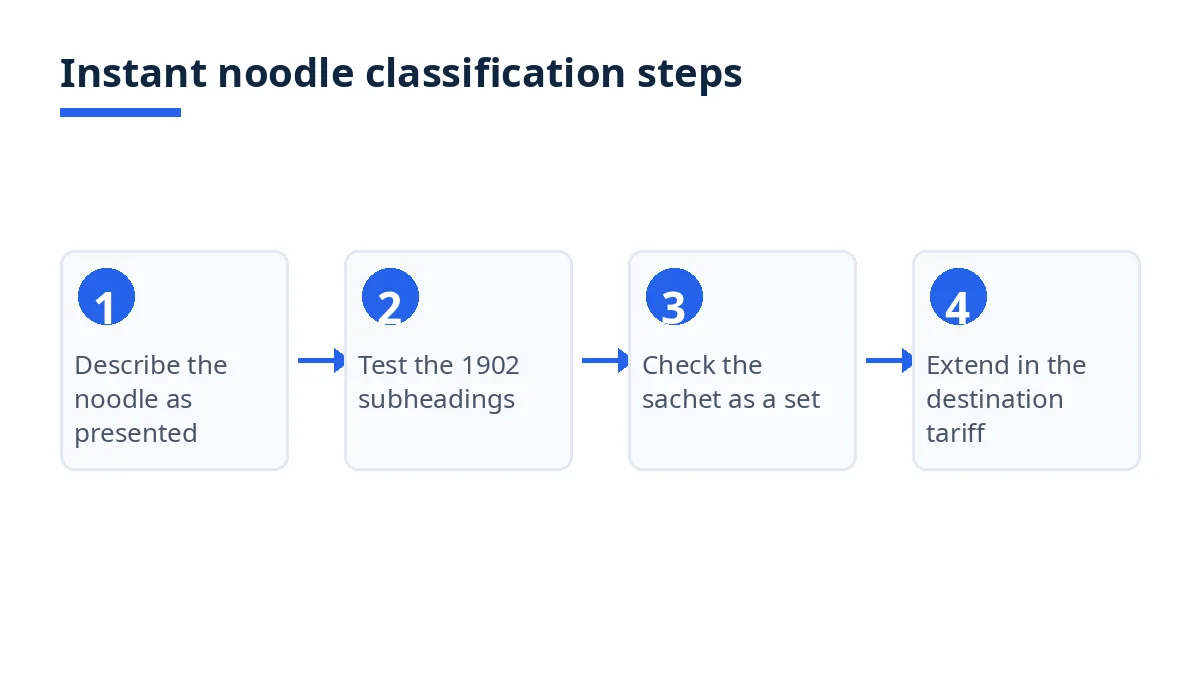
First, egg content: within uncooked pasta, not stuffed or otherwise prepared, the tariff splits containing eggs from other pasta. Second, stuffing: a filled noodle is a different question from a plain block, and the chapter notes add a limit, except in the case of stuffed products of heading 1902, food preparations containing more than 20 percent by weight of sausage, meat, meat offal, blood, insects, fish or crustaceans, molluscs or other aquatic invertebrates, or any combination of them, fall outside chapter 19.1 2 Third, cooked state: a pre-cooked or fried presentation must be tested against 1902.30, and a fully prepared ready-to-eat dish raises a further boundary question against headings for prepared foods, including 1904 and 2104. Fourth, the sachet and the set question: a seasoning, spice, sauce, or oil sachet raises the question whether the pack is classified by the noodle block alone, by the sachet, or by the component that gives the set its essential character.1 Fifth, presentation: a loose block, a multi-pack, and a cup pack are not automatically the same line.
Wheat instant noodle block: is this an uncooked, unstuffed pasta
Deciding factor: egg content and cooked state. A plain dried wheat block with no egg, not stuffed, and not cooked points indicatively to 1902.19, to be verified.1 2 If the specification shows the block was fried or pre-cooked before packing, test 1902.30 first instead, to be verified.
Egg noodle: does egg content move the line
Deciding factor: the ingredient specification. A dried instant noodle block containing eggs, not stuffed or otherwise prepared, points indicatively to 1902.11, to be verified.1 2 A noodle that merely looks yellow, without egg in the ingredients, does not meet the containing eggs test.
Rice noodle: is this still a 1902 pasta, or a different product
Deciding factor: flour or starch base and the heading wording. A rice noodle still has to be tested as pasta as presented, including whether it is dried, cooked, stuffed, or presented as a prepared dish. A transparent noodle made from a bean starch is a boundary question to test in the destination tariff.2
Cup noodle with a sachet: is this one product, or a set
Deciding factor: the set question and essential character. A cup with a noodle block plus a seasoning sachet is a set for retail sale, so test whether the noodle block gives the set its essential character. The United Kingdom national line for dried other pasta includes instant noodles containing spices, seasonings or sauces, for United Kingdom entries only.2 In the United States tariff, test the sauce-packaged lines under 1902.11 and 1902.19, and other pasta at 1902.30.00.1
Fried versus air-dried presentation: does the cooking method change the line
Deciding factor: cooked or otherwise prepared state. An air-dried block that is uncooked when packed points indicatively toward the uncooked lines, 1902.11 or 1902.19 depending on egg content, each to be verified.1 2 A block fried in oil, steamed, or otherwise cooked before packing points indicatively toward 1902.30, other pasta, to be verified.
Flavoured seasoning as a separate item: is the sachet classified with the noodles
Deciding factor: whether the sachet is part of the noodle product or a separate item in the pack. A dry spice sachet packed for use with that noodle block is tested as part of the set question above.2 A liquid sauce, oil sachet, or sachet containing meat or fish is a stronger separate-item question.
National codes: US HTS, EU CN/TARIC, UK commodity code
Each line below is a national line to confirm in that country's tariff on the entry date. Do not copy a line into another country's declaration.
United States HTS, to confirm on the entry date: Revision 18 (2026), Chapter 19, lists uncooked pasta, not stuffed or otherwise prepared, at 1902.11 for containing eggs and 1902.19 for other pasta, each with a line for pasta packaged with sauce preparations, and stuffed pasta at 1902.20.00, other pasta at 1902.30.00, and couscous at 1902.40.00.1 The opened United States chapter does not name a separate instant noodle line, so test an instant noodle entry against those lines.
European Union CN/TARIC, to confirm on the entry date: start from the same six digit subheadings, extend to the 8 digit Combined Nomenclature line, then confirm the full TARIC line on the entry date.4 No European Union instant noodle line is asserted here, so every EU line must be confirmed in TARIC before filing.
United Kingdom commodity code, to confirm on the entry date: the United Kingdom tariff lists uncooked pasta, not stuffed or otherwise prepared, at 1902 11 for containing eggs and 1902 19 for other pasta, stuffed pasta at 1902 20, other pasta at 1902 30, and couscous at 1902 40.2 Within other pasta, dried, the opened page lists instant noodles containing spices, seasonings or sauces, at 1902 3010 30, as a United Kingdom national line to confirm on the entry date.2
How to confirm the code officially
First, read the heading text and chapter notes, then compare subheadings only at the same level. Second, extend the six digits to the national line and note the entry date.
For a binding answer in the United Kingdom, apply for an Advance Tariff Ruling before all customs procedures have been completed, because decisions cannot be made retrospectively, and HMRC aims to reply within 30 to 120 days with a ruling decision and the correct commodity code.5
Common classification mistakes
First, filing the trade name instead of the product as presented: instant, quick cook, and cup are marketing words, not subheading tests. Second, copying a full 8 or 10 digit code from another country: only the first six digits are shared, and the United Kingdom instant noodle line in this guide is a national line, not an international code. Third, ignoring the sachet: a pack with a seasoning sachet is not the same filing as a bare block. Fourth, ignoring the cooking method: a fried or pre-cooked block is not uncooked pasta, even if the buyer still adds hot water at home. Fifth, treating a supplier code as final: it may have been chosen for a different destination, specification, or tariff edition. Sixth, skipping the chapter notes, which carry legal force. Seventh, filing from memory after a specification change: a switch from wheat to rice, from no egg to egg, or from a bare block to a cup with a sachet can each move the line.
Related duties and documents
The code works out how customs treats the shipment, including duty treatment, taxes, and whether a licence, control, or preference applies, and those consequences are national and change over time, so no rate is stated in this guide. Read the current treatment in the destination tariff on the entry date, and keep the specification, the code reasoning, and the ruling or broker advice with the shipment file. Documents that support the classification are the supplier specification showing ingredients and cooking method, the pack artwork showing the block, the sachet, and the cup, the commercial invoice and packing list with the product description matching the specification, and any ruling or written broker advice.
FAQs
What is the HS code for instant noodles?
The indicative heading is 1902, pasta, whether or not cooked or stuffed or otherwise prepared, with the subheading turning on egg content, stuffing, cooked or prepared state, and the sachet question, as set out in the table above. Every line there is indicative only, and the full national code must be confirmed in the destination tariff on the entry date.
Is the HS code the same in every country?
The first six digits should be the same internationally for the same product, because they come from the shared WCO system, while the full code is not the same everywhere, because countries add their own digits, notes, and treatment after those six digits.3 4 The United Kingdom instant noodle line in this guide must not be copied into a United States or European Union declaration.
How do I confirm the correct code?
Write the full product description, read the heading text and chapter notes, compare subheadings only at the same level, extend the six digits in the destination tariff, and check published rulings for similar goods. For a binding United Kingdom answer, apply for an Advance Tariff Ruling before the goods clear, with the full specification, brochures, photographs, and samples where appropriate.5
What happens if I use the wrong code?
Customs can reclassify the goods, reassess duty and taxes, delay clearance while the classification is corrected, and impose penalties under national rules, and a wrong code can also mean a missed licence or control. If you find an error after filing, tell your broker promptly and fix the product file so the next shipment does not repeat the same code.
Next steps on Exportain
For the shared HS structure behind this guide, read HS Code (Harmonized System Code). For the step-by-step method for any product, read How to Find an HS Code: Step-by-Step. To discuss a noodle product with suppliers listed on the platform, browse Exportain suppliers.
Sources
- Harmonized Tariff Schedule of the United States Revision 18 (2026), Chapter 19. U.S. International Trade Commission (accessed )
- Pasta, whether or not cooked or stuffed or otherwise prepared; couscous, whether or not prepared - UK Integrated Online Tariff, heading 1902. GOV.UK, HM Revenue and Customs (accessed )
- What is the Harmonized System (HS)?. World Customs Organization (accessed )
- Harmonized System. European Commission, (accessed )
- Apply for an Advance Tariff Ruling. HM Revenue & Customs (GOV.UK), (accessed )
About the author
Sourcing from Bangladesh?
Post a request for quotation and suppliers on Exportain can send you their quotes directly.
Post an RFQ